Malaysia's Semiconductor Push Is Entering the Supplier-Depth Test
Malaysia does not have a semiconductor demand problem. It has a depth problem.
The investment numbers are loud, the AI story is attracting fresh global attention, and Penang and Kulim still sit inside one of Asia’s most durable chip clusters. What Malaysia has to prove now is harder: whether the layer beneath the boom - local design firms, advanced packaging know-how, specialist suppliers, and trained engineers - is thick enough to keep more of the value at home when the cycle gets rough.
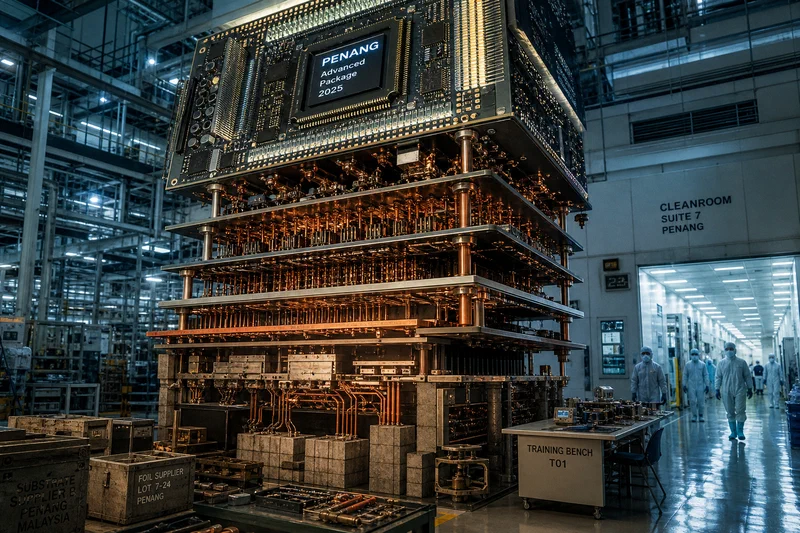
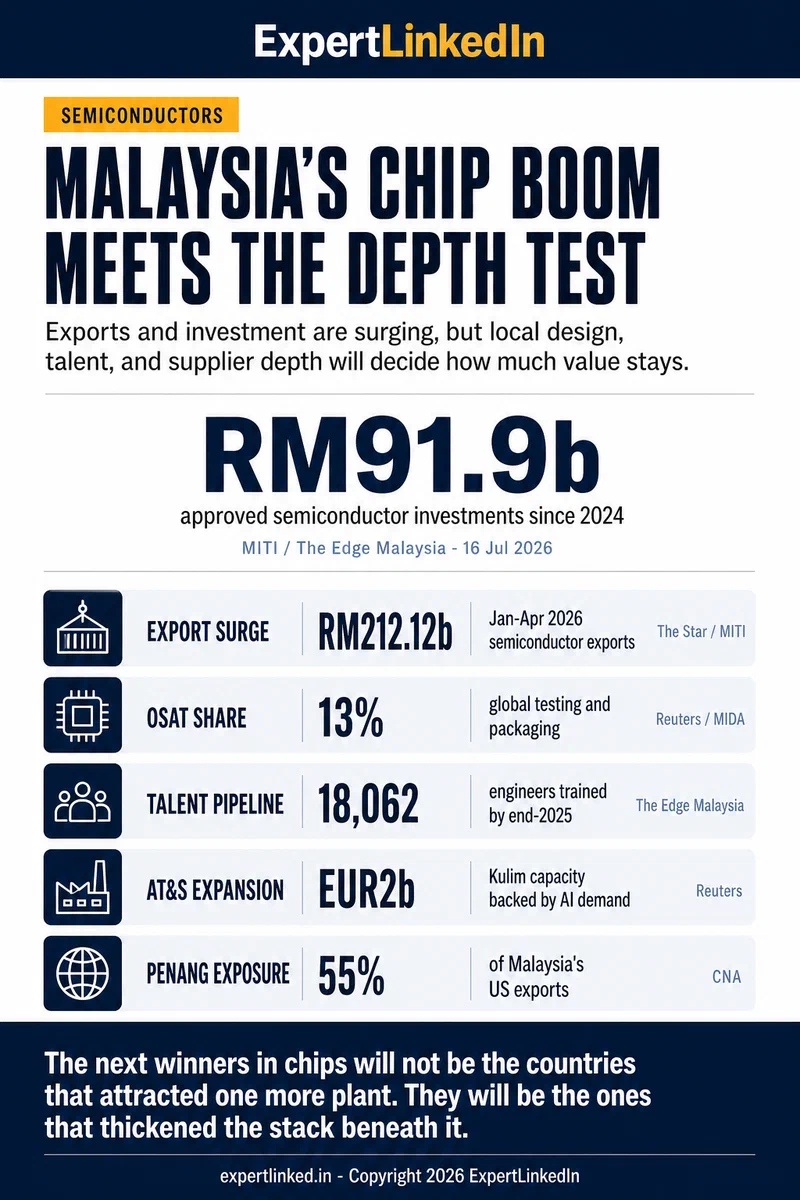
In July, MITI told Parliament that Malaysia had attracted RM91.9 billion in approved semiconductor investments between January 2024 and March 2026, including RM82.9 billion of foreign direct investment. A few weeks earlier, Parliament was also told that semiconductor exports rose 50% year on year to RM212.12 billion in the first four months of 2026. Those are not the numbers of a sector trying to prove relevance. They are the numbers of a sector being pulled deeper into the AI hardware boom.
The headline numbers are already there #
The historical context matters. In 1972, Intel sent a team to Penang for its first manufacturing facility outside the United States. By 1975, the plant employed roughly 1,000 people, and AMD, HP, and Hitachi followed. A cluster born from cost arbitrage eventually became something much more strategic.
Today, The Business Times says Malaysia holds nearly 13% of the worldwide outsourced semiconductor assembly and test market, while Reuters describes the country as accounting for about 13% of global chip testing and packaging. However you label the slice, the message is the same: Malaysia is no longer a marginal back-end location. It is a serious node in the hardware economy that sits under the AI boom.
But a large back-end share and a strong export number do not automatically mean the country is keeping the highest-margin layers. They can just as easily mean Malaysia has become indispensable to other people’s roadmaps. That is the first distinction worth holding in mind when reading the current wave of bullish semiconductor headlines.
The upgrade story is finally visible #
The National Semiconductor Strategy is a tacit admission that the old formula is not enough. MITI says it wants to move the industry from packaging and testing toward higher-value work such as integrated circuit design and wafer fabrication. Sim Tze Tzin told Parliament that 18,062 local engineers and technicians had been trained by end-2025, against a target of 60,000 by 2030. He also pointed to local names such as Pentamaster and ViTrox in automated test equipment, and SkyeChip, Oppstar, and GreatAsic in design, as proof that Malaysia can produce more than contract labor.
The better signal is where new activity is clustering. Bernama reported in March that Fitipower opened a Malaysian unit at the Selangor IC Design Park, focusing on display driver ICs, power management ICs, and edge AI system-on-chip work. That matters because it is R&D work, not just throughput work. It suggests Malaysia is trying to make itself harder to replace at the design and engineering layer, not only at the output layer.
A Sidec-backed profile of the park should be read carefully, not romantically. It says the Malaysia Semiconductor IC Design Park brings together 12 companies inside a 15,000 sq ft facility, offers subsidized EDA tools, IP services, and MPW access, and is backed by RM100 million in partner funding. The same profile ties the push to Malaysia’s US$250 million, 10-year Arm agreement and a 10,000-engineer training plan. The promotional tone is a little too polished for my taste, but the strategic logic is sound: if Malaysia wants more domestic chip companies, it has to lower the cost of starting them.
Packaging has stopped being the low-margin footnote #
One reason this moment matters is that AI has changed the economics of the so-called middle layers. In June, AT&S said it would invest up to EUR2 billion in Kulim, backed by long-term customer commitments and demand from AMD and another major client widely reported to be Intel. In July, AT&S chief executive Michael Mertin told Nikkei that the AI chip boom had shifted the bottleneck toward advanced packaging and substrates.
That is exactly the opening Malaysia should care about. No, it is not a sudden shortcut into frontier lithography. But it is a path into a more defensible layer of the stack: substrates, advanced packaging, process integration, equipment servicing, and adjacent materials. The next margin does not have to sit at the absolute frontier to matter. It just has to sit one layer above basic volume assembly.
MKS made the same point in more grounded factory language. Its new Penang Supercenter Factory sits on a 17-acre site with about 350,000 sq ft of built-up space. The full project implies more than 1,000 jobs and over US$94 million in investment to support wafer fabrication equipment demand. When firms like AT&S and MKS expand here, they are not buying only lower wages. They are buying ecosystem density, supplier response time, and a workforce that already understands high-spec production.
The boom is still more exposed than it looks #
This is where the easy narrative breaks. Reuters reported in October 2025 that Malaysia warned the United States that removing semiconductor tariff exemptions would hurt competitiveness and strain sectors closely integrated with U.S. supply chains. The immediate risk was not hypothetical. Washington had already imposed a 19% tariff on Malaysian exports to the United States, while also floating a 100% chip tariff for firms without a U.S. manufacturing presence. Malaysia’s own 2026 budget outlook estimated the tariff shock could lower GDP growth by 0.76 percentage points.
Penang shows how concentrated that exposure can become. CNA reports that the state accounts for 5% of global semiconductor exports and about 55% of Malaysia’s exports to the United States. That concentration is powerful when demand is strong. It becomes uncomfortable when one policy announcement in Washington can push brokers to cut technology earnings forecasts and make multinational capital spending more tentative.
The same CNA reporting captured the tension well. Industry leaders say the ecosystem remains intact and cite ongoing expansion by players such as Analog Devices. Penang officials say U.S. firms are still coming, and that the United States was the biggest source of approved manufacturing FDI in the state in the first half of 2025. But the warnings are getting more specific: 65% of respondents in a Malaysia semiconductor industry survey expected U.S. policies and tariffs to hurt electrical and electronics over the following year, while Intel was reportedly reassessing the pace of its Penang packaging and testing expansion. Momentum is real. So is the option value of waiting.
Supplier depth is measured when something awkward breaks #
The most revealing constraint is often a boring one. In March, Reuters reporting carried by The Business Times showed Malaysian chipmakers monitoring helium supply risks after conflict-driven disruption hit gas processing in Qatar. Wong Siew Hai of the Malaysia Semiconductor Industry Association noted that many local packaging and testing firms are less exposed because they can rely mostly on nitrogen, and that inventories and diversified sourcing were cushioning immediate risk.
That is useful because it clarifies the structure of Malaysia’s strength. The country is not equally vulnerable at every layer. Some segments are relatively insulated. Others are deeply dependent on imported tools, specialty gases, or customer roadmaps set elsewhere. East Asia Forum adds the geopolitical version of the same point: China’s 2025 imports of semiconductor manufacturing equipment from Malaysia reached US$3.4 billion, more than double the 2024 level, making Malaysia a more important regional node in a compliance-sensitive network shaped by U.S. export controls.
In other words, Malaysia’s strategic value is rising. But this is still a form of dependent upgrading. The country gains leverage, volume, and technical relevance, while remaining exposed to multinational sourcing decisions, regulatory pressure, and external chokepoints. That is not failure. It is simply a more honest description of where the cluster now sits.
What Malaysia has to thicken next #
The hardest part of the next phase is not attracting one more marquee plant. It is financing and scaling the local firms that can sit under those plants. MITI’s IndustryConnect idea - using multinational anchors to pull local SMEs into semiconductor and AI supply chains - makes sense. So does the push to lower design costs and expand training.
But the criticism from Penang is worth taking seriously. Analysts told CNA that official support still appears more energetic when courting foreign MNCs than when helping Malaysian firms upgrade their production mix. If that remains true, the country may keep winning volume without capturing enough of the second-order value: tooling, design IP, materials science, process engineering, and specialist services.
If you have followed my earlier arguments in Capital Without Capture, The Cost-of-Carry Premium, and more recently The Next AI Bottleneck in Southeast Asia Is Power Certainty, this is the same structural question in a narrower frame. Malaysia does not need another lecture about opportunity. It needs thicker local budgets, deeper technical training, and more Malaysian firms that can move from service provider to indispensable node.
Malaysia’s semiconductor boom is already big enough to impress. The next winners in chips will not be the countries that attracted one more plant. They will be the ones that thickened the stack beneath it.
Have a view on where Malaysia’s chip push is building real depth - or still leaning too hard on foreign anchors? I would like to hear it.
Email me at miguel.santos@tlnw.uk
References #
- The Business Times (June 29, 2026). “Beyond the assembly line - Can Malaysia climb the semiconductor value chain?” https://www.businesstimes.com.sg/wealth/wealth-investing/beyond-assembly-line-can-malaysia-climb-semiconductor-value-chain (Accessed September 3, 2026)
- The Edge Malaysia (July 16, 2026). “Semiconductor sector attracted RM91.9b in investments since 2024 - deputy minister.” https://theedgemalaysia.com/node/810926 (Accessed September 3, 2026)
- The Star (June 24, 2026). “M’sian semiconductor exports rose 50% in first four months of 2026, Dewan Rakyat told.” https://www.thestar.com.my/news/nation/2026/06/24/msian-semiconductor-exports-rose-50-in-first-four-months-of-2026-dewan-rakyat-told (Accessed September 3, 2026)
- Reuters (June 15, 2026). “AT&S invests up to EUR2 billion in Malaysia plan to capitalise on AI boom.” https://www.reuters.com/world/asia-pacific/ats-invests-up-2-billion-malaysia-plan-capitalise-ai-boom-2026-06-15/ (Accessed September 3, 2026)
- Nikkei Asia (July 28, 2026). “AI chip boom shifts bottleneck to advanced packaging, says AT&S CEO.” https://asia.nikkei.com/business/tech/semiconductors/ai-chip-boom-shifts-bottleneck-to-advanced-packaging-says-at-s-ceo (Accessed September 3, 2026)
- Digital News Asia (June 22, 2026). “MKS opens Supercenter Factory in Penang, strengthening Malaysia’s semiconductor manufacturing ecosystem.” https://www.digitalnewsasia.com/business/mks-opens-supercenter-factory-penang-strengthening-malaysias-semiconductor-manufacturing (Accessed September 3, 2026)
- Reuters (May 6, 2026). “Schneider Electric to launch Southeast Asia training hub in Malaysia.” https://www.reuters.com/world/asia-pacific/schneider-electric-launch-southeast-asia-training-hub-malaysia-2026-05-06/ (Accessed September 3, 2026)
- Bernama (March 20, 2026). “Taiwan-based Fitipower Sets Up Malaysian Unit At Selangor IC Design Park.” https://www.bernama.com/en/news.php?id=2535721 (Accessed September 3, 2026)
- Vulcan Post (sponsored content, September 3, 2025). “This semiconductor park is at the heart of Malaysia’s push for local chip innovation.” https://vulcanpost.com/896064/sidec-semiconductor-ic-design-park-malaysia-details-benefits-to-join/ (Accessed September 3, 2026)
- Reuters (October 10, 2025). “Malaysia says removing chip tariff exemption could harm competitiveness, U.S. supply chains.” https://www.reuters.com/world/asia-pacific/malaysia-says-removing-chip-tariff-exemption-could-harm-competitiveness-us-2025-10-10/ (Accessed September 3, 2026)
- Channel News Asia (October 15, 2025). “Trump’s semiconductor tariff threat casts long shadow on Penang’s chip hub status.” https://www.channelnewsasia.com/asia/penang-tariffs-semiconductor-chips-silicon-valley-5399886 (Accessed September 3, 2026)
- East Asia Forum (June 21, 2026). “China’s chipmaking supply chain runs through Southeast Asia.” https://eastasiaforum.org/2026/06/20/chinas-chipmaking-supply-chain-runs-through-southeast-asia/ (Accessed September 3, 2026)
- The Business Times / Reuters (March 17, 2026). “Chipmakers in Malaysia monitoring risks from helium supply disruptions: association.” https://www.businesstimes.com.sg/companies-markets/telcos-media-tech/chipmakers-malaysia-monitoring-risks-helium-supply-disruptions-association (Accessed September 3, 2026)
AI Content Notice
This article was created using artificial intelligence technology. Whenever possible, we include references and sources to support the information presented. Readers are encouraged to consult these sources for further information. While we strive for accuracy and provide valuable insights, readers should independently verify information and use their own judgment when making business decisions. The content may not reflect real-time market conditions or personal circumstances.
Related Articles
Infographic: Malaysia's Semiconductor Push Is Entering the Supplier-Depth Test
Malaysia no longer has to prove it can attract chip plants. With exports up 50% and RM91.9 billion …
The Next AI Bottleneck in Southeast Asia Is Power Certainty
Southeast Asia’s AI build-out is colliding with a physical constraint the hype cycle keeps …
Infographic: The Next AI Bottleneck in Southeast Asia Is Power Certainty
Southeast Asia’s AI build-out is colliding with a physical constraint the hype cycle keeps …