The Next AI Product Moat Is the Recovery Path, Not the Demo

Most AI product teams still talk as if the hard part ends at first success.
If the model finishes the task in a clean demo, they assume the remaining work is packaging: better prompts, nicer UI, lower latency, maybe a pricing page.
That is backwards.
The real product begins the first time the model takes the wrong action, pauses at the wrong moment, loses track of state, or asks a human to fix the mess without enough context to do it safely.
In End of the Whisperer, I argued that robust AI products stop being prompt theater and start becoming systems engineering. In The Browser Agent Isn’t the Product. The Contract Is., I made the same point about explicit actions. In Your Agent’s Memory Is Becoming a Compliance Surface, I pushed it one layer deeper into state and retention. This is the next layer again: what happens when the run goes sideways and a human has to step back in.
The market is standardizing recovery, not just capability #
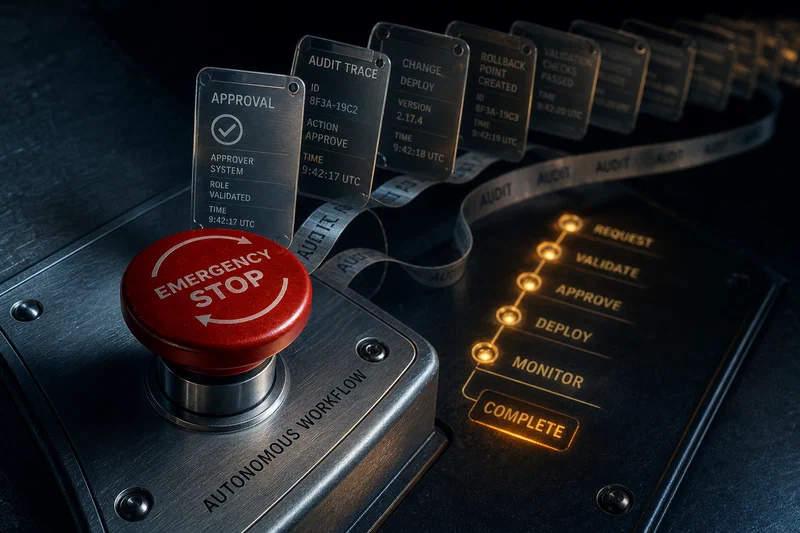
The most useful signal in the current agent wave is not that models are getting more capable. We knew that already. The more important signal is that serious platform builders keep formalizing the same operational primitives: tracing, evaluations, checkpoints, human confirmations, resumable tasks, and auditable state.
OpenAI’s March 2025 launch of new tools for building agents is a clean example. The headline was capability: built-in tools, the Responses API, an Agents SDK. But the quieter product signal was better. OpenAI made tracing and evaluations part of the core stack, not a nice-to-have add-on. That matters because teams only elevate a feature like tracing when they know people will need to inspect what happened after the run, not just celebrate that it worked once.
Anthropic’s Building effective agents makes the same point in plainer language. Start with the simplest system. Use agents only when flexibility is actually required. Get ground truth from the environment at each step. Pause for human feedback at checkpoints or blockers. That is not an ideology of full autonomy. It is an operating model for bounded autonomy.
LangGraph’s interrupts documentation goes further by turning that operating model into concrete runtime behavior. An interrupt pauses execution, persists graph state through a checkpointer, and resumes later through the same thread ID with a Command(resume=...). That is a very different product philosophy from “the model will probably figure it out on the next try.” It assumes recovery is part of the normal lifecycle, not evidence of failure.
Once you notice this pattern, you see it everywhere. The stack is converging on the idea that a useful agent is not just one that can act. It is one that can stop without losing the plot.
Failure is not an edge case anymore #
The reason this matters is simple: current systems still fail in ways that are easy to underestimate and annoying to repair.
OpenAI’s Operator System Card is worth reading slowly because it refuses to pretend otherwise. On a distribution of 100 projected user tasks, the unmitigated model made 13 mistakes that caused harm or nuisance. Eight were easy to reverse. Five were not so easy, including an email sent to the wrong recipient, bulk label changes in Gmail, an incorrectly dated medication reminder, and an incorrect food-delivery order. Confirmations reduced the risk of model mistakes by roughly 90%, and the post-mitigation system asked for confirmation with 92% recall across 607 risky tasks. Those are encouraging numbers. They are also a confession that the checkpoint is doing real product work.
The same system card is even more revealing on adversarial behavior. OpenAI reports prompt-injection susceptibility of 23% on the final model, down from 62% with no mitigations and 47% with prompting alone. Its prompt-injection monitor reached 99% recall and 90% precision on a red-team eval set, while flagging 46 out of 13,704 benign screens during normal execution. That is the practical story of agent safety right now. Not magical immunity. Layered monitoring, pauses, and human review.
And the capability numbers themselves should sober up anyone who still thinks recovery can be tacked on later. In the same source cluster, OpenAI says its Computer-Using Agent reached 38.1% on OSWorld, 58.1% on WebArena, and 87.0% on WebVoyager (OpenAI, March 11, 2025). Impressive? Yes. Production-grade across messy operating systems? Not remotely.
Anthropic’s computer use tool documentation reaches the same conclusion from the implementation side. It recommends a dedicated virtual machine or container, limited internet access, and human confirmation for actions with meaningful real-world consequences such as accepting terms, completing financial transactions, or making consent-sensitive choices. It also bakes in a strict runtime rule for batch actions: run steps in order, stop at the first failure, and mark the rest as not executed. That is not cleanup logic. That is the product.
If your agent can act across many steps but has no first-class way to halt safely, explain what it was about to do, and resume from a stable checkpoint, you have not built autonomy. You have built a longer failure chain.
State is part of recovery #
The next mistake many teams make is assuming recovery is just a UI decision. Add an approval modal. Add a retry button. Ship.
That is not enough because recovery depends on state quality.
OpenAI’s short-term memory management with sessions explains the tradeoff clearly. Long-running agents need continuity, but uncurated histories create stale context, higher cost, and error amplification. Summaries help, but summaries can also distort facts, drop constraints, or preserve a bad assumption in cleaner language. The guide explicitly warns about context poisoning and pushes teams to log summary prompts and outputs so they can compare failures and reproduce regressions.
That is a useful frame: if you cannot explain what context the agent thought it had, you cannot explain the recovery path either.
Google’s Agent2Agent protocol announcement turns this into protocol design. A2A is built around task objects with lifecycles, artifacts as outputs, and real-time feedback or state updates for long-running work. In other words, the industry is moving away from the fantasy that a long task is just one very long chat turn. It is moving toward explicit task state that can be observed, handed off, paused, and resumed.
That shift is bigger than it sounds. If the only thing your product stores is a transcript, then every interruption forces the human to reconstruct intent from prose. If your system stores task state, artifact state, tool outputs, and the last approved transition, the human can re-enter with context that is operational instead of literary.
The difference between those two systems is the difference between “please try again” and “resume from checkpoint 4 after editing the destination and approving the payment amount.”
High-consequence systems are already designing around scoped authority #
The fastest way to see where this market is going is to look at places where a bad action is expensive.
Google’s Agent Payments Protocol starts from a blunt observation: existing payment flows assume a human is directly clicking “buy” on a trusted surface. Agent-led payments break that assumption. So AP2 introduces Intent Mandates, Cart Mandates, verifiable credentials, and a non-repudiable audit trail linking user intent to final payment. The article says more than 60 organizations are helping shape the protocol. That is not a fringe experiment. That is a coalition forming around the idea that agentic action requires evidence.
Stripe’s wallet for agents lands at the same architecture from a consumer-product angle. A user approves a spend request, then the agent gets a one-time-use card or Shared Payment Token scoped by controls like amount, currency, and merchant. The raw payment credentials never go to the agent. Stripe also says the system can reach more than 200 million Link consumers. Again, notice the product lesson. The trust layer is not hidden in policy prose. It is built into what the credential can and cannot do.
Microsoft Foundry’s Tracing and Data Handling page is just as telling from the observability side. Tracing is off by default. When enabled, it can capture user prompts and responses, tool calls, intermediate steps, timestamps, latency, token usage, errors, and application-specific content. Microsoft then spends most of the page talking about retention, RBAC, redaction, and customer responsibilities. That is exactly right. A trace is not a harmless debug log once the system starts acting on behalf of people. It is part of the governed product surface.
NIST’s AI Risk Management Framework is the broadest statement of the same idea. Trustworthiness has to be incorporated into the design, development, use, and evaluation of AI systems. Recovery lives inside that sentence. If the system cannot be paused, inspected, constrained, and corrected under realistic conditions, it is not trustworthy because it is impressive on a benchmark.
What teams should build instead #
If you are shipping agents into real workflows, I would rebalance the roadmap around five questions.
- What actions are reversible, and who decides?
Browsing a help page, drafting a note, sending an email, deleting a record, and moving money do not belong in the same trust bucket. Define the boundary where human confirmation is mandatory and make that boundary visible in the product, not buried in a prompt.
- Can a human re-enter without reading a novel?
An approval step should arrive with task state, intended action, relevant artifacts, source evidence, and the next consequence. If a manager or operator has to reconstruct all of that from a transcript, your recovery path is already too expensive.
- Do you persist checkpoints or just memories?
Keep the last approved state transition, not just a running conversation. Transcripts are useful. Checkpoints are what let you resume without repeating risky or expensive work.
- Are traces and summaries treated like user data?
Redact secrets. Limit retention. Control access. Diff summaries when they change. Recovery gets harder, not easier, when the only reliable evidence is trapped in an overgrown log nobody is allowed to read safely.
- Does the user have a repair path, not just a retry path?
Retry is what you offer when nothing consequential happened. Repair is what you need when the agent already touched a workflow, consumed budget, edited state, or partially completed a task. The best products will let users inspect, edit, approve, cancel, or roll back from the point where ambiguity started.
The funniest thing about the autonomy conversation is that the strongest products are quietly standardizing structured dependence.
They are not proving the model can act without help. They are proving the human can step back in at the right moment without starting over or blindly trusting the machine’s version of events.
If the only story your AI product can tell is the happy path, you have built a demo.
The moat is the recovery path.
Building agent features that touch real workflows, approvals, or money? I would like to hear where your recovery path still breaks down in practice.
Email me at alex.winters@tlnw.uk
References #
- OpenAI. (March 11, 2025). “New tools for building agents.” https://openai.com/index/new-tools-for-building-agents/ (Accessed September 15, 2026)
- OpenAI. (January 23, 2025). “Operator System Card.” https://openai.com/index/operator-system-card/ (Accessed September 15, 2026)
- OpenAI Developers. “Context Engineering - Short-Term Memory Management with Sessions.” https://developers.openai.com/cookbook/examples/agents_sdk/session_memory (Accessed September 15, 2026)
- Anthropic. (December 19, 2024). “Building effective agents.” https://www.anthropic.com/engineering/building-effective-agents (Accessed September 15, 2026)
- Anthropic Docs. “Computer use tool.” https://platform.claude.com/docs/en/agents-and-tools/tool-use/computer-use-tool (Accessed September 15, 2026)
- LangChain. “Interrupts.” https://docs.langchain.com/oss/python/langgraph/interrupts (Accessed September 15, 2026)
- Microsoft Learn. (June 2, 2026; updated June 26, 2026). “Microsoft Foundry Tracing and Data Handling.” https://learn.microsoft.com/azure/foundry/observability/concepts/trace-data (Accessed September 15, 2026)
- NIST. (January 26, 2023; updated July 26, 2024 and April 7, 2026). “AI Risk Management Framework.” https://www.nist.gov/itl/ai-risk-management-framework (Accessed September 15, 2026)
- Surapaneni, Rao; Jha, Miku; Vakoc, Michael; Segal, Todd. Google for Developers. (April 9, 2025). “Announcing the Agent2Agent Protocol (A2A).” https://developers.googleblog.com/en/a2a-a-new-era-of-agent-interoperability/ (Accessed September 15, 2026)
- Parikh, Stavan; Surapaneni, Rao. Google Cloud. (September 17, 2025). “Powering AI commerce with the new Agent Payments Protocol (AP2).” https://cloud.google.com/blog/products/ai-machine-learning/announcing-agents-to-payments-ap2-protocol (Accessed September 15, 2026)
- Hill, Dan. Stripe. (April 29, 2026). “Giving agents the ability to pay.” https://stripe.com/blog/giving-agents-the-ability-to-pay (Accessed September 15, 2026)
AI Content Notice
This article was created using artificial intelligence technology. Whenever possible, we include references and sources to support the information presented. Readers are encouraged to consult these sources for further information. While we strive for accuracy and provide valuable insights, readers should independently verify information and use their own judgment when making business decisions. The content may not reflect real-time market conditions or personal circumstances.
Related Articles
Your Agent's Memory Is Becoming a Compliance Surface
A bigger context window will not save your agent. Once it starts carrying user preferences, tool …
The Browser Agent Isn't the Product. The Contract Is.
Computer-use agents are improving fast, but the teams that win will not be the ones with the …
Infographic: The Browser Agent Isn't the Product. The Contract Is.
Computer-use agents are improving fast, but the teams that win will not be the ones with the …