Back-to-Work Burnout After Vacation Is Real - and What to Do Before September 2026 Speeds Up

The most misleading performance data of the month is often collected in the first week back from vacation. Someone returns, clears inbox debt like it is a fire drill, answers faster than they should, works through lunch to prove they are fully back, and then a manager quietly stores that burst as evidence of what September can now demand.

“I took a full week off for the first time in months, and I actually came back feeling better. Then by the second day I was already exhausted again. I had 700 unread messages, three meetings added while I was away, and a manager who kept saying how great it was to have my energy back because we need to move faster in September. I do not think anyone is trying to be cruel. But I can feel the first week back becoming a test I am expected to keep passing. How do I stop one frantic catch-up week from becoming the new baseline for my role?” – Senior client success lead, software company
This sits beside three recent Clinic questions but is not the same as any of them. On Aug. 7 I wrote about Vacation Coverage Became Permanent Scope - and What to Do Before Fall 2026 Makes It Official. On Aug. 14 I wrote about Always-On Flexibility at Work in August 2026 - Here’s the Clinical Read and the 3-Move Response. And on Aug. 28 I wrote about You Came Back to a Reorganized Team - How to Reclaim Scope Before Q4 2026 Hardens It. This question is narrower and, in its own way, more dangerous. It is about measurement. The first week back is a clearance week. Too many organizations treat it like a capacity test.
The Clinical Read #
Harvard Business Review’s July 24 article The Invisible Work Draining Your Best Employees is the best place to start because it corrects the most common mistake leaders make. Workload is not just tasks, hours, and deadlines. It is also the mental load of tracking moving parts, repairing handoffs, remembering context, smoothing relationships, catching quality issues, and holding unfinished decisions in your head. The first week back from vacation is overloaded with exactly that kind of work. You are not simply doing your job again. You are reacquiring it.
That same HBR piece makes a second point that matters even more here: leaders should create true offline periods, assign coverage by capacity, reduce non-essential contact during high-volume windows, and protect real recovery. Many teams do the opposite. They welcome the returning person back and then immediately use that person’s relief, goodwill, and restored energy to absorb the backlog the system allowed to accumulate. The worker looks “fine” because the strain is invisible and the effort is temporary.
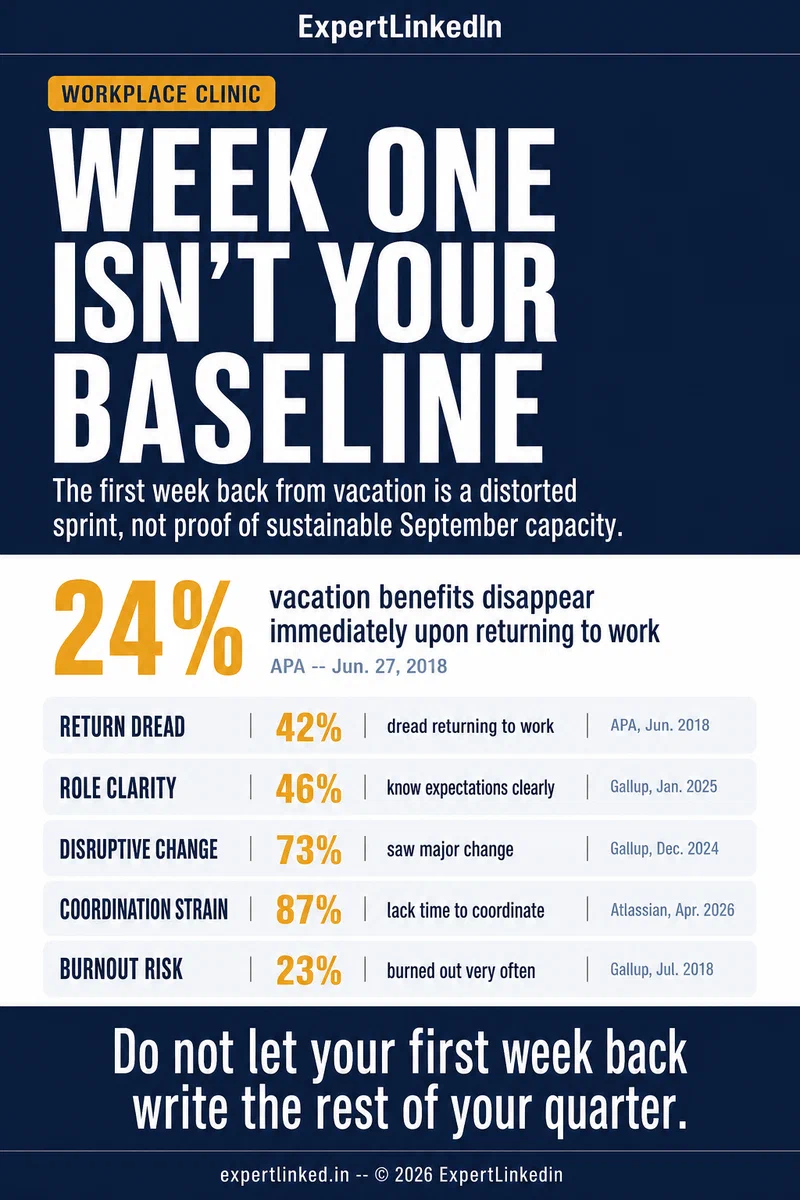
APA’s vacation research explains why this window is such bad data. In its 2018 Work and Well-Being survey of 1,512 employed U.S. adults, 24% of workers said the positive effects of vacation disappeared immediately upon returning to work, and another 40% said the benefits lasted only a few days. Forty-two percent said they dread returning to work, and 28% said they wind up working more than they planned while on vacation. David W. Ballard of APA’s Center for Organizational Excellence warned employers not to rely on occasional vacation to offset a stressful work environment (American Psychological Association, June 27, 2018). That does not mean vacation failed. It means the return window is unstable. It combines recovery, backlog, reentry anxiety, and performative catch-up in one compressed period.
Harvard Business Review gave the deeper principle years ago in Resilience Is About How You Recharge, Not How You Endure. The title is enough to expose the trap. A return week should help a worker reestablish sustainable pace. Instead, many teams reward endurance theater. They see someone come back strong and decide the lesson is that the person can simply hold more.
Gallup’s burnout research shows why that reading is so dangerous. In Gallup’s study of nearly 7,500 full-time employees, 23% reported feeling burned out very often or always, and another 44% felt burned out sometimes. Gallup ties burnout not mainly to weak character, but to unmanageable workload, lack of role clarity, weak manager support, and unreasonable time pressure (Gallup, July 12, 2018). That is almost a checklist for the modern return week.
The broader workplace is already soft in the wrong places. Gallup found in January 2025 that only 31% of U.S. employees were engaged and only 46% clearly knew what was expected of them at work (Gallup, January 13, 2025). If expectations are already blurry, a strong first week back becomes an easy substitute for actual role design.
Why the First Week Back Lies #
The first week back lies because it mixes several things that do not belong in the same measurement.
It includes backlog clearance. It includes social repair. It includes impression management. It often includes after-hours catch-up that nobody logs honestly because the worker does not want their vacation to become a problem for the team. And it includes a private psychological move that high performers know too well: the urge to erase any evidence that your absence created friction.
That would already be enough to distort the signal. But workers are returning into unstable organizations. Gallup’s The Great Detachment found that 73% of employees said their organization had experienced disruptive change in the prior year, while managers reported added responsibilities for employees at 69%, team restructuring at 55%, and budget cuts at 46% (Gallup, December 2, 2024). September is not landing on top of a steady system. It is landing on top of a tired one.
Then add the speed problem. Atlassian’s State of Teams 2026 found that 89% of executives say AI increases speed, but only 6% are sure they have clear examples of organization-wide AI ROI. At the same time, 87% of knowledge workers say they lack the time or capacity to coordinate, and 85% say they use AI at work even though only 29% have embedded it in actual flows of work (Atlassian Teamwork Lab, April 27, 2026). That matters because the returning worker is not only catching up on tasks. They are catching up on fragments, drafts, approvals, and follow-up generated faster upstream than the team has redesigned for.
Gallup’s March 2026 wellbeing data makes the silence around all this easier to understand. Forty-three percent of workers say they remain in their current role primarily because leaving would be too difficult or costly, and 36% specifically say their schedule or flexibility arrangement is one reason they stay (Gallup, March 23, 2026). So even when a person knows the return pace is unsustainable, they may still hesitate to challenge it.
Managers are not necessarily calm observers here, either. Gallup’s Manager Squeeze notes that managers are more likely than non-managers to be burned out and disengaged, while 64% report employees taking on additional job responsibilities and 51% cite team restructuring (Gallup, September 5, 2023). A squeezed manager may read your return sprint as reassurance because they badly want reassurance.
Here is the uncomfortable truth: the first week back often produces flattering data for systems that want more than they are willing to design for.
The 3-Move Reset #
Move 1: Rename the week before the system does it for you #
Do not describe this period to yourself or your manager as “business as usual.” Call it what it is: a reentry week.
For five business days, keep a simple two-column record:
- backlog clearance work that exists because you were away
- recurring work that would have existed even if you had never left
Also note anything you did to create the illusion of smooth return:
- after-hours replies
- skipped breaks or lunch
- meetings you said yes to only because you were newly back
- context rebuilding or stakeholder repair work
- personal recovery time you traded away to look responsive
This is not melodrama. It is classification. If you do not label the week, the organization will do it for you, and it will usually label it capacity.
Move 2: Have the reset conversation by day four, not after everyone forgets #
Do not wait until the adrenaline has faded and the evidence has gone soft.
Say something like this:
“I can clear the return backlog this week, but I do not want us to confuse clearance work with sustainable capacity. I want to separate what is catch-up, what is standing work, and what September actually needs to look like once the reentry spike passes.”
That sentence works because it is not defensive and it is not vague. You are not claiming fragility. You are protecting the team from bad planning.
Then ask three direct questions:
- Which of this week’s work only exists because I was out?
- What response time should count as normal next week rather than this week?
- If we want to keep any of this pace, what is being removed, reassigned, or supported differently?
The goal is to stop the team from treating temporary compression as steady-state design.
Move 3: Make September choose its trade-offs in the open #
If leadership likes what your return week produced, make them choose the sustainable version instead of quietly inheriting the temporary one.
Your choices may sound like this:
- “If this pace was useful only because I was clearing backlog, then next week should reset to the actual baseline.”
- “If you want some of this responsiveness to continue, we need to name what leaves my plate or what support changes with it.”
- “If we are not sure yet, let’s test the September setup for two weeks with explicit priorities and a review date.”
That final option is often the smartest one. It gives the organization a bridge between courtesy and policy.
What you are refusing is not hard work. What you are refusing is free calibration. A return sprint is not proof that the role permanently widened. It is proof that a conscientious person knows how to catch up quickly when needed.
If you manage people, apply the same standard downward. Do not applaud a strong return week and then quietly bank it. Separate reentry from baseline in your own planning, or you will train your best people to hide the cost until the cost becomes burnout.
What Not to Let September Do #
The World Health Organization defines burnout as chronic workplace stress that has not been successfully managed, marked by exhaustion, cynicism or mental distance, and reduced professional efficacy (World Health Organization). That definition matters here because the first week back can look deceptively healthy. The person is moving fast. The inbox is shrinking. The meetings are covered. Everyone says welcome back.
But speed is not the same thing as sustainability. Relief is not the same thing as design. And a strong return is not consent to make that strength permanent.
If you come back from vacation and sprint, let it count as professionalism. Do not let it become September’s price for your role. Do not let your first week back write the rest of your quarter.
Seeing this in your own team right now? Send it. The most useful Clinic questions often begin with one line: “I think they are measuring me off the week I got back.”
Email me at olivia.bennett@tlnw.uk
References #
- American Psychological Association (May 24, 2017). “Change at Work Linked to Employee Stress, Distrust and Intent to Quit, New Survey Finds.” https://www.apa.org/news/press/releases/2017/05/employee-stress (Accessed September 4, 2026)
- American Psychological Association (June 27, 2018). “Vacation Time Recharges U.S. Workers, but Positive Effects Vanish Within Days, New Survey Finds.” https://www.apa.org/news/press/releases/2018/06/vacation-recharges-workers (Accessed September 4, 2026)
- Atlassian Teamwork Lab (April 27, 2026). “The State of Teams 2026.” https://www.atlassian.com/blog/state-of-teams-2026 (Accessed September 4, 2026)
- Gallup (July 12, 2018). “Employee Burnout, Part 1: The 5 Main Causes.” https://www.gallup.com/workplace/237059/employee-burnout-part-main-causes.aspx (Accessed September 4, 2026)
- Gallup (September 5, 2023). “The Manager Squeeze: How the New Workplace Is Testing Team Leaders.” https://www.gallup.com/workplace/510326/manager-squeeze-new-workplace-testing-team-leaders.aspx (Accessed September 4, 2026)
- Gallup (December 2, 2024). “The Great Detachment: Why Employees Feel Stuck.” https://www.gallup.com/workplace/653711/great-detachment-why-employees-feel-stuck.aspx (Accessed September 4, 2026)
- Gallup (January 13, 2025). “U.S. Employee Engagement Sinks to 10-Year Low.” https://www.gallup.com/workplace/654911/employee-engagement-sinks-year-low.aspx (Accessed September 4, 2026)
- Gallup (March 23, 2026). “U.S. Worker Thriving Declines as Job Market Pessimism Grows.” https://www.gallup.com/workplace/703280/worker-thriving-declines-job-market-pessimism-grows.aspx (Accessed September 4, 2026)
- Harvard Business Review (June 24, 2016). “Resilience Is About How You Recharge, Not How You Endure.” https://hbr.org/2016/06/resilience-is-about-how-you-recharge-not-how-you-endure (Accessed September 4, 2026)
- Harvard Business Review (July 24, 2026). “The Invisible Work Draining Your Best Employees.” https://hbr.org/2026/07/the-invisible-work-draining-your-best-employees (Accessed September 4, 2026)
- World Health Organization. “Burn-out an ‘occupational phenomenon’.” https://www.who.int/standards/classifications/frequently-asked-questions/burn-out-an-occupational-phenomenon (Accessed September 4, 2026)
AI Content Notice
This article was created using artificial intelligence technology. Whenever possible, we include references and sources to support the information presented. Readers are encouraged to consult these sources for further information. While we strive for accuracy and provide valuable insights, readers should independently verify information and use their own judgment when making business decisions. The content may not reflect real-time market conditions or personal circumstances.
Related Articles
Infographic: Back-to-Work Burnout After Vacation Is Real - and What to Do Before September 2026 Speeds Up
The first week back from vacation is usually a backlog-clearing sprint, not proof of sustainable …
You Came Back to a Reorganized Team - How to Reclaim Scope Before Q4 2026 Hardens It
Coming back to a ’new setup’ is one of the easiest ways organizations turn temporary …
Vacation Coverage Became Permanent Scope - and What to Do Before Fall 2026 Makes It Official
Temporary summer coverage often gets mistaken for permanent capacity. If August stretched your role, …