How to Build a Q4 2026 Sponsor Map Before Performance Review Season Starts

Most professionals who say, “I have a visibility problem,” are describing the wrong failure.
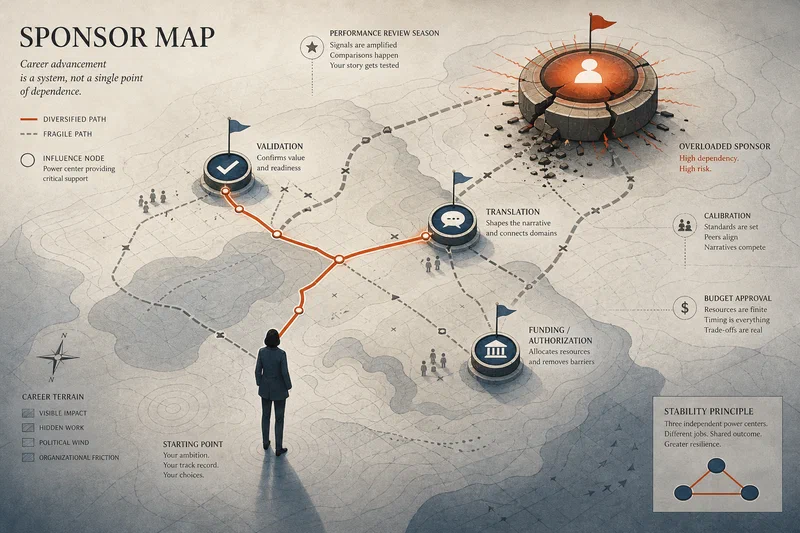
The more accurate diagnosis is usually sponsor concentration. One manager knows your work is strong. One manager praises you privately. One manager may even want to help. But if performance review calibration sits with a skip-level leader, if headcount sits with finance, or if your next move crosses functions, one supportive manager is not a career strategy. It is a single point of failure.
That distinction matters more in September than it did in June. By Q4, many companies have already started shaping review narratives, promotion slates, budget trade-offs, and succession conversations. The loud work of performance review season may happen later in the quarter, but the real positioning starts now.
This is the next logical step after How to Build a One-Page 2026 Business Case for Internal Mobility and New Scope, The Internal Labor Market: Why Q3 2026 Career Leverage Is Built Before the Job Posting Exists, and The 3 Questions to Pressure-Test Your Q4 2026 Career Position Before September Hiring Resets. Once you know the internal market matters, and once you have a carryable business case, the next question is simple: who exactly can move your case through the system?
Stop calling it visibility if the decision rights sit elsewhere #
Harvard Business Review’s sponsorship coverage has made an important point for years: advocacy only matters when it changes what happens in rooms you do not control. Center for Creative Leadership work on decision-making returns to a related problem: overloaded leaders become bottlenecks when too many approvals route through them. Gallup’s manager data explains why your manager may not be able to carry your case alone.
In plain English, the issue is often not that nobody has seen your work. The issue is that too much of your career upside depends on one person being willing and able to defend it through multiple decision points.
A senior analyst in a healthcare system may have a director who thinks she is exceptional, but the promotion case still dies if finance does not see the savings. A product operations lead at a large software company may be beloved by a VP, but if the headcount owner is elsewhere and no peer leader can translate the case laterally, the role stays informal.
That is sponsor concentration. And it is fixable.
The Q4 sponsor map: validator, translator, funder #
Build your map around three roles. One person can cover more than one role, but do not assume they do.
1. Validator #
The validator can vouch for the quality, consistency, and business usefulness of your work.
This is usually your manager, project lead, or the person closest to the output. They can say, with credibility, “Yes, this person already operates at that level,” or, “Yes, this workflow depends on their judgment.”
Audit questions:
- Can this person name the specific result, not just say I am great?
- Have they seen the work over time, not just during a crisis?
- Could they explain the difference between my role on paper and my role in practice?
- Would they say it in calibration or only in a 1:1?
If your validator can only offer vague praise, you do not yet have validation. You have goodwill.
2. Translator #
The translator can carry the case upward or sideways into language another decision-maker trusts.
This is the missing role in many careers. Translators sit at the seam between functions, levels, or politics. They can tell a finance partner why your work reduces cost or risk and tell a skip-level leader why the scope is no longer temporary.
Audit questions:
- Who can explain my case to a leader who does not know my day-to-day work?
- Who can convert my proof into budget, operating, or risk language?
- Who benefits if my role is clarified and can say that credibly?
- If my manager were unavailable for two weeks, who else could still move the case?
If nobody can answer those questions, your sponsor map is brittle.
3. Funder #
The funder controls headcount, budget, formal scope, or political cover.
This might be your skip-level manager, a business unit head, or a finance partner. Funders do not need to know you best. They need to believe the case is worth paying for.
Audit questions:
- Who can approve protected capacity, a title change, or new scope?
- Who feels the cost if this work stays informal?
- What evidence would make this person say yes faster?
- What competing priorities are they balancing this quarter?
If you do not know who the funder is, you are not early. You are blind.
Build the map before review season hardens #
Here is the practical sequence I would use over the next 10 days.
Step 1: Name the decision you want. Not “more visibility.” Not “career growth.” Name the Q4 decision: promotion case, formal scope expansion, internal transfer support, protected capacity, or ownership of a specific workflow.
Step 2: Put real names into each role. Write down at least one validator, one translator, and one funder. If the same name appears in all three boxes, that is your warning sign.
Step 3: Test the gaps. Ask yourself where the map is thin.
- Strong validator, weak translator: your work is respected but trapped locally.
- Strong translator, weak validator: your story travels, but the proof may not hold.
- Strong validator and translator, weak funder access: people agree, but nobody can formalize it.
Step 4: Give each role the artifact they need. Your validator needs proof. Your translator needs a compact operating narrative. Your funder needs a bounded ask tied to cost, risk, or throughput.
Step 5: Run one conversation per role. Do not treat every stakeholder the same.
- With the validator, ask: “What would you say is the strongest evidence that this scope is already real?”
- With the translator, ask: “If you had to explain this case to a skeptical leader in two minutes, what would matter most?”
- With the funder, ask: “What would make this easier to approve in Q4?”
That last question is more useful than asking whether they support you. Support is cheap. Approval criteria are useful.
What diversified sponsorship looks like in practice #
At a large enterprise software company, a customer-success operations manager might map sponsorship like this:
- Validator: direct manager who has watched her reduce escalations and shorten onboarding time.
- Translator: sales-ops director who can explain the impact across revenue teams.
- Funder: VP who owns Q4 operating budget and can formalize cross-functional scope.
Notice the pattern. The map is stronger because career risk is spread across multiple nodes, not concentrated in one supportive relationship.
The rule for September #
If you have one sponsor, you have encouragement.
If you have a validator and a translator, you have momentum.
If you have a validator, a translator, and a funder aligned before review season, you have a credible Q4 pathway.
That is the standard. Not whether you feel seen. Whether your case can survive distance, hierarchy, and competing priorities.
Do not spend September trying to become more generally visible. Spend it building a sponsor map sturdy enough to move one specific decision.
Have a question or story about sponsorship strategy? I’d love to hear from you.
Email me at jackson.rodriguez@tlnw.uk
References #
- Atlassian Teamwork Lab. (April 27, 2026). “The State of Teams 2026.”
- Center for Creative Leadership. (March 2, 2026). “Leadership & Decision-Making: A Framework & Process.”
- Gallup. (March 23, 2026). “U.S. Worker Thriving Declines as Job Market Pessimism Grows.”
- Gallup. (September 5, 2023). “The Manager Squeeze: How the New Workplace Is Testing Team Leaders.”
- Harvard Business Review. (February 14, 2023). “Don’t Just Sponsor Women and People of Color — Defend Them.”
- ExpertLinked. (August 24, 2026). “How to Build a One-Page 2026 Business Case for Internal Mobility and New Scope.”
- ExpertLinked. (August 29, 2026). “The Internal Labor Market: Why Q3 2026 Career Leverage Is Built Before the Job Posting Exists.”
- ExpertLinked. (August 31, 2026). “The 3 Questions to Pressure-Test Your Q4 2026 Career Position Before September Hiring Resets.”
AI Content Notice
This article was created using artificial intelligence technology. Whenever possible, we include references and sources to support the information presented. Readers are encouraged to consult these sources for further information. While we strive for accuracy and provide valuable insights, readers should independently verify information and use their own judgment when making business decisions. The content may not reflect real-time market conditions or personal circumstances.
Related Articles
The Internal Labor Market: Why Q3 2026 Career Leverage Is Built Before the Job Posting Exists
In Q3 2026, the most important labor market for many professionals is inside the firm. Scope …
How to Build a One-Page 2026 Business Case for Internal Mobility and New Scope
Most internal moves stall on sponsor friction, not talent. A one-page business case turns proof, …
How to Write a Q3 2026 Scope Memo Before Budget Season Rewrites Your Role
In a still labor market, a one-page scope memo can turn hidden workflow value into a …