The 3 Questions to Pressure-Test Your Q4 2026 Career Position Before September Hiring Resets

Most readers do not need a dramatic September move. They need a more honest August reading.
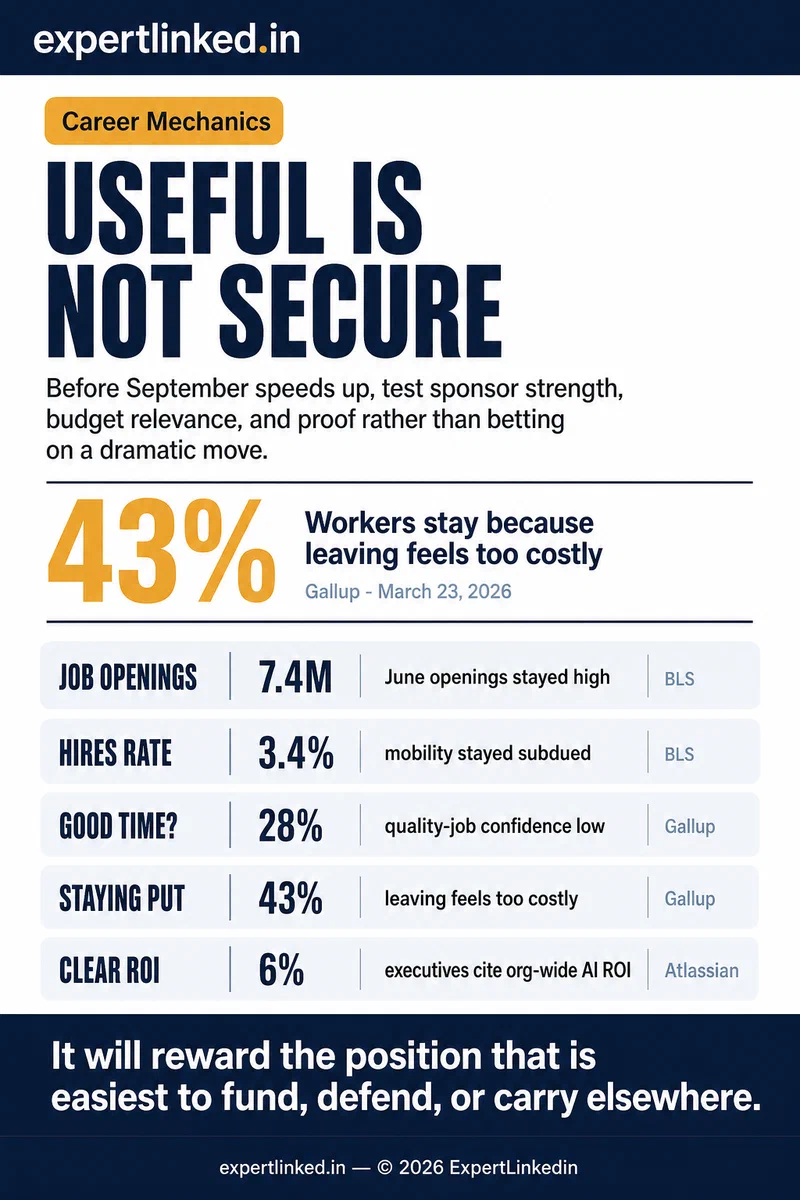
June JOLTS still showed 7.4 million openings, but only a 3.4% hires rate and a 2.0% quits rate. July payrolls fell by 23,000, unemployment held at 4.1%, July CPI eased to 3.4%, and real hourly earnings still fell 0.2% over the year. Gallup says only 28% of workers think now is a good time to find a quality job, while 43% say leaving feels too difficult or costly (U.S. Bureau of Labor Statistics, August 4, 2026; U.S. Bureau of Labor Statistics, August 7, 2026; U.S. Bureau of Labor Statistics, August 12, 2026; U.S. Bureau of Labor Statistics, August 12, 2026; Gallup, March 23, 2026). This is not a panic market. It is a selective one.
Tomorrow’s July JOLTS release and Friday’s August jobs report can still move the tone. They are unlikely to change the core problem for most professionals. September does not usually create leverage from nothing. It resets hiring narratives, budget language, and manager attention around work that already looks sponsorable.
If The H2 Career Decisions That Matter Now argued that July narrowed the choice set, How to Build a One-Page 2026 Business Case for Internal Mobility and New Scope showed how to reduce sponsor friction, and The Late-August 2026 Labor Market Verdict showed that September still opens on employer-friendly terms, then the next question is simpler: is your current position strong enough to carry into Q4 without wishful thinking?

Harvard Business Review’s July piece on pressure-testing priorities argued that when ambient urgency becomes normal, the answer is better tests, not more frantic motion (Harvard Business Review, July 27, 2026). That logic travels cleanly to careers. August makes useful people feel essential. September reveals whether the organization agrees strongly enough to fund, formalize, or move around them.
Question 1: Is there real sponsor strength behind my role, or only private praise? #
The first test is not whether your manager likes you. It is whether someone with budget or influence can carry the case when you are not in the room.
Many professionals confuse appreciation with sponsorship. Their manager says, “You’ve been huge for us,” or “I don’t know how we would have managed this month without you.” Nice words. Not the same thing as upward support. Gallup’s manager data explains why that gap keeps widening: 64% of managers reported added responsibilities, 51% reported team restructuring, and 42% reported budget cuts. Only three in ten managers strongly agreed their supervisor keeps them informed about what is going on in the organization (Gallup, September 5, 2023). Overloaded managers do not sponsor fuzzy cases. They postpone them.
Real sponsor strength usually leaves traces. Your manager starts using your language in planning notes. They ask for the metric behind the problem. They bring you into a cross-functional meeting because the work has become visible above your level. They want the one-page version, not another long explanation. That is why the Aug. 24 business-case piece mattered: the issue is often not whether your value exists, but whether it travels.
Three signs that sponsor strength is real:
- Your manager can name the business problem you solve without telling your life story.
- Someone above your manager has seen the work, the risk, or the saved time firsthand.
- The next step has decision language attached to it: pilot, remit, budget, ownership, title track, or protected capacity.
Three signs it is not:
- The praise only appears after a fire drill.
- Your work is admired but never translated into a bounded ask.
- Every serious conversation gets deferred until “after planning season,” even though planning season is already here.
If this question produces only soft encouragement, do not call that security. Call it what it is: goodwill without sponsorship.
Question 2: Does this work have Q4 budget relevance, or is it just August cleanup? #
The second test is compounding value. Does the work you are doing solve a problem September budgets can recognize, or are you mostly absorbing chaos so the system can avoid naming it?
The macro backdrop matters here. BEA’s second estimate showed Q2 real GDP growing at a 1.5% annual rate, real final sales to private domestic purchasers up 4.2%, and corporate profits up $400.9 billion. July personal income rose 0.4%, disposable personal income rose 0.5%, and the PCE price index rose 0.2% on the month and 3.7% over the year (Bureau of Economic Analysis, August 26, 2026; Bureau of Economic Analysis, August 26, 2026). Employers are not reading that backdrop as a reason to fund every useful person. They are reading it as permission to stay selective.
Inside firms, AI pressure is making that selectivity sharper. Atlassian found that 89% of executives say AI increases speed, but only 6% can point to clear organization-wide ROI. Eighty-seven percent of knowledge workers say they lack the time or capacity to coordinate, and only 29% say AI is embedded in actual flows of work (Atlassian Teamwork Lab, April 27, 2026). Microsoft says 53% of leaders think productivity must increase while 80% of workers say they lack enough time or energy to do their jobs (Microsoft WorkLab, April 23, 2025). In plain English, September budgets are more likely to back work that reduces coordination drag, protects quality, or closes an obvious operating gap than work that merely proves you were busy in August.
Budget relevance is real when your work does one of four things:
- Protects revenue or customer trust.
- Reduces review burden, exception handling, or executive escalations.
- Makes a cross-functional process measurable enough to own.
- Turns temporary coverage into a repeatable operating rule.
Budget relevance is weak when the work is noble but invisible:
- You are carrying emotional glue work that nobody has priced.
- You are doing manual cleanup that disappears because nobody documented it.
- You are covering for structural confusion without changing who owns the confusion.
This is where The Late-August 2026 Labor Market Verdict matters. If September still belongs more to employers than workers, then your safest play is not “I worked incredibly hard.” It is “I solve a problem the budget would feel if it vanished.”
Question 3: What documented proof survives if September does not reward patience? #
The third test is the uncomfortable one. If internal sponsorship stalls, what proof exists outside your head?
Gallup says 51% of workers are actively looking or watching for something else, yet nearly half of active searchers describe the experience as negative and more than half of those who applied in the past 30 days did not land a single interview. The same study says 43% remain where they are mainly because leaving would be too difficult or costly (Gallup, March 23, 2026). Indeed’s August outlook survey is not much kinder to white-collar wishful thinking: economists expect the Job Postings Index to be down 0.5% by the end of September and 1.4% by June 2027 on average, while 57% expect AI to put at least slight downward pressure on college-educated workers’ wages over the next year (Indeed Hiring Lab, August 5, 2026). This is a labor market that has cooled, not one that is suddenly about to rescue vague positioning.
Documented proof is what makes your leverage portable.
At minimum, you want three artifacts before mid-September:
- One before-and-after metric tied to a workflow, queue, revenue leak, risk, or review burden.
- One document that explains the problem, the boundary, and the smallest sensible next step.
- One signal that someone else relied on you in a way that can be named: an email, planning note, meeting invite, handoff rule, or stakeholder request.
If you can only describe your value conversationally, you do not have proof yet. You have a story. Stories help. Artifacts travel.
This is the bridge back to The H2 Career Decisions That Matter Now. July’s lesson was that waiting for the market to feel safer is usually a timing mistake. August’s lesson is narrower: waiting for your value to become obvious on its own is also a mistake.
The reason this third question matters is that it forces a cleaner decision. If you have sponsor strength and budget relevance but weak proof, spend the next 10 to 14 days documenting what is already true. If you have proof but no sponsor strength, the internal market may value you privately without ever formalizing the role. If you have neither, stop calling the situation stable just because it is familiar.
What your answers should trigger this week #
Most readers do not need to quit on Monday. They need to classify their position honestly.
- If all three answers are yes, book the Q4 conversation now. Ask for a bounded decision before the Sept. 4 jobs report disappears into another news cycle.
- If one or two answers are yes, run a short proof sprint. Tighten the artifact, reduce the sponsor burden, and force one concrete conversation before mid-September.
- If all three answers are weak, begin a targeted exit process without drama. The market is still selective, which is exactly why you need a narrow hypothesis and portable proof rather than a mass-application binge.
Gallup’s role-clarity data should keep this from sounding abstract. Only 46% of employees strongly agree they clearly know what is expected of them at work, and only 31% are engaged (Gallup, January 13, 2025). In a market this ambiguous, vague usefulness gets exploited more often than it gets formalized.
Most readers do not need a dramatic move this week. They need to stop asking whether they feel busy, appreciated, or hopeful, and start asking whether they are sponsorable, budget-relevant, and provable.
September will not reward the person who felt busiest in August. It will reward the position that is easiest to fund, defend, or carry elsewhere.
Pressure-testing your Q4 position right now, or seeing one of these three questions fail in real time? I would like to hear what the evidence looks like from inside your role.
Email me at jackson.rodriguez@tlnw.uk.
References #
- Atlassian Teamwork Lab. (April 27, 2026). “The State of Teams 2026.” https://www.atlassian.com/blog/state-of-teams-2026 (Accessed August 31, 2026)
- Bureau of Economic Analysis. (August 26, 2026). “GDP (Second Estimate) and Corporate Profits, 2nd Quarter 2026.” https://www.bea.gov/news/2026/gdp-second-estimate-and-corporate-profits-2nd-quarter-2026 (Accessed August 31, 2026)
- Bureau of Economic Analysis. (August 26, 2026). “Personal Income and Outlays, July 2026.” https://www.bea.gov/news/2026/personal-income-and-outlays-july-2026 (Accessed August 31, 2026)
- Gallup. (March 23, 2026). “U.S. Worker Thriving Declines as Job Market Pessimism Grows.” https://www.gallup.com/workplace/703280/worker-thriving-declines-job-market-pessimism-grows.aspx (Accessed August 31, 2026)
- Gallup. (January 13, 2025). “U.S. Employee Engagement Sinks to 10-Year Low.” https://www.gallup.com/workplace/654911/employee-engagement-sinks-year-low.aspx (Accessed August 31, 2026)
- Gallup. (September 5, 2023). “The Manager Squeeze: How the New Workplace Is Testing Team Leaders.” https://www.gallup.com/workplace/510326/manager-squeeze-new-workplace-testing-team-leaders.aspx (Accessed August 31, 2026)
- Harvard Business Review. (July 27, 2026). “3 Questions to Pressure-Test Your Priorities.” https://hbr.org/2026/07/3-questions-to-pressure-test-your-priorities (Accessed August 31, 2026)
- Indeed Hiring Lab. (August 4, 2026). “June 2026 JOLTS Report: The Labor Market is a Duck on a Pond.” https://hiringlab.indeed.com/2026/08/04/june-2026-jolts-report/ (Accessed August 31, 2026)
- Indeed Hiring Lab. (August 5, 2026). “Economists Expect a Cooled Labor Market and an AI Reshuffling of White-Collar Work.” https://hiringlab.indeed.com/2026/08/05/q2-labor-market-outlook-survey/ (Accessed August 31, 2026)
- Microsoft WorkLab. (April 23, 2025). “2025: The year the Frontier Firm is born.” https://www.microsoft.com/en-us/worklab/work-trend-index/2025-the-year-the-frontier-firm-is-born (Accessed August 31, 2026)
- U.S. Bureau of Labor Statistics. (August 4, 2026). “Job Openings and Labor Turnover - June 2026.” https://www.bls.gov/news.release/jolts.nr0.htm (Accessed August 31, 2026)
- U.S. Bureau of Labor Statistics. (August 7, 2026). “The Employment Situation - July 2026.” https://www.bls.gov/news.release/empsit.nr0.htm (Accessed August 31, 2026)
- U.S. Bureau of Labor Statistics. (August 12, 2026). “Consumer Price Index Summary - July 2026.” https://www.bls.gov/news.release/cpi.nr0.htm (Accessed August 31, 2026)
- U.S. Bureau of Labor Statistics. (August 12, 2026). “Real Earnings - July 2026.” https://www.bls.gov/news.release/realer.nr0.htm (Accessed August 31, 2026)
- ExpertLinked. (July 27, 2026). “The H2 Career Decisions That Matter Now - Before the Q3 Data Closes the Window.” https://expertlinked.in/posts/2026-07-27-the-h2-career-decisions-that-matter-now-before-the-q3-data-closes-the-window/ (Accessed August 31, 2026)
- ExpertLinked. (August 24, 2026). “How to Build a One-Page 2026 Business Case for Internal Mobility and New Scope.” https://expertlinked.in/posts/2026-08-24-how-to-build-a-one-page-2026-business-case-for-internal-mobility-and-new-scope/ (Accessed August 31, 2026)
- ExpertLinked. (August 26, 2026). “The Late-August 2026 Labor Market Verdict: 3 Signals That Will Shape September Hiring.” https://expertlinked.in/posts/2026-08-26-the-late-august-2026-labor-market-verdict-3-signals-that-will-shape-september-hiring/ (Accessed August 31, 2026)
AI Content Notice
This article was created using artificial intelligence technology. Whenever possible, we include references and sources to support the information presented. Readers are encouraged to consult these sources for further information. While we strive for accuracy and provide valuable insights, readers should independently verify information and use their own judgment when making business decisions. The content may not reflect real-time market conditions or personal circumstances.
Related Articles
Infographic: The 3 Questions to Pressure-Test Your Q4 2026 Career Position Before September Hiring Resets
Most readers do not need to panic or quit. They need to pressure-test whether their current role has …
How to Build a One-Page 2026 Business Case for Internal Mobility and New Scope
Most internal moves stall on sponsor friction, not talent. A one-page business case turns proof, …
The 3 Proofs You Need to Make a Lateral Career Move Internally in Q3 2026
In a still labor market, the internal move that gets approved is the one you can already prove in …