Southeast Asia's Digital Banks Are Entering the Primary-Money Test
The next moat in Southeast Asian digital banking may be the least glamorous feature in the stack: getting paid into the account.
The region has already proved it can get consumers to download, scan, top up, and tap. The harder fight in late 2026 is for the place where salary lands, bills clear, spare cash stays, and the second or third product gets bought without a fresh trust decision. That is the primary-money test.
In Southeast Asia’s Next Fintech Moat Is the Payout Network, Not the Wallet., I argued that the scarce payments asset was moving underneath the app. On the customer side, the same logic is now moving into the account itself. The screenshot still matters. The economics increasingly sit with the provider that becomes the default financial base camp.
The onboarding story is getting old #
The adoption numbers are no longer the interesting part. Worldpay’s 2026 regional breakdown, summarized by Fintech News Singapore, showed digital wallets taking 36% of Singapore’s point-of-sale value and 40% of e-commerce value in 2025. In the Philippines, the same report said GCash connects more than 94 million users to over 6 million merchants while cash still represents 42% of in-store spending. Vietnam is already supporting 49 licensed wallet operators, while QR payments grew 62% in volume and 151% in value in 2025.
Those are strong adoption figures. They are not primary-relationship figures.
A consumer can use a wallet for coffee, a different app for remittance, an incumbent bank for salary, and a separate lender for credit. That is real digital usage, but it is thin economics if you are the product owner trying to build durable margin. Opening the app is cheaper than owning the place where money rests.
That distinction matters because it changes what a winning metric looks like. Downloads, monthly active users, and payment volume tell you whether the front door works. They do not tell you whether the customer has moved enough trust to let you underwrite, upsell, or keep balances at lower acquisition cost.
The most strategic feature in Southeast Asian digital banking may again look boring: salary crediting.
Trust Bank is the clearest current case #
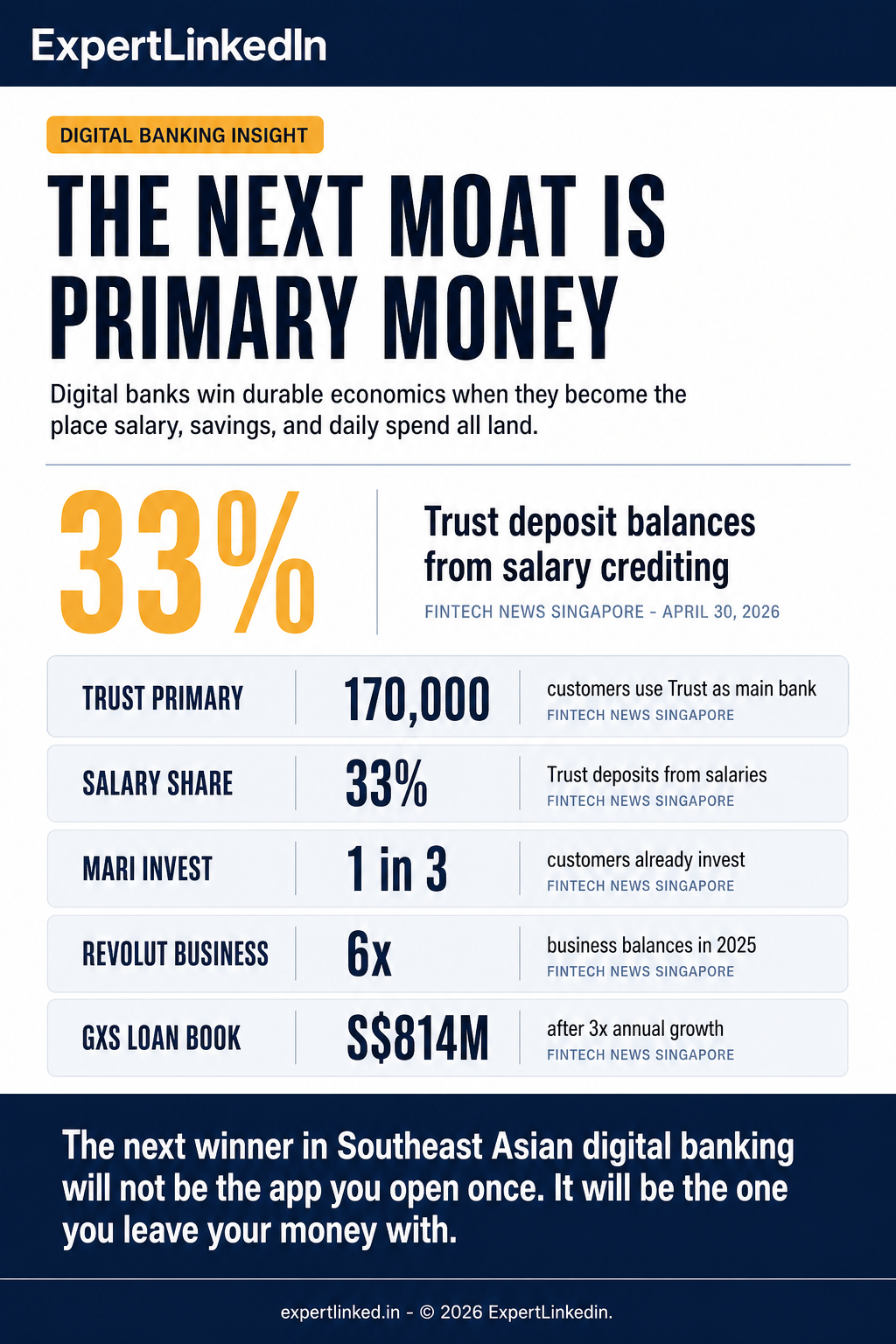
Trust Bank’s April profitability milestone matters less because it was first and more because it revealed the mechanism. Fintech News Singapore reported that more than 170,000 customers already use Trust as their primary financial institution and that salary crediting now accounts for about one-third of total deposit balances. The same report says customers are actively using 240,000 Savings Pots, while Trust disbursed about S$900 million in loans in 2025, sold more than 75,000 insurance policies, and saw around 50,000 customers open TrustInvest accounts.
That is not a single winning feature. It is a widening claim on the customer’s financial life.
The useful signal here is not simply that Trust reached one million customers or that more than 70% of new clients arrive through referrals. It is that enough of those customers have started routing recurring financial behavior through the bank that adjacent products become cheaper to sell and more defensible to operate. Once pay lands there, the next savings product, insurance offer, installment loan, or investment prompt no longer has to win trust from zero.
Trust’s AI story is also more interesting when read through that lens. The bank said nearly half of customer chats are now handled start to finish by its AI chatbot, and on September 8 it rolled out Trust AI Ask, which lets customers search card transactions and spending patterns in natural language while reducing routine query volumes. Helpful features, yes. But the automation sits on top of a deeper product truth. AI lowered service cost after Trust had already become more embedded in day-to-day money behavior.
That is the order many teams still get wrong. They ship intelligence first and relationship depth later. Trust appears to have done the harder thing first.
Singapore’s other digital banks show where the split is happening #
Look across Singapore’s digital banking field and the same pattern shows up in different forms.
MariBank’s March launch of Mari Invest Singapore Equity from S$1 looks small on the surface. It is not. The bank said about one in three customers has already invested in at least one MariBank investment product. In August, Fintech News Singapore added that MariBank’s deposit base had reached S$1.9 billion, the second largest among Singapore’s digital banks, with management planning to expand further across loans, investment, and business banking. That is what a bank does when it wants to graduate from transactional utility into long-term wallet share.
Revolut Singapore offers a different version of the same move. Its March update showed domestic transactions now make up nearly half of local activity, business account balances grew more than sixfold, and the business customer base increased fivefold in 2025. The company also expanded into robo-advice, business cash funds, and merchant acquiring tools. That is not travel-card behavior anymore. It is a bid to become a daily money operating system for both consumers and small businesses.
GXS is the useful tension case. Its August results showed the bank still carrying the largest FY2025 loss at S$132 million, yet the same update showed its loan book grew more than three times to S$814 million and total income rose nearly 50% to S$44 million. The customer base is heavily oriented toward early-career professionals, gig workers, and self-employed entrepreneurs, and its new credit card uses Grab and Singtel rewards plus ecosystem distribution through the Grab app.
I do not read that as failure. I read it as evidence that ecosystem reach and primary money are not the same thing.
Rewards can pull spending. Ecosystem data can improve targeting. Neither automatically means the customer keeps their salary, emergency cash, or investment life with you. The economics change meaningfully only when a bank stops being a clever extension of another platform and starts becoming the platform where the customer’s own balance sheet is organized.
The regional next phase is thicker product, not another wallet #
This is not only a Singapore story.
In Vietnam, Kredivo’s acquisition of Timo was not really about buying a prettier brand. It was about buying a regulatory pathway and an existing trust layer in a market that does not issue standalone digital bank licenses. Kredivo plans to invest about US$15 million over three years, retain the Timo brand, migrate its lending stack into the platform, and then add card products. That is textbook primary-money strategy: use distribution to enter, then add higher-value money behavior.
MoMo, while not a bank, is revealing the same pressure from the wallet side. Reuters reporting summarized by Fintech News Vietnam said early investor talks could value MoMo above US$2 billion, while the company stressed that it has been profitable since 2024, serves more than 30 million users, and already spans lending, insurance, savings, investment products, and merchant services. That product sprawl is not a lack of focus. It is what happens when pure payments stop being enough.
Grab’s April product showcase made the same move explicit in the Philippines. Its Cash Loan product offers up to P50,000, starting at 2.99% per month, using behavioral data such as ride frequency and food-order activity to underwrite users who do not fit traditional scorecards. Tap to Pay and cross-border travel payments widened the merchant and payments layer at the same time. Again, the point is not that another feature shipped. The point is that the region’s most important consumer platforms keep pushing deeper into recurring money behavior.
Even the infrastructure side tells the same story. Bank Indonesia’s PIDI innovation hub is explicitly about building the digital talent needed to turn ideas into risk-managed, market-ready products. That matters because a primary-money relationship is harder to operate than a payments front end. It needs fraud controls, underwriting discipline, service design, treasury management, compliance, and product sequencing that can hold up after the first burst of growth.
In other words, the next phase of digital banking in Southeast Asia looks less like app marketing and more like bank building.
What I would track from here #
If I were evaluating which digital banks in Southeast Asia are really moving from usage to durability, I would pay less attention to raw sign-up numbers and more attention to five unglamorous signals.
- How much of the deposit base comes from salary crediting or other recurring inflows?
- How many customers use at least two or three products, not just one?
- Is domestic recurring spend growing faster than promo-driven or travel-linked volume?
- Are business balances and SME operating accounts deepening, or is usage still consumer-light?
- Does service automation sit on top of real relationship depth, or is it being asked to substitute for it?
Those questions are deliberately boring. That is the point. Mature banking economics are usually built on habits that feel ordinary to the customer and extremely hard to dislodge once established.
Back in March, I wrote that Singapore’s digital banks had crossed the wealth threshold. In July, Southeast Asia Solved the QR Code. The Real Fight Now Is Reconciliation. argued that checkout speed had stopped being the scarce asset. Last week, Southeast Asia’s Next Fintech Moat Is the Payout Network, Not the Wallet. pushed that logic beneath the interface. This is the consumer-side equivalent.
The next winner in Southeast Asian digital banking will not be the app you open once. It will be the one you leave your money with.
Working on digital banking, deposits, or product strategy in Southeast Asia? I would like to hear which feature actually moved customers from casual use to primary-account behavior.
Email me at chloe.tan@tlnw.uk
References #
- Fintech News Singapore (April 3, 2026). “Southeast Asia Payment Methods in 2026: Everything You Need to Know.” https://fintechnews.sg/128337/e-commerce/southeast-asia-payment-methods-2026-global-payments-report/ (Accessed September 10, 2026)
- Fintech News Singapore (April 30, 2026). “How Trust Bank Became Singapore’s First Digital Bank to Reach Profitability.” https://fintechnews.sg/130789/digital-banking-news-singapore/trust-bank-profitability-singapore-digital-bank-milestone/ (Accessed September 10, 2026)
- Fintech News Singapore (September 8, 2026). “Trust Bank’s App Can Now Use AI to Break Down Your Card Spending.” https://fintechnews.sg/136845/digital-banking-news-singapore/trust-bank-ai-ask-card-spending/ (Accessed September 10, 2026)
- Fintech News Singapore (March 24, 2026). “MariBank Rolls Out Singapore Equities Investment Product from S$1.” https://fintechnews.sg/128010/digital-banking-news-singapore/maribank-singapore-equities/ (Accessed September 10, 2026)
- Fintech News Singapore (March 24, 2026). “Revolut Singapore Stays Profitable in 2025 as Subscription Revenue Jumps 75%.” https://fintechnews.sg/128023/digital-banking-news-singapore/revolut-singapore-profitable-2025/ (Accessed September 10, 2026)
- Fintech News Singapore (August 21, 2026). “GXS Bank Posts Heaviest Loss, Even As Loan Book Grew Three Times.” https://fintechnews.sg/136072/digital-banking-news-singapore/singapore-digital-bank-profit-fy2025/ (Accessed September 10, 2026)
- Fintech News Singapore (August 17, 2026). “GXS Bank Launches Cashback Credit Card With Grab, Singtel Rewards.” https://fintechnews.sg/135870/digital-banking-news-singapore/gxs-credit-card/ (Accessed September 10, 2026)
- Fintech News Singapore (March 12, 2026). “Kredivo Group Acquires Vietnamese Digital Bank Timo in Regional Push.” https://fintechnews.sg/127641/digital-banking-news-singapore/kredivo-timo-acquisition/ (Accessed September 10, 2026)
- Fintech News Vietnam (April 8, 2026). “MoMo’s Early Investor Interest Points to Valuation Above US$2 Billion.” https://fintechnews.sg/128597/vietnam/momo-investor/ (Accessed September 10, 2026)
- Fintech News Singapore (April 9, 2026). “Here Are All the Fintech Products Launched at GrabX.” https://fintechnews.sg/128715/fintech/grab-launches-fintech-tools-sea/ (Accessed September 10, 2026)
- TechNode Global (February 25, 2026). “Indonesia launches digital innovation hub to accelerate digital solutions.” https://technode.global/2026/02/25/indonesia-launches-digital-innovation-hub-to-accelerate-digital-solutions/ (Accessed September 10, 2026)
AI Content Notice
This article was created using artificial intelligence technology. Whenever possible, we include references and sources to support the information presented. Readers are encouraged to consult these sources for further information. While we strive for accuracy and provide valuable insights, readers should independently verify information and use their own judgment when making business decisions. The content may not reflect real-time market conditions or personal circumstances.
Related Articles
Infographic: Southeast Asia's Digital Banks Are Entering the Primary-Money Test
Digital wallets already won the screenshot in Southeast Asia. The harder fight for digital banks now …
Southeast Asia Solved the QR Code. The Real Fight Now Is Reconciliation.
ASEAN payments already win on speed; the next moat is structured trade data that makes collections, …
SEA Weekly: After Liberation Day — What Southeast Asia Built Instead
The tariff anniversary week that mattered wasn’t for what it revealed about factories. It was …