Briefing Room - October 2026: The Best Reporting on Calibration, Pay Pressure, and Selective Hiring

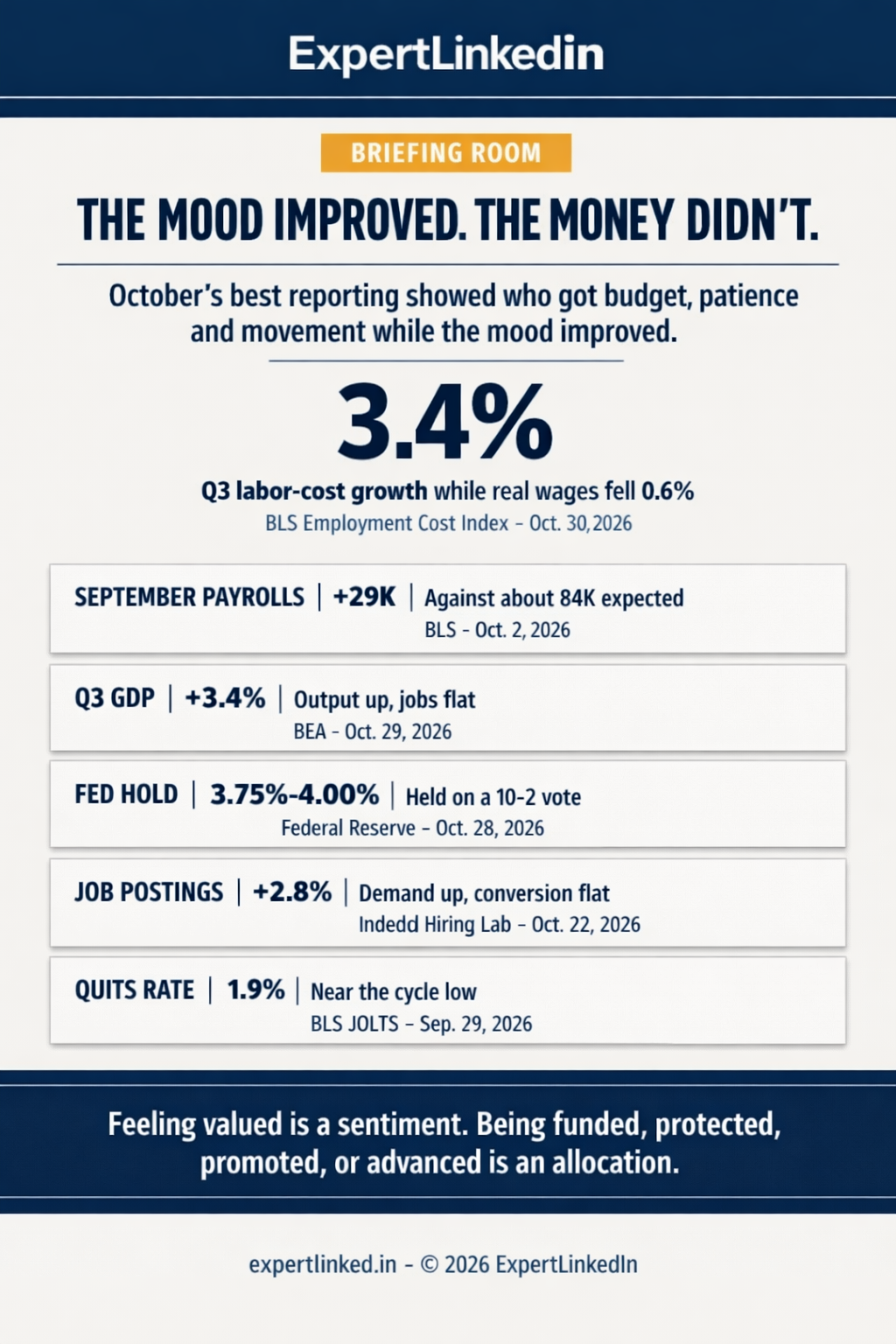
October finally gave everyone the reassuring paragraph. Real GDP grew at a 3.4% annual rate. The Federal Reserve held rates steady. Job postings turned positive year over year for the first time in nearly four years. And the month’s marquee jobs report added just 29,000 positions — a number so soft that stocks rallied, because it lowered the odds of another rate hike.
The mood improved. The leverage did not.
That is the one-line argument that ties October together, and it is why the month’s strongest reporting is not a scoreboard of who sounded confident. It is a ledger of who got budget, patience, and movement once the year-end comparisons began. October was Q4’s first full operating month: managers turned private impressions into calibration language, 2027 bands began to harden, and AI productivity claims arrived in the margin line while the hiring line stayed narrow. The reporting worth carrying into November connects measurement to money — the only place the two ever meet.

Best Labor-Market Release: The September Employment Situation #
The Employment Situation — September 2026 U.S. Bureau of Labor Statistics — October 2, 2026
This was the month’s defining release, and the cleanest example of a stable stock versus a stalled flow. Payrolls rose just 29,000, against roughly 84,000 expected. Unemployment ticked up to 4.2%. July and August were revised down a combined 60,000, leaving the three-month average at 51,000. Average hourly earnings rose 3.0% year over year — the slowest since May 2021 (CNBC, October 2, 2026).
The reassuring half sits in the same report: household employment rose 406,000 and participation climbed to 61.8%. Indeed Hiring Lab named the tension exactly — “steadiness without a spark” — and its economists delivered the month’s most useful sentence: employers “keep signaling that they want more workers, but they just aren’t hiring them” (Indeed Hiring Lab, October 2, 2026).
Here is the tell almost nobody quoted. The U.S. labor force shrank by roughly 700,000 workers in 2026 — only the second such year outside a recession since 1948. Fewer people looking makes a calm 4.2% partly arithmetic. Intent is not movement, and September proved the difference.
Best Pay Signal: The Q3 Employment Cost Index #
Employment Cost Index — Third Quarter 2026 U.S. Bureau of Labor Statistics — October 30, 2026
The pay-relevant number of October is not CPI; it is the ECI, because it measures what employers actually paid for labor and it arrives in time to set next year’s band. Its internals are the quarter’s quietest uncomfortable truth: civilian compensation rose 3.4% over the year, but wages and salaries rose only 3.1%, benefits 3.9%, and private health benefits 6.4%. Adjust for prices, and inflation-adjusted wages and salaries fell 0.6%.
Read that as a worker and the paradox resolves. Your raise is smaller than inflation. Your employer’s cost of labor is larger than your raise. The difference is absorbed in benefits you cannot spend.
The forward signal is just as blunt. Pay is being differentiated — the share of organizations spreading one flat raise across everyone fell from 44% to 32%, with 2027 salary budgets tracking about 3.4% (Payscale, August 4, 2026; SHRM, August 18, 2026). “Be patient until 2027” does not describe a rebound. It describes the same ~3% plus a harder comparative test.
Best Policy Signal: The October 28 FOMC Statement #
FOMC Statement Board of Governors of the Federal Reserve System — October 28, 2026
The Fed held its target range at 3.75%–4.00% on a 10–2 vote, noting that “job gains have kept pace with the workforce.” A hold is genuinely good news and almost entirely beside the point: it is the absence of a new shock, not the arrival of a new opening. Two dissents keep the December hike live, so the regime is pause within tightening. The statement is a sentence about December, not a signal about your mobility — and the same low quits that let inflation cool are what let employers hold the line on pay.
Best Calibration Research: How the Room Decides #
How Calibration Meetings Introduce Bias Into Performance Reviews — HBR, January 5, 2024 · Noise — HBR, October 2016 · CHROs Think Performance Management Systems Work — Gallup, May 6, 2024
The best calibration research was not new; it was newly relevant. HBR found that the process designed to remove bias introduces its own — roundtables converge on the first, most confident, most repeatable story. But Gallup’s numbers should reorganize how you read the whole month: only 2% of Fortune 500 CHROs strongly agree their system inspires improvement, and just 22% of employees call it fair.
The system does not need to be accurate. It needs to be comparable. And comparability is exactly what praise is not. Gallup and Workhuman found well-recognized workers are 45% less likely to leave within two years (Gallup, September 18, 2024). But recognition is cheap: replacing a manager runs about 200% of salary, a technical specialist about 80%. If praise buys loyalty at a fraction of the price of pay, a rational employer under budget pressure leans on it hardest in the year it can least afford raises. WorldatWork supplies the receipt: 78% of workers have experienced a “quiet promotion,” and 67% have absorbed a departed colleague’s workload without more pay. Gratitude and a retention tactic look identical in October. They separate in January.
Best AI Workflow-Accountability Reporting: Who Pays for the Gain #
2026 Global Human Capital Trends — Deloitte, March 4, 2026 · The State of Teams 2026 — Atlassian Teamwork Lab, April 27, 2026
The month’s sharpest accountability reporting named a vacuum most teams still avoid: who owns judgment when humans and AI are both in the loop? Deloitte, drawing on more than 9,000 leaders, found 7 in 10 now treat speed as the primary competitive strategy, yet 59% still take a tech-focused approach to AI — and those organizations are 1.6 times more likely to miss expected returns. Authorship is “blurring,” it warns, and workers are “questioning what counts as effort, ownership, fairness, and accountability.”
Atlassian supplied the operating proof: 89% of executives say AI increases speed, but only 6% are confident of clear organization-wide ROI; 87% of knowledge workers lack the time to coordinate, and coordination failures cost the Fortune 500 $161 billion a year. HBR clocked the hidden layer at roughly 6.4 hours a week of supervising and correcting AI output (HBR, August 5, 2026). Acceleration arrives first; workflow design arrives later; the gap sits in between — and someone absorbs it. Output competes with the tool; judgment does not.
Best Earnings-Call Language: A Forecast Wearing the Grammar of a Result #
AI and Productivity: What Firms Are Saying on Earnings Calls Federal Reserve Bank of St. Louis — July 31, 2026
Early Q3 earnings season produced a lot of confidence and very little hiring, and the St. Louis Fed’s transcript study is the best tool for telling the two apart. Across roughly 490,000 transcripts from about 5,200 public firms, about 95% of AI-related productivity sentences describe future gains, against roughly three-fourths of non-AI sentences — while utilization-adjusted total factor productivity grew just 0.07% over the four quarters ending in Q1 2026 (San Francisco Fed, June 4, 2026).
On a 2026 earnings call, then, “productivity” is a forecast wearing the grammar of a result. The money went to the margin and capex lines. TSMC posted record revenue of US$46.72 billion, up 50.9% year over year, with high-performance computing at 68% of revenue — a capital win, not a headcount win. Salesforce’s Marc Benioff said AI lifted developer productivity by more than 20% and paused new engineering hiring for the year. Netflix cut about 1,000 roles, 6% of its workforce, framing the quarter around “efficiency” (Futurum Group, October 15, 2026; Next Edition, October 16, 2026). Companies that discuss AI in workforce or restructuring terms go on to post headcount growth 3.2 percentage points lower (JobsData.ai, through September 2026). When productivity is up and hiring in the same function is flat, the productivity claim is the headcount decision.
The One Argument October’s Reporting Could Not Settle #
Good curating also means naming where the reporting disagreed with itself, because that is where readers get their edge.
The Fed read quits — stuck at 1.9% — as slack: proof workers cannot push wages up. Workers reading the same number see a frozen door. Both are true, and the disagreement is the point: the condition that cools inflation is the condition that caps your pay.
Then the growth paradox. GDP grew 3.4% while employers added 29,000 jobs. That is not a contradiction; it is a capital- and AI-investment-led expansion that adds output without adding many workers. Strong growth is not a mobility signal — it is proof the gap between “the economy” and your career has widened.
And the postings-versus-conversion split. Indeed’s Job Postings Index climbed to 103.8, up 2.8% year over year, with 68% of sectors above year-ago levels (Indeed Hiring Lab, October 22, 2026). But hires sit near 3.3%, the vacancy yield is 0.71 — below a normal 2019 market — and posted wages grow 2.4% against CPI of 3.7%. Advertised pay is losing to prices at the exact moment demand looks better. That is substitution, not a reopening.
Best October Idea From ExpertLinked: From Private Planning to a Scorecard #
The best thing we published this month is a sequence that turns measurement into money. First, write the self-evaluation as a translation tool, not a diary — sentences a sponsor can lift without rewriting (October 5). Then convert prevention into a ledger, because the avoided error and the held deadline become leverage only when they carry a baseline and an organization-native unit (October 12). Then name the budget line — merit, structure, or retention exception — because a 4.4% ask cannot be a merit increase at all (October 26).
It is the only October framework that moves directly from the measurement layer to the money layer. It extends September’s The Performance-Review Economy and The 90-Day Q4 2026 Career Positioning Plan with the artifacts that survive a room you are not in.
October at ExpertLinked #
If you want the full October arc rather than just this month’s picks, start here:
- October 1 - Your Executive LinkedIn Post Is Now a Source Document
- October 2 - I Can’t Tell Whether to Stay Through Year-End or Leave Now - and What to Do Before Q4 2026 Burns You Out
- October 2 - He Turned AI Governance Work Into a Credible Leadership Pivot Before Q4 2026
- October 5 - How to Write a Q4 2026 Self-Evaluation for Work Before Calibration Starts
- October 6 - The Clinical AI Error That Never Shows Up in the Benchmark
- October 7 - What the September 2026 Jobs Report Says About Q4 Hiring - Before the Fed Minutes Land
- October 8 - Your LinkedIn Is Now Part of Your Q4 2026 Scorecard
- October 9 - My Self-Evaluation Feels Like Propaganda - and What to Write Before Q4 2026 Calibration
- October 10 - Timing Beats Volume: India’s Festive AI Marketing Scorecard
- October 12 - How to Turn Risk Reduction Into a Q4 2026 Promotion Case Before Budget Freeze
- October 13 - Southeast Asia’s Next Fintech Moat Is Settlement Finality, Not the Stablecoin
- October 14 - What the September 2026 CPI Report Could Change About Q4 Pay Talks - and What It Probably Won’t
- October 15 - The Verification Tax: Who Actually Pays for the AI Productivity Gain
- October 16 - The Deadline Got Faster, Not Safer - and What to Do When AI Speed Becomes Your New Baseline
- October 16 - What Melanie Perkins’ Path From Fusion Books to Canva Teaches About Fixing Workflow Friction
- October 17 - Your Next AI Feature Shouldn’t Write a Word: The Quiet Rise of Decision Models
- October 19 - How to Build a 30-Day Q4 2026 External Option Without Looking Disengaged at Work
- October 20 - Your Employer Brand Is Now a Composite - and You Only Control the Weakest Input
- October 21 - What Early Q3 2026 Earnings Calls Say About AI Productivity - and Why Q4 Hiring Plans Still Look Narrow
- October 22 - Executive Visibility Has Two Ledgers - and Q4 Only Pays Out the One You’ve Been Ignoring
- October 23 - I’m the Reliable One, So Everything Late Lands on Me - and What to Do Before Year-End 2026
- October 24 - The AI-Off Audit: Why Clinical AI Is Erasing the Judgment It Still Depends On
- October 26 - How to Build a Year-End Pay Ask Before the Q3 2026 Employment Cost Index Lands
- October 27 - Your Next Customer Is a Machine: India’s Q4 2026 Agent-Readiness Test
- October 28 - What October’s Labor and Inflation Data Says Before the Oct. 28 Fed Decision - and Why Year-End Mobility Still Looks Selective
- October 29 - Record Festive GMV, Thinner Seller Margin: The Bill Behind India’s Q4 2026 Shopping Boom
- October 30 - My Review Says I’m High Impact, But My Pay Isn’t Moving - and What to Do Before 2027 Planning Starts
- October 30 - What Sarah Guo’s Move From Greylock to Conviction Teaches About Selective Career Timing in Q4 2026
- October 31 - The Calibration Quarter: How Q4 2026 Career Outcomes Get Locked by Scorecards, Not Sentiment
October’s strongest reporting kept collapsing labor data, policy, pay, management research, and AI workflow into one argument: better numbers do not automatically distribute protection. Someone still has to translate the work, price the avoided loss, and name the line it should be funded from. The scorecard — not the sentiment — is what gets carried into 2027.
Have a candidate for November’s Briefing Room — or a reporting thread this issue missed? I’d like to hear what you’re seeing.
Email me at jackson.rodriguez@tlnw.uk
References #
- U.S. Bureau of Labor Statistics (October 2, 2026). “The Employment Situation — September 2026.” https://www.bls.gov/news.release/empsit.nr0.htm (Accessed October 31, 2026)
- U.S. Bureau of Labor Statistics (October 14, 2026). “Consumer Price Index — September 2026.” https://www.bls.gov/news.release/cpi.nr0.htm (Accessed October 31, 2026)
- U.S. Bureau of Labor Statistics (October 14, 2026). “Real Earnings — September 2026.” https://www.bls.gov/news.release/realer.nr0.htm (Accessed October 31, 2026)
- U.S. Bureau of Labor Statistics (October 21, 2026). “Usual Weekly Earnings — Third Quarter 2026.” https://www.bls.gov/news.release/wkyeng.nr0.htm (Accessed October 31, 2026)
- U.S. Bureau of Labor Statistics (October 30, 2026). “Employment Cost Index — Third Quarter 2026.” https://www.bls.gov/news.release/eci.nr0.htm (Accessed October 31, 2026)
- U.S. Bureau of Labor Statistics (September 29, 2026). “Job Openings and Labor Turnover — August 2026.” https://www.bls.gov/news.release/jolts.nr0.htm (Accessed October 31, 2026)
- Board of Governors of the Federal Reserve System (October 28, 2026). “FOMC Statement.” https://www.federalreserve.gov/newsevents/pressreleases/monetary20261028a.htm (Accessed October 31, 2026)
- U.S. Bureau of Economic Analysis (October 29, 2026). “Gross Domestic Product, Third Quarter 2026 (Advance Estimate).” https://www.bea.gov/data/gdp/gross-domestic-product (Accessed October 31, 2026)
- Indeed Hiring Lab (October 2, 2026). “September 2026 Jobs Report: Steadiness Without a Spark.” https://hiringlab.indeed.com/2026/10/02/september-2026-jobs-report-steadiness-without-a-spark/ (Accessed October 31, 2026)
- Indeed Hiring Lab (October 22, 2026). “US Labor Market Snapshot — October 2026.” https://hiringlab.indeed.com/2026/10/22/us-labor-market-snapshot-october-2026/ (Accessed October 31, 2026)
- Federal Reserve Bank of Atlanta (October 8, 2026). “Wage Growth Tracker.” https://www.atlantafed.org/chcs/wage-growth-tracker (Accessed October 31, 2026)
- Gallup (May 6, 2024). “CHROs Think Performance Management Systems Work — Employees Disagree.” https://www.gallup.com/workplace/644717/chros-think-performance-management-system-works.aspx (Accessed October 31, 2026)
- Gallup (March 23, 2026). “U.S. Worker Thriving Declines as Job Market Pessimism Grows.” https://www.gallup.com/workplace/703280/worker-thriving-declines-job-market-pessimism-grows.aspx (Accessed October 31, 2026)
- Gallup & Workhuman (September 18, 2024). “Employee Retention Depends on Getting Recognition Right.” https://www.gallup.com/workplace/650174/employee-retention-depends-getting-recognition-right.aspx (Accessed October 31, 2026)
- Harvard Business Review (January 5, 2024). “How Calibration Meetings Introduce Bias Into Performance Reviews.” https://hbr.org/2024/01/how-calibration-meetings-introduce-bias-into-performance-reviews (Accessed October 31, 2026)
- Harvard Business Review (October 2016). “Noise.” https://hbr.org/2016/10/noise (Accessed October 31, 2026)
- Harvard Business Review (August 5, 2026). “How Much Time Do Your Employees Spend Botsitting?” https://hbr.org/2026/08/how-much-time-do-your-employees-spend-botsitting (Accessed October 31, 2026)
- Deloitte (March 4, 2026). “2026 Global Human Capital Trends.” https://www.deloitte.com/us/en/insights/topics/talent/human-capital-trends.html (Accessed October 31, 2026)
- Atlassian Teamwork Lab (April 27, 2026). “The State of Teams 2026.” https://www.atlassian.com/blog/state-of-teams-2026 (Accessed October 31, 2026)
- Federal Reserve Bank of St. Louis (July 31, 2026). “AI and Productivity: What Firms Are Saying on Earnings Calls.” https://www.stlouisfed.org/on-the-economy/2026/jul/ai-productivity-what-firms-say-earnings-calls (Accessed October 31, 2026)
- Federal Reserve Bank of San Francisco (June 4, 2026). “Total Factor Productivity (utilization-adjusted).” https://www.frbsf.org/research-and-insights/data-and-indicators/total-factor-productivity-tfp/ (Accessed October 31, 2026)
- FactSet (September 18, 2026). “More Than 65% of S&P 500 Earnings Calls for Q2 Cited ‘AI’.” https://insight.factset.com/more-than-65-of-sp-500-earnings-calls-for-q2-cited-ai (Accessed October 31, 2026)
- JobsData.ai (data through September 2026). “S&P 500 earnings calls citing ‘AI’.” https://jobsdata.ai/predictions/earnings-call-ai-mentions (Accessed October 31, 2026)
- WorldatWork (2026). “Quiet Promotions and the Expanding Scope of Work.” https://www.worldatwork.org/ (Accessed October 31, 2026)
- Payscale (August 4, 2026). “2026–2027 Salary Budget Survey.” https://www.payscale.com/press-releases/2026-salary-budget-survey (Accessed October 31, 2026)
- SHRM (August 18, 2026). “2027 Salary Raises Expected to Decline Slightly.” https://www.shrm.org/topics-tools/news/benefits-compensation/2027-pay-salary-raises-employers-decline-slightly (Accessed October 31, 2026)
- Futurum Group (October 15, 2026). “TSMC Q3 FY 2026 Earnings Beat and Raise on AI and HPC Demand.” https://futurumgroup.com/insights/tsmc-q3-fy-2026-earnings-beat-and-raise-on-ai-and-hpc-demand/ (Accessed October 31, 2026)
- Next Edition (October 16, 2026). “Netflix Shares Fall as Q3 Earnings Expose Rising AI and Content Costs.” https://next-edition.com/articles/science-technology-netflix-shares-fall-as-q3-earnings-expose-rising-ai-and-content-costs-2026-10-16 (Accessed October 31, 2026)
- CNBC (October 2, 2026). “Labor market faltered in September as jobs increased by just 29,000, unemployment rate rose to 4.2%.” https://www.cnbc.com/2026/10/02/jobs-report-september-2026.html (Accessed October 31, 2026)
AI Content Notice
This article was created using artificial intelligence technology. Whenever possible, we include references and sources to support the information presented. Readers are encouraged to consult these sources for further information. While we strive for accuracy and provide valuable insights, readers should independently verify information and use their own judgment when making business decisions. The content may not reflect real-time market conditions or personal circumstances.
Related Articles
Infographic: Briefing Room - October 2026: The Best Reporting on Calibration, Pay Pressure, and Selective Hiring
October’s best reporting connects measurement to money — GDP up 3.4% and a Fed hold beside …
The Calibration Quarter: How Q4 2026 Career Outcomes Get Locked by Scorecards, Not Sentiment
October’s data finally split confidence from leverage — 3.4% GDP growth and a Fed hold, …
How to Turn Risk Reduction Into a Q4 2026 Promotion Case Before Budget Freeze
The most valuable work you did this quarter is probably not in your self-evaluation — it’s the …