The AI-Off Audit: Why Clinical AI Is Erasing the Judgment It Still Depends On

In the three months after four Polish endoscopy units switched on an AI polyp detector, the doctors started finding fewer adenomas when the AI was switched off. Nothing about the patients had changed. The endoscopists had.
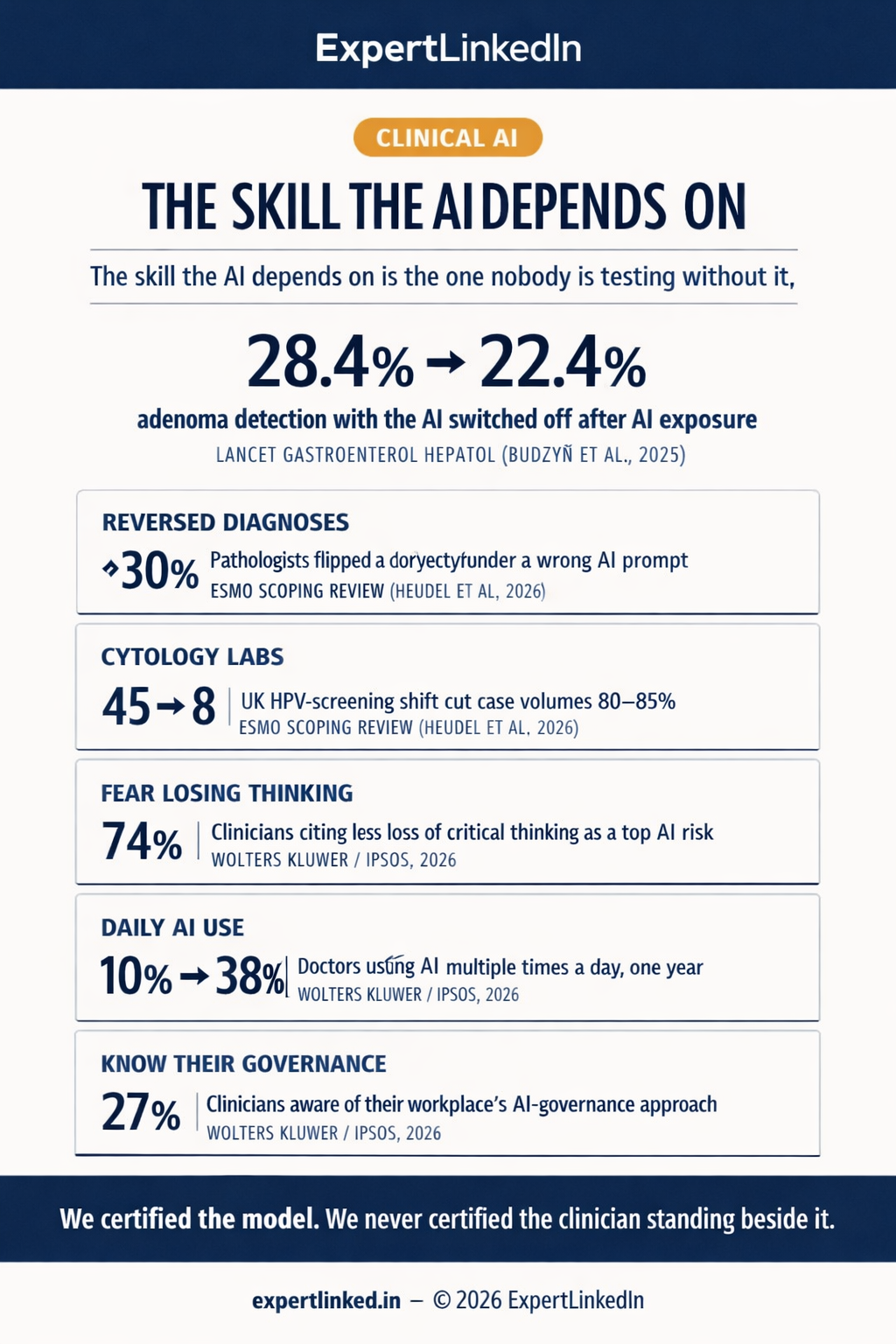
The numbers are hard to look away from. In a multicentre study published in Lancet Gastroenterology & Hepatology, the adenoma detection rate of standard, non-AI-assisted colonoscopy fell from 28.4% to 22.4% after clinicians had been working alongside the AI — an absolute drop of six percentage points (95% CI −10.5 to −1.6). While the AI was on, detection held steady. The skill the tool existed to support had quietly slipped in the background, and it only became visible when someone turned the machine off.
The thread: for two years the clinical-AI safety conversation has been about the model — accuracy scores, benchmarks, whether the algorithm is right. The more uncomfortable question is whether the clinician still is. Every AI system deployed in a hospital leans on a competent human backstop, and every deployment that asks that human to “supervise” the model also removes the cognitive reps that build the competence. We measure automation bias at a single decision. We do not measure skill decay across a career. The missing instrument is the AI-off audit.
On October 6, I wrote about the error that never shows up in the benchmark — the clinician who follows a confident wrong AI suggestion, even when the AI explains itself. This is the other half of that story. That piece was about a single decision. This one is about what happens when a decision is repeated a thousand times, the model is right on most of them, and the skill to disagree quietly disappears.
We measure the model, and the pair — never the person alone #
Clinical AI safety works in three layers, and we only test two of them. We test the model (its accuracy against a benchmark). We increasingly test the pair, though weakly (how often a clinician follows the model when it is wrong). The third layer — whether the clinician is still competent without the model — sits almost entirely unmeasured. Hospitals monitor models for drift. Almost none monitor clinicians for skill drift.
That asymmetry is the whole problem. A safety architecture that says “the human is the backstop” is only as good as the backstop, and nobody is checking the backstop.
It is not that the field is unaware of the risk. The evidence base is small but it points one way. A 2026 scoping review of deskilling — “the erosion of physicians’ expertise due to reliance on automation” — in ESMO Real World Data & Digital Oncology put it plainly: across radiology, pathology, endoscopy and decision support, “evidence of clinical deskilling, though scarce, is consistent.” Its conclusion is the sentence the field keeps skipping: “Safeguarding clinical expertise should be considered a central component of AI safety and resilience in medicine.”
Three harms, three timelines #
The literature has quietly stopped using one word, because “deskilling” was hiding three different failures with three different clocks.
- Never-skilling. No skill is lost because none was built. A dermatology commentary last week in the International Journal of Dermatology described residents who ask a language model to name a lesion before diagnosing it themselves: the reasoning “never gets acquired.” The title is the diagnosis — “The Differential That Never Gets Generated.” This is a student-and-trainee problem, and it is nearly invisible, because the model supplies the output the assessment is looking for. It is now serious enough that Nature Medicine ran a piece on it in May, and medical-education journals have started building frameworks to prevent it — a Johns Hopkins “readiness gate” now sits before independent AI-augmented practice (Medical Teacher).
- Deskilling. An acquired skill erodes. This is the colonoscopy finding above, and it hits residents and mid-career clinicians whose judgment is still consolidating or still load-bearing.
- Mis-skilling. The wrong pattern is learned as right. The ESMO review cites experimental pathology tasks in which more than 30% of participants reversed a correct initial diagnosis when shown an incorrect AI suggestion under time pressure. The same contamination shows up in the colonoscopy evidence: pooled across dozens of trials, computer-aided detection reliably increases the detection of clinically trivial and non-neoplastic lesions while showing no clear gain in advanced adenomas (Digestive Diseases and Sciences). If the model mostly surfaces findings that don’t matter, it may be training clinicians on the wrong distribution — inflating a quality number while quietly degrading the discrimination that catches the dangerous lesion.
The uncomfortable truth: it can be structural, not personal #
We tend to picture deskilling as a personal failure — a doctor who got lazy. The most disturbing example in the review is not personal at all. When the UK moved cervical screening to HPV primary testing, cytology case volumes fell by 80–85% and laboratories consolidated from 45 centres to 8. The skill didn’t erode in one clinician’s head; it eroded in an entire profession’s caseload, along with the training pipeline that fed it. That kind of loss is far harder to reverse, because you cannot “mindset” your way back to a diagnostic volume that no longer exists.
The workforce already knows. In the Wolters Kluwer Future Ready Healthcare survey, fielded by Ipsos in March 2026, 74% of clinicians named losing critical thinking and decision-making as a top AI risk — while doctors using AI multiple times a day had quadrupled in a year, from 10% to 38%. Here is the gap: only 27% of clinicians knew how their own workplace governs AI. Adoption is sprinting, fear is loud, and the governance meant to close the distance is largely invisible (Wolters Kluwer / Ipsos).
Even the tools under-rank the risk. A September study in the Journal of Clinical Medicine asked five large language models to name and rank AI’s risks in interventional pulmonology. Every model put automation bias and technical accuracy first; deskilling never once ranked higher than third. The human specialists ranked it their single highest research priority.
The counter-evidence you have to keep #
It would be easy — and wrong — to end there. AI used at the right moment can build skill rather than erode it.
A 2025 study in Surgical Endoscopy compared endoscopists trained with AI against those trained the conventional way, then measured them both without it. The AI-trained group later performed better unaided: adenoma detection up 5.3 points, sessile-lesion detection up 5.4 points. Read alongside the Polish colonoscopy result, the two studies stop contradicting each other and start explaining each other. In one, AI was present while the skill was forming — a scaffold. In the other, AI was present after the skill had formed and replaced it in routine practice — a crutch. Same tool, opposite effect, different stage.
The same nuance shows up in radiology. When readers were tested unassisted first and then assisted in a European Journal of Radiology fracture study, the model improved accuracy, speed and inter-reader agreement. That study’s design — unassisted first — is itself the answer.
Why “human in the loop” cannot save the loop #
The safety case for clinical AI assumes a competent human. The credential is supposed to guarantee that human. But nursing-education researchers argued this month in Nurse Education in Practice that when generative AI produces the work through which competence is certified, “the credential ceases to be a reliable guarantee of what it claims to represent” — and the harm “accumulates before longitudinal evidence can reveal it.” Meanwhile the strongest statutory regime we have, the EU’s, mandates “human oversight” of high-risk medical AI without defining or testing the competence that oversight assumes (Radiography). And post-market surveillance, as a 2026 clinical-therapeutics review notes, watches the device for drift — not the clinician (Clinical Therapeutics).
So the loop is real, and the loop is blind. We are asking a skill to act as a safety net while quietly removing the practice that keeps the skill sharp.
The five-move AI-off audit #
If I were responsible for a clinical AI programme this quarter, I would stop treating “human oversight” as a sentence in a policy and start treating it as a measurement.
- Schedule the AI-off audit. Test unassisted performance at defined intervals — not once at go-live. Measure the outcome the AI is supposed to improve (adenoma detection, lesion recognition, diagnostic concordance) with the tool switched off, and track the trend, not the level.
- Sequence human-first. Build AI-independent competence before guided AI use before supervised collaboration. Teach the skill before you hand over the task, or you are running the experiment backwards.
- Separate development from evaluation. If clinicians fear that hesitation and uncertainty will be used against them, they will hide it — and you will lose the very signal that shows a skill is fading. Keep the developmental record out of the evaluative one.
- Use AI as a comparator, not a substitute. Keep your own read first, then compare against the machine. AI-assisted auscultation works as a “reflective tool” that sharpens diagnostic acuity; the same tool as a replacement degrades it.
- Make oversight a demonstrated competence, not a signature. Gate independent AI-augmented practice behind a proven unassisted baseline, and re-certify it. A human in the loop who has never been tested outside the loop is a name, not a control.
We spent the last two years certifying the model. The certification we keep postponing is the harder one — the clinician, without it. The AI-off audit is not a rejection of clinical AI. It is the price of continuing to rely on the human at the centre of it.
Working on clinical AI evaluation, training or governance and trying to keep unassisted judgment measurable? I’d like to hear how you test the clinician, not just the model.
Email me at sophia.patel@tlnw.uk
References #
- Budzyń, K., Romańczyk, M., Kitala, D., et al. (2025). “Endoscopist deskilling risk after exposure to artificial intelligence in colonoscopy: a multicentre, observational study.” Lancet Gastroenterology & Hepatology, 10(10), 896–903. https://doi.org/10.1016/S2468-1253(25)00133-5 (Accessed October 24, 2026)
- Heudel, P. E., Crochet, H., Filori, Q., Bachelot, T., and Blay, J. Y. (2026). “Artificial intelligence in medicine: a scoping review of the risk of deskilling and loss of expertise among physicians.” ESMO Real World Data & Digital Oncology, 12, 100693. https://doi.org/10.1016/j.esmorw.2026.100693 (Accessed October 24, 2026)
- Khandelwal, A. (2026). “The Differential That Never Gets Generated.” International Journal of Dermatology. https://doi.org/10.1111/ijd.70743 (Accessed October 24, 2026)
- Khamis, N., Chen, B., and Tackett, S. (2026). “A competency milestones framework for AI-augmented clinical training and practice.” Medical Teacher, 1–7. https://doi.org/10.1080/0142159X.2026.2743047 (Accessed October 24, 2026)
- Patel, N., Kumar, A., Chi, J., et al. (2026). “The Long road to AI-physician partnership starts with learners: a map for AI in medical education.” BMJ Digital Health & AI, 2(1), e000056. https://doi.org/10.1136/bmjdh-2026-000056 (Accessed October 24, 2026)
- Greengrass, C. J. (2026). “Rethinking AI in clinical decision support: a framework for reciprocal human-AI interaction (BRACE).” Frontiers in Digital Health, 8, 1887161. https://doi.org/10.3389/fdgth.2026.1887161 (Accessed October 24, 2026)
- Schaye, V. E., Parsons, A. S., Olson, A. P. J., Abdulnour, R. E., and Daniel, M. (2026). “Theory-informed redesign of clinical reasoning education in the era of generative artificial intelligence.” Academic Medicine. https://doi.org/10.1093/acamed/wvag318 (Accessed October 24, 2026)
- Brenner, A., and Müller, A. (2026). “The credential and the clinician: Generative AI, cognitive substitution, and what universities owe society in nursing education.” Nurse Education in Practice, 96, 104969. https://doi.org/10.1016/j.nepr.2026.104969 (Accessed October 24, 2026)
- Marchi, G., and Corbetta, L. (2026). “Artificial Intelligence-Related Risks in Interventional Pulmonology: An Exploratory Enumeration and Ranking Study Across Five General-Purpose Large Language Models.” Journal of Clinical Medicine, 15(19), 7340. https://doi.org/10.3390/jcm15197340 (Accessed October 24, 2026)
- Orzeszko, Z., Gach, T., Necka, S., Ochwat, K., Major, P., and Szura, M. (2025). “The implementation of computer-aided detection in an initial endoscopy training improves the quality measures of trainees’ future colonoscopies: a retrospective cohort study.” Surgical Endoscopy, 39(8), 5276–5286. https://doi.org/10.1007/s00464-025-11890-3 (Accessed October 24, 2026)
- Pamuk, G. G., Yüce, M., Öztürk, S., et al. (2026). “YOLO26x-based automated fracture detection on radiographs and its impact on radiologist performance: A multi-reader multi-case study.” European Journal of Radiology, 203, 113025. https://doi.org/10.1016/j.ejrad.2026.113025 (Accessed October 24, 2026)
- Anthony, A. E., Ademi, A., Flanagan, J. S., Stopper, P. B., Rolandelli, R. H., and Nemeth, Z. H. (2026). “Real-Time Computer-Aided Detection During Colonoscopy—Effects on Advanced, Diminutive, and Non-Neoplastic Lesion Detection.” Digestive Diseases and Sciences. https://doi.org/10.1007/s10620-026-10269-1 (Accessed October 24, 2026)
- Melbye, H., Rudebeck, C. E., and Pasterkamp, H. (2026). “Chest auscultation — tradition and expectations: Concerns and promises in the era of smart stethoscopes.” Scandinavian Journal of Primary Health Care, 44(1), 2739502. https://doi.org/10.1080/02813432.2026.2739502 (Accessed October 24, 2026)
- Chau, M., and Smith, M. (2026). “Artificial intelligence, disclosure and consent: a comparative review of Australian and European Union legal frameworks for medical imaging.” Radiography, 32(8), 103607. https://doi.org/10.1016/j.radi.2026.103607 (Accessed October 24, 2026)
- Vaezzadeh, S., Oyesile, C., Barber, N., and Pakkal, B. (2026). “Medical Device Safety Throughout the Product Lifecycle: Regulatory Frameworks, Digital Transformation, and the Role of Artificial Intelligence in Devices and Monitoring.” Clinical Therapeutics. https://doi.org/10.1016/j.clinthera.2026.08.013 (Accessed October 24, 2026)
- Wolters Kluwer / Ipsos. (2026). “2026 Future Ready Healthcare Survey.” https://www.wolterskluwer.com/en/news/future-ready-healthcare-ai-adoption-patient-clinician-insights (Accessed October 24, 2026)
- “AI-induced never-skilling in medical education.” (2026). Nature Medicine. https://doi.org/10.1038/s41591-026-04438-y (Accessed October 24, 2026)
AI Content Notice
This article was created using artificial intelligence technology. Whenever possible, we include references and sources to support the information presented. Readers are encouraged to consult these sources for further information. While we strive for accuracy and provide valuable insights, readers should independently verify information and use their own judgment when making business decisions. The content may not reflect real-time market conditions or personal circumstances.
Related Articles
Infographic: The AI-Off Audit: Why Clinical AI Is Erasing the Judgment It Still Depends On
Clinical AI’s safety case assumes a competent clinician will catch its mistakes. But every …
The Clinical AI Error That Never Shows Up in the Benchmark
We keep certifying clinical AI on model accuracy scores, but the 2026 evidence shows the real safety …
Clinical AI's Next Bottleneck Isn't Accuracy. It's Who Pays - and by What Standard.
Clinical AI has enough breakthrough demos; the harder question now is which tools earn reimbursement …