Timing Beats Volume: Why India's Festive AI Marketing Boom Is a Scorecard Illusion

The festive season does not reward the busiest marketer. It rewards the one whose bank account agrees with the dashboard.
Every October, I watch the same ritual play out across Mumbai’s business districts. Founders triple the ad budget, point three AI tools at the content calendar, and ship more creative in a fortnight than they used to produce in a quarter. Then Diwali passes. The decks look magnificent. The cash flow statement starts asking questions nobody wants to answer out loud.
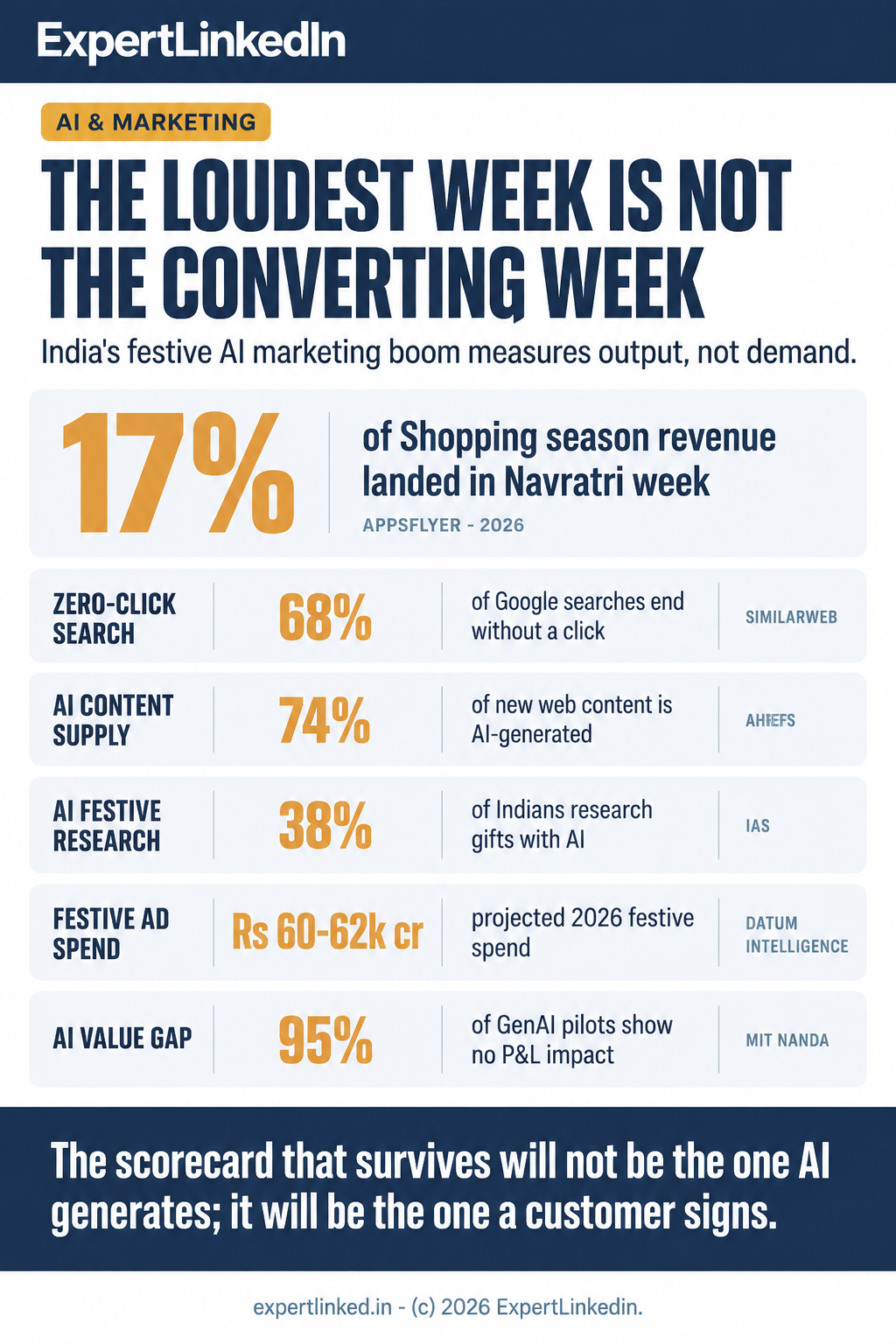
This year the stakes are higher. Diwali falls on November 8, search interest for “Diwali sales” started climbing as early as August, and India’s festive ad market is projected to reach ₹60,000–62,000 crore, with digital taking 67.8% of it.
So before you spend another rupee, sit with one uncomfortable argument.
AI made marketing output infinite and almost free. It did not make attention, trust, or cash infinite. When a machine fills your dashboard, it will happily measure the thing that got cheap — activity — and quietly ignore the thing that got scarce — being chosen. Festive season 2026 is the audit that will expose the difference.

Three curves are crossing, and only one of them is good news #
Three trends are colliding this quarter, and most founders are only watching the one that flatters them.
The first is that the discovery surface is shrinking. Bain found that about 80% of consumers now rely on zero-click results in at least 40% of their searches, trimming organic traffic by an estimated 15–25%. Pew Research found that when an AI summary appears, users click a traditional result on just 8% of visits versus about 15% when no summary exists. Similarweb now puts the zero-click rate at 68% of Google searches. Gartner predicted traditional search volume would fall about 25% by 2026. The pond is getting smaller.
The second is that content supply is exploding. Ahrefs found that 74% of new website content is now AI-generated, and that 87% of marketers already use AI for content creation. When everyone ships three times the content with one-third of the differentiation, the marginal value of each new page drifts toward zero.
The third is that festive ad spend is rising anyway. 72% of Indian households plan to spend more this festive season. More money is now chasing a surface that is smaller and noisier than last year.
Put those together and you get the quiet trap of festive 2026: rising costs, rising output, and rising confidence — all sitting on top of a buying journey that moved somewhere your old dashboard cannot see.
Your dashboard is lying to you — kindly #
Here is the part that should make you nervous. Two of the most credible measurement firms on earth looked at AI-referred traffic and reached opposite conclusions.
Adobe Analytics found that traffic from generative-AI sources jumped 1,200% between July 2024 and February 2025, and that those visitors showed 8% higher engagement, browsed 12% more pages, and bounced 23% less. Then Adobe added the line everyone skips: that same AI traffic was 9% less likely to convert than other channels.
Similarweb, meanwhile, reports that AI-referred visitors convert better — around 7% versus 5% on desktop transactional sites.
Same phenomenon. Opposite verdict. That disagreement is not a data flaw — it is the whole lesson. “Is AI traffic good?” is the wrong question. “For which buyer, at what cost, in which week?” is the only question that survives contact with your P&L. Anyone judging AI channels on a single blended conversion rate will be misled in one direction or the other.
And the gap is not limited to marketing. MIT’s NANDA initiative found that about 95% of enterprise generative-AI pilots show no measurable impact on profit and loss, blaming a “learning gap” rather than the models. Deloitte’s 2026 enterprise read reaches the same conclusion: awareness and access have skyrocketed, while real value and ROI remain rare.
Activity up. Audited value flat. That is the same pattern at enterprise scale, at channel scale, and at the content scale. It is not a coincidence. It is what happens when the scorecard measures inputs and calls them outcomes.
The surprise: the loudest week is not the converting week #
Now the finding that should change how you spend this month.
AppsFlyer’s 2026 festive report is titled, bluntly, “Where Timing Beats Volume.” Its data shows that Shopping’s real revenue peak is Navratri week, which captured 17% of the entire season’s revenue on Android alone — while Diwali week ranked among the season’s lowest for Shopping. Every vertical peaks on a different week. Attention and conversion are simply not the same thing.
Sit with how wrong that is. The industry pyramided its biggest budgets onto the loudest week. The buyers had already moved.
This is what I mean by an unaudited scorecard. Most small businesses buy festive volume — impressions stacked around the big day — when they should be buying festive timing — the specific weeks that actually convert for their category. That is not a budget problem. It is a measurement problem wearing a budget costume.
The Indian buyer already moved. Your scorecard didn’t. #
India makes the misalignment sharper than almost anywhere else, because our buying culture runs on trust and recommendation — and those now route through models.
Integral Ad Science’s Holiday Shopping India 2026 report found that 38% of Indian consumers now use AI tools specifically to research products and gift ideas, up from 32% a year earlier. Openness to AI-assisted shopping sits at 86%, most or all festive shopping now happens online for 84% of shoppers, and 91% say online ads influence what they discover.
Read that carefully. Your customer is asking a model, “What should I buy, and where?” The answer arrives before they ever see your blue link, your banner, or your beautifully AI-generated reel. If your scorecard is built on clicks and impressions, you are measuring a door fewer and fewer people walk through.
What an audited scorecard actually looks like #
I have run an agency long enough to know that nobody changes their metrics because a columnist feels strongly. So here is the practical version. Six moves, in order of pain.
1. Demote output to a diagnostic. Impressions, “content shipped,” and “AI-assisted velocity” are not headline KPIs. They are footnotes. If a number goes up when a machine does more work, it belongs in the appendix.
2. Own the second step. Every discovery surface should funnel into something you control: an email list, a WhatsApp broadcast, a consultation request, a quote flow. In June I argued in The Death of the ‘Human API’ that AI rewards businesses that turn chaos into infrastructure. This is the festive version: the first click is rented; the second step must be owned.
3. Track cohorts, not blends. Separate AI-referred traffic from paid, organic, and direct — with its own cost and its own conversion. The Adobe-versus-Similarweb disagreement disappears the moment you stop averaging yourself into confusion.
4. Buy converting weeks, not loud weeks. Pull last year’s numbers by week. Find your Navratri. Put weight there, not on the calendar date everyone else is bidding up.
5. Earn trust, because slop is now a discount. “Slop” was named 2025 Word of the Year by both Merriam-Webster and the American Dialect Society, and the Reuters Institute’s Digital News Report 2025 keeps showing how fragile audience trust has become. Unedited AI output is no longer a flex; in a trust-driven market it is a liability. Named people, real numbers, and corroborated proof are the assets AI cannot mass-produce.
6. Make the site executable, not just readable. As I wrote in AI Search Is Eating the First Click for Small Businesses, the modern site has to work for humans and agents. If your pricing is buried, your booking flow is a maze, or your quote form demands twelve steps, both will simply move on.
The only metric a machine cannot fake #
Last week I sat with a founder who had spent his entire festive budget on AI-generated creative and watched his reach climb while his orders stayed flat. He kept asking which tool would fix it. The honest answer was that no tool would, because the tool was never the problem. The scorecard was.
We spend so much energy asking what AI can produce that we forget to ask what it can authenticate. It can manufacture a thousand posts. It cannot manufacture one customer who chooses you twice.
So here is your test for the next three weeks. If a metric is easy for a machine to fill, it is easy for a machine to fool. The scorecard that survives this festive season will not be the one your AI tools generate. It will be the one your customer signs.
Running a festive campaign right now? Send me the messy numbers — the ones that don’t match the deck — not the polished version.
Email me at raj.sharma@tlnw.uk
References #
- Bain & Company (February 19, 2025). “Goodbye Clicks, Hello AI: Zero-Click Search Redefines Marketing.” https://www.bain.com/insights/goodbye-clicks-hello-ai-zero-click-search-redefines-marketing/ (Accessed October 10, 2026)
- Pew Research Center (July 22, 2025). “Google users are less likely to click on links when an AI summary appears in the results.” https://www.pewresearch.org/short-reads/2025/07/22/google-users-are-less-likely-to-click-on-links-when-an-ai-summary-appears-in-the-results/ (Accessed October 10, 2026)
- Similarweb (June 10, 2026). “Zero-Click Marketing: The SEO Strategy For A World Where Most Searches Skip Your Site.” https://www.similarweb.com/blog/marketing/geo/zero-click-marketing/ (Accessed October 10, 2026)
- Gartner (February 19, 2024; coverage February 24, 2026). “Gartner Predicts Search Engine Volume Will Drop 25% by 2026.” https://emarketed.com/ai/gartner-predicts-25-percent-search-volume-drop-2026/ (Accessed October 10, 2026)
- Adobe Analytics (March 17, 2025). “Traffic to U.S. retail websites from generative AI sources jumps 1,200 percent.” https://blog.adobe.com/en/publish/2025/03/17/adobe-analytics-traffic-to-us-retail-websites-from-generative-ai-sources-jumps-1200-percent (Accessed October 10, 2026)
- Fortune (August 18, 2025). “MIT report: 95% of generative AI pilots at companies are failing.” https://fortune.com/2025/08/18/mit-report-95-percent-generative-ai-pilots-at-companies-failing-cfo/ (Accessed October 10, 2026)
- Deloitte (2026). “The State of AI in the Enterprise – 2026 AI report.” https://www.deloitte.com/us/en/what-we-do/capabilities/applied-artificial-intelligence/content/state-of-ai-in-the-enterprise.html (Accessed October 10, 2026)
- Ahrefs (September 23, 2025; updated May 31, 2026). “AI-Generated Content 101 for Marketers and Creators.” https://ahrefs.com/blog/ai-generated-content/ (Accessed October 10, 2026)
- Integral Ad Science (September 30, 2026). “Holiday Shopping India 2026 Report.” https://integralads.com/apac/insider/iass-holiday-shopping-india-2026-report/ (Accessed October 10, 2026)
- Datum Intelligence via ET BrandEquity (September 23, 2026). “Festive ad spend in India set to reach INR 60,000–62,000 crore in 2026.” https://brandequity.economictimes.indiatimes.com/news/the-pitch-report/festive-ad-spend-in-india-set-to-reach-inr-60000-62000-crore-in-2026-datum-intelligence/134434624 (Accessed October 10, 2026)
- Think with Google India (September 21, 2026). “Festive advertising in AI Search India: Win India’s Tyohaar 2026.” https://business.google.com/in/think/consumer-insights/festive-advertising-strategy-ai-search-india/ (Accessed October 10, 2026)
- AppsFlyer (2026). “India Festive Report 2026: Where Timing Beats Volume.” https://www.appsflyer.com/resources/reports/india-festive-report-2026/ (Accessed October 10, 2026)
- Reuters Institute for the Study of Journalism (2025). “Digital News Report 2025.” https://reutersinstitute.politics.ox.ac.uk/digital-news-report/2025 (Accessed October 10, 2026)
- Wikipedia (2025). “AI slop.” https://en.wikipedia.org/wiki/AI_slop (Accessed October 10, 2026)
- HubSpot (updated 2026). “Zero-click searches and the future of your marketing funnel.” https://blog.hubspot.com/marketing/zero-click-searches (Accessed October 10, 2026)
- Salesforce (2026). “State of Marketing.” https://www.salesforce.com/resources/research-reports/state-of-marketing/ (Accessed October 10, 2026)
AI Content Notice
This article was created using artificial intelligence technology. Whenever possible, we include references and sources to support the information presented. Readers are encouraged to consult these sources for further information. While we strive for accuracy and provide valuable insights, readers should independently verify information and use their own judgment when making business decisions. The content may not reflect real-time market conditions or personal circumstances.
Related Articles
Infographic: Timing Beats Volume: Why India's Festive AI Marketing Boom Is a Scorecard Illusion
AI made marketing output cheap and infinite, but attention, trust, and cash are not. As Diwali 2026 …
AI Search Is Eating the First Click for Small Businesses
The small-business moat in AI search is no longer raw traffic volume but the system that turns …
Infographic: AI Search Is Eating the First Click for Small Businesses
The small-business moat in AI search is no longer raw traffic volume but the system that turns …