Your Next Customer Is a Machine: India's Q4 2026 Agent-Readiness Test

Somewhere in Mumbai this week, a sale was made to a customer who never arrived.
No homepage. No banner. No festive creative. Just a question typed into an AI assistant, a shortlist the machine assembled in seconds, and a checkout that opened inside the same window. By the time the order landed, the shop had already lost an argument it did not know it was having.
I have spent fifteen years telling Indian businesses to fight for the first click. This festive season, the ground has shifted again — and the new contest is not for the customer’s click. It is for the machine’s recommendation.
The shortlist moved first. The checkout is following. #
Let me stay honest, because the hype runs ahead of the facts on both sides.
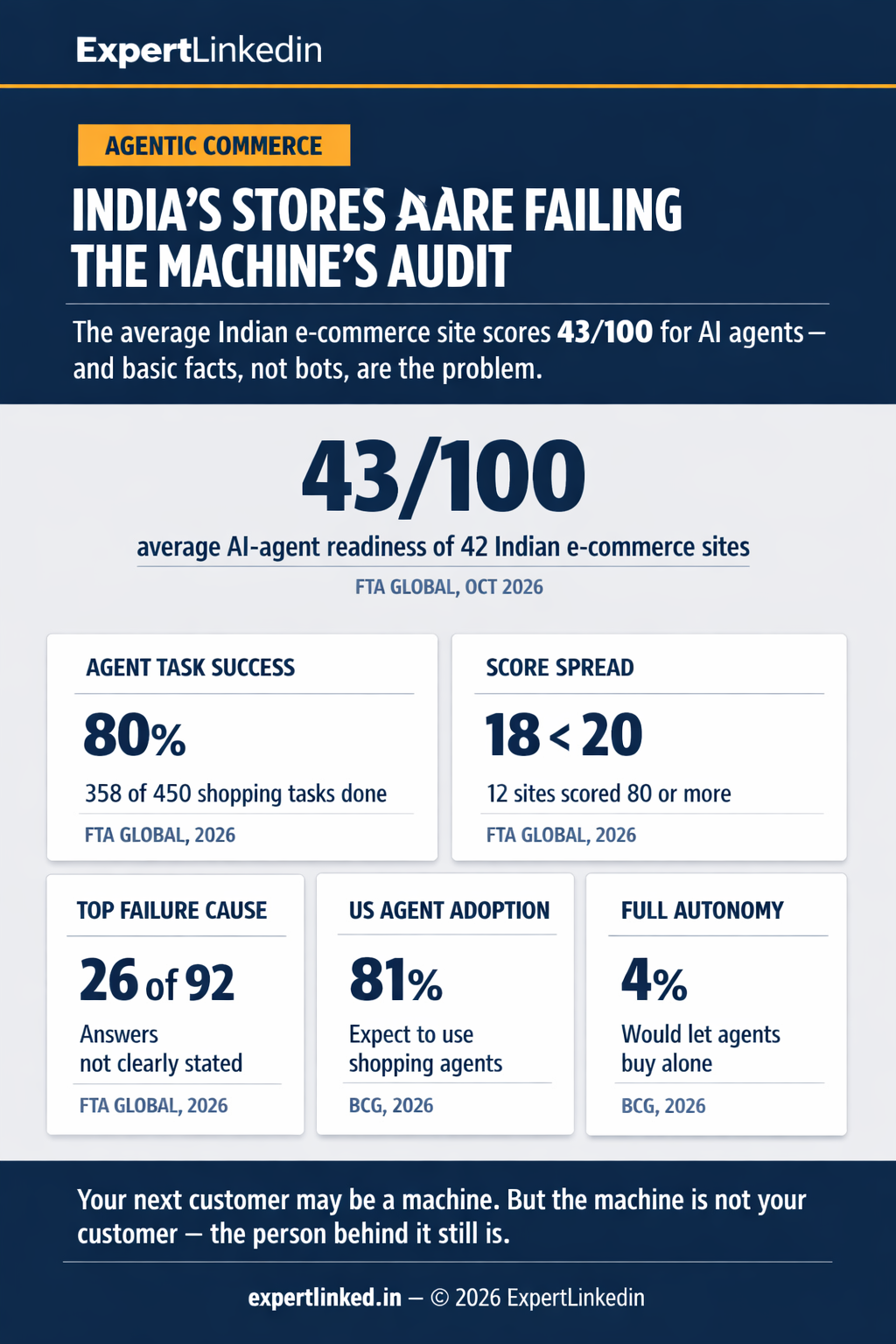
The bullish case is loud. Deloitte projects that by 2030, 25% of global e-commerce sales will be enabled by AI agents. BCG’s survey of 50 of the world’s largest retailers found that 81% of US consumers and 53% of Europeans expect to use agents when they shop. Gartner forecasts that AI agents will intermediate more than $15 trillion in B2B spending by 2028.
The sceptical case is just as loud. Forrester’s mid-2026 read is blunt: most “agentic” experiences are still conversational, “true autonomy is rare,” and “hype is running ahead of behavior.” Even BCG concedes that only 4% of consumers would let an agent finish a purchase on its own.
Both are true, and the gap between them is the story. The recommendation is already automated; the transaction is still mostly human. As BCG puts it, “the battleground today is the recommendation, not the transaction.” Your next customer may still tap pay with their own thumb — but they are choosing from a list a machine wrote.
I made an earlier version of this argument in August, in AI Search Is Eating the First Click for Small Businesses: discovery was moving inside the answer, and the storefront was turning into a confirmation surface. What is new is that the confirmation surface is being swallowed too. In late 2025, Stripe and OpenAI launched Instant Checkout and the Agentic Commerce Protocol, letting US shoppers buy from Etsy sellers — and soon from more than a million Shopify merchants — without ever leaving ChatGPT.

In India, this is not a thought experiment #
India is running the experiment in public. In September, Google began testing direct buying from Flipkart inside Gemini and AI Mode, with a Buy button that opens a Flipkart checkout without leaving the AI interface — and it planned a broader rollout “ahead of India’s festive shopping season.” That sits on Google’s own agent standard, the Universal Commerce Protocol. In the same stretch, Google made AI performance insights generally available in India, so merchants can now see their “share of voice” inside AI Mode and AI Overviews.
The platforms are already hedging. Zomato opened a server that lets assistants discover restaurants and place orders; MakeMyTrip is taking bookings through OpenAI; Meesho is courting agents while adding abuse safeguards; and Meta’s new assistant, Muse, has become the consumer agent Indian firms are bracing for. Even payments are moving: India is preparing a framework that would let AI agents make small UPI payments without human sign-off on every transaction, built on delegated-authority tools like UPI Circle and Reserve Pay — with spending limits, audit trails and identity checks designed in.
This matters more in India than almost anywhere else. Bain’s How India Shops Online 2026 puts e-retail at $65–66 billion in GMV in 2025, on track for $170–180 billion by 2030. And the fastest-growing slice — quick commerce — is already a search-led, low-browse, sub-five-minute journey with eight times the visit-to-order conversion of traditional e-retail. When the browsing disappears, whoever controls the shortlist controls the market.
The uncomfortable number: 43 out of 100 #
Here is the finding that should end the complacency.
A new study by FTA Global gave India’s leading e-commerce sites a simple test. It sent three real AI agents — Claude, GPT and Gemini — to shop 50 Indian e-commerce websites. The agents completed 358 of 450 tasks, or 80%. But when it scored how ready those sites were for machine shoppers, the average came in at 43 out of 100. Twelve sites scored 80 or above; eighteen scored below 20.
And here is the genuinely surprising part. The failures were not caused by agents being blocked. Of the 92 tasks agents could not finish, 26 failed because the answer simply was not stated clearly on the page, 13 because the content needed JavaScript, and only 11 because of blocking or a site error. The leaders — boAt, Flipkart, Mamaearth and Moglix, all scoring 92 to 95 — mostly won by doing something unglamorous: publishing structured, server-side data on price and stock.
Read that again. The average Indian store is failing a machine’s audit on the price of the product, the cost of delivery and the return window — the three most basic facts in commerce. Not on design. Not on creativity. Not on the magic of its festive campaign.
There is a second, quieter warning. When FTA compared the three agents’ answers on return policies, all three agreed on only 29 of 50 sites — and disagreed on 13, mostly where the policies themselves were contradictory. If your own policies confuse a machine, they are almost certainly confusing your customers too.
Why blocking the bots will not save you #
The instinct to lock the door is understandable — and mostly useless.
Amazon began blocking Meta’s Muse agent from its store in September. Walmart went the other way, launching an “Agent Gateway” that lets approved agents search and buy, backed by “Agent Profiles” and terms that cap what an agent may do. Cloudflare changed its crawler defaults on 15 September, nudging many sites into blocking AI agents on ad-bearing pages. Yelp demands agents pay through a data licence; airlines cite security.
But the FTA data shows how little this buys the long tail. Twenty-one of the 50 Indian sites blocked a generic cloud crawler — and yet real, named agents still completed 77% of tasks on those fully blocking sites, barely below the 82% on open ones. The bots that matter are no longer generic crawlers you can switch off. They arrive carrying a customer’s request.
The real prize is the mandate, not the sale #
This is where I think most founders are watching the wrong scoreboard.
BCG found that retailers’ biggest fear is not lost sales — it is losing the customer relationship, cited by 91% of those surveyed. History is blunt about what comes next: every intermediary that has ever stood between a retailer and a shopper — comparison sites, paid search, online travel agencies — eventually charged for the position, with OTAs taking 15% to 25% of every booking.
Walmart’s response is the instructive one: it is not fighting agents, it is defining their mandate — separate profiles, spending limits, clear permissions. The fight is over who holds the switch. For a small Indian seller, the discipline is the same: keep the transaction and the relationship, even as you rent the discovery.
India’s structural bet: open rails, messy shelves #
India holds one card most markets do not. Instead of surrendering retail to closed “walled gardens,” it is building open, machine-readable public infrastructure — ONDC, on the Beckn protocol — designed to push platform commissions down from 5–45% to 2–5% and to let any seller be discoverable by any agent. Gartner expects 35% of countries to be locked into region-specific AI platforms by 2027 — a sovereignty split India is trying to exploit rather than suffer.
But open rails do not fix messy shelves. A protocol can lower the toll; it cannot decide whether your return policy is legible or your stock count is true. The infrastructure is not the bottleneck. Your data hygiene is.
What to do before Diwali — and before 2027 #
Two weeks ago I argued here that the loudest metric is not the converting one, in Timing Beats Volume. The agent era sharpens that by a notch. The machine does not read your dashboard; it reads your feed. So run the audit a machine would run:
- State the basics plainly. Price, delivery charge, return window, stock — written as text an agent can read, not buried in a policy PDF or a JavaScript widget.
- Ship structured data. Clean product feeds and server-side HTML are not an IT chore; they are your new conversion rate. The top scorers in India’s study won on exactly this.
- Keep a road you own. Forrester’s advice to experiment in your own channels first is the quiet insurance policy: an email list, a WhatsApp broadcast, a direct booking flow.
- Define your agent terms. Decide what an agent may do on your behalf — and what it may not — before someone else’s default decides for you.
- Protect the relationship. Let the machine buy, but make sure the customer behind it still belongs to you.
The machine is the filter. The human is still the customer. #
I will not pretend to know how fast this goes. Forrester is right that true autonomy is rare, and the graveyard of 2026 AI projects — the abandoned pilots, the shut-down assistants — warns against buying every narrative.
But one thing is already true, in India, this festive season: the recommendation is being made by machines, and the data says the average Indian store would fail that machine’s audit tomorrow. That is not a technology problem waiting for a bigger budget. It is a clarity problem you can fix this week.
Your next customer may be a machine. But the machine is not your customer — the person behind it still is. The businesses that understand the difference will rent discovery without ever losing the relationship. The rest will be recommended around.
Running a business through the festive crush right now? Tell me what the AI assistants are actually asking you for — and which answer you could not give.
Email me at raj.sharma@tlnw.uk
References #
- BCG (2026). “How Retailers Can Win With AI Shopping Agents in 2026.” https://www.bcg.com/publications/2026/retailers-win-ai-shopping-agents (Accessed October 27, 2026)
- Deloitte (2026). “Agentic Commerce: AI Shopping Agents Guide.” https://www.deloitte.com/us/en/Industries/consumer/articles/agentic-commerce-ai-shopping-agents-guide.html (Accessed October 27, 2026)
- Stripe (September 2025). “Stripe powers Instant Checkout in ChatGPT and releases Agentic Commerce Protocol co-developed with OpenAI.” https://stripe.com/newsroom/news/stripe-openai-instant-checkout (Accessed October 27, 2026)
- Bain & Company (2026). “How India Shops Online 2026.” https://www.bain.com/insights/how-india-shops-online-2026/ (Accessed October 27, 2026)
- Storyboard18 (September 17, 2026). “Google expands agentic commerce tools ahead of festive shopping, brings AI performance insights to India.” https://www.storyboard18.com/how-it-works/google-boosts-ai-commerce-tools-for-festive-shopping-season-ws-l-110838.htm (Accessed October 27, 2026)
- MediaNews4U (October 2026). “Indian ecommerce sites score 43/100 on AI Agent Readiness: FTA Global Study.” https://www.medianews4u.com/indian-ecommerce-sites-score-43-100-on-ai-agent-readiness-fta-global-study/ (Accessed October 27, 2026)
- TechCrunch (September 26, 2026). “Google tests buying from Walmart-owned Flipkart through Gemini and AI Mode in India.” https://techcrunch.com/2026/09/26/google-tests-buying-from-walmart-owned-flipkart-through-gemini-and-ai-mode-in-india/ (Accessed October 27, 2026)
- Business Standard (September 26, 2026). “AI is shopping for you now. What does that mean for ecommerce in India?” https://www.business-standard.com/industry/news/ai-is-shopping-for-you-now-what-does-that-mean-for-ecommerce-in-india-126092600312_1.html (Accessed October 27, 2026)
- TechCrunch (October 21, 2026). “While Amazon blocks AI agents, Walmart rolls out the welcome mat.” https://techcrunch.com/2026/10/21/while-amazon-blocks-ai-agents-walmart-rolls-out-the-welcome-mat/ (Accessed October 27, 2026)
- TechCrunch (October 6, 2026). “The next hurdle for AI agents: getting websites to let them in.” https://techcrunch.com/2026/10/06/the-next-hurdle-for-ai-agents-getting-websites-to-let-them-in/ (Accessed October 27, 2026)
- Forrester (May 28, 2026). “The State Of Agentic Commerce In Mid-2026.” https://www.forrester.com/blogs/the-state-of-agentic-commerce-in-mid-2026/ (Accessed October 27, 2026)
- Whalesbook (2026). “India’s ONDC Strategy Challenges Global AI Walled Gardens.” https://www.whalesbook.com/news/English/technology/Indias-ONDC-Strategy-Challenges-Global-AI-Walled-Gardens/6a8d29b784d2dd5c12e451af (Accessed October 27, 2026)
- Digital Commerce 360 (November 28, 2025). “Gartner: AI agents will command $15 trillion in B2B purchases by 2028.” https://www.digitalcommerce360.com/2025/11/28/gartner-ai-agents-15-trillion-in-b2b-purchases-by-2028/ (Accessed October 27, 2026)
- Economic Times / Reuters (September 1, 2026). “India preparing rollout of agentic payments on UPI.” https://economictimes.indiatimes.com/tech/technology/india-preparing-rollout-of-agentic-payments-on-upix/articleshow/133673880.cms (Accessed October 27, 2026)
AI Content Notice
This article was created using artificial intelligence technology. Whenever possible, we include references and sources to support the information presented. Readers are encouraged to consult these sources for further information. While we strive for accuracy and provide valuable insights, readers should independently verify information and use their own judgment when making business decisions. The content may not reflect real-time market conditions or personal circumstances.
Related Articles
Infographic: Your Next Customer Is a Machine: India's Q4 2026 Agent-Readiness Test
Your next customer’s shortlist is now written by an AI agent. India’s festive season is …
Timing Beats Volume: Why India's Festive AI Marketing Boom Is a Scorecard Illusion
AI made marketing output cheap and infinite, but attention, trust, and cash are not. As Diwali 2026 …
AI Search Is Eating the First Click for Small Businesses
The small-business moat in AI search is no longer raw traffic volume but the system that turns …