He Turned AI Governance Work Into a Credible Leadership Pivot Before Q4 2026

This is a composite narrative. “Daniel” is not a specific real individual. His story draws from recurring patterns Olivia has observed among mid-career operations, program, and compliance professionals who inherit AI-related quality and governance cleanup. Institutional details and identifying characteristics have been fictionalised. Any resemblance to a specific person or employer is unintentional.
The title on my door still says operations lead. The work has quietly become something else. When our compliance officer left in August, the AI governance questions followed me home: who reviews vendor output, who signs off on the thresholds, who owns the audit trail. Nobody asked me to take it on — it just became mine, and now the board wants an answerable state of AI risk before Q4 planning locks the titles and budgets. - Olivia Bennett
This is the pattern I have watched repeat all year: praise lands on the person who cleans up the risk, while the remit lands on the person who makes the risk legible. Daniel never asked to run AI governance. He simply made the board’s question answerable enough that leadership had to hand back decision rights — before Q4 planning locked the titles without him.

The Cleanup Nobody Wanted #
Daniel is 44. He leads the operations team at a mid-market B2B company that processes financial and claims work. The company rolled out AI copilots and a vendor AI document tool to the operations teams fast. Faster than the controls. In August, the compliance officer left.
What Daniel inherited was not a project. It was a pile:
- Hallucinated dates and commitments sitting in client-facing, AI-drafted documents.
- An exception queue nobody owned.
- A vendor contract with no documented verification standard.
- Client and audit emails — “who reviewed this?” — landing on his team by default.
- A board that suddenly wanted a state of AI risk before Q4 planning.
The unglamorous reality: it looked like cleanup. It was really the layer between ambition and exposure.
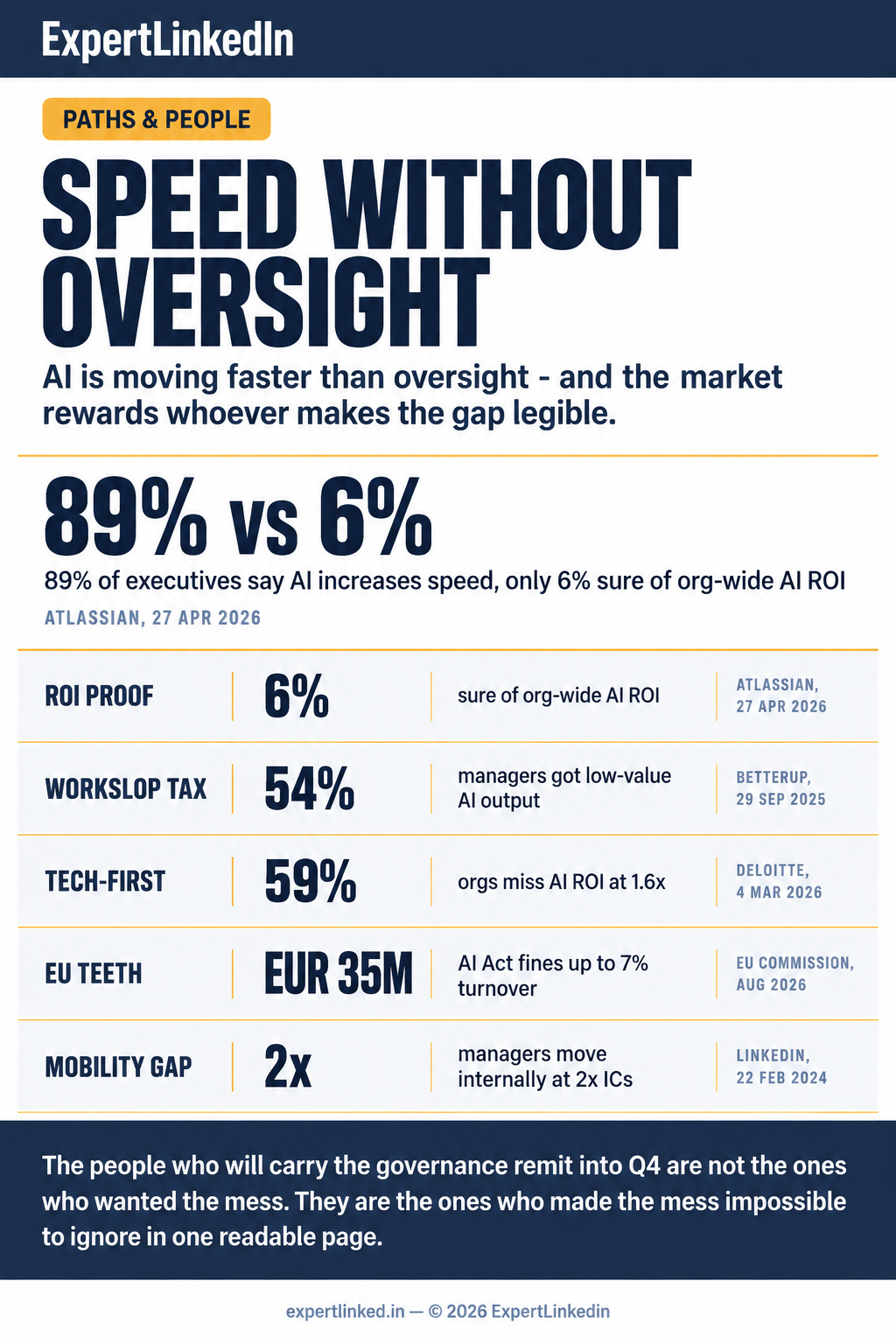
The numbers back what his calendar already showed. In a BetterUp study, 54% of managers received low-value AI-generated output in the prior month, and each instance cost roughly 1 hour 51 minutes — an invisible tax of about $186 per employee per month (BetterUp, September 29, 2025). At the same time, 89% of executives say AI increases speed, yet only 6% can point to clear organization-wide AI ROI, and 87% of knowledge workers say they lack time to coordinate (Atlassian, State of Teams 2026, April 27, 2026).
The gap between what leadership believed and what the work showed was Daniel’s opening.
Why the Rules Got Louder in 2026 #
The rules did not stay quiet while Daniel cleaned up.
In Europe, enforcement is now live. The European Commission began enforcing AI Act rules and new transparency requirements on August 2, 2026, with fines for prohibited practices up to EUR 35 million or 7% of worldwide annual turnover (European Commission, July 31, 2026; Enforcement policy page).
In the United States, the picture is a patchwork. Colorado’s first comprehensive state AI law entered into force on February 1, 2026, with active enforcement delayed pending rulemaking, and the framework is being re-enacted with a new effective date of January 1, 2027 (Colorado Attorney General AI page; Licentium, April 29, 2026). Meanwhile, NIST’s AI Risk Management Framework 1.0 is “being revised” as part of the White House AI Action Plan (NIST, accessed October 2, 2026).
The SEC had already set the tone. In March 2024, it charged two investment advisers, Delphia and Global Predictions, with making false and misleading statements about AI use, and collected $400,000 in combined penalties (SEC, March 18, 2024). The lesson carried straight into 2026: AI claims must be provable with controls and documentation.
Deloitte’s latest human capital research explains why so many organizations struggle. 59% still take a tech-focused approach to AI, and they are 1.6x more likely not to exceed expected AI returns. The big questions are decision rights and accountability (Deloitte, 2026 Global Human Capital Trends, March 4, 2026).
Here is the verdict. AI governance is simultaneously more consequential and less settled than it was a year ago. Boards cannot buy a settled rulebook, so they start looking for a person who can map the mess. That is the opening Daniel walked through.
The Legibility Move #
Daniel did not pitch “I want to lead AI governance.” He also did not build a giant compliance program. He built a one-page “State of AI Risk” map. It had four columns, and each column kept asking the same quiet question: who actually owns this?
The first column was who decides what ships. A decision-ownership map, by output type. Who approves a client summary. Who approves an audit response. Who approves a pricing statement. Who approves a privacy statement. It turned “someone should check” into a name.
The second column was what must be verified before client-facing output. Named review thresholds. AI can draft. A named human verifies commitments before anything leaves the account. No exceptions without a second named human.
The third column was what the audit trail has to prove. Regulatory line items, listed plainly. Alongside them, the fine exposure range. EU fines up to EUR 35M, or 7% of worldwide turnover. The risk stopped being a vague worry and started being a number.
The fourth column was near-misses and rework hour cost, in dollars. Plus a “what would have to break” consequence log. Rework hours. Audit requests. Client churn risk. Fine exposure. The unowned risk, quantified at last.
The breakthrough was not that Daniel made the risk go away. He made it answerable. That is the whole trick. The map let leadership stop deferring the question, because the question finally had an owner. Trust followed legibility, not enthusiasm.
Adrian’s lesson was translation; this story’s lesson is legibility of risk — and the two are not the same muscle. (He Became the AI Workflow Translator His Team Needed - and Turned It Into a Q3 2026 Career Pivot)
Why did it work? The research explains it. AI deployers are each targeted by more than 500 governance documents, yet they hold almost no enforcement or monitoring power. Documentation alone is not power. A legible map that names decision owners is (MIT AI Risk Initiative, April 2026 update). And the people already carrying the weight are not executives — middle managers are the de facto governance layer being overloaded (HBR, AI Adoption Is Overloading Your Middle Managers, June 26, 2026). Daniel gave that overload a shape leadership could act on.
The Credible Test #
Then came the part that mattered. Leadership gave something back.
Daniel received named approval authority over AI-output thresholds. A written remit that says “AI risk and quality owner.” A budget line item. And a seat at the Q4 planning table, where the decision rules get set. That is decision rights, not gratitude. It is the difference between being thanked and being trusted.
Here is the caution thread. If the company had kept his old workload intact and given him none of the decision rights, that would not be a pivot. It would be a more fashionable version of overload. The compliance-janitor version of the September error-transfer story (AI Helped Us Move Faster - Now the Errors Belong to Me. What to Do Before Q4 2026 Reviews).
Being thanked is not being trusted. Daniel’s win was not the compliment. It was the named authority.
Why This Is the Smart Q4 Move #
You might be weighing whether to wait for the external market to confirm an “AI governance” title. Read the labor data first. It sounds better than it moves.
Indeed’s September 2026 US Labor Market Snapshot is the clearest version of that. Job postings posted their first positive year-over-year reading in almost four years, at +0.7%. But quits sit at 1.9%. Hiring remains historically subdued. As Indeed put it, “the news of a triumphant resurgence has not reached the JOLTS data” (Indeed Hiring Lab, September 24, 2026). Gallup tells a similar story: only 28% of workers say now is a good time to find a quality job, and 43% say leaving feels too difficult or costly (Gallup, March 23, 2026). The external market is not about to hand you a governance remit on a plate.
Internal mobility is rising, but unevenly. Average internal mobility rose from 18.7% in 2021 to 24.4% in 2023. And managers move internally at about twice the rate of individual contributors. The people who get scope are the people whose value is legible upward (LinkedIn Talent Blog, February 22, 2024). Daniel was not waiting to be discovered. He made the value readable, in one page, to the people who set Q4 titles and budgets.
Here is the verdict. Waiting for an external “AI governance” requisition is the slower, less probable route in this window. Converting an internal remit before Q4 planning locks titles and budgets is the realistic play. If you are still deciding between staying and converting, or leaving and hunting, run the audit on your own position first. (How to Run a Stay-or-Go Audit Before Q4 2026 Closes Your Career Options)
The people who will carry the governance remit into Q4 are not the ones who wanted the mess. They are the ones who made the mess impossible to ignore in one readable page.
Converted cleanup work into real scope before Q4 locked it in? Or watched the company thank you for the cleanup and never hand back the decision rights? I want both versions of the story.
Email me at olivia.bennett@tlnw.uk
References #
- Atlassian (April 27, 2026). “The State of Teams 2026.” https://www.atlassian.com/blog/state-of-teams-2026 (Accessed October 2, 2026)
- BetterUp (September 29, 2025). “The hidden cost of AI ‘workslop’ – and how leaders can fix it.” https://www.betterup.com/blog/hidden-costs-workslop (Accessed October 2, 2026)
- Colorado Attorney General. “Artificial Intelligence (AI) and Automated Decision-Making Technology.” https://coag.gov/ai (Accessed October 2, 2026)
- Deloitte (March 4, 2026). “2026 Global Human Capital Trends.” https://www.deloitte.com/us/en/insights/topics/talent/human-capital-trends.html (Accessed October 2, 2026)
- European Commission (July 31, 2026). “Commission starts enforcing AI Act rules and new transparency requirements on 2 August.” https://digital-strategy.ec.europa.eu/en/news/commission-starts-enforcing-ai-act-rules-and-new-transparency-requirements-2-august (Accessed October 2, 2026)
- European Commission. “Enforcement of the AI Act.” https://digital-strategy.ec.europa.eu/en/policies/enforcement-ai-act (Accessed October 2, 2026)
- Gallup (March 23, 2026). “U.S. Worker Thriving Declines as Job Market Pessimism Grows.” https://www.gallup.com/workplace/703280/worker-thriving-declines-job-market-pessimism-grows.aspx (Accessed October 2, 2026)
- Harvard Business Review (June 26, 2026). “AI Adoption Is Overloading Your Middle Managers.” https://hbr.org/2026/06/ai-adoption-is-overloading-your-middle-managers (Accessed October 2, 2026)
- Indeed Hiring Lab (September 24, 2026). “US Labor Market Snapshot - September 2026.” https://hiringlab.indeed.com/2026/09/24/us-labor-market-snapshot-september-2026/ (Accessed October 2, 2026)
- Licentium (April 29, 2026). “Colorado AI Act SB24-205 Takes Effect February 2026 as Enforcement Delayed Pending Rulemaking.” https://www.licentium.io/post/colorado-ai-act-sb24-205-takes-effect-february-2026-as-enforcement-delayed-pending-rulemaking (Accessed October 2, 2026)
- LinkedIn Talent Blog (February 22, 2024). “Internal Mobility Is Booming - But Not for Everybody.” https://www.linkedin.com/business/talent/blog/talent-management/internal-mobility-is-booming-but-not-for-everybody (Accessed October 2, 2026)
- MIT AI Risk Initiative (April 2026 update). “Mapping the AI Governance Landscape: April 2026 Update.” https://airisk.mit.edu/blog/mapping-the-ai-governance-landscape-april-2026-update (Accessed October 2, 2026)
- NIST. “AI Risk Management Framework.” https://www.nist.gov/itl/ai-risk-management-framework (Accessed October 2, 2026)
- U.S. Securities and Exchange Commission (March 18, 2024). “SEC Charges Two Investment Advisers with Making False and Misleading Statements About Their Use of Artificial Intelligence.” https://www.sec.gov/newsroom/press-releases/2024-36 (Accessed October 2, 2026)
AI Content Notice
This article was created using artificial intelligence technology. Whenever possible, we include references and sources to support the information presented. Readers are encouraged to consult these sources for further information. While we strive for accuracy and provide valuable insights, readers should independently verify information and use their own judgment when making business decisions. The content may not reflect real-time market conditions or personal circumstances.
Related Articles
Infographic: He Turned AI Governance Work Into a Credible Leadership Pivot Before Q4 2026
The career upside of AI governance is not in wanting the mess. It is in making the mess legible. …
I Can't Tell Whether to Stay Through Year-End or Leave Now - and What to Do Before Q4 2026 Burns You Out
Most stay-through-year-end decisions are not decisions at all — they are hopes dressed as plans. If …
My Manager Agrees With Me Privately but Won't Sponsor Me Publicly - and What to Do Before Q4 Reviews
A private “I agree” can still function like a hidden no. If your manager never turns …