AI Helped Us Move Faster - Now the Errors Belong to Me. What to Do Before Q4 2026 Reviews

The most dangerous sentence in an AI-heavy workplace is often not “Use the tool.” It is “Just send it,” spoken right before the person closest to the draft becomes the person closest to the blame.

“Our team started using AI for client updates, internal summaries, and first-pass analysis this quarter. On paper, everything got faster. In practice, I am the one checking names, dates, logic, tone, and whether anything embarrassing or false is about to go out. When something slips through, nobody says the system is immature. They ask why I missed it. My manager keeps praising the speed gain, but I feel like I inherited the error budget. How do I stop this from becoming my Q4 review story?” – Senior customer operations lead, health tech company
This week’s note is the AI-speed version of the accountability chain I wrote about in My Manager Agrees With Me Privately but Won’t Sponsor Me Publicly - and What to Do Before Q4 Reviews, You Own the Deliverable but Not the Decision - and What to Do About That in Q3 2026, and You Came Back to a Reorganized Team - How to Reclaim Scope Before Q4 2026 Hardens It. The surface story changes. The underlying pattern does not. The organization wants the benefit of faster output before it has decided who owns review, exceptions, and trust.
The Clinical Read #
Most AI frustration at work is not really about whether the tool works at all. It is about whether the surrounding workflow was ever designed.
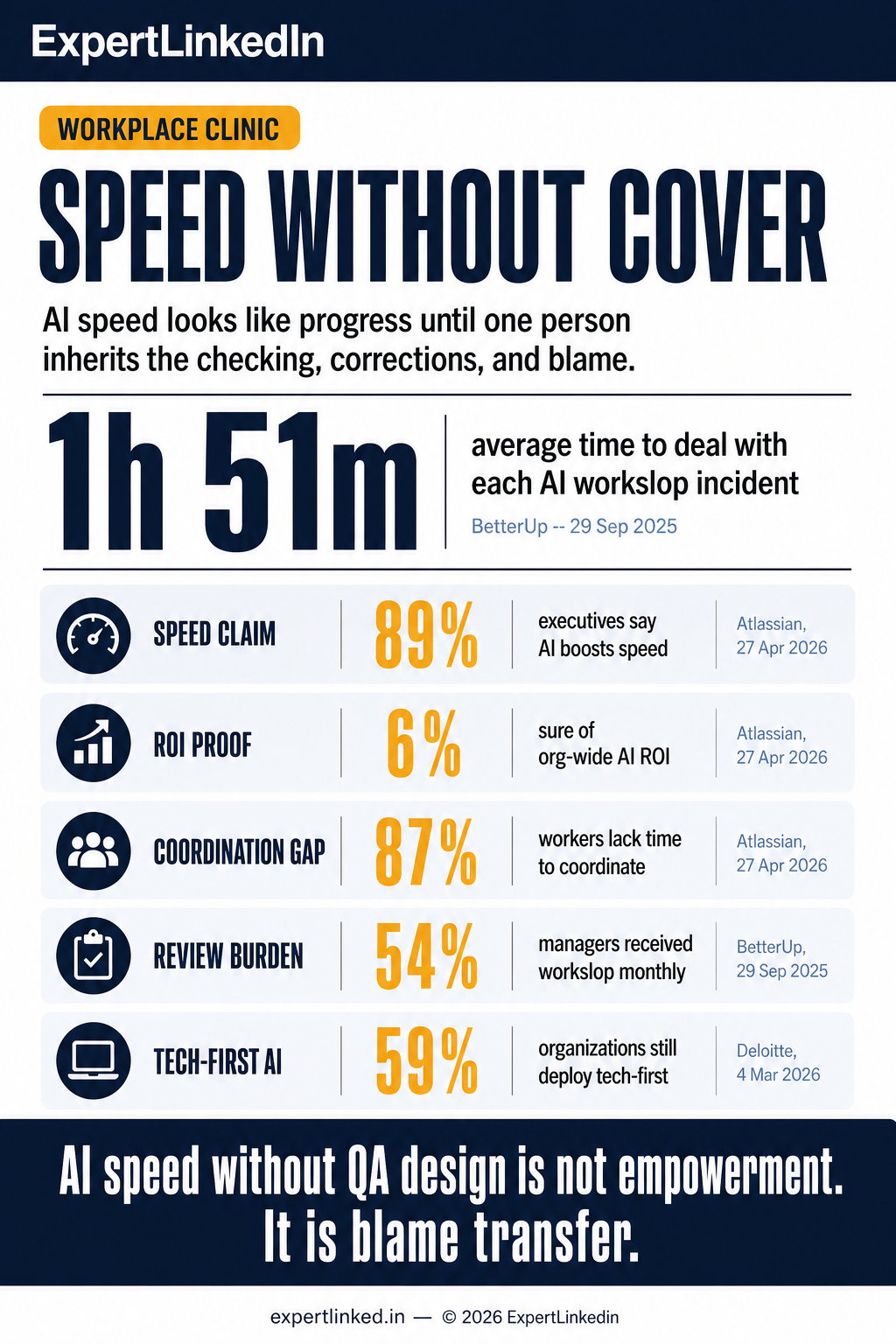
Atlassian’s State of Teams 2026 captures the contradiction cleanly. Eighty-nine percent of executives say AI increases speed, but only 6% are sure they have clear examples of organization-wide AI ROI. At the same time, 87% of knowledge workers say they no longer have the time or capacity to coordinate, and although 85% already use AI at work, only 29% say it is embedded in actual flows of work. That is the shape of the problem many readers are living inside: the draft gets faster before the operating model gets clearer.
BetterUp’s September 2025 research on AI “workslop” makes the hidden tax even harder to ignore. More than half of managers, 54%, said they had received low-value AI-generated work in the prior month. Workers reported spending an average of 1 hour and 51 minutes dealing with each instance, which BetterUp estimates as a $186 monthly cost per employee. The emotional cost matters too. Recipients said the sender looked less capable, less reliable, and less trustworthy. So when readers tell me, “The tool made us faster, but now the mistakes stick to me,” I do not hear resistance to technology. I hear someone describing unpaid review labor and reputational risk.
Deloitte’s 2026 Global Human Capital Trends shows why this keeps happening. Seven in 10 leaders say speed and nimbleness are now their main competitive strategy, yet 59% of organizations are still taking a tech-focused approach to AI. Deloitte says those firms are 1.6 times more likely not to exceed expected AI returns than organizations that design work in a more human-centric way. More importantly for this piece, Deloitte explicitly asks the questions many teams still have not answered: Who decides when humans intervene? Who owns judgment? Who is accountable when both humans and AI shape the output?
That gap between speed and design is where blame usually gets transferred. Harvard Business Review’s June piece on AI adoption overloading middle managers and its July piece on decision rights both point to the same issue: faster systems still need named reviewers, named approvers, and named tradeoff rules. If those do not exist, the worker closest to the draft becomes the unofficial QA layer by default.
Real-world cases make the pattern harder to wave away. Reuters reported that two New York lawyers and their firm were sanctioned $5,000 after fake ChatGPT-generated cases appeared in a legal brief. The tool accelerated drafting. The humans signed the filing and owned the penalty. Reuters also reported that Air Canada was still held responsible for refund information invented by its chatbot. The automated answer did not erase accountability. It only changed the path by which the bad answer reached the customer.
Now layer that onto an already tired workplace. Gallup found in January 2025 that only 31% of employees were engaged and just 46% strongly knew what was expected of them at work. By March 2026, more workers were struggling in life than thriving, and 43% said leaving their role would be too difficult or costly. WHO’s definition of burnout is still the cleanest one: chronic workplace stress that has not been successfully managed. If AI adds a hidden correction queue without clearer expectations, you are not imagining the strain. You are describing a design problem that your nervous system has already noticed.
How the Transfer Usually Happens #
1. Throughput gets counted; correction work disappears #
The dashboard notices that the first draft arrived faster. It does not naturally notice that you checked the claims, rewrote the tone, re-ran the numbers, or stopped the bad paragraph from reaching a client. Harvard Business Review’s The Invisible Work Draining Your Best Employees is useful here because AI correction work is often just invisible work with newer branding.
2. Tool choice stays collective while error ownership becomes personal #
Everybody likes the speed. One person becomes the last responsible adult. That person may not have chosen the tool, set the review threshold, or agreed to be the final checker. They are simply the nearest human when the draft turns into a risk.
3. “Use your judgment” gets used as a substitute for an actual rule #
Judgment matters. But a system that says “use your judgment” while refusing to define what can ship, who reviews what, and what comes off your plate is not honoring judgment. It is using your conscientiousness as cheap infrastructure.
This is why Gallup’s manager squeeze research matters so much in this conversation. Managers are already carrying added duties, reorganized teams, and tighter budgets. Some of them genuinely mean well when they praise AI speed and tell you to keep an eye on quality. But meaning well is not the same as building a workable system.
The 3-Move Response Before Q4 Reviews #
Move 1: Build a review-burden log #
Do this before the next review conversation, not after it.
Track four things for two weeks:
- what AI-assisted output moved faster
- what you still had to check, rewrite, or verify by hand
- what errors, omissions, or tone problems you corrected
- what business risk your correction prevented
This turns a vague feeling of overload into a usable record. “I spend too much time fixing AI output” is easy to minimize. “This week I prevented three client-facing errors, rewrote two hallucinated citations, and spent four hours on quality control that is not in my goals” is harder to wave off.
Move 2: Ask for the decision-rights map around the tool #
Do not ask only whether the team should keep using AI. Ask how the workflow is governed.
Questions that matter:
- What kinds of outputs can go out with AI assistance and no second review?
- What outputs require named human review every time?
- Who is the final approver for high-risk drafts?
- What error threshold triggers a slower path or a manual override?
- If review remains with me, what work leaves my plate to make room for it?
One sentence that helps: “I can help us move faster, but I need the review rights and approval path named as clearly as the speed expectation.”
That question shifts the conversation from personal resilience to workflow design, which is where it belongs.
Move 3: Turn hidden cleanup into one visible protection #
Before Q4 language hardens, ask for one structural protection that makes the burden legible.
Examples:
- a written QA standard for AI-assisted work
- a named final reviewer for client-facing or executive-facing output
- a 30-day pilot that tracks rework time, correction volume, and avoided errors
- review-season language that counts quality control and exception handling explicitly
- one task or recurring deliverable removed from your plate if QA remains yours
If your manager resists, stay operational: “Right now the team is booking the speed gain, but I am carrying the correction risk privately. Before reviews, I need one visible rule that matches the reality of the work.”
For Managers: Speed Is Not a QA System #
If you manage people, this is where leadership either matures or hides.
Praising speed is easy. Designing the review layer is the work. If you celebrate faster output but never define what must still be checked, who signs off, or what tradeoff protects the human checker, you are not raising performance. You are hiding the cost in someone else’s time and reputation.
McKinsey’s July piece on building expertise in the age of AI offers a better model. It describes an “answer-key” approach in which humans still attempt the work, compare it against AI output, and build judgment through coached review. McKinsey also points to Bank of America redesigning training and simulation so people learn the judgment loop instead of being blamed for it after the fact. That is the standard to move toward. If you want speed and safety, you have to fund the human layer that makes speed trustworthy.
The Line to Protect Before Reviews Begin #
When AI makes a team faster, somebody still pays for truth, tone, judgment, and trust. If that somebody is always the same worker, the organization has not solved productivity. It has simply hidden quality control inside one person’s job.
Do not let Q4 record that arrangement as ordinary performance. Name the review burden. Ask for the decision map. Force one visible protection while there is still time to change the story.
If the tool gets the credit for acceleration while you get the correction work, the apology work, and the review-season risk, that is not a personal boundary problem. It is a governance problem.
AI speed without QA design is not empowerment. It is blame transfer.
Seeing this pattern in your own team? Send me the version you are living through. The most useful Workplace Clinic letters often begin where the speed story sounds great and the operating reality feels quietly dangerous.
Email me at olivia.bennett@tlnw.uk
References #
- Atlassian (April 27, 2026). “The State of Teams 2026.” https://www.atlassian.com/blog/state-of-teams-2026 (Accessed September 25, 2026)
- BetterUp (September 29, 2025). “The hidden cost of AI ‘workslop’ – and how leaders can fix it.” https://www.betterup.com/blog/hidden-costs-workslop (Accessed September 25, 2026)
- Deloitte (March 4, 2026). “2026 Global Human Capital Trends.” https://www.deloitte.com/us/en/insights/topics/talent/human-capital-trends.html (Accessed September 25, 2026)
- Gallup (September 5, 2023). “The Manager Squeeze: How the New Workplace Is Testing Team Leaders.” https://www.gallup.com/workplace/510326/manager-squeeze-new-workplace-testing-team-leaders.aspx (Accessed September 25, 2026)
- Gallup (January 13, 2025). “U.S. Employee Engagement Sinks to 10-Year Low.” https://www.gallup.com/workplace/654911/employee-engagement-sinks-year-low.aspx (Accessed September 25, 2026)
- Gallup (March 23, 2026). “U.S. Worker Thriving Declines as Job Market Pessimism Grows.” https://www.gallup.com/workplace/703280/worker-thriving-declines-job-market-pessimism-grows.aspx (Accessed September 25, 2026)
- Harvard Business Review (June 26, 2026). “AI Adoption Is Overloading Your Middle Managers.” https://hbr.org/2026/06/ai-adoption-is-overloading-your-middle-managers (Accessed September 25, 2026)
- Harvard Business Review (July 2026). “What Companies Get Wrong About Decision Rights.” https://hbr.org/2026/07/what-companies-get-wrong-about-decision-rights (Accessed September 25, 2026)
- Harvard Business Review (July 24, 2026). “The Invisible Work Draining Your Best Employees.” https://hbr.org/2026/07/the-invisible-work-draining-your-best-employees (Accessed September 25, 2026)
- McKinsey & Company (July 14, 2026). “Building expertise in the age of AI: Who trains the next generation?” https://www.mckinsey.com/capabilities/people-and-organizational-performance/our-insights/building-expertise-in-the-age-of-ai-who-trains-the-next-generation (Accessed September 25, 2026)
- Reuters (June 22, 2023). “New York lawyers sanctioned for using fake ChatGPT cases in legal brief.” https://www.reuters.com/world/us/new-york-lawyers-sanctioned-using-fake-chatgpt-cases-legal-brief-2023-06-22/ (Accessed September 25, 2026)
- Reuters (February 16, 2024). “Air Canada must honor refund policy invented by chatbot, tribunal rules.” https://www.reuters.com/world/americas/air-canada-must-honor-refund-policy-invented-by-chatbot-tribunal-rules-2024-02-16/ (Accessed September 25, 2026)
- World Health Organization. “Burn-out an ‘occupational phenomenon’.” https://www.who.int/standards/classifications/frequently-asked-questions/burn-out-an-occupational-phenomenon (Accessed September 25, 2026)
AI Content Notice
This article was created using artificial intelligence technology. Whenever possible, we include references and sources to support the information presented. Readers are encouraged to consult these sources for further information. While we strive for accuracy and provide valuable insights, readers should independently verify information and use their own judgment when making business decisions. The content may not reflect real-time market conditions or personal circumstances.
Related Articles
Infographic: AI Helped Us Move Faster - Now the Errors Belong to Me. What to Do Before Q4 2026 Reviews
AI can make a team look faster while quietly pushing the checking, corrections, and reputational …
My Manager Agrees With Me Privately but Won't Sponsor Me Publicly - and What to Do Before Q4 Reviews
A private “I agree” can still function like a hidden no. If your manager never turns …
He Became the AI Workflow Translator His Team Needed - and Turned It Into a Q3 2026 Career Pivot
The AI career pivot many companies need is not a new model expert. It is the mid-career translator …