What the September 2026 Jobs Report Says About Q4 Hiring - Before the Fed Minutes Land

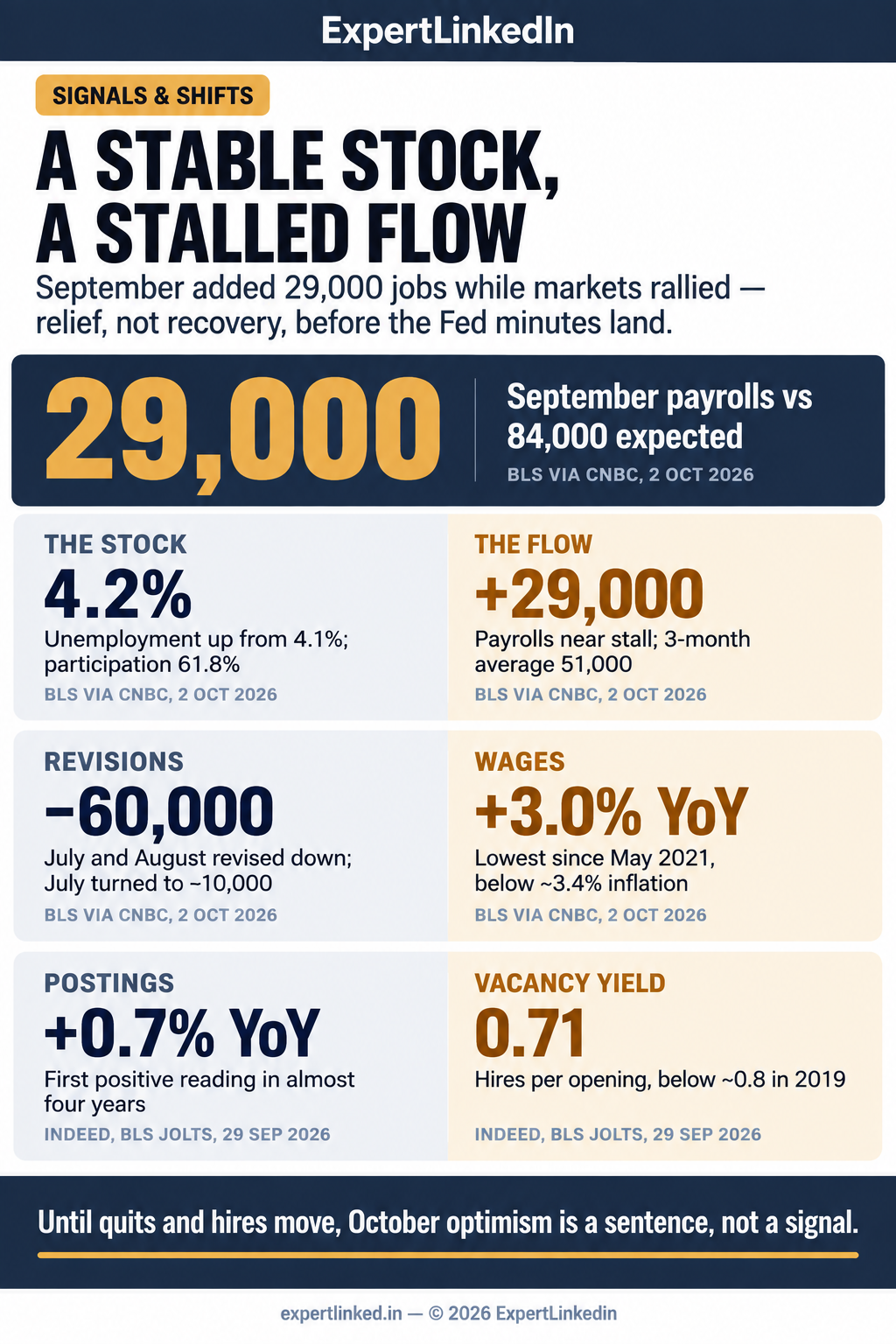
The September jobs report added 29,000 jobs. The stock market went up.
That sentence is the whole week, and it should bother you. A labor market that nearly stopped adding jobs was repackaged within minutes as good news — not because hiring improved, but because traders decided the weak print made another rate hike less likely. That is relief, not recovery. For anyone planning a Q4 move, the gap between those two words is everything.
Here is the number that should lead the story. Nonfarm payrolls rose just 29,000 in September, against the 84,000 economists expected (CNBC, October 2, 2026). The unemployment rate ticked up to 4.2% from 4.1%. And the revisions were worse than the headline: July’s gain was rewritten as a loss of 10,000, and July and August together were revised down by 60,000. The three-month average is now 51,000 jobs a month (Indeed Hiring Lab, October 2, 2026).

The headline looks stable. The flow does not. #
There is a calm paragraph inside that same report, and you will hear it repeated all month. Household employment rose 406,000. The labor force grew by 485,000. The participation rate climbed to 61.8%, its highest since May. The broadest unemployment measure, U-6, fell to 7.6%, its lowest since January 2025.
That is the split that defines this quarter: a stable-looking stock and a stalled flow.
The distinction matters more than it sounds. The unemployment rate is a stock — how many people are jobless right now. Payroll growth, hires, and quits are flows — whether the market is actually moving people into new work. A low unemployment rate can survive even when the flow freezes, and it survives most easily when the labor force itself is shrinking. The U.S. labor force has contracted by roughly 700,000 workers in 2026 — only the second time since 1948 that has happened outside a recession (Indeed Hiring Lab, September 24, 2026). Fewer people looking makes it mathematically harder for the unemployment rate to rise. A calm 4.2% is not proof of strength. It can be arithmetic.
Wages tell the same story. Average hourly earnings rose just 0.1% for the month and 3.0% year over year — the slowest since May 2021. Set against inflation still running near 3.4%, that is a pay cut in real terms (CNBC, October 2, 2026). “Wage growth fell to a new five-year low and is being wiped out entirely by inflation,” Navy Federal’s chief economist put it. That is the squeeze the headline skips.
This is the same divergence I flagged on September 9: better payroll tone is not the same thing as a genuine reopening in mobility. Three weeks later, the tone improved again. The mobility did not.
Intent is not movement. #
The most important sentence in this month’s data came from Indeed’s economists describing the whole labor market: employers “keep signaling that they want more workers, but they just aren’t hiring them.”
Look at where the optimism is coming from. Indeed’s job-postings index broke above zero, year over year, for the first time in almost four years, and 60% of occupational sectors are now above their pre-pandemic baseline (Indeed Hiring Lab, September 24, 2026). ADP reported +90,000 private jobs on September 30 — a “strong report,” in its chief economist’s words — just two days before the official count printed 29,000 (CNBC, September 30, 2026).
Now look at what is actually moving. The August JOLTS report, which landed at the end of September, showed the same split that has held all year: hires drifting sideways near 3.2%, quits stuck at 1.9%, layoffs at 1.0%, and the vacancy yield — hires per opening, the honest measure of how fast roles actually get filled — down to 0.71, below the roughly 0.8 of a normal 2019 market (Indeed Hiring Lab, September 29, 2026).
Openings are a signal of intent. An intention is not a hire.
I made this distinction on September 30: what looks like a reopening is often employer planning energy, not worker bargaining power. The September jobs report is the latest confirmation. Postings can rise, ADP can surprise, and executives can sound confident, all while the number of people actually starting new jobs stays flat.
The Fed minutes land today — and they reveal the real debate. #
On September 16, the Federal Reserve raised its benchmark rate by a quarter point to 3.75%–4.00% — its first hike in more than three years — and made clear that inflation, not unemployment, was the problem it intended to fix (Federal Reserve, September 16, 2026). The projections were blunt: 16 of 18 committee members expected at least one more hike before year-end (Indeed Hiring Lab, September 16, 2026). August’s surprisingly strong payrolls had given the Fed cover to tighten.
Then September printed 29,000. Within hours, the market-implied odds of the Fed holding at its October 27–28 meeting jumped to 82.8%, and the next hike got pushed to December (CNBC, October 2, 2026). One Wall Street economist called the number “the nail in the coffin for an October hike.”
So the minutes from the September 15–16 meeting — due this afternoon, not yet public as I write — matter less for what they say about October than for what they say about the committee’s tolerance. The Fed’s preferred inflation gauge showed core prices still running at 3.0% and headline at 3.4% in August, both well above the 2% target (BEA, September 30, 2026; CNBC, September 30, 2026). The minutes will show how a committee that hiked into a softening labor market is weighing that trade: how much cooling it will accept to finish the inflation job, and how divided it is about it. Chair Kevin Warsh was already facing a split committee — July’s vote ran 9–3.
I said on September 23 that hires and quits are the two signals to trust more than Fed tone, and that has not changed. The minutes can explain the past. They cannot open a door that the hiring flow has kept shut.
What this means for your Q4. #
Strip it down to four checks, and you can ignore most of the noise this month.
- Payrolls. A month below roughly 100,000 is a labor market that is holding, not expanding. September was 29,000.
- Quits. At 1.9%, workers are still not voting with their feet. The pre-pandemic norm was about 2.3%. Until that moves, the outside market is not genuinely open.
- Wages versus inflation. At 3.0% against 3.4% inflation, real pay is falling. That weakens the case for a big external move and strengthens the case for the internal one.
- Earnings language. When companies talk productivity and margins but not headcount, the plan is to do more with the people they already have. That is a Q4 posture, not a hiring boom.
In plain English: the tone of the market improved faster than the market itself. That is exactly the setup the 90-day Q4 positioning plan called “retrench” — keep building quietly, protect your evidence, and treat your current role as the asset to defend. A soft-but-stable market is not a reason to panic, and it is not a reason to sprint. It is a reason to be selective.
The good news is real where it exists. Postings are up year over year. Layoffs are low. GDP is solid — the Commerce Department revised first- and second-quarter growth up to 2.5% and 2.2%, and the Atlanta Fed is tracking the third quarter near 3.7% (CNBC, October 2, 2026). None of that is nothing. But all of it is the stock of an economy that is still large and still functioning. The flow — the part that decides whether you can change jobs, negotiate up, or move on — is what is stuck.
So watch the minutes this afternoon. Then watch the one number that actually answers the question: not whether the Fed sounds reassuring, but whether quits and hires finally start to move. Until they do, October optimism is a sentence, not a signal.
What is your read on the September report — real stabilization, or a stall dressed up as one? I want to hear the counterargument.
Email me at jackson.rodriguez@tlnw.uk
References
-
Bureau of Labor Statistics. The Employment Situation — September 2026. Released October 2, 2026. https://www.bls.gov/news.release/empsit.nr0.htm
-
Bureau of Labor Statistics. Job Openings and Labor Turnover Survey — August 2026. Released September 29, 2026. https://www.bls.gov/news.release/jolts.nr0.htm
-
Bureau of Economic Analysis. Personal Income and Outlays, August 2026 (BEA 26-43). Released September 30, 2026. https://www.bea.gov/news/2026/personal-income-and-outlays-august-2026
-
Federal Reserve. FOMC Statement, September 16, 2026. https://www.federalreserve.gov/newsevents/pressreleases/monetary20260916a.htm
-
Federal Reserve. 2026 FOMC Meeting Calendar and Minutes Release Schedule. Accessed October 7, 2026. https://www.federalreserve.gov/monetarypolicy/fomccalendars.htm
-
Indeed Hiring Lab (October 2, 2026). “September 2026 Jobs Report: Steadiness Without a Spark.” https://hiringlab.indeed.com/2026/10/02/september-2026-jobs-report-steadiness-without-a-spark/
-
Indeed Hiring Lab (September 29, 2026). “August 2026 JOLTS Report: Little Change, Limited Dynamism.” https://hiringlab.indeed.com/2026/09/29/august-2026-jolts-report/
-
Indeed Hiring Lab (September 24, 2026). “US Labor Market Snapshot — September 2026.” https://hiringlab.indeed.com/2026/09/24/us-labor-market-snapshot-september-2026/
-
Indeed Hiring Lab (September 16, 2026). “September 2026 FOMC Reaction: Walking a Fine Line.” https://hiringlab.indeed.com/2026/09/16/september-2026-fomc-reaction-walking-a-fine-line/
-
CNBC (October 2, 2026). “Labor market faltered in September as jobs increased by just 29,000, unemployment rate rose to 4.2%.” https://www.cnbc.com/2026/10/02/jobs-report-september-2026.html
-
CNBC (September 30, 2026). “Fed’s preferred gauge showed core inflation at 3.0% in August, much lighter than expected.” https://www.cnbc.com/2026/09/30/feds-preferred-gauge-showed-core-inflation-at-3point0percent-in-august-much-lighter-than-expected.html
-
CNBC (September 30, 2026). “Private sector jobs rose by 90,000 in September, better than expected, ADP reports.” https://www.cnbc.com/2026/09/30/private-sector-jobs-rose-by-90000-in-september-better-than-expected-adp-reports.html
-
CNBC (September 14, 2026). “Counting the votes: Warsh faces a tough battle as Fed girds for expected rate hike.” https://www.cnbc.com/2026/09/14/counting-the-votes-warsh-faces-tough-battle-as-fed-girds-for-expected-rate-hike.html
-
ExpertLinked (September 9, 2026). “What the August 2026 Jobs Report and July JOLTS Still Don’t Say About Fall Hiring.” https://expertlinked.in/posts/2026-09-09-what-the-august-2026-jobs-report-and-july-jolts-still-dont-say-about-fall-hiring/
-
ExpertLinked (September 23, 2026). “What the September 2026 Fed Decision Says About Q4 Hiring Plans - and the 2 Signals Workers Should Trust More.” https://expertlinked.in/posts/2026-09-23-september-2026-fed-decision/
-
ExpertLinked (September 28, 2026). “The 90-Day Q4 2026 Career Positioning Plan for a Market That Still Isn’t Fully Open.” https://expertlinked.in/posts/2026-09-28-the-90-day-q4-2026-career-positioning-plan-for-a-market-that-still-isnt-fully-open/
-
ExpertLinked (September 30, 2026). “What the August 2026 JOLTS Report Says About Q4 Hiring - Before the September PCE Data Lands.” https://expertlinked.in/posts/2026-09-30-what-the-august-2026-jolts-report-says-about-q4-hiring-before-the-september-pce-data-lands/
AI Content Notice
This article was created using artificial intelligence technology. Whenever possible, we include references and sources to support the information presented. Readers are encouraged to consult these sources for further information. While we strive for accuracy and provide valuable insights, readers should independently verify information and use their own judgment when making business decisions. The content may not reflect real-time market conditions or personal circumstances.
Related Articles
Infographic: What the September 2026 Jobs Report Says About Q4 Hiring - Before the Fed Minutes Land
September added just 29,000 jobs — and stocks rallied. The report looked stable in the stock and …
Infographic: What the June Jobs Report Actually Said About the Hires Rate — and Whether the Stillness Broke
The stillness didn’t break — the ‘strong spring’ was revised down by 74,000 jobs, …
What the June Jobs Report Actually Said About the Hires Rate — and Whether the Stillness Broke
The stillness didn’t break — the ‘strong spring’ was revised down by 74,000 jobs, …