What the September 2026 Fed Decision Says About Q4 Hiring Plans - and the 2 Signals Workers Should Trust More

The Fed raised rates last week. If you only read the headline, that sounds like straightforward bad news for Q4 hiring.
The stranger read is closer to the truth. A hawkish Fed decision can still improve CEO tone, because it tells employers the economy looks solid enough to take more restraint. Workers should not confuse that better tone with broader permission. The two signals that still matter more are the hires rate and quits behavior.

What the Fed actually told decision-makers #
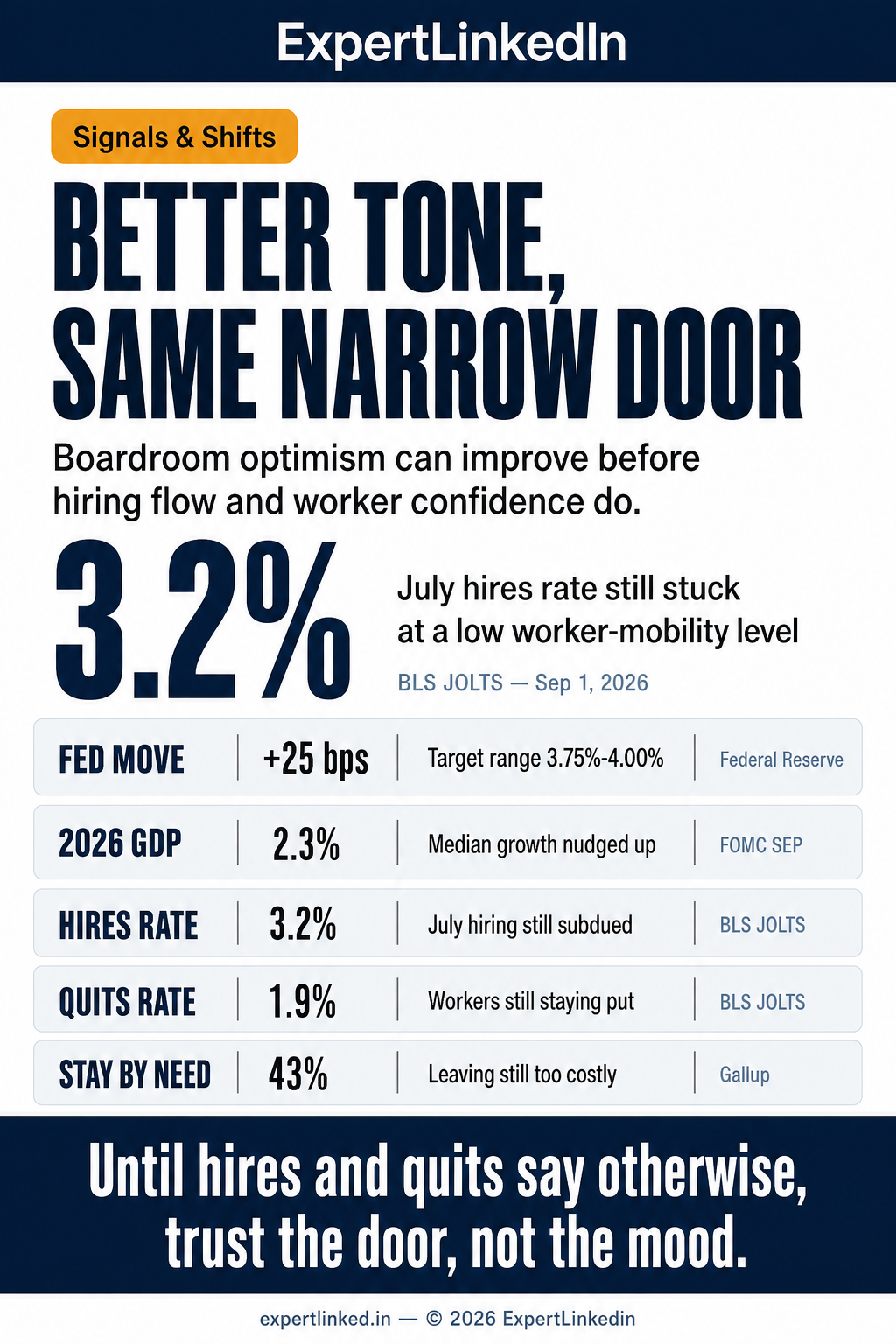
On September 16, the Federal Open Market Committee raised the target range for the federal funds rate by 25 basis points to 3.75% to 4.00% in a unanimous vote (Federal Reserve, September 16, 2026). On the surface, that looks like a clean argument for caution.
But the statement language matters more than the quarter-point on its own. The Committee said economic activity is “expanding at a solid pace,” domestic spending has been resilient, productivity growth is strong, capital investment is robust, and job gains have kept pace with the workforce while unemployment has changed little (Federal Reserve, September 16, 2026). That is not recession language. It is resilience language.
For management teams doing Q4 planning, that distinction is the whole game. A Fed that is still tightening because the economy looks sturdy is sending a very different signal than a Fed that is easing because something broke. It does not mean companies will hire broadly. It does mean many leaders will feel more comfortable saying the environment is manageable.
That is the first trap for workers reading the moment. Better tone is not the same as a wider door.
The projections say “selective confidence,” not “reopening” #
The Summary of Economic Projections sharpened that read.
Relative to June, the Fed nudged its 2026 median GDP projection up to 2.3% from 2.2%, lowered its 2026 unemployment projection to 4.1% from 4.3%, raised its 2026 PCE inflation projection to 3.7% from 3.6%, raised core PCE to 3.4% from 3.3%, and lifted its median year-end federal funds rate projection to 4.1% from 3.8% (Federal Reserve SEP, September 16, 2026).
That combination is more revealing than the rate move itself. The Fed is effectively saying: growth is holding up better than we thought, labor is not deteriorating as fast as we thought, inflation is still too sticky, and policy needs to stay tighter for longer.
For Q4 hiring plans, that usually translates into a specific employer behavior: fill the roles you can justify, keep capital investment moving, and stay selective everywhere else.
Indeed’s August 2026 labor-market outlook survey points in the same direction. Economists surveyed by Indeed expected the Job Postings Index to be about 0.5% below its June level by the end of September and about 1.4% lower by June 2027, while unemployment drifts only modestly higher to about 4.4% by year-end (Indeed Hiring Lab, August 5, 2026). That is not a collapse. It is a cooled market that stays selective.
This is why the September 16 decision can improve boardroom confidence without producing anything that workers should mistake for a reopening. Employers may feel they have a clearer macro backdrop. That does not mean they suddenly have broader appetite for risk.
The two signals workers should trust more #
I made one version of this distinction in What the August 2026 Jobs Report and July JOLTS Still Don’t Say About Fall Hiring. I made another in What the August 2026 CPI Report Says Before the September Fed Decision - and Why Hiring Still Looks Selective. The post-decision version is even simpler.
If you are a worker trying to read Q4 honestly, trust two flow signals more than commentary.
1. The hires rate #
July JOLTS showed 5.1 million hires and a hires rate of 3.2%, down from 3.4% in June. Professional and business services alone posted 188,000 fewer hires month over month (U.S. Bureau of Labor Statistics, September 1, 2026; Indeed Hiring Lab, September 1, 2026).
That matters more than a better tone because the hires rate is the cleanest measure of whether employers are actually opening the front door faster.
Yes, August payrolls were better than July. Total nonfarm employment rose 162,000, the unemployment rate held at 4.1%, and June plus July revisions added another 55,000 jobs to the recent trend (U.S. Bureau of Labor Statistics, September 4, 2026). That is real improvement on the stock side.
It still does not settle the flow question.
Payroll counts tell you net jobs were added. The hires rate tells you whether employers are actually bringing people in more freely. A market can add jobs and still keep hiring tight. That is why the next release that matters for workers is not another round of CEO commentary. It is August JOLTS on September 29. If the hires rate is still sitting around 3.2%, Q4 will remain narrower than the tone suggests.
2. Quits behavior #
The quits rate was 1.9% in July, while layoffs held at 1.0% (BLS JOLTS, September 1, 2026). That combination still describes a low-hire, low-fire labor market. Employers are not shedding labor aggressively, but workers are not voting with their feet either.
Gallup’s March 2026 worker data explains why. Only 28% of workers said it was a good time to find a quality job, and 43% said they remain in their current role mainly because leaving would be too difficult or costly (Gallup, March 23, 2026).
That is the worker-side confidence signal the Fed decision cannot manufacture.
Workers quit when they believe the expected gain from moving beats the cost of staying. If executives sound calmer after the Fed decision but workers still do not quit more often, the market has not reopened in the way workers actually need. It has only become easier to narrate.
What this says about Q4 hiring plans #
The uncomfortable truth is that the September Fed decision may help hiring plans before it helps hiring freedom.
Management teams got a macro message of resilience. Growth still looks decent. Spending still looks resilient. Productivity and capital investment still look strong. That can absolutely make leaders more comfortable approving must-have hires, preserving project budgets, and talking more confidently about Q4.
But the first beneficiaries of that better tone are unlikely to be broad swaths of mid-level white-collar hiring. More likely, the early improvement shows up in narrow, senior, AI-complementary, or hard-to-replace roles. Indeed’s July analysis of AI-exposed occupations found that 71% of the rebound in software-development postings between May 2025 and May 2026 came from senior roles, and 37% came from roles mentioning AI in the title (Indeed Hiring Lab, July 8, 2026). BLS’s new AI exposure framework explicitly warns that exposure is not a jobs forecast, which is the right caution here too (U.S. Bureau of Labor Statistics, August 27, 2026).
Still, the directional point holds. When employer confidence improves in a cooled market, hiring tends to reopen first where the business case is easiest to defend. That is selective expansion, not broad permission.
So the clean read for September 23 is this: the Fed decision says Q4 hiring plans may sound better than they did in August. It does not yet say workers should trust that tone more than the flow data.
Boardroom confidence can arrive before worker mobility does. Until hires and quits say otherwise, trust the door, not the mood.
Reading a better Q4 tone inside a still-selective market? I would like to hear what hiring feels like in your sector right now.
Email me at jackson.rodriguez@tlnw.uk
References #
- Federal Reserve. (September 16, 2026). “Federal Reserve issues FOMC statement.” https://www.federalreserve.gov/newsevents/pressreleases/monetary20260916a.htm (Accessed September 23, 2026)
- Federal Reserve. (September 16, 2026). “Summary of Economic Projections.” https://www.federalreserve.gov/monetarypolicy/fomcprojtabl20260916.htm (Accessed September 23, 2026)
- Federal Reserve. (Accessed September 23, 2026). “FOMC meeting calendars and information.” https://www.federalreserve.gov/monetarypolicy/fomccalendars.htm (Accessed September 23, 2026)
- Gallup. (March 23, 2026). “U.S. Worker Thriving Declines as Job Market Pessimism Grows.” https://www.gallup.com/workplace/703280/worker-thriving-declines-job-market-pessimism-grows.aspx (Accessed September 23, 2026)
- Indeed Hiring Lab. (July 8, 2026). “AI and Job Postings: From Destruction to Creation?” https://hiringlab.indeed.com/2026/07/08/ai-and-job-postings-from-destruction-to-creation/ (Accessed September 23, 2026)
- Indeed Hiring Lab. (August 5, 2026). “Economists Expect a Cooled Labor Market and an AI Reshuffling of White-Collar Work.” https://hiringlab.indeed.com/2026/08/05/q2-labor-market-outlook-survey/ (Accessed September 23, 2026)
- Indeed Hiring Lab. (September 1, 2026). “July 2026 JOLTS Report: Little Changed. Again.” https://hiringlab.indeed.com/2026/09/01/july-2026-jolts-report-little-changed-again/ (Accessed September 23, 2026)
- U.S. Bureau of Labor Statistics. (August 27, 2026). “Artificial Intelligence (AI) exposure categories.” https://www.bls.gov/emp/publications/ai-exposure-categories.htm (Accessed September 23, 2026)
- U.S. Bureau of Labor Statistics. (September 1, 2026). “Job Openings and Labor Turnover - July 2026.” https://www.bls.gov/news.release/jolts.nr0.htm (Accessed September 23, 2026)
- U.S. Bureau of Labor Statistics. (September 4, 2026). “The Employment Situation - August 2026.” https://www.bls.gov/news.release/empsit.nr0.htm (Accessed September 23, 2026)
- U.S. Bureau of Labor Statistics. (September 11, 2026). “Consumer Price Index Summary - August 2026.” https://www.bls.gov/news.release/cpi.nr0.htm (Accessed September 23, 2026)
- U.S. Bureau of Labor Statistics. (September 11, 2026). “Real Earnings - August 2026.” https://www.bls.gov/news.release/realer.nr0.htm (Accessed September 23, 2026)
AI Content Notice
This article was created using artificial intelligence technology. Whenever possible, we include references and sources to support the information presented. Readers are encouraged to consult these sources for further information. While we strive for accuracy and provide valuable insights, readers should independently verify information and use their own judgment when making business decisions. The content may not reflect real-time market conditions or personal circumstances.
Related Articles
Infographic: What the September 2026 Fed Decision Says About Q4 Hiring Plans - and the 2 Signals Workers Should Trust More
The Fed’s September 2026 decision may improve CEO tone before it improves worker mobility. For …
What the July 2026 JOLTS Report Says About the September Jobs Report - and the 1 Signal to Watch
July JOLTS kept the labor market in low-hire, low-fire mode. The number to ignore is the headline; …
What the June 2026 JOLTS Report Says About Q3 Mobility - Before the August Jobs Report Lands
Openings held steady, but quits and hires didn’t move—the gap between those signals is where …