What the August 2026 JOLTS Report Says About Q4 Hiring - Before the September PCE Data Lands


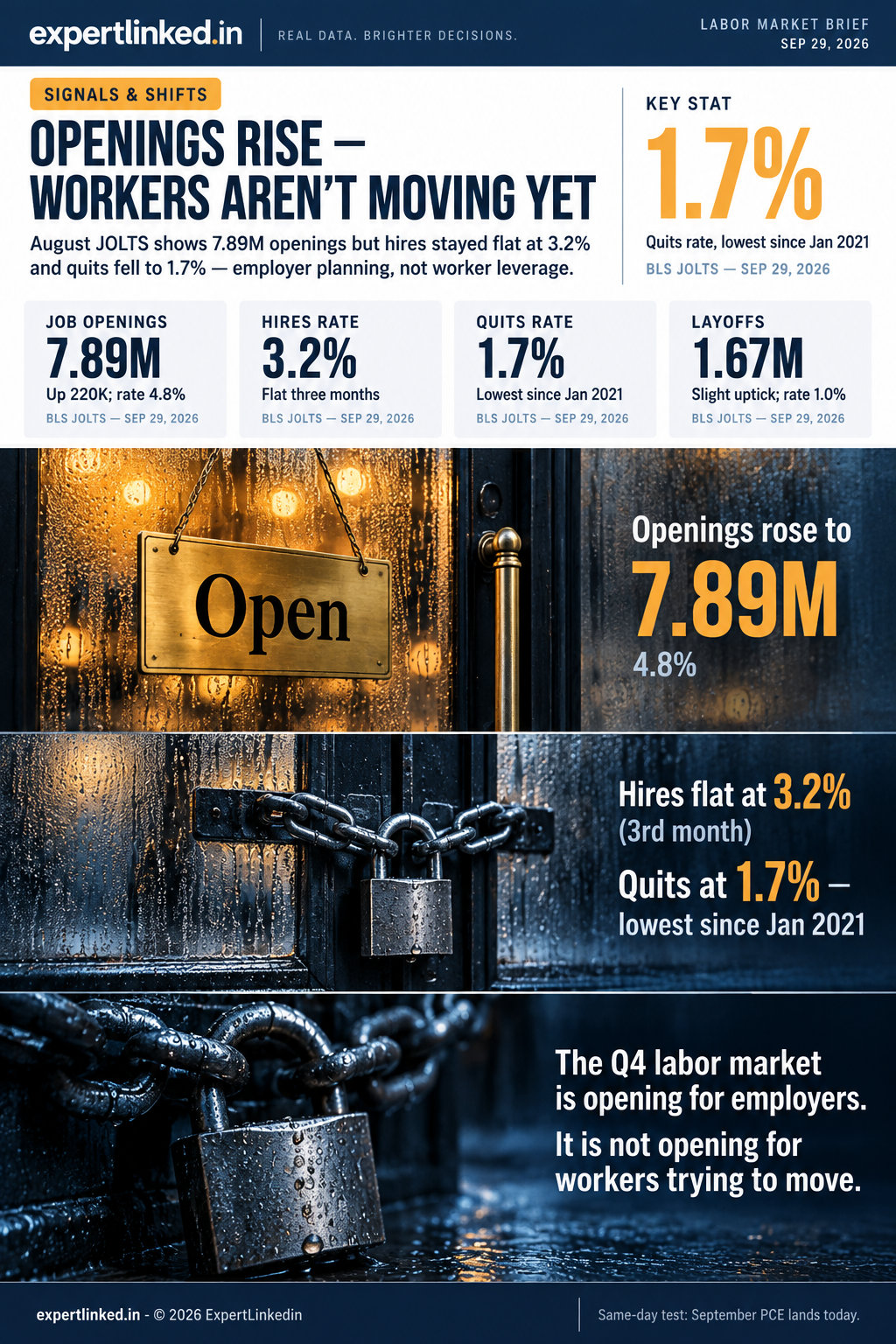
The August JOLTS openings headline landed at 7.89M. That is the number that will lead every morning note, every wire alert, every strategy email titled “Q4 hiring is back.”
It is true — and incomplete.
Openings rose by 220,000. The rate ticked up to 4.8% from 4.6% in July. On its own, that is a legitimate improvement. Employers listed more roles in August than any month since early 2025. If you only read the headline, the story writes itself: Q4 hiring is back, October is the month to make a move.
Read one level deeper and the story inverts.
Hires — the number of people who actually started jobs in August — came in at 5.19 million. The hires rate stayed flat at 3.2% for the third consecutive month. Employer intent rose. Employer execution did not.
And quits dropped to 2.63 million. The quits rate fell to 1.7%.
That number — 1.7% — is the lowest since January 2021. Let that land. We are five years past the pandemic lockdowns, and workers are voluntarily leaving their jobs at the same rate they were during the period when leaving a job meant walking into an epidemiological unknown. Pre-pandemic, the quits rate averaged around 2.3%. The current rate is not a normalization. It is a retreat.
This is the triple-divergence that matters: openings up, hires flat, quits collapsing. Three data points that cannot coexist in a genuinely reopening labor market. They can only coexist in a market where employers are window-shopping — listing roles, testing the talent pool, extending offer timelines — while workers are anchoring in place by necessity, not by choice.
The August payroll story fits on the same page.
Nonfarm payrolls added 142,000. Unemployment sits at 4.3%. Average hourly earnings rose 3.6% year over year. June and July were revised up by a combined 21,000. That is a solid report. But the payroll data measures how many people are employed — not how many are moving between jobs. The flow beneath the stock is the relevant signal, and the flow has been frozen for three months.
Indeed’s Job Postings Index reinforces the narrowing. Postings sit 12.8% above the pre-pandemic baseline, but the trend is downward. Wage growth has cooled to 3.4% year over year. Software, finance, and marketing postings are running 10–15% below year-ago levels. The white-collar knowledge economy is not seeing a Q4 surge. It is seeing selective reopening concentrated in senior roles and AI-tagged titles: 71% of the software-development posting rebound came from senior roles, and 37% from roles mentioning AI in the title.
The Fed already flagged the quits rate.
At the September 16–17 FOMC meeting, the committee raised rates 25 basis points to 3.75%–4.00%. The SEP raised GDP to 2.3%, lowered unemployment to 4.1%, and raised PCE inflation to 3.7%. But the most important moment came in the press conference: Powell explicitly named the quits rate as a signal the Fed watches for labor market slack.
The Fed is reading the same data. If quits stay this low, the committee reads that as a sign that workers lack the leverage to push wages higher — which reduces the urgency to hold rates elevated. Market pricing currently reflects one Q4 cut if the data cooperates. The quits rate is a key variable in that calculation.
Gallup tells us how workers feel — and the answer is not good.
The Worker Confidence Index dropped to +32, down from +38. That is the lowest since late 2024. Only 28% of workers say now is a good time to find a quality job. And 43% say they stay because the cost and risk of leaving is too high — not because they want to be there.
This is the behavioral texture behind the 1.7% quits rate. Workers are not staying because they are satisfied. They are staying because the expected gain from leaving — adjusted for risk, relocation cost, and the narrowing of attractive outside options — no longer clears the threshold. The market looks open from the outside. Once you are inside it, the calculus is different.
Employers are cautious, too.
The Beige Book, released September 3, told the same story from the other side. Six of twelve Fed districts reported modest or slight labor market tightening. Only two reported broad-based hiring pickup. Employers described “extending offer timelines and narrowing candidate pools.” That phrasing captures the asymmetry: employers feel good enough to list roles but not urgent enough to fill them quickly.
The October optimism that we are about to see — the “Q4 hiring season” framing, the budget-cycle energy, the strategic-planning confidence — is real. But it is employer-side real. Companies feel better about their own capacity to hire selectively. That is not the same as workers having the leverage to quit, negotiate, or switch jobs. Those are two different labor markets living inside the same data release.
The same-day test changes the interpretive frame.
Today, September 30, the BEA releases the August Personal Income and Outlays report (including core PCE inflation), the Q2 GDP Third Estimate, and the Corporate Profits report. We are publishing this article before those numbers land.
This is the interpretive key. If core PCE runs hot — above the expected ~2.5% — the Fed’s path to a Q4 cut narrows. A hot PCE reading would make the JOLTS openings gain read as noise: employers planning against a higher-for-longer rate environment, listing roles they have no urgency to fill. If core PCE runs cool, the Q4 easing narrative strengthens, and the openings number becomes a more credible leading indicator for actual hiring in Q4.
The JOLTS report and the PCE report land on the same day. That is not a coincidence. It is the macro calendar forcing a decision. By the end of today, the market will have a much clearer answer to the question this article poses.
This is the confirmation piece in a sequence I have been writing all quarter.
On August 26, I wrote about three signals that would shape September hiring — hires, quits, and sector breadth. On September 9, I argued that the payroll-flow divergence meant better employment numbers did not equal genuine reopening in mobility. On September 23, after the Fed decision, I said hires and quits were the two signals to trust more than the Fed’s tone.
Today, both signals landed. Hires flatlined for a third month. Quits hit a five-year low. The flow never improved. The verdict is in.
You do not need to have read those pieces to follow this one. But if you have been tracking this sequence, today is the day the thesis is confirmed.
Here is what I think the next three months look like.
October will bring a burst of employer-side confidence. Budgets reset. Headcount plans circulate. The openings headline provides cover for optimistic Q4 narratives. That confidence is real — but it is management-side real. It will not translate into broad-based worker mobility unless hires and quits start moving.
If they do not — if the September JOLTS report (due late October) shows quits recovering to 1.9% or 2.0% — the August dip may prove transitory. I will update the read when that data lands. But one month at 1.7% is a signal. The burden of proof is now on the recovery.
For mid-career professionals reading this: the Q4 labor market is opening for employers. It is not opening for workers trying to move. If you are planning a career move, the tactical advice from my September 28 piece still holds. But the macro read is clearer than it was two weeks ago. The fall window is narrower. The leverage sits on the employer side. Plan accordingly.
The provocative question that keeps me up.
What happens if the quits rate stays at 1.7% — or goes lower — through Q4? That would mean workers are not just anchoring in place temporarily. It would mean the structural calculus of job mobility has fundamentally shifted. The “great resignation” era gave way to a “great stay” that is not contentment — it is constraint. And if constraint is the new baseline, the entire framework for how we think about wage growth, bargaining power, and career mobility needs to be rebuilt.
I will be watching the September JOLTS and the October payroll data to answer that question. Today’s PCE data will tell us whether the rate environment validates or undercuts the employer-side optimism. But the deeper question — whether workers will ever regain the mobility they had in 2021–2023 — is still open.
If you have thoughts on this — data I missed, a read I got wrong, a counterargument I should consider — I want to hear them. Email me at jackson.rodriguez@tlnw.uk.
References
-
Bureau of Labor Statistics. Job Openings and Labor Turnover Survey (JOLTS), August 2026. Released September 29, 2026. https://www.bls.gov/news.release/jolts.nr0.htm
-
Bureau of Labor Statistics. Employment Situation Summary, August 2026. Released September 4, 2026. https://www.bls.gov/news.release/empsit.nr0.htm
-
Indeed Hiring Lab. Job Postings Index and Wage Growth Tracker. Accessed September 30, 2026. https://hiringlab.indeed.com/
-
Indeed Hiring Lab. “AI and Job Postings: From Destruction to Creation.” July 8, 2026. https://hiringlab.indeed.com/2026/07/08/ai-and-job-postings-from-destruction-to-creation/
-
Indeed Hiring Lab. “Q2 Labor Market Outlook Survey.” August 5, 2026. https://hiringlab.indeed.com/2026/08/05/q2-labor-market-outlook-survey/
-
Federal Reserve. FOMC Statement and Press Conference, September 16–17, 2026. https://www.federalreserve.gov/newsevents/pressreleases/monetary20260916a.htm
-
Federal Reserve. Beige Book, September 3, 2026. https://www.federalreserve.gov/monetarypolicy/beigebook202609.htm
-
Gallup. Worker Confidence Index and Job Market Perceptions. Accessed September 30, 2026. https://www.gallup.com/workplace/703280/worker-thriving-declines-job-market-pessimism-grows.aspx
-
Bureau of Labor Statistics. “AI Exposure Categories.” August 27, 2026. https://www.bls.gov/emp/publications/ai-exposure-categories.htm
-
Bureau of Economic Analysis. Personal Income and Outlays, August 2026; GDP Third Estimate, Q2 2026; Corporate Profits. Release date: September 30, 2026. https://www.bea.gov/
AI Content Notice
This article was created using artificial intelligence technology. Whenever possible, we include references and sources to support the information presented. Readers are encouraged to consult these sources for further information. While we strive for accuracy and provide valuable insights, readers should independently verify information and use their own judgment when making business decisions. The content may not reflect real-time market conditions or personal circumstances.
Related Articles
Infographic: What the August 2026 JOLTS Report Says About Q4 Hiring - Before the September PCE Data Lands
Three-panel infographic showing the triple-divergence: openings up, hires flat, quits collapsing. …
Infographic: What the September 2026 Fed Decision Says About Q4 Hiring Plans - and the 2 Signals Workers Should Trust More
The Fed’s September 2026 decision may improve CEO tone before it improves worker mobility. For …
What the September 2026 Fed Decision Says About Q4 Hiring Plans - and the 2 Signals Workers Should Trust More
The Fed’s September 2026 decision may improve CEO tone before it improves worker mobility. For …