Record Festive GMV, Thinner Seller Margin: The Bill Behind India's Q4 2026 Shopping Boom

Ten days before Diwali, a seller I have worked with for six years is sitting on the best numbers of his life and the worst cash position of his life. Both are true. Both come from the same season.
His dashboard says growth. His payout statement says something else — a number he has to reconcile line by line before he can tell his wife whether this Diwali was good. That gap is the story nobody published in October.
Give the record its due #
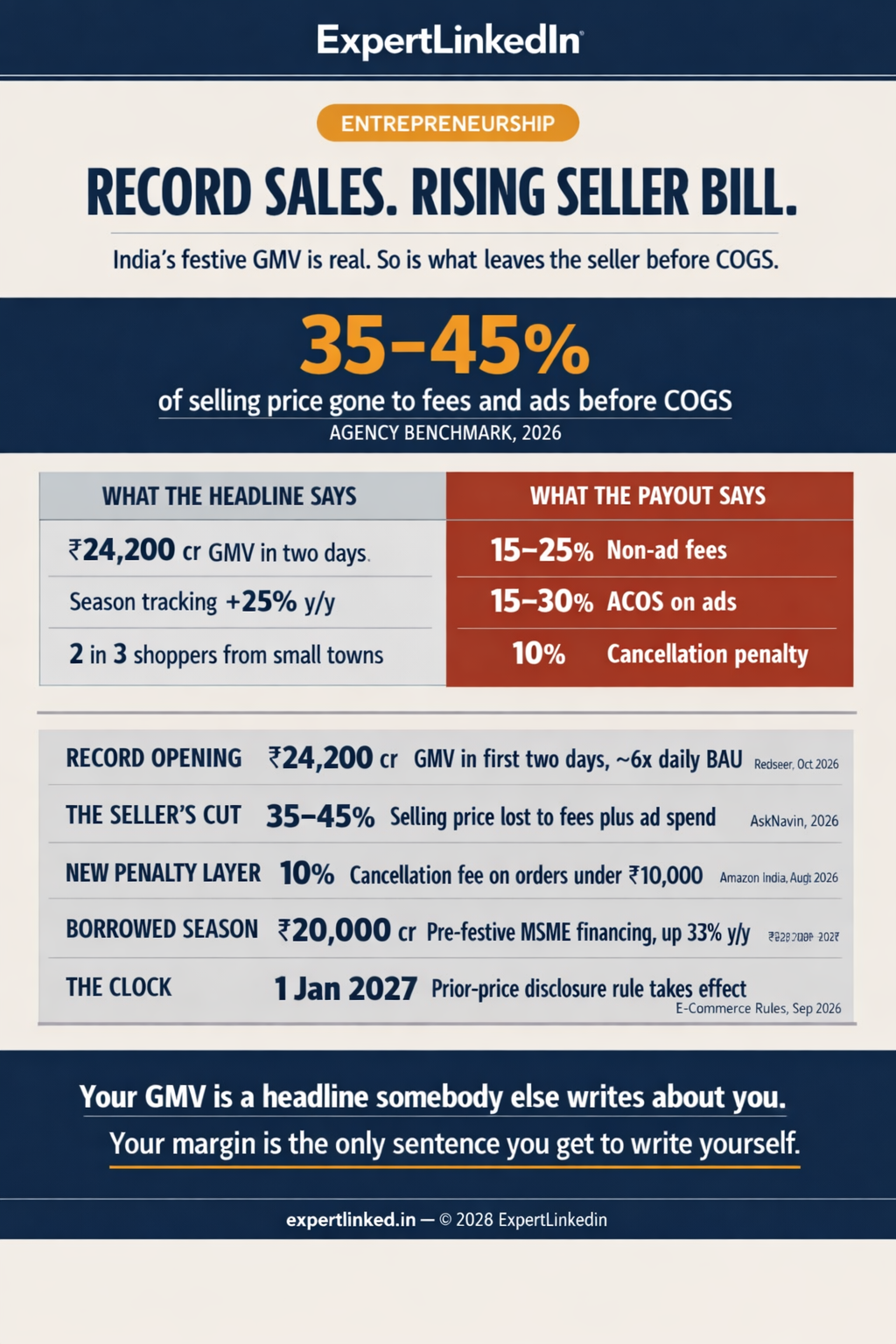
The boom is not fake. Redseer put the first two days of festive e-commerce at Rs 24,200 crore in GMV across Amazon, Flipkart, Meesho and Ajio — about six times the daily business-as-usual rate, from 8–9 crore orders placed by 6–6.5 crore shoppers. Two-thirds came from Tier 2 cities and rural India. Redseer expects the season to grow roughly 25% year on year to $15–16 billion.
Platform numbers rhyme: Amazon India reported orders more than doubling in the first twelve hours of the Great Indian Festival and 440 million-plus visits on October 8–9, 72% from outside the top nine metros. Flipkart’s Big Billion Days closed with orders, units and buyers up 20–22%, 60% of buyers from Tier 2 and beyond.
That broadening is the India I grew up in finally getting served, and I will not be cynical about it.
But GMV is a measurement, not a verdict. So let us open the payout statement.
The bill, itemised #
Every marketplace order settles through a stack with five layers.
Visible fees. Referral commission, closing fee, shipping and handling, plus 18% GST on the fees themselves. Agency benchmarking puts this non-advertising stack at 15–25% of selling price for mid-priced goods.
The ad layer. A 15–30% ACOS is normal now, not exceptional. Add it to the fees and a seller hands back 35–45% of the selling price before COGS, packaging, warehousing or their own margin. On a Rs 799 order, one worked example lands at roughly Rs 251 in fees — 31% — before the product cost.
The penalty layer, which is new. From August 17, 2026, Amazon changed how it calculates cancellation fees for Easy Ship and Self Ship sellers: no longer category-based, but a percentage of order value — 10% below Rs 10,000, 8% up to Rs 50,000, 5% up to Rs 1 lakh, 2% above, plus GST. Closing fees rose Rs 1–3 from September 7. Flipkart added a three-tier penalty from August 23: Rs 30 for a missed dispatch date, Rs 60 for a cancellation, Rs 90 for a delay that becomes one.
One seller told PTI the fee gap between an Amazon-fulfilled and an Easy Ship seller can reach Rs 45 per unit on the same order. Another named what the policy quietly assumes: sometimes the pickup executive does not arrive, and the seller wears it.
Returns. Indian fashion runs COD returns near 24% against about 10% prepaid — and in the festive quarter that COD figure has been benchmarked as high as 58%. A bounced Rs 1,000 COD order costs roughly Rs 200–250 in reverse freight, inspection and refund processing. The Tier 2 and Tier 3 surge in every growth headline is also, mechanically, a COD surge.
Financing. Stocking the season is not free. Pre-festive MSME financing crossed Rs 20,000 crore, up 33% — and as of October 28 it had already exceeded the entire previous festive period, with peak still ahead. Micro-MSME financing more than doubled.
Read the five layers together and the arithmetic is no longer mysterious. A brand can grow 25% and lose money on every incremental rupee of that growth. That is not a paradox. That is a P&L.

The cleverest thing this year was not a fee hike #
In March 2026, Amazon India did something genuinely generous. It expanded zero referral fees to 12.5 crore products under Rs 1,000 across 1,800-plus categories, cut Easy Ship fees more than 20% for items under Rs 300, and let multi-unit boxes save up to 90% on the second unit. A Rs 999 jewellery set fell from Rs 324 in total fees to Rs 100.
Five months later, cancellation and closing fees went up.
Look at what moved. The fee you can see, compare and shop for went down. The fee that is conditional, unpredictable, and triggered by an operational failure you often do not control went up. That is not a price rise. It is a restructuring of risk — the way an insurer cuts your premium while raising your deductible.
Founders benchmark the wrong number, because the wrong number is the one on the public fee schedule. The right number only shows up when something breaks at 11 p.m. in a demand spike.
And one seller’s quote in Amazon’s own March release explains the whole mechanism: after the fee cut, the savings “let us crank up ad spends like never before.” The platform gave back margin and took back attention. That is the treadmill, described honestly by a man standing on it.
The shopper became an arbitrageur #
The demand side was re-engineered too, and most brand teams are a year behind it.
CashKaro’s October 7–12 data shows average order value jumping from Rs 1,100 to Rs 2,639, with GMV about eighteen times a comparable period. The featured deals included a laptop at 52% off MRP, sneakers at 70% off, a flagship phone at 50% off.
And the shopper stacks: sale discount, plus a 10% bank instant discount, plus cashback, plus — for the organised — affiliate commission earned by passing the deal onward. Mint is precise about the mechanic: platforms can use bank-funded or bank-linked offers to improve the checkout price without deeper markdowns.
Fairness matters: sellers do not fund the entire stack. The bank co-funds its discount; the affiliate is paid from commission the ecosystem carries. Sellers fund the layers that carry risk and buy visibility — ads, penalties, returns, unsold stock. Everyone else funds the layer that makes the banner look generous.
One more detail worth noticing: mobile phones are the largest GMV category at 38–40% of value, and they declined 7–10% year on year in that dataset, because memory costs pushed prices up and upgrade cycles stretched. The record is being carried by fashion, beauty, grocery and discount depth, not by the premium gadget cycle that used to do the lifting.
Fast delivery, slow math #
Quick commerce is where the arithmetic gets sharpest. Commission is quoted at 15–25%, but commission is the smallest number on the page. Add listing fees and ad spend that is now effectively mandatory for visibility, and brands commonly hand over 30–35% of selling price before COGS. Ad rates rose more than 40% in a year and roughly double in festive windows. And return-to-vendor means the platform carries no inventory risk: unsold stock comes back to the brand, packaging and all, after the brand has paid for listing and ads.
The rule of thumb: you need about 70% gross margin before the channel works. Which is why beauty thrives there and mass-market packaged food cannot.
It is not only a tax. Sauce.vc’s Manu Chandra makes the fair case — clearer inventory visibility and faster payments than traditional distribution are real gains that never appear in a margin sheet. Veeba’s Viraj Bahl offers the sanest framing I have heard: quick commerce is 8–10% of his revenue against 70%-plus from general trade, and fast-channel earnings should fund scale in the margin-rich one. That is not a channel strategy; it is a cash-flow strategy, the only kind that survives.
The platforms are squeezed too #
Here is the number that reframes everything. Swiggy reported a net loss of Rs 922 crore for Q2 FY27, with Instamart’s adjusted EBITDA loss at Rs 895 crore. In the same quarter, Eternal’s Blinkit posted an adjusted EBITDA profit of Rs 184 crore. One winner, one still bleeding, same category, same quarter.
When the platform’s own P&L is that thin, only a few levers move: ad load, commission, penalties, listing fees. The seller’s rising cost is not a plot. It is the mirror image of the platform’s search for profit — which is why commerce and retail media is now the fastest-growing line in Indian advertising: Rs 11,500 crore this festive season, up 27%, with quick-commerce ads alone at Rs 2,200 crore, up 50%.
The money is not leaving advertising. It is moving inside the transaction, onto a shelf the seller rents. Globally it is the same direction: stacking fees, fulfilment, surcharges and ads, Marketplace Pulse data puts Amazon’s effective cut at up to about 50% of seller revenue in the US. India’s 35–45% is the local version of a global take rate. Waiting for platforms to get kinder is not a plan.
The clock nobody set their watch to #
From January 1, 2027, India’s amended e-commerce rules require that where a price reduction is announced, both the reduced price and the “prior price” are displayed — defined as the lowest price in the thirty days before. Sponsored listings must be clearly disclosed. Search manipulation is banned. Platforms must run a yearly dark-pattern self-audit and display a compliance certificate.
Sit with that. The 50%-to-70%-off banner, stacked with a bank offer and cashback, is about to become a compliance question rather than a marketing one. The last festive season run under the old discount-theatre rules is the one happening right now.
And the uncomfortable part: for many small sellers, deep discounting is not a trick. It is the only demand lever they can afford, because they cannot outbid a funded brand on ads. A rule that protects the shopper from fake urgency also removes the small seller’s cheapest route to a first order — in the same quarter that ad, penalty and financing costs rise.
That is not an argument against the rules. It is an argument for doing the math before January, not after.
What I would do in the next sixty days #
- Build the settlement sheet before the growth plan. One row per SKU: price, referral, closing, shipping, GST on fees, ad spend, expected penalty weighted by your real cancellation rate, expected return/RTO cost, financing cost. The last three decide the year.
- Find your true floor price, not your MRP. If 60% off plus a 10% card offer is what clears stock, that is your honest price. The MRP is decoration with an expiry date of December 31, 2026.
- Sort channels by who carries the risk. Where you own the customer, accept lower volume. Where you rent visibility, rent deliberately — with a budget cap and an exit date.
- Price the tail risk explicitly. A 5% dispatch-failure rate against a 10% penalty belongs in your unit economics, not in a bad month you explain later.
- Fix attribution before spend. A 5% ad-efficiency win is noise if two or three points are leaking through penalties, RTO and unsold stock.
GMV is what they say about you #
I have spent fifteen years telling Indian businesses to go where the customer is. I still believe it. But I have watched too many good owners leave a record festive season with a hero’s dashboard and a borrower’s bank statement.
The demand is real. The growth is real. But growth is not earning, and a platform’s record is not a founder’s profit.
Your GMV is a headline somebody else writes about you. Your margin is the only sentence you get to write yourself. Write it in October, in numbers, before the Diwali lights go up — because in January the rules change, and the sellers who survive that change will be the ones who already knew what every order cost them.
If you run a business through this festive crush, I want to see your settlement sheet — especially the line that surprised you most. Which number did you only discover after the season ended?
Email me at raj.sharma@tlnw.uk
References #
- BW CFO World (October 2026). “E-commerce festive sales touch Rs 24,000 crore in first two days: Redseer.” https://www.bwcfoworld.com/article/e-commerce-festive-sales-touch-rs-24-000-cr-in-first-two-days-redseer-628031 (Accessed October 29, 2026)
- BW Disrupt (October 2026). “India’s e-commerce platforms see festive surge as Amazon, Flipkart, Meesho and Myntra report strong demand.” https://www.bwdisrupt.com/article/india-s-e-commerce-platforms-see-festive-surge-as-amazon-flipkart-meesho-and-myntra-report-strong-demand-630798 (Accessed October 29, 2026)
- ET Online (October 15, 2026). “CashKaro data shows how Indians shopped this festive season.” https://economictimes.indiatimes.com/small-biz/sme-sector/cashkaro-data-shows-how-indians-shopped-this-festive-season-smarter-savings-and-growth-beyond-metros/articleshow/134957539.cms (Accessed October 29, 2026)
- NDTV / PTI (August 25, 2026). “Amazon, Flipkart revise seller fees, penalties ahead of festival season.” https://www.ndtv.com/india-news/amazon-flipkart-revise-seller-fees-penalties-ahead-of-festival-season-11955140 (Accessed October 29, 2026)
- Amazon India Press Center (March 2, 2026). “Amazon announces zero referral fees on over 12.5 crore products.” https://press.aboutamazon.com/in/2026/3/amazon-announces-zero-referral-fees-on-over-12-5-crore-products-sellers-to-save-up-to-70-in-fees (Accessed October 29, 2026)
- AskNavin Digital (2026). “Amazon & Flipkart seller fees 2026: the real payout cost.” https://asknavindigital.com/blog/amazon-flipkart-seller-payout-breakdown-2026 (Accessed October 29, 2026)
- Angadi Labs (2026). “India fashion ecommerce benchmarks 2026: AOV, UPT, returns, COD and RTO.” https://www.angadilabs.com/blog/india-fashion-ecommerce-benchmarks (Accessed October 29, 2026)
- StartupTalky (2026). “What quick commerce actually costs D2C brands.” https://startuptalky.com/quick-commerce-real-cost-d2c-brands/ (Accessed October 29, 2026)
- BW Businessworld (October 2026). “MSME festive financing rises 33% to Rs 20,000 crore in 2026.” https://www.businessworld.in/article/msme-festive-financing-rises-33-to-rs-20-000-cr-in-2026-report-630905 (Accessed October 29, 2026)
- ET BrandEquity / Datum Intelligence (2026). “Festive ad spend in India set to reach INR 60,000-62,000 crore in 2026.” https://brandequity.economictimes.indiatimes.com/news/the-pitch-report/festive-ad-spend-in-india-set-to-reach-inr-60000-62000-crore-in-2026-datum-intelligence/134434624 (Accessed October 29, 2026)
- MediaNama (September 2026). “India amends e-commerce rules on dark patterns, pricing.” https://www.medianama.com/2026/09/223-consumer-protection-ecommerce-amendment-rules-2026/ (Accessed October 29, 2026)
- Livemint (October 2026). “How Flipkart and Amazon are shaping India’s banking partnerships for 10% festive discounts.” https://www.livemint.com/technology/axis-and-icici-vs-sbi-how-flipkart-and-amazon-are-shaping-india-s-banking-partnerships-for-10-festive-discounts-11790782352409.html (Accessed October 29, 2026)
- Univest (October 23, 2026). “Swiggy vs Eternal shares compared after Q2 FY27 results.” https://univest.in/blogs/swiggy-vs-eternal-shares-compared-which-is-better-stock-after-q2-fy27-results-blinkit-instamart-food-delivery-valuation (Accessed October 29, 2026)
- ZonGuru (2026). “What percentage does Amazon take? The real numbers for 2026.” https://www.zonguru.com/blog/what-percentage-does-amazon-take (Accessed October 29, 2026)
AI Content Notice
This article was created using artificial intelligence technology. Whenever possible, we include references and sources to support the information presented. Readers are encouraged to consult these sources for further information. While we strive for accuracy and provide valuable insights, readers should independently verify information and use their own judgment when making business decisions. The content may not reflect real-time market conditions or personal circumstances.
Related Articles
Infographic: Record Festive GMV, Thinner Seller Margin: The Bill Behind India's Q4 2026 Shopping Boom
India’s festive season is heading for record GMV — Rs 24,200 crore in two days. But 35-45% of …
Your Next Customer Is a Machine: India's Q4 2026 Agent-Readiness Test
Your next customer’s shortlist is now written by an AI agent. India’s festive season is …
Infographic: Your Next Customer Is a Machine: India's Q4 2026 Agent-Readiness Test
Your next customer’s shortlist is now written by an AI agent. India’s festive season is …