What Early Q3 2026 Earnings Calls Say About AI Productivity - and Why Q4 Hiring Plans Still Look Narrow

On the first wave of Q3 2026 earnings calls, one word is doing a lot of quiet work: productivity. It is the word executives reach for when they describe the future — and the same word they use to explain why the next hire can wait.
The first wave landed this month: the big banks on October 13–16, TSMC on October 15, and Netflix in mid-to-late October. The mega-cap platform companies — Microsoft, Alphabet, Meta, Amazon — report next week, so the picture is partial. But the pattern is already legible, and it is the same one this column has tracked since September: the language of confidence is improving faster than the movement underneath it. Today adds a wage test in the same breath. The BLS usual weekly earnings release for the third quarter lands this morning and measures the median full-time worker — not the average.

The productivity sentence is a forecast wearing the grammar of a result #
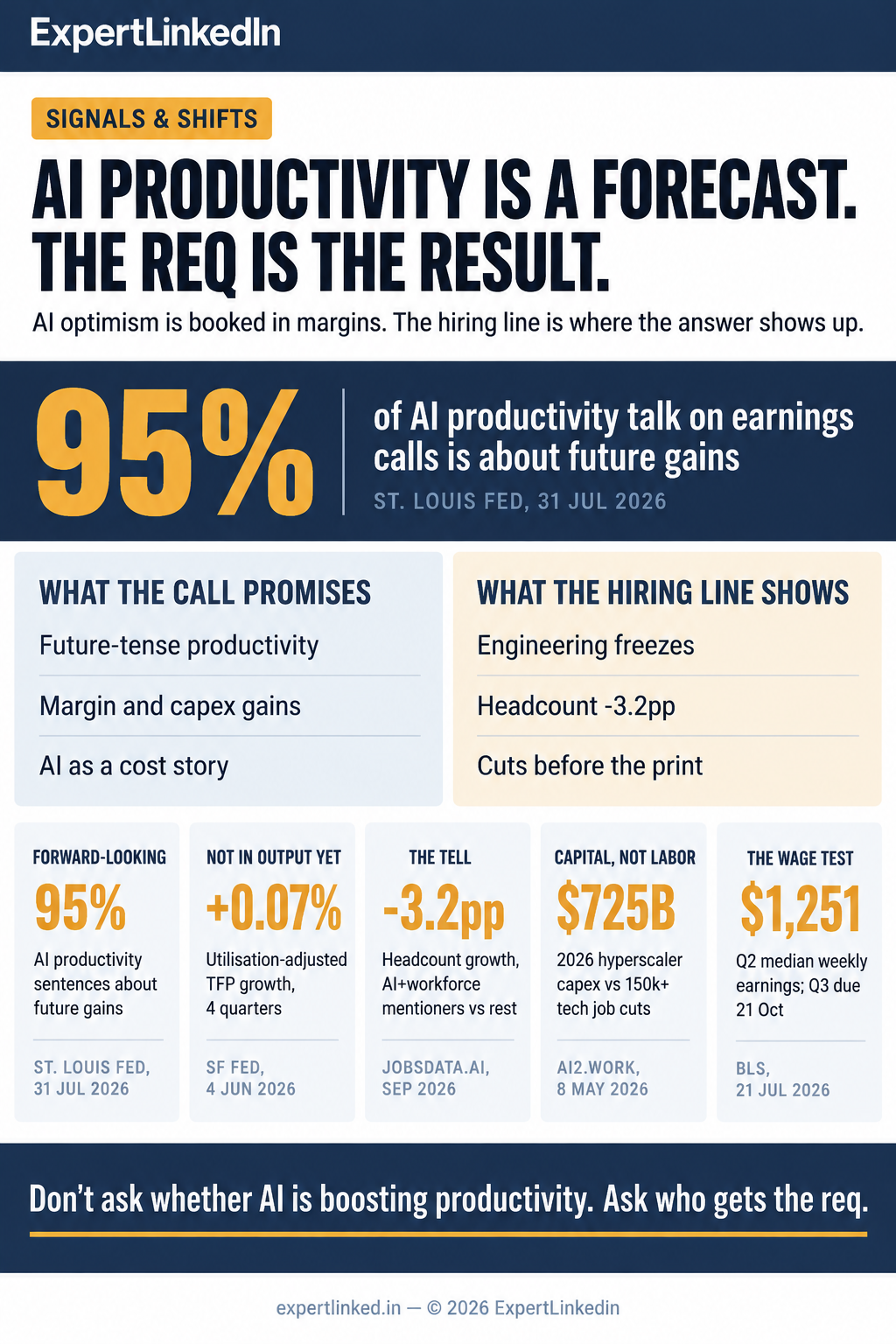
Start with the sharpest finding of the season, and it is not from a company — it is from the transcript data. The Federal Reserve Bank of St. Louis analysed roughly 490,000 earnings-call transcripts from about 5,200 publicly traded U.S. firms and found that about 95% of AI-related productivity sentences describe future gains, versus roughly three-fourths of non-AI productivity sentences (St. Louis Fed, July 31, 2026). Even more one-sided: 95% of AI-related sentences frame productivity as increasing, with almost no one describing a decline. The share of productivity talk that mentions AI climbed to about 15% by the end of 2025.
Now put the aggregate beside it. Utilization-adjusted total factor productivity — the broadest measure of how efficiently the economy turns inputs into output — grew just 0.07% over the four quarters ending in the first quarter of 2026 (San Francisco Fed, June 4, 2026 update).
That gap is the first thing to carry into any Q4 conversation. On a 2026 earnings call, “productivity” is mostly a forecast wearing the grammar of a result. And the forecast is nearly universal: the term “AI” appeared on 67% of S&P 500 earnings calls in the second quarter — the third straight quarter above 65%, against a ten-year average of 114 calls (FactSet, September 18, 2026). Saying “we’re using AI” is now table stakes. What matters is what the sentence does next.
Where the money actually went — the margin line and the capex line #
Look at the follow-through, and the optimism narrows into something more specific. The four largest hyperscalers committed roughly $725 billion in capital spending for 2026 — nearly triple their 2024 total — while more than 150,000 tech jobs were cut across 500-plus companies since January (AI2.work, May 8, 2026). Meta’s Mark Zuckerberg framed it without much decoration: “We basically have two major cost centers in the company: compute infrastructure and people-oriented things.”
The earnings-call research points the same direction. Companies that discuss AI in the context of workforce, efficiency, or restructuring go on to post headcount growth 3.2 percentage points lower than companies that don’t — about 67% of the S&P 500 now mentions AI this way (JobsData.ai, through September 2026).
Some executives make the mechanism explicit. Salesforce’s Marc Benioff said AI coding tools lifted developer productivity by more than 20%, and the company paused new engineering hires for the year — while increasing sales hiring by roughly 20% (SalesforceBen). Snap says AI now generates more than 65% of its new code. Netflix confirmed cuts of about 1,000 roles — 6% of its workforce — days before a print framed around AI production and “efficiency,” with co-CEO Ted Sarandos telling analysts the company was building “a more focused, more efficient company” (Next Edition, October 16, 2026).
This is the season’s uncomfortable truth, and it is worth saying plainly: when a company says productivity is up and hiring in the same function is flat, the productivity claim is doing the work of a headcount decision. It is not a business result you can borrow as a reason to expect a broader opening. It is a staffing policy signal.
A three-lane test for any productivity claim #
You don’t need a transcript subscription. You need one question: does the productivity sentence have a headcount number attached — and is it in the same function? That gives three lanes.
- Lane 1 — future tense, no headcount number. “AI is making our teams more productive.” There is no req, no role, no promotion path. Treat it as marketing. It is a forecast, not leverage for you.
- Lane 2 — productivity plus a freeze or cut in the same function. Salesforce engineering; Snap’s code; Netflix production. Treat this as a substitution signal for that role family. The gain is real, and it is being paid for by the next hire.
- Lane 3 — productivity plus new roles or mobility elsewhere. Hiring redirected toward sales; a capacity build-out in research and cloud. This is the only version that widens the map. It is also the rarest.
Most of this season’s commentary sits in Lane 1. A meaningful slice is Lane 2. Lane 3 is what to look for next week, when the platform companies report.
The counterweight: the paychecks #
Here is why the margin story is not the whole story — and why today’s release matters. September’s real average hourly earnings fell 0.7% over the year, because nominal pay rose 3.0% while consumer prices rose 3.7% (BLS Real Earnings, released October 14, 2026). Real weekly earnings slipped 0.1% over the year. Nominal raises kept arriving; purchasing power did not.
The same-day test is a different measure. The usual weekly earnings release tracks the median full-time worker — in the second quarter, $1,251 a week, up 4.6% year over year against CPI’s 3.9%, a modest real gain (BLS, July 21, 2026). Median and average can tell different stories, and both are true: the typical worker has been holding roughly even, while the average earnings series — where the mix shift lives — is where the squeeze concentrates.
So watch three things when the third-quarter number lands: whether the median clears $1,251, whether its year-over-year change stays ahead of inflation, and whether the share of full-time workers holds. The read for Q4 is simple. If the median keeps pace while the average slips, the productivity gains are landing upstream — at the margin and in the capex line — and not in the pay most readers actually take home. That is the same split I flagged on CPI day two weeks ago: the gauge moves, the drawer does not.
The boom is capital, not labor #
This is the second uncomfortable truth, and TSMC’s quarter proves it cleanly. The chipmaker posted record revenue of US$46.72 billion, up 50.9% year over year, with high-performance computing at 68% of revenue and net income up 68.7% — and reiterated a record capital budget near US$60–64 billion (Futurum Group, October 15, 2026). CEO C.C. Wei said AI demand still “runs ahead of supply.” It is the purest AI-demand win of the season — and it is a capital-intensive manufacturer whose growth is capex and yield, not headcount.
Even inside Big Tech, the direction is not uniform, which is why “AI kills jobs” and “AI creates jobs” are both lazy. Alphabet added roughly 11,800 people year over year, including more than 4,000 in one quarter, because its bottleneck was product velocity. Meta and Microsoft went the other way — Microsoft’s headcount fell by about 5,000 (BizTech Weekly, July 30, 2026). And in a reminder that “narrow hiring” is not the same as “no hiring,” JPMorgan Chase’s third-quarter expenses rose 12% year over year, driven in part by front-office hiring and wage inflation, while the bank described its AI spend as a modest ~$700 million a year and framed agentic tools mostly as a liability and governance question (JPMorgan Chase, October 14, 2026).
The lesson is not that the market is closed. It is that Q4 is re-weighted, not shut — toward revenue-facing and AI-adjacent roles, away from generalist and support functions. That is exactly the gap between “fewer employees” and “different employees,” and it is a mobility problem before it is a jobs problem.
What to do with this before the platform calls land #
The posture in this series has not changed, and this week sharpens it rather than resetting it. On October 7 I said the tone of the market keeps improving ahead of the market itself. The earnings season is the same pattern in a different suit: enthusiastic, forward-looking, and not yet matched to broad hiring. And the two signals from September’s Fed decision — the hires rate, still flat near 3.2%, and quits, stuck around 1.9% — remain the honest ones. Earnings-call optimism is another tone signal. Hires and quits are the arbiter.
So treat a glowing productivity claim as a raised proof threshold, not a green light. If your function is showing up in Lane 2 — productivity up, hiring flat — the right move is to make your value legible in the formats that survive calibration: the documented consequence, the risk you retired, the scope you absorbed. That is the work this month’s promotion and self-evaluation pieces have been building toward, and it is what the late-October pay and ECI releases will test.
Don’t ask whether AI is boosting productivity. Ask who gets the req.
Tracking how AI language is landing in your own workplace — a productivity claim, a freeze, a quiet reallocation? Tell me which lane your team is in, and I’ll tell you what to watch next.
Email me at jackson.rodriguez@tlnw.uk
References
-
Federal Reserve Bank of St. Louis (July 31, 2026). “AI and Productivity: What Firms Are Saying on Earnings Calls.” https://www.stlouisfed.org/on-the-economy/2026/jul/ai-productivity-what-firms-say-earnings-calls (Accessed October 21, 2026)
-
Federal Reserve Bank of San Francisco (June 4, 2026). “Total Factor Productivity (utilization-adjusted).” https://www.frbsf.org/research-and-insights/data-and-indicators/total-factor-productivity-tfp/ (Accessed October 21, 2026)
-
FactSet (September 18, 2026). “More Than 65% of S&P 500 Earnings Calls for Q2 Cited ‘AI’.” https://insight.factset.com/more-than-65-of-sp-500-earnings-calls-for-q2-cited-ai (Accessed October 21, 2026)
-
JobsData.ai (data through September 2026). “S&P 500 earnings calls citing ‘AI’.” https://jobsdata.ai/predictions/earnings-call-ai-mentions (Accessed October 21, 2026)
-
AI2.work (May 8, 2026). “Hyperscalers Commit $725 Billion to AI Capex While Slashing Headcount.” https://ai2.work/blog/hyperscalers-commit-725-billion-to-ai-capex-while-slashing-headcount (Accessed October 21, 2026)
-
SalesforceBen. “Marc Benioff Explains Hiring Changes as AI Slows Engineering Growth but Accelerates Investment.” https://www.salesforceben.com/marc-benioff-explains-hiring-changes-as-ai-slows-engineering-growth-but-accelerates-investment/ (Accessed October 21, 2026)
-
Next Edition (October 16, 2026). “Netflix Shares Fall as Q3 Earnings Expose Rising AI and Content Costs.” https://next-edition.com/articles/science-technology-netflix-shares-fall-as-q3-earnings-expose-rising-ai-and-content-costs-2026-10-16 (Accessed October 21, 2026)
-
Futurum Group (October 15, 2026). “TSMC Q3 FY 2026 Earnings Beat and Raise on AI and HPC Demand.” https://futurumgroup.com/insights/tsmc-q3-fy-2026-earnings-beat-and-raise-on-ai-and-hpc-demand/ (Accessed October 21, 2026)
-
CNBC (October 15, 2026). “TSMC posts record profit for a sixth straight quarter, beating estimates on AI boom.” https://www.cnbc.com/2026/10/15/tsmc-third-quarter-profit-global-ai-.html (Accessed October 21, 2026)
-
BizTech Weekly (July 30, 2026). “Tech Giants’ 2026 Workforce Shifts: AI-Driven Hiring, Layoffs, and the Future of Jobs in Alphabet, Meta & Microsoft.” https://biztechweekly.com/tech-giants-2026-workforce-shifts-ai-driven-hiring-layoffs-and-the-future-of-jobs-in-alphabet-meta-microsoft/ (Accessed October 21, 2026)
-
JPMorgan Chase & Co. (October 14, 2026). “3Q26 Earnings Call Transcript.” https://www.jpmorganchase.com/content/dam/jpmc/jpmorgan-chase-and-co/investor-relations/documents/quarterly-earnings/2026/3rd-quarter/3q26-earnings-transcript.pdf (Accessed October 21, 2026)
-
U.S. Bureau of Labor Statistics (October 14, 2026). “Real Earnings — September 2026.” https://www.bls.gov/news.release/realer.nr0.htm (Accessed October 21, 2026)
-
U.S. Bureau of Labor Statistics (July 21, 2026). “Usual Weekly Earnings of Wage and Salary Workers — Second Quarter 2026.” https://www.bls.gov/news.release/wkyeng.nr0.htm (Accessed October 21, 2026)
-
U.S. Bureau of Labor Statistics (scheduled October 21, 2026). “Usual Weekly Earnings of Wage and Salary Workers — Third Quarter 2026.” https://www.bls.gov/news.release/wkyeng.nr0.htm (Pending at publication)
-
Indeed Hiring Lab (September 24, 2026). “Labour Market Outlook Survey — Q3 2026.” https://hiringlab.indeed.com/2026/09/24/q3-labor-market-outlook-survey/ (Accessed October 21, 2026)
-
Indeed Hiring Lab (September 24, 2026). “US Labor Market Snapshot — September 2026.” https://hiringlab.indeed.com/2026/09/24/us-labor-market-snapshot-september-2026/ (Accessed October 21, 2026)
-
ExpertLinked (October 14, 2026). “What the September 2026 CPI Report Could Change About Q4 Pay Talks - and What It Probably Won’t.” https://expertlinked.in/posts/2026-10-14-what-the-september-2026-cpi-report-could-change-about-q4-pay-talks-and-what-it/
-
ExpertLinked (October 7, 2026). “What the September 2026 Jobs Report Says About Q4 Hiring - Before the Fed Minutes Land.” https://expertlinked.in/posts/2026-10-07-what-the-september-2026-jobs-report-says-about-q4-hiring-before-the-fed-minutes-land/
-
ExpertLinked (September 23, 2026). “What the September 2026 Fed Decision Says About Q4 Hiring Plans - and the 2 Signals Workers Should Trust More.” https://expertlinked.in/posts/2026-09-23-september-2026-fed-decision/
-
ExpertLinked (October 12, 2026). “How to Turn Risk Reduction Into a Q4 2026 Promotion Case Before Budget Freeze.” https://expertlinked.in/posts/2026-10-12-how-to-turn-risk-reduction-into-a-q4-2026-promotion-case-before-budget-freeze/
AI Content Notice
This article was created using artificial intelligence technology. Whenever possible, we include references and sources to support the information presented. Readers are encouraged to consult these sources for further information. While we strive for accuracy and provide valuable insights, readers should independently verify information and use their own judgment when making business decisions. The content may not reflect real-time market conditions or personal circumstances.
Related Articles
Infographic: What Early Q3 2026 Earnings Calls Say About AI Productivity - and Why Q4 Hiring Plans Still Look Narrow
Early Q3 earnings calls are full of AI optimism — but it is arriving in the margin line, not the …
Infographic: What the September 2026 CPI Report Could Change About Q4 Pay Talks - and What It Probably Won't
The September CPI report lands today, and markets will react within minutes. But your pay is set by …
What the September 2026 CPI Report Could Change About Q4 Pay Talks - and What It Probably Won't
The September CPI report lands today, and markets will react within minutes. But your pay is set by …