How to Turn Risk Reduction Into a Q4 2026 Promotion Case Before Budget Freeze

The most valuable thing you did this quarter is probably not in your self-evaluation. It is the disaster that never happened — the AI-generated draft you caught before a client saw it, the cross-team fight you absorbed before it reached your director, the deadline that held because you noticed the detail everyone else skipped.
That work protects the organization every week. By default, it protects nothing about your promotion case. And October is the month this stops being a philosophical problem: managers are turning private impressions into calibration language, next year’s budgets are closing, and the window to convert “what I prevented” into “what I’m worth” is narrowing.

Why prevention is invisible — and why that is a system, not a you problem #
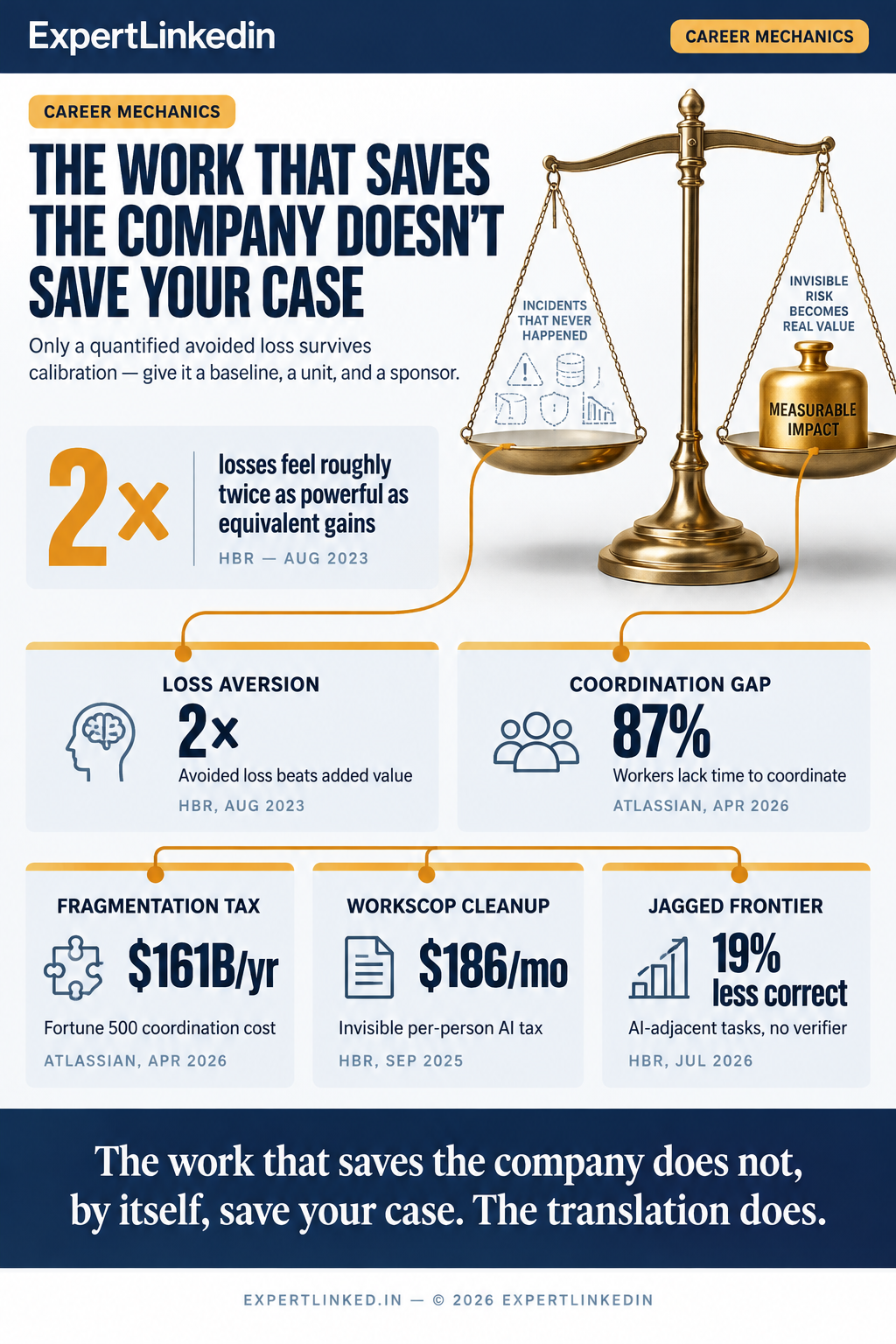
Start with the trap, stated plainly by Harvard Business Review’s July 2026 work on AI-era performance management. “Employees who rely heavily on AI may appear highly productive,” the authors write, “while those who slow down to verify assumptions, challenge outputs, or correct errors might appear less efficient precisely when they’re adding the most value” (HBR, July 2026). In the field experiment behind that piece, workers with AI access were 19% less likely to get the right answer on tasks just outside the model’s capability — the “jagged technological frontier.” The person who catches that error is doing the single most valuable thing in the workflow. The metric says they slowed everyone down.
This is not a 2026 glitch. Columbia’s Tory Higgins named the underlying bias decades ago: a “prevention focus” is the habit of seeing your goals as keeping things running smoothly — people who “work more slowly and deliberately” and “seek reliability over ‘coolness’” (HBR, July 2013). Promotion systems reward the opposite: visible progress, bold moves, a number that went up. Prevention has no number that went up. It only has numbers that did not go down.
And the volume of that work is climbing. Atlassian’s State of Teams 2026 found that 87% of knowledge workers lack the time or capacity to coordinate, and that coordination failures cost the Fortune 500 $161 billion a year, because “reviews, sign-offs, and alignment decisions can’t keep up with the flood of new work” (Atlassian Teamwork Lab, April 27, 2026). Someone absorbs that gap. Gallup’s manager research explains why no one credits them for it: managers are more burned out and disengaged than their teams, with 69% reporting added responsibilities and 46% reporting budget cuts (Gallup, December 2, 2024). The person who would have to defend your case is the most overloaded person in the building.
So the fix is not “be more visible.” Generic visibility advice fails because prevention has no image. The fix is to convert prevention into the one currency the system already reads.
The mechanism: losses are heavier than gains #
The research on this is unusually clean. “Losses are twice as powerful compared to their equivalent gains,” and the recommended persuasion move is not to add value but to “highlight the cost of inaction” (HBR, August 2023). That is precisely what risk-reduction work is: cost of inaction, already paid.
There is one catch. Avoided loss is a counterfactual, and people suffer from “opportunity cost neglect” — they do not automatically compute what a choice displaced unless you name it (HBR, January 2011). A number without a baseline is a rumor. A number against a baseline is evidence. That is the whole job: give the invisible loss a baseline, a unit, and a comparison.
Build the risk-reduction ledger #
One page. Three columns. Every line is a loss you prevented, each with a baseline and a unit the organization already uses.
| Loss type | What it usually sounds like (support) | What it should say (promotion) | The unit |
|---|---|---|---|
| Avoided error | “I cleaned up the AI drafts.” | “I own final QA on [workflow]; it caught [X] errors before [risk] materialized.” | Rework hours; error rate |
| Avoided delay | “I kept the project on track.” | “I closed the translation gap between [team A] and [team B], preventing [N] days of rework on [deliverable].” | Cycle time; delay cost |
| Avoided political drag | “I dealt with the conflict.” | “I rebuilt [relationship], which unblocked [decision] and removed a recurring escalation from [leader]’s desk.” | Escalations; decisions de-risked |
You do not need perfect numbers. You need defensible ones, and HBR has already published the templates. One manager discovered that each week of delay on a single feature “cost the company $20,000” and put it on a one-page business case (HBR, August 2023). For AI-era error-catching, the workslop research gives a unit: recipients spend about 1 hour 56 minutes per instance and absorb roughly $186 a month in invisible cleanup — more than $9 million a year for a 10,000-person company (HBR, September 2025). And HBR’s senior-leader guidance supplies the exact sentence shape for political drag: “I spent three months rebuilding trust between the clinical team and regulatory group. That groundwork helped us get the FDA submission done in half the time” (HBR, January 2026).
Notice what those sentences share. None of them says “I helped.” They name a scope, a system, and a result.
Convert consequence into level #
That is the second conversion, and it is harder than the arithmetic. A ledger proves consequence; a promotion case has to prove level. “I helped” is support language. “I own the QA layer for two teams, and it cut final-round corrections from 11 to 3 in six weeks” is level language — it describes scope and a system, not a favor.
Then route it before the freeze. The 90-day Q4 plan set the dates: comparison and compensation logic by October 16, the carry sheet and the ask by October 23, final freeze November 13. The self-evaluation you drafted two weeks ago is where the language lives, and the four-page evidence packet is where it gets structured. The ledger is the missing middle — the part that turns “I was reliable” into “here is the loss this role prevents.”
Keep the ask small and timed. HBR is blunt that a promotion is “a series of ongoing conversations,” not a single event (HBR, January 2018), and the strongest opening is advice, not feedback. Try: “Before Q4 planning closes, I want to make sure the risk-reduction work I’ve picked up is visible. If you were carrying this into calibration, what one number would make the case easier to defend?” That question does two things at once: it tells your manager the work exists, and it hands them the carry sheet they will need anyway.
Three ways this goes wrong #
Manufacturing fear. Loss-framing only works if the loss is credible and valued; the research warns that a bad comparison makes the entire case look unserious (HBR, January 2011). Quantify the loss you actually prevented, not the catastrophe you can imagine.
Arguing effort. “I worked hard on quality” is a diary entry, not a ledger. The room rewards consequence, and consequence has a number attached.
Asking an overloaded manager to do the translation for you. Gallup’s data is unambiguous — the manager is the bottleneck, not the adversary. If your case needs rewriting, the room will rewrite it without you.
The uncomfortable part #
The system is not going to reward prevention on its own, and it will not fix itself this quarter. Only 2% of Fortune 500 CHROs strongly agree that their performance management system inspires improvement (Gallup, May 6, 2024). You cannot wait for the system to learn to see you. You have to hand it the number it already knows how to read.
The external market is not coming to the rescue either. September added just 29,000 jobs and unemployment ticked to 4.2% (BLS Employment Situation, October 2, 2026), while quits held at 1.9% (BLS JOLTS, August 2026). Indeed Hiring Lab summed the mood as “steadiness without a spark” — a market where “employers are holding on to the workers they have and holding off on hiring the ones they don’t” (Indeed Hiring Lab, October 2, 2026). When the outside door is barely open, the internal case is the higher-probability lever — which makes the work of translating prevention worth doing now, not in January.
So before the budget freeze, do the thing that feels least like self-promotion and matters most: write down what did not happen. The caught error. The held deadline. The fight that never reached the room. Attach a baseline, a unit, and a sponsor’s name to each one. The work that saves the company does not, by itself, save your case. The translation does.
Picked up a risk-reduction responsibility that nobody has priced? Send me the line you’re trying to write and I’ll tell you where it needs a baseline — and which number would make it survive the room.
Email me at jackson.rodriguez@tlnw.uk
References #
- Atlassian Teamwork Lab (April 27, 2026). “The State of Teams 2026.” https://www.atlassian.com/blog/state-of-teams-2026 (Accessed October 12, 2026)
- U.S. Bureau of Labor Statistics (October 2, 2026). “The Employment Situation — September 2026.” https://www.bls.gov/news.release/empsit.nr0.htm (Accessed October 12, 2026)
- U.S. Bureau of Labor Statistics (October 1, 2026). “Job Openings and Labor Turnover — August 2026.” https://www.bls.gov/news.release/jolts.nr0.htm (Accessed October 12, 2026)
- Gallup (December 2, 2024). “The Great Detachment: Why Employees Feel Stuck.” https://www.gallup.com/workplace/653711/great-detachment-why-employees-feel-stuck.aspx (Accessed October 12, 2026)
- Gallup (May 6, 2024). “2% of CHROs Think Their Performance Management System Works.” https://www.gallup.com/workplace/644717/chros-think-performance-management-system-works.aspx (Accessed October 12, 2026)
- Harvard Business Review (January 2011). “The Persuasive Power of Opportunity Costs.” https://hbr.org/2011/01/column-the-persuasive-power-of-opportunity-costs (Accessed October 12, 2026)
- Harvard Business Review (July 2013). “The Hidden Danger of Being Risk-Averse.” https://hbr.org/2013/07/hidden-danger-of-being-risk-averse (Accessed October 12, 2026)
- Harvard Business Review (August 2023). “Making the Case for the Resources Your Team Needs.” https://hbr.org/2023/08/making-the-case-for-the-resources-your-team-needs (Accessed October 12, 2026)
- Harvard Business Review (September 2025). “AI-Generated Workslop Is Destroying Productivity.” https://hbr.org/2025/09/ai-generated-workslop-is-destroying-productivity (Accessed October 12, 2026)
- Harvard Business Review (January 2026). “How to Articulate Your Contributions as a Senior Leader.” https://hbr.org/2026/01/how-to-articulate-your-contributions-as-a-senior-leader (Accessed October 12, 2026)
- Harvard Business Review (July 2026). “Performance Management Needs New Metrics in the AI Era.” https://hbr.org/2026/07/performance-management-needs-new-metrics-in-the-ai-era (Accessed October 12, 2026)
- Indeed Hiring Lab (October 2, 2026). “September 2026 Jobs Report: Steadiness Without a Spark.” https://hiringlab.indeed.com/2026/10/02/september-2026-jobs-report-steadiness-without-a-spark/ (Accessed October 12, 2026)
- Knight, Rebecca (January 29, 2018). “How to Ask for a Promotion.” Harvard Business Review. https://hbr.org/2018/01/how-to-ask-for-a-promotion (Accessed October 12, 2026)
- ExpertLinked (October 5, 2026). “How to Write a Q4 2026 Self-Evaluation for Work Before Calibration Starts.” https://expertlinked.in/posts/2026-10-05-how-to-write-a-q4-2026-self-evaluation-for-work-before-calibration-starts/ (Accessed October 12, 2026)
- ExpertLinked (September 14, 2026). “The 4-Page Q4 2026 Evidence Packet for Performance Reviews, Promotions, and Pay Talks.” https://expertlinked.in/posts/2026-09-14-the-4-page-q4-2026-evidence-packet-for-performance-reviews-promotions-and-pay-talks/ (Accessed October 12, 2026)
- ExpertLinked (September 28, 2026). “The 90-Day Q4 2026 Career Positioning Plan for a Market That Still Isn’t Fully Open.” https://expertlinked.in/posts/2026-09-28-the-90-day-q4-2026-career-positioning-plan-for-a-market-that-still-isnt-fully-open/ (Accessed October 12, 2026)
AI Content Notice
This article was created using artificial intelligence technology. Whenever possible, we include references and sources to support the information presented. Readers are encouraged to consult these sources for further information. While we strive for accuracy and provide valuable insights, readers should independently verify information and use their own judgment when making business decisions. The content may not reflect real-time market conditions or personal circumstances.
Related Articles
Infographic: How to Turn Risk Reduction Into a Q4 2026 Promotion Case Before Budget Freeze
The most valuable work you did this quarter is probably not in your self-evaluation — it’s the …
The 4-Page Q4 2026 Evidence Packet for Performance Reviews, Promotions, and Pay Talks
Most review packets fail because they show effort and force a sponsor to rewrite the case. This …
My Self-Evaluation Feels Like Propaganda - and What to Write Before Q4 2026 Calibration
If your self-evaluation sounds like a press release, your instinct is right. Here is how to stop …