How to Write a Q4 2026 Self-Evaluation for Work Before Calibration Starts

The calibration room will not reconstruct your year from memory. Whoever writes the first story owns the anchor — and if it isn’t you, the story gets written about you.
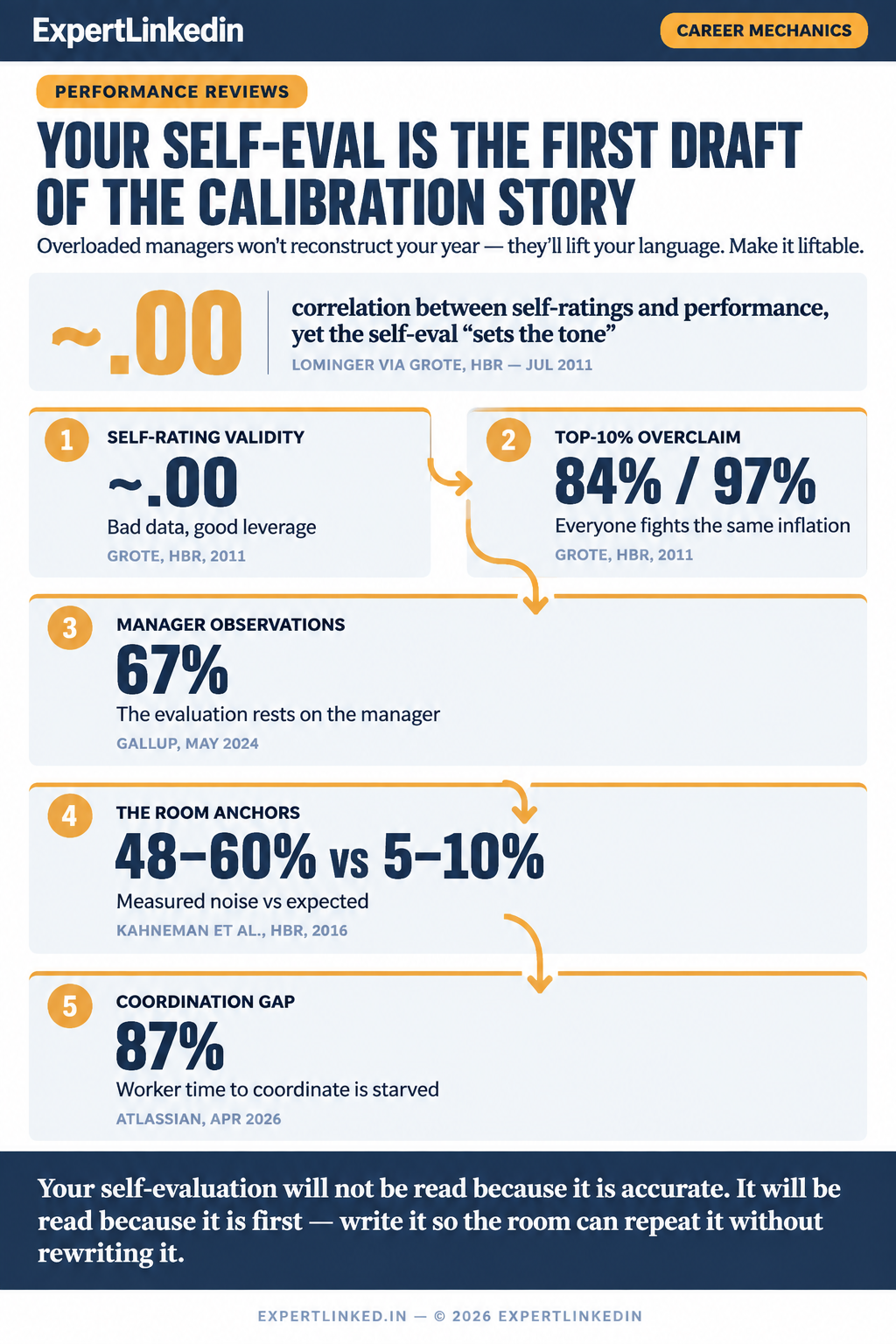
That sentence sounds like rhetoric. It’s mechanics. The research on self-ratings is unsparing: they barely correlate with actual performance, with meta-analytic correlations so low they hover near zero. Gallup adds the surrounding absurdity — only 2% of CHROs think their performance management system actually works (Gallup, May 6, 2024). Yet the self-evaluation still does something concrete. It sets the tone for the only conversation where your value gets priced this year.
Tone-setting matters more in October 2026 than it did in a hot market. Payrolls added just 29,000 jobs in September, and the quits rate held at 1.9% — what Indeed Hiring Lab called “steadiness without a spark.” Add worker confidence: only 28% of U.S. workers say now is a good time to find a quality job (Gallup, March 23, 2026). In plain English: nobody is leaving, hiring is selective rather than collapsing, and the internal calibration cycle is where career leverage lives this fall.
So here is the thesis, stated early so we can work with it: strong self-evaluations are not personal diaries. They are translation tools, built so a sponsor, a skip-level manager, or a calibration room can repeat the case without rewriting it.

Your self-evaluation is a translation tool, not a diary #
A diary is written to be read. A translation tool is written to be repeated. That single distinction decides whether your self-evaluation does anything for you this cycle.
Start with the reality of your manager’s calendar. Marlo Lyons’ guidance on effective self-assessments rests on a plain fact: managers do not remember your full year, and they do not have the time to rebuild it (HBR, December 12, 2023). Gallup’s performance-management research adds a structural number: the manager’s observations carry roughly 67% of the evaluation (Gallup, May 6, 2024). And the calibration room has its own physics — Kahneman, Sibony, and Sunstein showed in “Noise” that roundtables converge on the opinions stated first or most confidently, regardless of which is best supported (HBR, October 2016).
Together, those three facts give the form its real power: the self-evaluation is the only input you author that arrives before your manager’s draft and before the room opens. It is the one place you get to write in the system before the system writes about you. An overloaded 2026 manager will lift language rather than reconstruct the year — so make it liftable. In plain English: write sentences your manager, skip-level, and sponsor can copy without feeling dishonest. HBR’s reporting on the AI productivity boom is explicit about why: managers are the bottleneck being asked to absorb, review, and coordinate more output than ever (Fosslien & Duffy, HBR, May 25, 2026).
This is exactly what the sponsor map defined two weeks ago. The translator role exists for one behavior: repeating the case without rewriting it. Your self-evaluation is where that translator gets the material. If the material needs rewriting, the room will simply rewrite it — probably without you in it.
Write the full draft before your manager does #
The first move is a timing move. Write the complete draft before your manager writes theirs.
You already have the schedule. The evidence packet from September 14 pinned the freeze dates: pages 1-2 by October 9, the comparison and compensation logic by October 16, the carry sheet and the ask by October 23, and the final freeze on November 13. The 90-day plan from September 28 wired those dates into decision gates, with October’s posture simple: retrench internally, protect the evidence, and treat your current role as the asset to defend. Your self-evaluation is the form-fitting translation of those four pages — so it should ride the same freeze dates, not trail them.
Arrive first, arrive complete, and make it copy-paste ready. Dick Grote, the man who has spent his career arguing that self-appraisals are mostly noise, still gives writers one piece of advice that survives his own skepticism: write so a busy manager can lift “I” to “she” (HBR, July 11, 2011). That is the bar. When your manager opens the form and finds a finished draft with numbers, names, and outcomes already in sentence form, the path of least resistance is to take it and get on with the day. That is not manipulation. It is respecting that the person carrying 67% of the evaluation is the most overloaded person in the chain — ignored at your own cost.
The four-part skeleton #
Four parts, nothing else. If you cannot fit your year into this, you have not decided what matters yet.
Part 1: Role reality #
Lead with the problem you actually solved, and separate your formal role from your operating role. The form you were hired into and the work the organization now depends on are rarely the same document. Name the gap.
Example fill-in line: “On paper my role is [title’s mandate]. In practice, since [month], I have been the owner of [the problem] because [why it fell to you], and it now touches [stakeholders].”
Part 2: Consequence proof #
What changed because you did the work? Use STAR-style structure: situation, task, action, result. Maximum five accomplishments, each one ending in a stakeholder outcome, not an activity report. Lyons puts the line that should be taped to your monitor: maintaining a database isn’t an accomplishment, no matter how hard it was (HBR, December 12, 2023).
Example fill-in line: “I cut [metric] from [X] to [Y] by owning [process], which let [stakeholder] do [outcome] without [previous failure].”
Part 3: The coordination and cleanup translation #
This is the part people skip — and it decides calibration in the AI era. The work that protects quality now lives in QA, cleanup, exception handling, and “botsitting” — HBR’s August reporting clocked it at roughly 6.4 hours a week of unowned agent supervision (HBR, August 5, 2026). Atlassian’s State of Teams finds 87% of knowledge workers lack the time or capacity to coordinate when everyone is in execution mode (Atlassian, April 27, 2026). HBR’s July piece on invisible work makes the translation rule explicit: this labor barely registers on dashboards, so it only exists in calibration if you write it there (HBR, July 24, 2026).
So translate it into the language of what breaks without you. If it is not in the self-evaluation, it does not exist in the room.
Example fill-in line: “I run final QA on [named AI-assisted workflow], catching [X errors] before [named risk] materialized. Without this layer, [stakeholder] would redo [volume of work] every cycle.”
Part 4: The ask and the forward commitment #
End with one bounded ask, framed as advice rather than feedback. HBS research shows that asking for advice produces more concrete, usable input than asking for feedback (HBS Working Knowledge, January 16, 2026). Then list one or two development areas you are already working on — balance builds credibility. Liz Wiseman’s guidance on acing a self-appraisal is blunt: a review with zero weaknesses reads as either dishonest or unselfaware, and a spike of self-awareness makes the rest of the case more believable (HBR, March 31, 2023).
Example fill-in line: “The outcome I am aiming for in Q1 is [one bounded outcome]. If you were carrying this case upward, what one piece of advice would make it easier to approve? I am also working on [development area 1] and [development area 2].”
The copy-paste test #
Before you submit, run the test that matters. Imagine a sponsor or skip-level leader standing in the calibration room, holding your self-evaluation and nothing else. If they had to repeat the case without rewriting it, would these sentences survive?
- Could someone lift “I” to “she” and read it aloud without embarrassment?
- Does every claim carry a number, a date, or a named stakeholder?
- Is the “what breaks without you” line on the page?
- Can the room repeat your single bounded ask in one breath?
- Are there any adjectives left standing?
Consequence and comparison survive averaging. Adjectives do not survive calibration meetings.
Before and after: the translation table #
Here is the same content twice — once as a diary, once as a translation tool. Match the right column.
| Diary (written to be read) | Translation tool (written to be repeated) |
|---|---|
| “I worked hard on X all year.” | “I reduced [specific failure] by owning [specific process].” |
| “I’m passionate about quality.” | “I caught [X errors] before [named risk] materialized.” |
| “I helped the team whenever they needed me.” | “I unblocked [team] on [project] by [concrete action].” |
| “I exceeded expectations.” | “I delivered [outcome] against [baseline/comparison].” |
Nobody in the room disputes the left column; they just cannot do anything with it. The right column is what they can repeat.
The system is unfair — and usable #
Now the part nobody wants to hear, because it costs nothing and changes everything.
Self-ratings are bad data. The near-zero correlation with performance is matched by the inflation: 84% of middle managers and 97% of executives rate themselves in the top 10% of performers (Grote, HBR, July 11, 2011). Calibration is sold as fairness but, mechanically, it compresses toward the middle — that is literally what calibration software like Lattice’s exists to enforce (Lattice, February 4, 2020). And refusing the form does not end the rating: firms quietly rebuild “ghost ratings” from whatever the manager remembers, so the story gets written about you with even less of your input (Cespedes, HBR, July 8, 2022).
So the system is unfair — and it is still your best lever. You do not get to choose whether you are rated. You get to choose whether the story the room repeats is yours. Amy Gallo’s durable advice on the dreaded self-appraisal makes the same point in one line: this is the only document where you get to write the record (HBR, March 29, 2013). In a market where quits sit at 1.9%, the internal review is the main room where your value gets priced. Skipping the form does not cost you the rating. It costs you the first draft.
Do not spend the next week writing a diary entry the room will have to translate for you. Spend it writing the version of your year that survives contact with an overloaded manager, a distracted skip-level, and a room that repeats the first confident story it hears. Use the four-part skeleton. Freeze it on the schedule. Run it through the copy-paste test. And send it before anyone else writes your story.
Your self-evaluation will not be read because it is accurate. It will be read because it is first — write it so the room can repeat it without rewriting it.
Writing your self-evaluation now? Send me the draft and I will run the copy-paste test on it — I’ll tell you which sentences survive the room and which ones still read like a diary.
Email me at jackson.rodriguez@tlnw.uk
References #
- U.S. Bureau of Labor Statistics (October 1, 2026). “Job Openings and Labor Turnover — August 2026.” https://www.bls.gov/news.release/jolts.nr0.htm (Accessed October 5, 2026)
- U.S. Bureau of Labor Statistics (October 2, 2026). “The Employment Situation — September 2026.” https://www.bls.gov/news.release/empsit.nr0.htm (Accessed October 5, 2026)
- Indeed Hiring Lab (October 2, 2026). “September 2026 Jobs Report: Steadiness Without a Spark.” https://hiringlab.indeed.com/2026/10/02/september-2026-jobs-report-steadiness-without-a-spark/ (Accessed October 5, 2026)
- Atlassian Teamwork Lab (April 27, 2026). “The State of Teams 2026.” https://www.atlassian.com/blog/state-of-teams-2026 (Accessed October 5, 2026)
- Cespedes, Frank V. (July 8, 2022). “How to Conduct a Great Performance Review.” Harvard Business Review. https://hbr.org/2022/07/how-to-conduct-a-great-performance-review (Accessed October 5, 2026)
- Fosslien, Liz & West Duffy, Mollie (May 25, 2026). “Managers Are Struggling to Keep Up with the AI Productivity Boom.” Harvard Business Review. https://hbr.org/2026/05/managers-are-struggling-to-keep-up-with-the-ai-productivity-boom (Accessed October 5, 2026)
- Gallo, Amy (March 29, 2013). “How to Write the Dreaded Self-Appraisal.” Harvard Business Review. https://hbr.org/2013/03/how-to-write-the-dreaded-self-appraisal (Accessed October 5, 2026)
- Gallup (September 5, 2023). “The Manager Squeeze: How the New Workplace Is Testing Team Leaders.” https://www.gallup.com/workplace/510326/manager-squeeze-new-workplace-testing-team-leaders.aspx (Accessed October 5, 2026)
- Gallup (March 23, 2026). “U.S. Worker Thriving Declines as Job Market Pessimism Grows.” https://www.gallup.com/workplace/703280/worker-thriving-declines-job-market-pessimism-grows.aspx (Accessed October 5, 2026)
- Gallup (May 6, 2024). “2% of CHROs Think Their Performance Management System Works.” https://www.gallup.com/workplace/644717/chros-think-performance-management-system-works.aspx (Accessed October 5, 2026)
- Grote, Dick (July 11, 2011). “Let’s Abolish Self-Appraisal.” Harvard Business Review. https://hbr.org/2011/07/lets-abolish-self-appraisal (Accessed October 5, 2026)
- Harvard Business Review (July 24, 2026). “The Invisible Work Draining Your Best Employees.” https://hbr.org/2026/07/the-invisible-work-draining-your-best-employees (Accessed October 5, 2026)
- Harvard Business Review (August 5, 2026). “How Much Time Do Your Employees Spend Botsitting?” https://hbr.org/2026/08/how-much-time-do-your-employees-spend-botsitting (Accessed October 5, 2026)
- Kahneman, Daniel; Sibony, Olivier & Sunstein, Cass R. (October 2016). “Noise.” Harvard Business Review. https://hbr.org/2016/10/noise (Accessed October 5, 2026)
- Lattice (February 4, 2020). “Introducing Native Performance Review Calibration.” https://www.lattice.com/blog/introducing-lattice-calibration (Accessed October 5, 2026)
- Lyons, Marlo (December 12, 2023). “How to Write an Effective Self-Assessment.” Harvard Business Review. https://hbr.org/2023/12/how-to-write-an-effective-self-assessment (Accessed October 5, 2026)
- Azpúrua, Ana Elena (research by Whillans, Ashley) (January 16, 2026). “Want Better Performance Reviews? Change This One Word.” Harvard Business School Working Knowledge. https://www.library.hbs.edu/working-knowledge/want-better-performance-reviews-change-this-one-word (Accessed October 5, 2026)
- Wiseman, Liz (March 31, 2023). “Acing Your Self-Appraisal (Even If It’s Your First).” Harvard Business Review. https://hbr.org/2023/03/acing-your-self-appraisal-even-if-its-your-first (Accessed October 5, 2026)
- ExpertLinked (September 7, 2026). “How to Build a Q4 2026 Sponsor Map Before Performance Review Season Starts.” https://expertlinked.in/posts/2026-09-07-how-to-build-a-q4-2026-sponsor-map-before-performance-review-season-starts/ (Accessed October 5, 2026)
- ExpertLinked (September 14, 2026). “The 4-Page Q4 2026 Evidence Packet for Performance Reviews, Promotions, and Pay Talks.” https://expertlinked.in/posts/2026-09-14-the-4-page-q4-2026-evidence-packet-for-performance-reviews-promotions-and-pay-talks/ (Accessed October 5, 2026)
- ExpertLinked (September 28, 2026). “The 90-Day Q4 2026 Career Positioning Plan for a Market That Still Isn’t Fully Open.” https://expertlinked.in/posts/2026-09-28-the-90-day-q4-2026-career-positioning-plan-for-a-market-that-still-isnt-fully-open/ (Accessed October 5, 2026)
AI Content Notice
This article was created using artificial intelligence technology. Whenever possible, we include references and sources to support the information presented. Readers are encouraged to consult these sources for further information. While we strive for accuracy and provide valuable insights, readers should independently verify information and use their own judgment when making business decisions. The content may not reflect real-time market conditions or personal circumstances.
Related Articles
Infographic: How to Write a Q4 2026 Self-Evaluation for Work Before Calibration Starts
Self-ratings barely correlate with performance, yet the self-evaluation still sets the tone for …
The 4-Page Q4 2026 Evidence Packet for Performance Reviews, Promotions, and Pay Talks
Most review packets fail because they show effort and force a sponsor to rewrite the case. This …
How to Build a Q4 2026 Sponsor Map Before Performance Review Season Starts
One supportive manager is rarely enough. Before Q4 review season, map who can validate your work, …