My Self-Evaluation Feels Like Propaganda - and What to Write Before Q4 2026 Calibration

The sentence that should worry you in a self-evaluation is not “I exceeded expectations.” It is any sentence your company could run in a recruiting ad without changing a single word.
That is the propaganda test, and most of us fail it every October. We open the form, feel a small wave of dread, and reach for the safest available language — the mission statement, the values slide, the phrase “drove cross-functional impact.” It reads professional. It also reads like the company wrote it about itself.
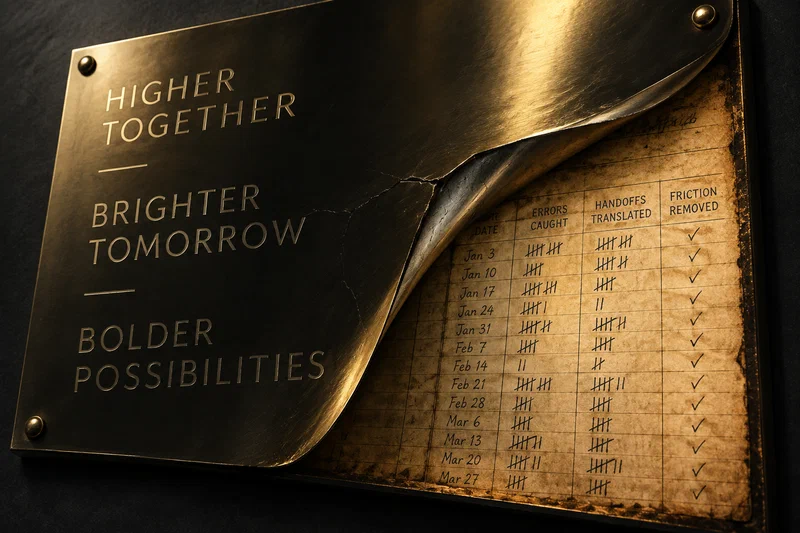
“I sat down to write my self-evaluation and I cannot get past the first line, because everything I write either sounds like a press release or sounds small. I copied our values almost word for word — ‘ownership,’ ‘customer obsession,’ ‘one team.’ But my job is fixing things quietly: catching errors before they reach clients, translating between teams that refuse to talk, keeping a process alive so it does not collapse when someone leaves. When I use company language, I sound like I am running for office. My manager said last year’s review was ‘a bit generic.’ But how do I make invisible work sound like it matters without sounding like I am exaggerating? Calibration is in three weeks and I feel stuck.” – Senior program manager, health technology company
If this is you, you are not lacking confidence. You have a bullshit detector, and it is working. The problem is that you are pointing it at yourself when you should be pointing it at the language.
The Clinical Read #
Start with the uncomfortable finding: corporate language is often designed to be impressive and empty at the same time. A Cornell study by the cognitive psychologist Shane Littrell, published this year in Personality and Individual Differences and reported by The Guardian, found that “corporate bullshit” — puzzling buzzwords and jargon that is “semantically empty and often confusing” — is used by management to persuade and impress. And here is the twist that matters for your self-evaluation: the workers most impressed by corporate speak were the least equipped to make effective business decisions. They rated their supervisors as more charismatic and visionary and felt more inspired by their company’s mission statement. They also performed worse. Slogan language feels good and predicts nothing.
So when your draft starts to sound like the company wrote it, that discomfort is evidence: you are noticing the words carry no consequence.
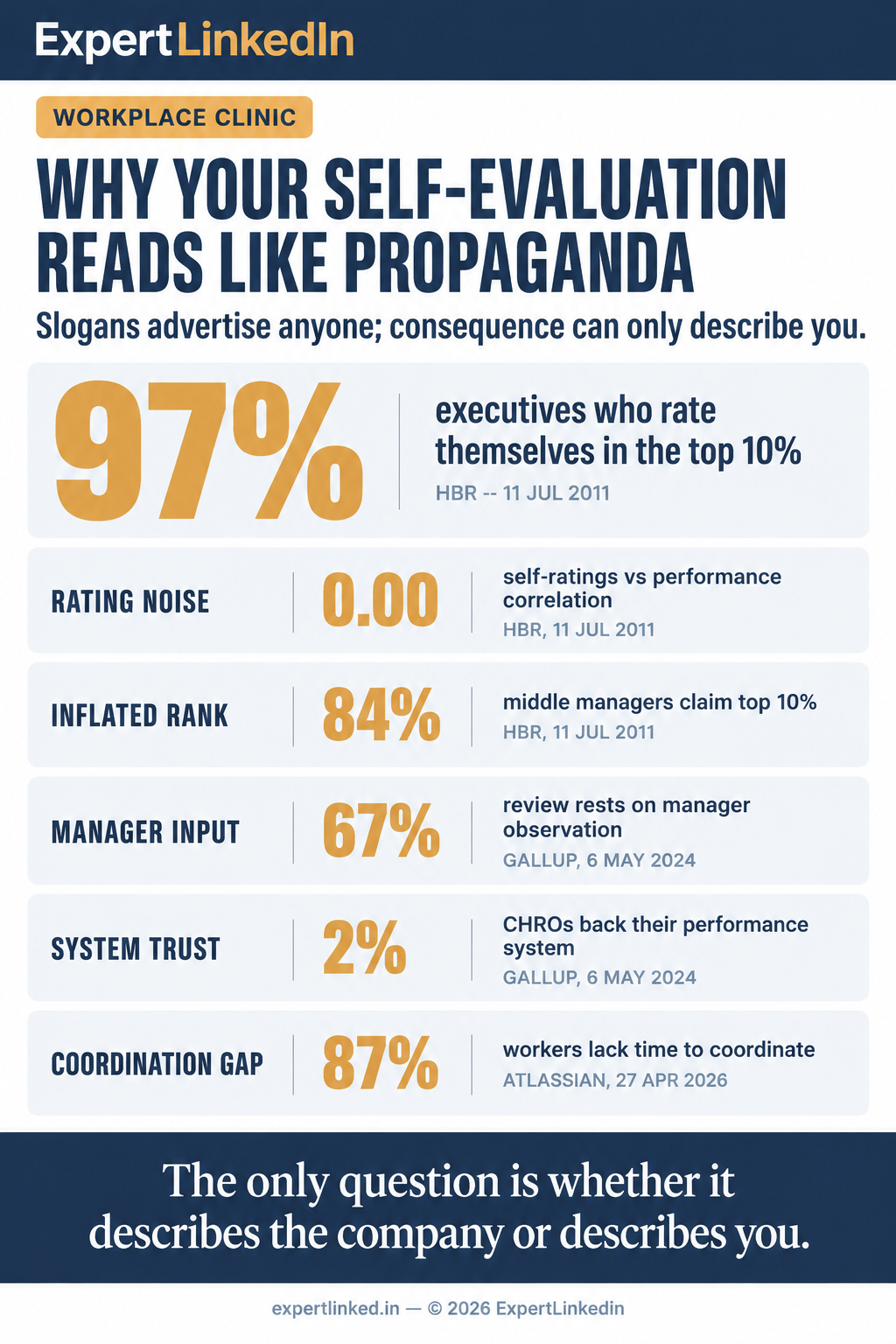
There is a reason we drift there anyway. The self-evaluation is a rigged genre. Dick Grote, who spent his career arguing self-appraisals should be abolished, found that “the overall correlation between self-ratings and performance was .00,” and that the poorer the performer, the more inflated the self-rating (HBR, July 11, 2011). In a 2007 BusinessWeek survey of 2,000 managers and executives, no subgroup had fewer than 80% claiming top-10% status, and 97% of executives did. The genre rewards top-10% posturing. So honest people feel like frauds, and frauds feel comfortable. The exit is not to posture harder. It is to stop rating yourself and start documenting what happened.
Marlo Lyons’ guidance on writing an effective self-assessment rests on one plain fact: your manager will not remember your year, and does not have time to rebuild it. Gallup puts a number on it — evaluations are based on the manager’s observations about 67% of the time (Gallup, May 6, 2024). And only 2% of Fortune 500 CHROs strongly agree their performance management system inspires employees to improve.
In plain English: the form is nearly worthless as a scorecard and nearly decisive as a first impression. You are not writing to be rated accurately. You are writing to be repeated accurately.
This hurts most when your real work is cleanup. Harvard Business Review’s July reporting on the invisible work draining your best employees describes the “mental load” — the continuous cognitive and emotional labor of planning, organizing, and keeping work from breaking — as invisible and easy to dismiss as poor time management. That work is rising, not shrinking. Atlassian’s State of Teams 2026 finds 87% of knowledge workers say that, with everyone in execution mode, they lack the time or capacity to coordinate, and calls the resulting “fragmentation tax” a $161 billion annual cost to the Fortune 500 (Atlassian, April 27, 2026). The organization is running on coordination labor it cannot see. Your self-evaluation is one of the few instruments that can make it countable.
This is the same pattern I wrote about on Sept. 25 in AI Helped Us Move Faster - Now the Errors Belong to Me, where invisible QA became blame transfer, and on Sept. 11 in Our Summer Workaround Became the New KPI, where a temporary workaround hardened into a permanent baseline. Both times, the work that held things together was real and the language that described it was missing. Calibration does not punish you for doing invisible work. It punishes you for describing it in a language the room cannot use.
The Propaganda Test #
Before you write another line, run every sentence through one question: could this appear in the company’s recruiting deck? If yes, it is not evidence. Rewrite it.
| Propaganda (could advertise anyone) | Record (could only describe you) |
|---|---|
| “I drove cross-functional impact.” | “I unblocked [project] by rewriting the handoff between [team A] and [team B].” |
| “I’m passionate about quality.” | “I caught [X errors] before they reached a client this quarter.” |
| “I embody our value of ownership.” | “When [owner] left, I held [process] for [N] weeks so nothing slipped.” |
| “I helped wherever needed.” | “I removed [specific friction] from [workflow], saving [team] [time/cost] per cycle.” |
Notice what the right column has that the left lacks: a person, a number, a consequence, or an avoided failure. Adjectives do not survive calibration meetings. Consequences do.
The Ledger: Three Columns, One Hour #
Take one focused hour and build a “friction-and-consequence ledger” from your last two quarters. No prose — just three columns.
- Consequence that changed. What measurably moved because you did the work? Not activity — outcome. A cycle that got faster, an error rate that fell, a launch that stayed on schedule.
- Friction you removed. Where did you translate, reconcile, or absorb? The meetings that only you could hold together, the requirements you clarified, the escalations you quietly prevented.
- What would have broken without you. The hardest and most important column. If you had not done this, what would have happened by name? Which client would have seen the error, which deadline would have slipped, which two teams would still be deadlocked?
That third column is the one corporate language flattens most, because it describes absence: nothing went wrong, so nothing gets credited. The fix is old — Grote’s advice to overloaded managers was to ask for a “good stuff list” of accomplishments only, so that “none of the employee’s successes are overlooked.” Your ledger is that list, finally written in the only terms a calibration room trusts: consequence and avoided loss.
If it helps, write the third column as a sentence your manager could read aloud without flinching: “If I had not caught the reconciliations on the [monthly close], [client] would have received bad numbers on [date].” That is not boasting. It is a factual statement about the system you are holding together, and it is exactly the language Jackson Rodriguez builds on in his Oct. 5 piece, How to Write a Q4 2026 Self-Evaluation for Work Before Calibration Starts. He is right that the self-evaluation is a translation tool. My addition is the emotional half: the reason it feels like propaganda is that you have been translating the company instead of translating yourself.
Write the Friction, Not the Feeling #
Now the part that decides whether this feels honest or performative.
Self-advocacy has a real social cost, and this is a nervous year to pay it. In APA’s 2025 Work in America survey, 54% of workers said job insecurity was significantly affecting their stress (APA, May 21, 2025). In a market like that, HBR’s reporting on savvy self-promotion is blunt: talking yourself up “has actually been associated with worse performance reviews — particularly for women, who are penalized more heavily when they boast,” and the “humblebrag” backfires hardest, rated as both less likable and less competent than a straightforward claim. In Ask an Expert: How Do I Advocate for Myself at Work?, a reader describes feeling “gaslit” into doubting whether her workload is even worth raising as a woman of color. That fear is not imaginary, and I will not tell you to ignore it. It is the same reason I wrote on Sept. 18 that a private “I agree” is not sponsorship — support only counts when it crosses into a room where decisions get made.
Here is the lower-friction path. Research on “dual-promotion” — a series of eleven studies with 2,558 participants — found that when you state your own accomplishment and credit a colleague in the same breath, you boost perceptions of warmth without harming perceptions of competence, and sometimes raise both (HBR, November 2023). So write: “The project shipped on time because I owned the reconciliation and Alex owned client communications.” You get the record. You do not pay the likability tax.
Then close the way the research says works. End with one bounded ask and two development areas. Lyons and Liz Wiseman both make the same point from different angles: a review with zero weaknesses reads as either dishonest or unaware, and asking for advice rather than feedback produces more useful input (HBR, March 31, 2023).
And separate the two conversations your company keeps blurring. Gallup’s guidance is explicit: praise and allocation are different currencies, and discussing pay and promotion inside the performance review “detracts from the feedback and lessons learned.” If your manager says “you’re doing great” this October, notice that recognition is not reward. The self-evaluation can win you the first; it cannot guarantee the second.
For Managers: Fluency Is Not Evidence #
If you manage people, this is your warning too.
The review you read is based mostly on your observations, and you are as overloaded as everyone else. That makes you a magnet for the most fluent writer rather than the most consequential one. Do not reward slogan fluency. Ask one question of every draft that reads a little too polished: “What would have broken without this person?” If the answer is not on the page, the writer either did invisible work they were afraid to name, or did very little work and learned the company’s vocabulary.
Then do what the research on cynicism and values says: close the gap between the language and the behavior. A review that scores people on values the organization does not actually live teaches everyone that the form is theater. Say what the evidence shows, and say what you cannot promise.
The Line to Protect Before Calibration #
The reason your self-evaluation feels like propaganda is not that you are dishonest. It is that you have been taught that the honest version — the ledger of what you caught, translated, and kept from breaking — sounds too small to matter. It does not sound small. It has just never been written in the language the room uses. That discomfort is the cost of learning to author your own record, not proof of fraud (Ibarra, HBR, January 2015).
So write it plainly. Consequence, friction removed, what would have broken. Run it through the propaganda test. Credit the people who helped, so the warmth survives the claim. And send it before your manager writes the story first.
The first draft of your year will be written this month, by someone. The only question is whether it describes the company or describes you.
If your self-evaluation has turned into a press release you do not recognize, send me the dilemma. Workplace Clinic is strongest when we name the difference between sounding small and being translated away.
Email me at olivia.bennett@tlnw.uk
References #
- American Psychological Association (May 21, 2025). “2025 Work in America Survey: Majority of U.S. workers say job insecurity has significant impact on their stress.” https://www.apa.org/pubs/reports/work-in-america/2025 (Accessed October 9, 2026)
- American Psychological Association (2024). “Stress in America 2024: A nation in political turmoil.” https://www.apa.org/pubs/reports/stress-in-america/2024 (Accessed October 9, 2026)
- Atlassian Teamwork Lab (April 27, 2026). “The State of Teams 2026.” https://www.atlassian.com/blog/state-of-teams-2026 (Accessed October 9, 2026)
- Gallo, Amy (March 29, 2013). “How to Write the Dreaded Self-Appraisal.” Harvard Business Review. https://hbr.org/2013/03/how-to-write-the-dreaded-self-appraisal (Accessed October 9, 2026)
- Gallup (January 13, 2025). “U.S. Employee Engagement Sinks to 10-Year Low.” https://www.gallup.com/workplace/654911/employee-engagement-sinks-year-low.aspx (Accessed October 9, 2026)
- Gallup (May 6, 2024). “2% of CHROs Think Their Performance Management System Works.” https://www.gallup.com/workplace/644717/chros-think-performance-management-system-works.aspx (Accessed October 9, 2026)
- Gallup (March 23, 2026). “U.S. Worker Thriving Declines as Job Market Pessimism Grows.” https://www.gallup.com/workplace/703280/worker-thriving-declines-job-market-pessimism-grows.aspx (Accessed October 9, 2026)
- Gallup (n.d.). “Why Performance Development Wins in the Workplace.” https://news.gallup.com/opinion/gallup/220478/why-performance-development-wins-workplace.aspx (Accessed October 9, 2026)
- Gallup & Workhuman (n.d.). “Workplace Recognition Research.” https://www.gallup.com/analytics/472658/workplace-recognition-research.aspx (Accessed October 9, 2026)
- Grote, Dick (July 11, 2011). “Let’s Abolish Self-Appraisal.” Harvard Business Review. https://hbr.org/2011/07/lets-abolish-self-appraisal (Accessed October 9, 2026)
- Harvard Business Review (June 2021). “Ask an Expert: How Do I Advocate for Myself at Work?” https://hbr.org/2021/06/ask-an-expert-how-do-i-advocate-for-myself-at-work (Accessed October 9, 2026)
- Harvard Business Review (May 2021). “Savvy Self-Promotion.” https://hbr.org/2021/05/savvy-self-promotion (Accessed October 9, 2026)
- Harvard Business Review (September 2022). “Don’t Let Cynicism Undermine Your Workplace.” https://hbr.org/2022/09/dont-let-cynicism-undermine-your-workplace (Accessed October 9, 2026)
- Harvard Business Review (November 2023). “How to Self-Promote Without Sounding Self-Centered.” https://hbr.org/2023/11/how-to-self-promote-without-sounding-self-centered (Accessed October 9, 2026)
- Harvard Business Review (July 24, 2026). “The Invisible Work Draining Your Best Employees.” https://hbr.org/2026/07/the-invisible-work-draining-your-best-employees (Accessed October 9, 2026)
- Harvard Business Review (September 2026). “Will Your Organization Stand By Its Values Even When It’s Hard?” https://hbr.org/2026/09/will-your-organization-stand-by-its-values-even-when-its-hard (Accessed October 9, 2026)
- Ibarra, Herminia (January 2015). “The Authenticity Paradox.” Harvard Business Review. https://hbr.org/2015/01/the-authenticity-paradox (Accessed October 9, 2026)
- Kahneman, Daniel; Sibony, Olivier & Sunstein, Cass R. (October 2016). “Noise.” Harvard Business Review. https://hbr.org/2016/10/noise (Accessed October 9, 2026)
- Lyons, Marlo (December 12, 2023). “How to Write an Effective Self-Assessment.” Harvard Business Review. https://hbr.org/2023/12/how-to-write-an-effective-self-assessment (Accessed October 9, 2026)
- Sainato, Michael (March 23, 2026). “Workers who fall for ‘corporate bullshit’ may be worse at their jobs, study finds.” The Guardian. https://www.theguardian.com/business/2026/mar/23/corporate-speak-study (Accessed October 9, 2026)
- Wiseman, Liz (March 31, 2023). “Acing Your Self-Appraisal (Even If It’s Your First).” Harvard Business Review. https://hbr.org/2023/03/acing-your-self-appraisal-even-if-its-your-first (Accessed October 9, 2026)
- ExpertLinked (September 11, 2026). “Our Summer Workaround Became the New KPI - and What to Do Before Q4 2026 Review Season.” https://expertlinked.in/posts/2026-09-11-our-summer-workaround-became-the-new-kpi-and-what-to-do-before-q4-2026-review-season/ (Accessed October 9, 2026)
- ExpertLinked (September 18, 2026). “My Manager Agrees With Me Privately but Won’t Sponsor Me Publicly - and What to Do Before Q4 Reviews.” https://expertlinked.in/posts/2026-09-18-my-manager-agrees-with-me-privately-but-wont-sponsor-me-publicly-and-what-to-do-before-q4-reviews/ (Accessed October 9, 2026)
- ExpertLinked (September 25, 2026). “AI Helped Us Move Faster - Now the Errors Belong to Me. What to Do Before Q4 2026 Reviews.” https://expertlinked.in/posts/2026-09-25-ai-helped-us-move-faster-now-the-errors-belong-to-me-and-what-to-do-before-q4-2026-reviews/ (Accessed October 9, 2026)
- ExpertLinked (October 5, 2026). “How to Write a Q4 2026 Self-Evaluation for Work Before Calibration Starts.” https://expertlinked.in/posts/2026-10-05-how-to-write-a-q4-2026-self-evaluation-for-work-before-calibration-starts/ (Accessed October 9, 2026)
AI Content Notice
This article was created using artificial intelligence technology. Whenever possible, we include references and sources to support the information presented. Readers are encouraged to consult these sources for further information. While we strive for accuracy and provide valuable insights, readers should independently verify information and use their own judgment when making business decisions. The content may not reflect real-time market conditions or personal circumstances.
Related Articles
Infographic: My Self-Evaluation Feels Like Propaganda - and What to Write Before Q4 2026 Calibration
If your self-evaluation sounds like a press release, your instinct is right. Here is how to stop …
How to Write a Q4 2026 Self-Evaluation for Work Before Calibration Starts
Self-ratings barely correlate with performance, yet the self-evaluation still sets the tone for …
Infographic: How to Write a Q4 2026 Self-Evaluation for Work Before Calibration Starts
Self-ratings barely correlate with performance, yet the self-evaluation still sets the tone for …