What the September 2026 CPI Report Could Change About Q4 Pay Talks - and What It Probably Won't

The September CPI report lands this morning, and by the afternoon the bond market will have decided what it means. Here is what it almost certainly will not change: the number at the bottom of your raise.
That is not cynicism. It is arithmetic about timing. In the cadence this column has tracked all quarter, the Q4 compensation and comparison page freezes on October 16 — two days from now — and the carry sheet goes up on October 23 (the 90-day Q4 plan). The September CPI print arrives on the doorstep, not in the room. Understanding which pay conversations cooler inflation can actually move — and which die anyway — is the whole game of CPI day.

First, what lands today — and what each number is for #
Two releases arrive together: CPI and Real Earnings for September. Neither is public as I write this, so I will not guess the print. What I can tell you is the shape of the release, because the composition matters more than the headline.
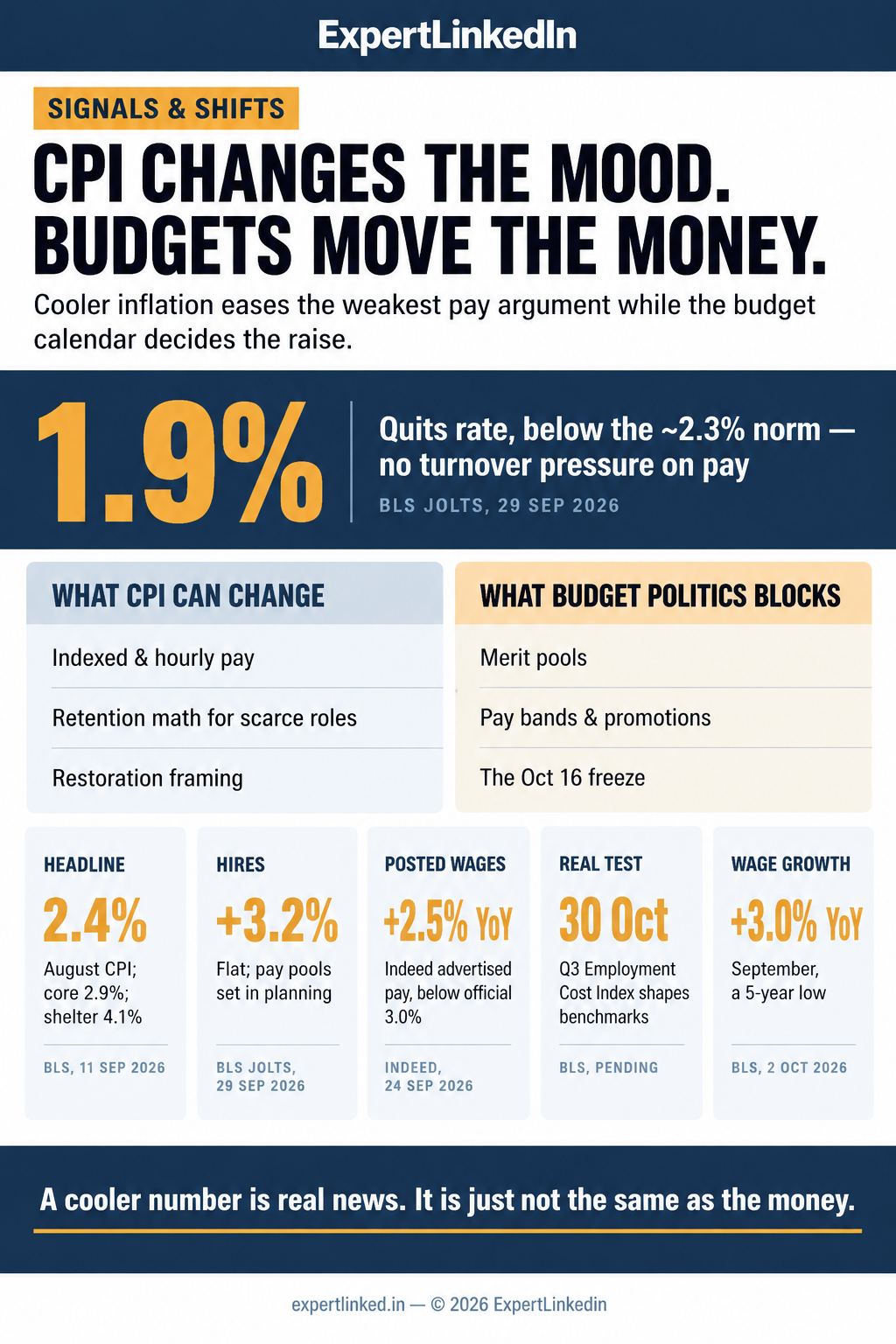
August’s CPI was the softest headline in fourteen months: 2.4% year over year, with core at 2.9% and shelter still stuck at 4.1% (BLS, September 11, 2026). Real average hourly earnings were up 1.2% over the year — a rare month when nominal wage growth of 3.6% beat prices. But the softening came mostly from energy, which fell 1.8% on the month, while rent and services held firm. Prices at the pump cool faster than the price in your lease.
Then the wage side cooled too. September’s jobs report showed average hourly earnings up just 3.0% year over year — the slowest since May 2021 — against a three-month payroll average of 51,000 (BLS, October 2, 2026). The Fed’s preferred gauge is still running 3.4% headline and 3.0% core (BEA, September 30, 2026). So we enter CPI day with prices near 3% on the measures the Fed trusts and wages decelerating on the measure employers use.
That is a strange kind of relief — and it points to the split I flagged a month ago: macro relief arrives faster than bargaining power does.
What cooler inflation can actually change #
Three conversations get easier when inflation eases. Only three.
1. Indexed and hourly pay. Where pay is literally tied to CPI — union escalators, some public-sector schedules, minimum-wage-linked rates — the number is load-bearing. A cooler print shrinks the gap those formulas have to close, which makes the adjustment cheaper to grant. This is the only place CPI moves money directly.
2. Retention math for hard-to-replace roles. When financing is expensive and hiring is slow, replacing you is riskier and more costly than it used to be. If inflation cools while rates stay high, the employer’s cheapest option is often a modest internal adjustment rather than an expensive external search.
3. The “restoration” framing. A cooler print lets a manager present a small, time-limited adjustment as restoring purchasing power rather than promising open-ended inflation matching — a far easier thing to defend than a permanent raise tied to a number the company does not control.
Notice what all three share. They are funded by the employer’s own cost and risk, and the CPI number only changes the story around them. The money was always going to come from somewhere else.
What it probably won’t change #
Here is the harder half, and it is where most pay conversations actually die.
Your merit pool was set in the annual planning cycle, months before this print. Most companies run a low-single-digit pool that does not move when a monthly price index does. If anything, “inflation is cooling” becomes the reason to keep it small.
Pay bands and promotion budgets are fixed structures. A cooler CPI does not widen a band or unfreeze a headcount exception. The gate is the budget calendar, not the price index — and those dates are already this week.
The “the market is paying more” argument is dead on arrival. Indeed’s posted-wage tracker is running +2.5% year over year, below official wage growth (Indeed Hiring Lab, September 24, 2026). ADP’s own pay measures put base pay at +3.2% (CNBC/ADP, September 30, 2026). Every tracker says pay growth is slowing. Arguing that the market is running hot is arguing against the data.
The uncomfortable part: cooler inflation is why your boss can say no #
This is the part almost nobody says out loud.
Pay pressure comes from workers leaving. When quits sit at 1.9% — well below the pre-pandemic norm of roughly 2.3% — no compensation budget is being forced open by turnover (BLS JOLTS, August 2026). Hires are flat at 3.2% and the vacancy yield is 0.71, meaning openings do not convert into jobs. Gallup finds only 28% of workers say now is a good time to find a quality job, and 43% stay because leaving is too costly.
Here is the link the headlines miss. The Fed treats low quits as slack — evidence that workers cannot push wages up. That is part of why it hiked to 3.75%–4.00% in September, the first hike in more than three years, and why the minutes released October 7 show a committee still focused on finishing the inflation job.
So the same low-quits condition that lets inflation cool is the condition that tells employers they can hold the line on pay. Cooler inflation improves your wallet story and weakens your leverage story at the same time. It is the rare piece of good news that arrives carrying its own counterargument — and the reason low quits have been the quiet story all quarter.
The number to watch is not CPI #
If you want the pay-relevant number this month, watch October 30 — the Employment Cost Index for the third quarter. ECI measures what employers actually paid for labor, including benefits, and it shapes next year’s salary benchmarks far more than any single CPI print. CPI tells you what prices did. ECI tells you what your employer’s peers did with their payrolls.
That is why CPI is context, not evidence. Repricing pay is not the same as reading prices, and the market’s fast reaction to a cool number is not the same as your committee’s slow one.
The translation #
If the print comes in cool this morning, do not walk into a pay conversation with “inflation is falling, so I deserve more.” You will be making the weakest argument in the room at the exact moment it is weakest. Instead:
- If your pay is indexed or hourly, put the CPI number on the table. That is the one time it works.
- For everything else, trade inflation for benchmark, scope, and replacement cost: “Here is the market rate for this work, here is the scope I have absorbed, and here is what it would cost to replace it.”
- Watch the calendar, not the tape. The compensation page freezes October 16; the evidence freeze is November 13.
The pattern in this series has not changed. The tone of the market keeps improving ahead of the market itself (October 7), and CPI day is that pattern in miniature: a fast reaction in markets, a slow response in payroll. A cooler number is real news. It is just not the same as the money.
Watching today’s CPI print land against your own pay conversation? Tell me which argument you plan to make — and I’ll tell you whether the room will fund it.
Email me at jackson.rodriguez@tlnw.uk
References
-
U.S. Bureau of Labor Statistics (September 11, 2026). “Consumer Price Index — August 2026.” https://www.bls.gov/news.release/cpi.nr0.htm (Accessed October 14, 2026)
-
U.S. Bureau of Labor Statistics (September 11, 2026). “Real Earnings — August 2026.” https://www.bls.gov/news.release/realer.nr0.htm (Accessed October 14, 2026)
-
U.S. Bureau of Labor Statistics (October 2, 2026). “The Employment Situation — September 2026.” https://www.bls.gov/news.release/empsit.nr0.htm (Accessed October 14, 2026)
-
U.S. Bureau of Labor Statistics (September 29, 2026). “Job Openings and Labor Turnover — August 2026.” https://www.bls.gov/news.release/jolts.nr0.htm (Accessed October 14, 2026)
-
U.S. Bureau of Labor Statistics (scheduled October 14, 2026). “Consumer Price Index — September 2026.” https://www.bls.gov/news.release/cpi.nr0.htm (Pending at publication)
-
U.S. Bureau of Labor Statistics (scheduled October 30, 2026). “Employment Cost Index — Third Quarter 2026.” https://www.bls.gov/news.release/eci.nr0.htm (Pending at publication)
-
U.S. Bureau of Economic Analysis (September 30, 2026). “Personal Income and Outlays, August 2026 (BEA 26-43).” https://www.bea.gov/news/2026/personal-income-and-outlays-august-2026 (Accessed October 14, 2026)
-
Board of Governors of the Federal Reserve System (September 16, 2026). “FOMC Statement.” https://www.federalreserve.gov/newsevents/pressreleases/monetary20260916a.htm (Accessed October 14, 2026)
-
Board of Governors of the Federal Reserve System (accessed October 14, 2026). “FOMC Calendars and Minutes.” https://www.federalreserve.gov/monetarypolicy/fomccalendars.htm
-
Indeed Hiring Lab (September 24, 2026). “US Labor Market Snapshot — September 2026.” https://hiringlab.indeed.com/2026/09/24/us-labor-market-snapshot-september-2026/ (Accessed October 14, 2026)
-
Indeed Hiring Lab (October 2, 2026). “September 2026 Jobs Report: Steadiness Without a Spark.” https://hiringlab.indeed.com/2026/10/02/september-2026-jobs-report-steadiness-without-a-spark/ (Accessed October 14, 2026)
-
ADP via CNBC (September 30, 2026). “Private sector jobs rose by 90,000 in September, better than expected, ADP reports.” https://www.cnbc.com/2026/09/30/private-sector-jobs-rose-by-90000-in-september-better-than-expected-adp-reports.html (Accessed October 14, 2026)
-
CNBC (October 2, 2026). “Labor market faltered in September as jobs increased by just 29,000.” https://www.cnbc.com/2026/10/02/jobs-report-september-2026.html (Accessed October 14, 2026)
-
Gallup (March 23, 2026). “U.S. Worker Thriving Declines as Job Market Pessimism Grows.” https://www.gallup.com/workplace/703280/worker-thriving-declines-job-market-pessimism-grows.aspx (Accessed October 14, 2026)
-
Gallup. “Why Pay Raises Matter More Than You Think.” https://www.gallup.com/workplace/357404/why-pay-raises-matter-more-than-you-think.aspx (Accessed October 14, 2026)
-
ExpertLinked (October 7, 2026). “What the September 2026 Jobs Report Says About Q4 Hiring - Before the Fed Minutes Land.” https://expertlinked.in/posts/2026-10-07-what-the-september-2026-jobs-report-says-about-q4-hiring-before-the-fed-minutes-land/
-
ExpertLinked (September 16, 2026). “What the August 2026 CPI Report Says Before the September Fed Decision - and Why Hiring Still Looks Selective.” https://expertlinked.in/posts/2026-09-16-what-the-august-2026-cpi-report-says-before-the-september-fed-decision-and-why-hiring-still-looks-selective/
-
ExpertLinked (September 30, 2026). “What the August 2026 JOLTS Report Says About Q4 Hiring - Before the September PCE Data Lands.” https://expertlinked.in/posts/2026-09-30-what-the-august-2026-jolts-report-says-about-q4-hiring-before-the-september-pce-data-lands/
-
ExpertLinked (September 28, 2026). “The 90-Day Q4 2026 Career Positioning Plan for a Market That Still Isn’t Fully Open.” https://expertlinked.in/posts/2026-09-28-the-90-day-q4-2026-career-positioning-plan-for-a-market-that-still-isnt-fully-open/
AI Content Notice
This article was created using artificial intelligence technology. Whenever possible, we include references and sources to support the information presented. Readers are encouraged to consult these sources for further information. While we strive for accuracy and provide valuable insights, readers should independently verify information and use their own judgment when making business decisions. The content may not reflect real-time market conditions or personal circumstances.
Related Articles
Infographic: What the September 2026 CPI Report Could Change About Q4 Pay Talks - and What It Probably Won't
The September CPI report lands today, and markets will react within minutes. But your pay is set by …
What the August 2026 CPI Report Says Before the September Fed Decision - and Why Hiring Still Looks Selective
Softer inflation is real. So is the gap between macro relief and the hiring freeze workers are still …
The 4-Page Q4 2026 Evidence Packet for Performance Reviews, Promotions, and Pay Talks
Most review packets fail because they show effort and force a sponsor to rewrite the case. This …