Your Executive LinkedIn Post Is Now a Source Document

Most executive LinkedIn posts are still being written like applause lines. AI is reading them like source documents.
When a buyer asks ChatGPT, Copilot, or Google AI Mode about a category, the model does not need another paragraph about “exciting times,” “customer obsession,” and “industry leadership.” It needs a named source, a defensible claim, and enough detail to attribute the idea somewhere real.
In Your LinkedIn Company Page Is Not a Channel. It’s a Proof Library. I argued that the company page had been demoted from broadcast engine to verification layer. In The New B2B Homepage Is a Verified Expert I pushed the argument one step further: the person increasingly opens the door. This is the operational layer beneath both claims. If the expert is now the front door, their content cannot read like brand wallpaper. It has to read like evidence.
Discovery now happens before the visit #
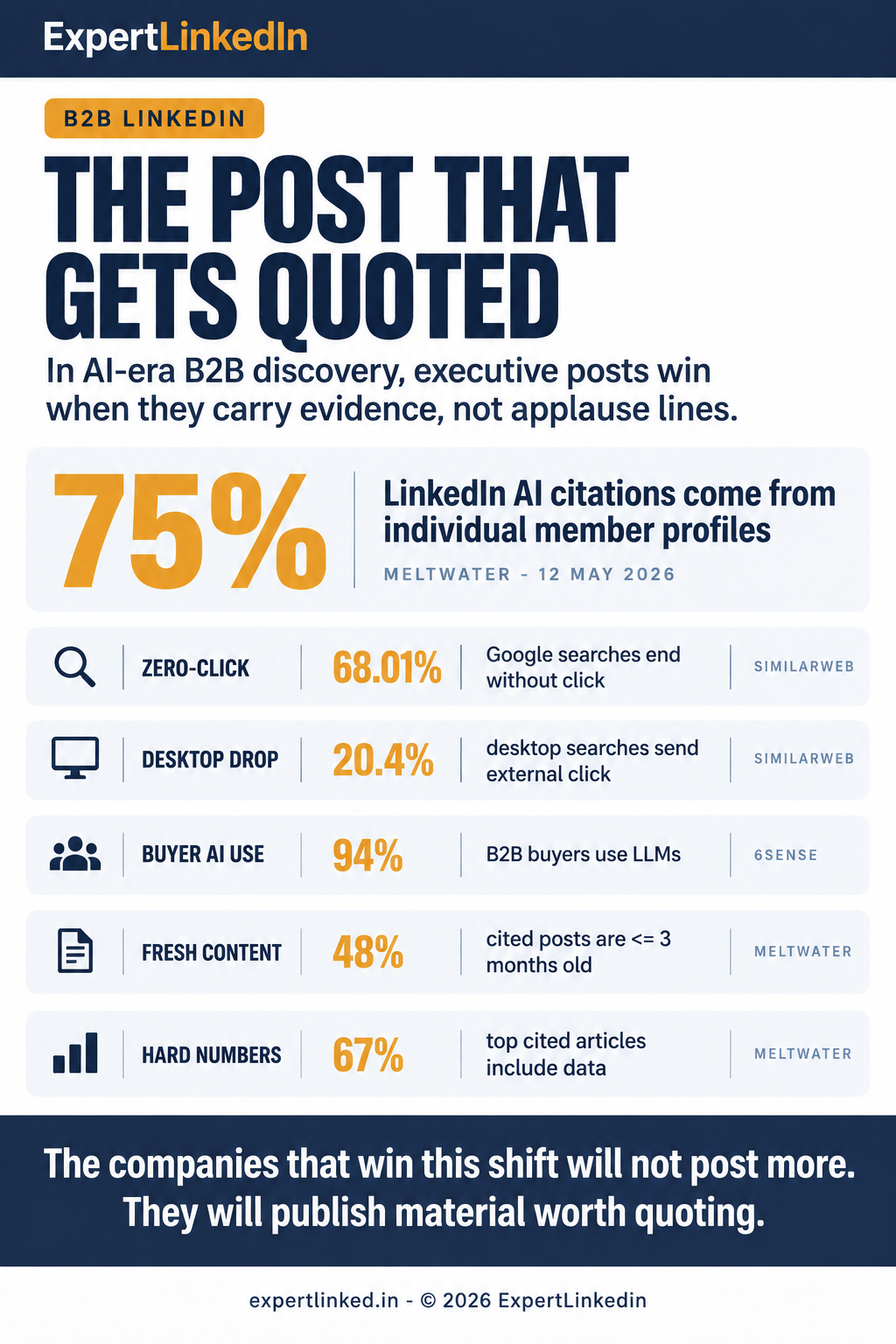
Similarweb’s June 2026 zero-click analysis says 68.01% of Google searches now end without an external click. On desktop, only 20.4% of searches produce any click to a non-Google site. That number matters especially in B2B, where vendor research, shortlist building, and procurement comparison still happen disproportionately on desktop.
Pew’s browsing study sharpens the behavior change. When Google showed an AI summary, users clicked a traditional result on 8% of visits, versus 15% when no AI summary appeared. They clicked a source inside the summary just 1% of the time. That is not a small UX tweak. It is a change in where the first impression gets formed.
The B2B side is moving just as fast. 6sense says 94% of B2B buyers now use LLMs during their buying journey. Its research also found the point of first contact moving from 69% to 61% of journey completion, meaning buyers are reaching vendors earlier but after doing more machine-assisted comparison work on their own. This is why so many marketing teams feel a strange contradiction right now: website traffic gets wobblier while deal conversations arrive better informed and less patient.
In that environment, the executive post is no longer just a distribution asset. It is part of the material buyers and AI systems use to build the first draft of your reputation.
The post now carries the identity layer #
This shift is not only about AI search. It is also about how LinkedIn itself evaluates and distributes professional information.
LinkedIn Engineering says the Feed now serves more than 1.3 billion professionals, and that its systems read far more than the text of a post. They evaluate author information, headline, company, industry, skills, engagement patterns, and how those signals change over time. In other words, your content is not encountered as free-floating copy. It arrives wrapped in identity.
That explains why the citation data keeps landing in the same place. LinkedIn’s June AI-visibility analysis says the platform appears in 11% of AI responses on average across ChatGPT Search, Google AI Mode, and Perplexity. Profound’s March research found LinkedIn became the number one cited domain for professional queries across six major AI search platforms, while Meltwater’s May study found that 75% of LinkedIn citations come from individual member profiles rather than Company Pages.
The market is telling you something blunt: attributable expertise is more reusable than anonymous brand polish.
Verification strengthens that further. LinkedIn says more than 100 million members have added a verification, and verified members see up to 60% more profile views and up to 50% more engagement on posts. Verified Pages, meanwhile, see 10.9x more views and 7.7x more followers. I do not read that as a cosmetic badge story. I read it as portable trust metadata. The post inherits more weight when the person and the organization look more anchorable.
That is why the executive post has quietly become a source document. It is no longer evaluated mainly as tone, reach, or personal charm. It is evaluated as a signed artifact attached to a real operator with a real context.
Structure became table stakes. Evidence became the differentiator #
This is the correction many thought-leadership programs still resist.
LinkedIn’s September 2026 AI-search guidance makes the point directly: structure matters, but a point of view AI cannot replicate is what gets cited. Meltwater found the same thing at scale. In its analysis of 9.5 million AI citations, the most-cited LinkedIn articles used bullets or numbered items 100% of the time, clear headings 92% of the time, named entities 75% of the time, and hard numbers 67% of the time. Yet the real lift came from content that answered a decision question with specifics a model could not invent on its own.
That is the crucial distinction. Formatting helps extraction. It does not create attribution value.
LinkedIn’s June post-level guidance is even more operational. It says posts work best when the opening line is clear enough to shape the URL, the structure follows direct questions and answers, and the post stays tight enough for retrieval systems to quote cleanly. It recommends 200-300 words for posts, 800-1,200 words for articles, and a paired system where one article seeds several follow-on posts. Its August guide adds the cadence point: articles generate roughly 60% of LinkedIn content citations while posts generate the other 40%. Different formats, different jobs, same authority system.
Meltwater adds two more useful corrections. First, 72% of cited LinkedIn content was original, not reshared. Second, 48% of cited content had been published in the previous three months. Freshness and originality matter because models prefer current, attributable material over repackaged consensus.
This is where most executive ghostwriting goes soft. It tries to make the leader sound polished, when the real requirement is to make the leader quotable. Those are not the same thing.
A polished post says: “AI is transforming how B2B buyers discover value.”
A quotable post says: “In our pipeline reviews this quarter, the first vendor question shifted from price to proof of implementation, because buyers had already used AI to compare features before speaking to sales.”
One is generic and safely agreeable. The other carries a vantage point, a time marker, and a defensible observation. One can be paraphrased by anyone. The other can be attributed.
The ghostwriter’s job has changed #
The old brief was “make the executive look active.” The new brief is “make the executive worth citing.”
That changes the work upstream. Communications teams need source packs, internal interviews, concrete examples, and a strong sense of which claims the company can defend in public. If the post references a market trend, it should carry the number. If it makes a strategic claim, it should name the customer pattern, the operational tradeoff, or the failure mode. If it challenges category consensus, it should do so with enough evidence that a buyer could bring it into a meeting without embarrassment.
The trust behavior behind this is already visible. 6sense, summarizing broader market research, says 58% of buyers engaged vendors earlier specifically to validate how AI capabilities were being implemented. The same guide cites TrustRadius research saying 90% of buyers click through to verify AI-provided information. So the post does not need to close the deal. It needs to survive verification.
That is why I increasingly think the best executive LinkedIn content behaves less like copywriting and more like a briefing note. The audience may see only 250 words in the feed. But beneath those 250 words there should be a research trail, a clear owner, and a claim the author would be comfortable repeating on stage, in a sales call, or in front of a skeptical customer.
If that sounds heavier than the old content calendar, it is. That is because the post is doing heavier work.
What strong teams are doing now #
The practical response is not to flood the feed with more executive commentary. It is to tighten the publishing system around source quality.
- Build every executive post from a source memo.
If a post includes a trend, quote, stat, customer pattern, or strong opinion, there should be an internal note showing where it came from and why it matters now.
- Pair one canonical article with a short run of posts.
Use the article to carry the deeper argument and the posts to distribute one fact, one tension, or one operator lesson at a time. This mirrors how AI systems and human readers already consume the material.
- Publish from topic owners, not only rank holders.
Meltwater found 51% of cited creators had fewer than 10,000 followers. The signal is expertise, not celebrity. A head of product, solutions architect, or customer operator with a sharp lane can outrun a vague executive voice quickly.
- Make specificity visible.
Name the company category, the tool, the date, the metric, the buyer question, the implementation tension. AI systems retrieve extractable details. Buyers trust them too.
- Use formats that reward depth, not just motion.
Socialinsider’s 2026 benchmarks found LinkedIn’s native document posts led engagement at 7.00%, ahead of the 5.20% overall average. That matters because research snapshots, frameworks, and annotated slides travel well in the feed while still behaving like evidence objects.
- Change the scorecard.
Impressions and likes still matter, but they are not enough. LinkedIn’s August guidance is right to split leading indicators from outcome metrics. Track engagement, but also track citations, share of voice, branded search lift, and which ideas keep resurfacing in buyer conversations.
The teams getting this right are not treating executive content as vanity media. They are treating it as reputation infrastructure.
The executive post used to be a polish layer applied after strategy. In 2026, it is part of the retrieval layer that helps decide who even makes the shortlist.
The companies that win this shift will not post more. They will publish material worth quoting.
Working on executive visibility, thought leadership, or the point where LinkedIn strategy meets AI discovery? I would like to hear where your content is being quoted, and where it is still disappearing.
Email me at victoria.sterling@tlnw.uk
References #
- Similarweb (June 10, 2026). “Zero-Click Marketing: The SEO Strategy For A World Where Most Searches Skip Your Site.” https://aisearch.similarweb.com/blog/zero-click-marketing/ (Accessed October 1, 2026)
- Pew Research Center (July 22, 2025). “Google users are less likely to click on links when an AI summary appears in the results.” https://www.pewresearch.org/short-reads/2025/07/22/google-users-are-less-likely-to-click-on-links-when-an-ai-summary-appears-in-the-results/ (Accessed October 1, 2026)
- 6sense (November 25, 2025). “How GenAI And LLMs Are Changing B2B Buyer Research, And How To Respond.” https://6sense.com/guides/how-genai-and-llms-are-changing-b2b-buyer-research-and-how-to-respond/ (Accessed October 1, 2026)
- Profound (March 9, 2026). “LinkedIn is the most-cited domain for professional queries in AI search.” https://www.tryprofound.com/blog/linkedin-is-the-most-cited-domain-for-professional-queries-in-ai-search (Accessed October 1, 2026)
- LinkedIn Marketing Blog (June 9, 2026). “How to Grow Your AI Search Visibility With LinkedIn Content.” https://www.linkedin.com/business/marketing/blog/ai-search/how-to-grow-your-ai-search-visibility-with-linkedin-content (Accessed October 1, 2026)
- LinkedIn Marketing Blog (June 30, 2026). “How to Maximize AI Visibility for Your LinkedIn Posts.” https://www.linkedin.com/business/marketing/blog/ai-search/how-to-maximize-ai-visibility-for-your-linkedin-posts (Accessed October 1, 2026)
- LinkedIn Marketing Blog (August 11, 2026). “New Guide: How B2B Marketers Can Dominate AI Search on LinkedIn.” https://www.linkedin.com/business/marketing/blog/ai-search/how-b2b-marketers-can-dominate-ai-search-on-linkedin-2026 (Accessed October 1, 2026)
- LinkedIn Marketing Blog (September 29, 2026). “Why Your Brand Needs a Point of View AI Can’t Replicate.” https://www.linkedin.com/business/marketing/blog/ai-search/why-your-brand-needs-a-point-of-view-artificial-intelligence-cant-replicate (Accessed October 1, 2026)
- LinkedIn Engineering (March 12, 2026). “Engineering the next generation of LinkedIn’s Feed.” https://www.linkedin.com/blog/engineering/feed/engineering-the-next-generation-of-linkedins-feed (Accessed October 1, 2026)
- LinkedIn News (December 9, 2025). “Verified: LinkedIn crosses 100M member milestone.” https://news.linkedin.com/2025/verified--linkedin-crosses-100m-member-milestone (Accessed October 1, 2026)
- Meltwater (May 12, 2026). “9.5M AI citations analyzed: How LinkedIn content wins AI search.” https://www.meltwater.com/en/blog/linkedin-ai-visibility-study (Accessed October 1, 2026)
- Socialinsider (March 16, 2026). “2026 LinkedIn Benchmarks.” https://www.socialinsider.io/social-media-benchmarks/linkedin (Accessed October 1, 2026)
AI Content Notice
This article was created using artificial intelligence technology. Whenever possible, we include references and sources to support the information presented. Readers are encouraged to consult these sources for further information. While we strive for accuracy and provide valuable insights, readers should independently verify information and use their own judgment when making business decisions. The content may not reflect real-time market conditions or personal circumstances.
Related Articles
Infographic: Your Executive LinkedIn Post Is Now a Source Document
Most executive LinkedIn posts are still written like brand theatre. In AI-mediated B2B discovery, …
The New B2B Homepage Is a Verified Expert
B2B buyers increasingly meet credible people before they ever reach a website. LinkedIn citations, …
Your LinkedIn Company Page Is Not a Channel. It's a Proof Library.
Most B2B teams still judge LinkedIn company pages by reach. In an AI-mediated, zero-click funnel, …