The New B2B Homepage Is a Verified Expert

Your B2B homepage is probably the wrong object.
In 2026, buyers are just as likely to meet a verified product leader, operator, or founder inside a LinkedIn citation, AI answer, or peer share as they are to land on your website. That changes what the first trust surface is, where discovery begins, and why so many company pages now feel weaker than the brands behind them.
In LinkedIn’s New Bottleneck Is Not Reach. It’s Operational Trust., I argued that LinkedIn had stopped being a simple content channel and started behaving like a trust system. In LinkedIn’s Spontaneity Tax: Why Professional Trust Is Becoming a Scheduled System, I made the same point from the platform side: improvised posting was losing ground to structured credibility. Last month, Your LinkedIn Company Page Is Not a Channel. It’s a Proof Library. turned that into a page strategy. This is the next move again: the first page buyers trust is increasingly a person.
Discovery starts before the visit #
The website is still important. It is just no longer guaranteed to be first.
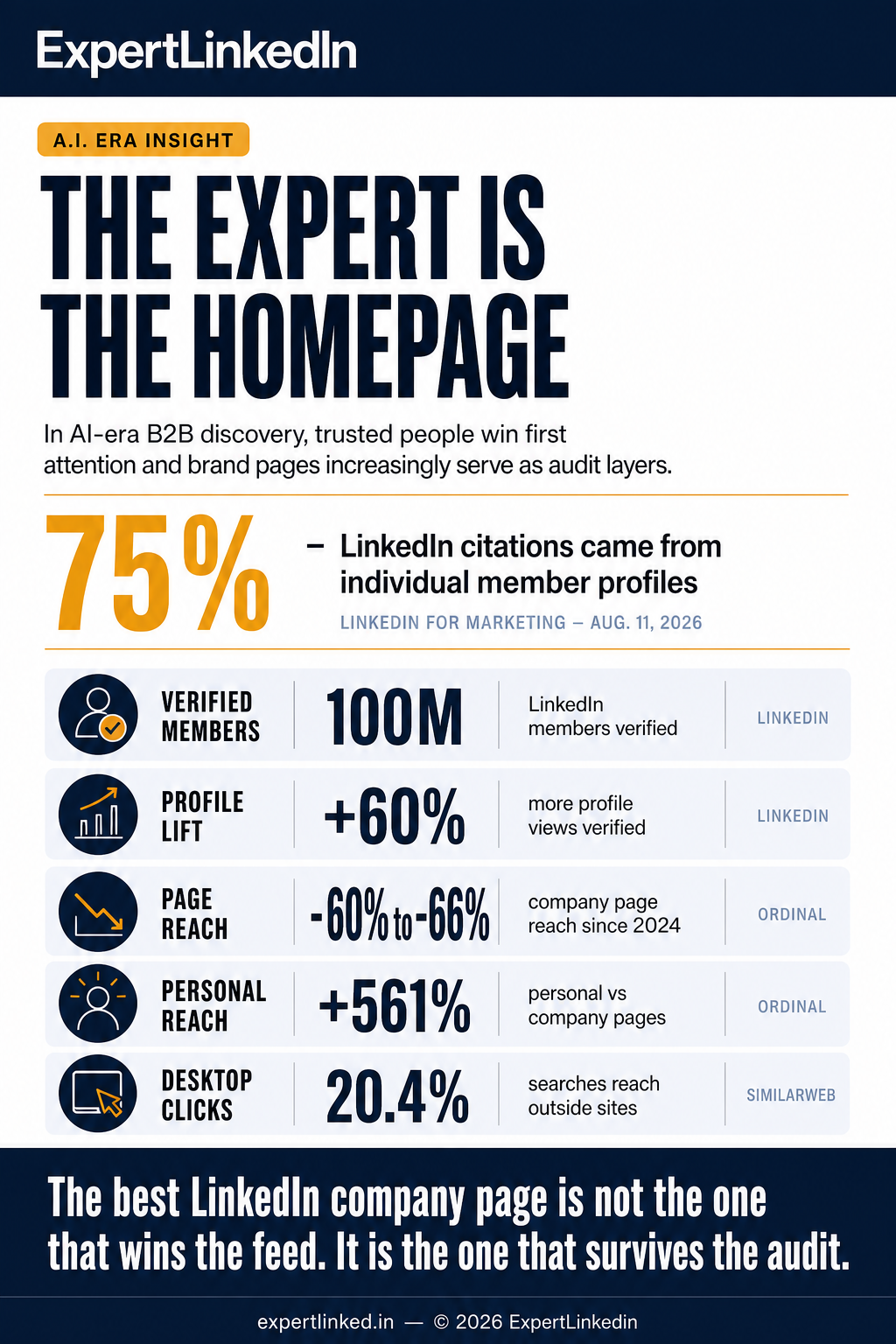
Similarweb’s June 2026 zero-click analysis says 68.01% of Google searches now end without a click. On desktop - the surface that looks far more like B2B buying behavior than mobile does - only 20.4% of searches produce any external click to a non-Google site. Pew’s July 2025 browsing study sharpened the same pattern: users clicked a traditional result on just 8% of visits when an AI summary appeared, versus 15% when one did not. They clicked a source inside the summary only 1% of the time.
For B2B teams, that should reset the whole mental model. Discovery is happening inside answer surfaces that may never send a visit. LinkedIn’s June AI-visibility research says 95% of B2B buyers who use AI rely on it to research vendors and solutions, and 84% use AI search engines directly during the buying process. LinkedIn’s August guide pushes the point further, citing 6sense data that 94% of B2B buyers now use generative AI for research, while the average B2B buying cycle compressed from 11.3 months in 2024 to 10.1 months in 2025.
If that is where discovery starts, your website is no longer the first page in the journey. It is one of the pages buyers check after they already have a draft opinion.
LinkedIn became the professional index #
The platform effect behind this is no longer subtle.
Profound’s March 2026 research found that LinkedIn moved from roughly #11 to roughly #5 in ChatGPT domain rank in three months, and that it became the #1 cited domain for professional queries across Gemini, Google AI Overviews, Google AI Mode, ChatGPT, Microsoft Copilot, and Perplexity. More important than the rank shift was the content shift. In ChatGPT responses, LinkedIn posts rose from 20.9% to 26.0% of citations, long-form articles rose from 6.0% to 8.9%, and the combined share of posts plus articles rose from 26.9% to 34.9%.
LinkedIn’s own June analysis of 89,000 unique cited LinkedIn URLs describes the same market from inside the system. On average across ChatGPT Search, Google AI Mode, and Perplexity, LinkedIn shows up in 11% of AI responses. That is not a side effect. It is discovery infrastructure.
The feed architecture is reinforcing it. LinkedIn Engineering says the Feed now serves more than 1.3 billion professionals, and that the most valuable content is timely, relevant to professional goals, and grounded in trust. Their retrieval and ranking systems do not just read post text. They read author context, skills, company, industry, and engagement history. In other words, the content is not being evaluated in isolation. The person attached to it matters.
That is the update most teams still have not internalized. LinkedIn is not only indexing topics. It is indexing attributable expertise.
The first trust touch now belongs to a person #
This is where the company-page story changes shape.
LinkedIn’s June AI-visibility article says that Perplexity cites Company Pages 59% of the time, while ChatGPT Search and Google AI Mode cite individual creators 59% of the time. Its August guide goes one step further and says 75% of LinkedIn citations came from individual member profiles. That is the key strategic distinction. The company entity still matters, but the first trusted encounter is increasingly carried by a named human being.
Verification makes that more powerful. LinkedIn’s December 2025 milestone announcement says over 100 million members have added a verification. Verified members see up to 60% more profile views and up to 50% more engagement on posts. LinkedIn is also pushing that trust signal beyond its own walls, with Zoom and review-heavy platforms such as G2 and TrustRadius displaying LinkedIn verification in other contexts.
That is why I do not treat verification as a cosmetic badge anymore. In an AI-mediated market, it behaves more like portable trust metadata. A verified expert profile tells both humans and retrieval systems that the source is attached to a real workplace, a real identity, and a real operating context.
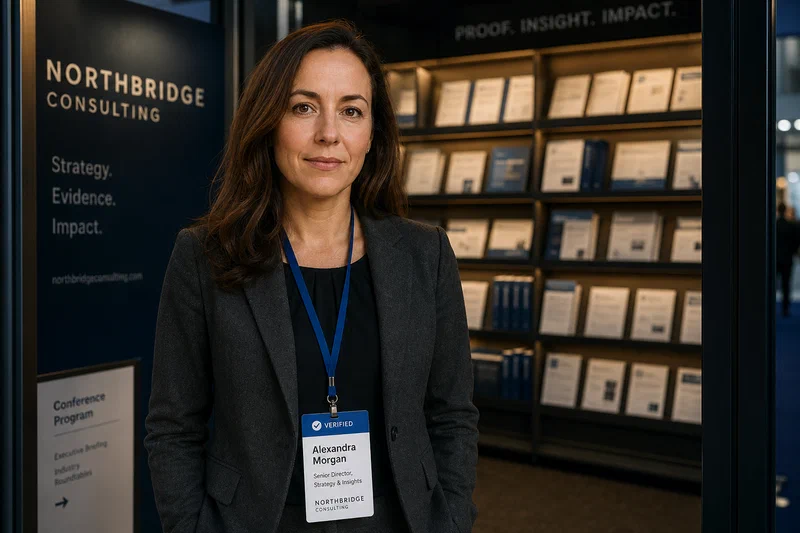
The verified subject-matter expert is becoming the new landing page: a human surface that answers the question, signals a real point of view, and gives buyers a name they can remember.
The company page has been demoted, not destroyed #
This does not make the company page irrelevant. It gives it a different job.
Ordinal’s 2026 analysis says company page reach fell 60% to 66% from 2024 to early 2026, while personal profiles now generate 561% more reach, 2.75x more impressions, and 5x more engagement than company pages posting identical content. That is a distribution downgrade, not a death sentence.
Meanwhile, LinkedIn’s own verification data says verified Pages still get 10.9x more views and 7.7x more followers. Social Media Today, citing Socialinsider’s benchmark on 1.3 million posts from 16,645 business pages, found that native document posts generate the strongest engagement of any LinkedIn format.
That is the clue. The company page is no longer the best object for first-touch reach. It is the audit layer buyers use to confirm that the expert they just encountered belongs to a coherent business.
This is where the page should be strong:
- A visible verified brand identity.
- A clean archive of original research, document posts, and operator-grade articles.
- Clear vocabulary around the topics the company should own.
- Enough organizational proof that the expert voice does not feel detached from the business.
People increasingly open the door. The page increasingly proves the house is real.
What winning teams are doing now #
The practical response is not “ask employees to post more.” It is tighter than that.
- Verify the people buyers will trust first.
Do not start with the logo. Start with the executives, product leads, operators, and specialists whose names already show up in deals, events, demos, research, and customer questions. LinkedIn’s March guidance is clear that authors need credibility more than virality, and that educational content is the crown jewel.
- Build one canonical article per theme, then distribute it through people.
LinkedIn’s own AI-search guidance says articles in the 800-1,200 word range and posts in the 200-300 word range do different jobs. Articles build authority. Posts distribute it. The strongest system is one in-depth article plus two to three supporting posts, all reinforcing the same point of view.
- Make the company page the audit layer, not the main broadcasting engine.
That means document carousels, original research, case-study proof, clear team identity, and consistent terminology. If the page is mostly announcements, it is underperforming its new role.
- Keep the language lane consistent.
LinkedIn repeatedly stresses terminology discipline because AI systems build stronger associations when a company and its experts keep naming the same category, problem, and product logic the same way. If the CEO, product lead, and page all describe the same thing differently, the signal dilutes.
- Measure trust outcomes separately from feed activity.
LinkedIn’s August guide recommends splitting metrics into leading indicators, outcome metrics, and diagnostics. That is the right frame. Post impressions and comments are not the same as citations, share of voice, or sentiment inside AI discovery. And those are not the same as downstream branded search or pipeline movement. Their own data says new pages take a median 6.81 days to be cited by ChatGPT or Claude, while 90% take up to 37 days. Teams still making go or no-go decisions on one week’s engagement data are grading the wrong part of the system.
The strategic correction #
If your subject-matter experts are invisible, your website can still be beautiful and your company page can still be active while your real first page remains blank.
That is the correction most B2B teams now need to make. The homepage still exists. The company page still matters. But they are increasingly supporting actors in a trust sequence that starts earlier, moves faster, and attaches first to a person.
In 2026, the best LinkedIn company page is not the one that wins the feed. It is the one that survives the audit.
Working on executive visibility, employee advocacy, or AI-era trust signals on LinkedIn? I would like to hear where your buyers are actually meeting your brand first.
Email me at victoria.sterling@tlnw.uk
References #
- LinkedIn Corporate Communications Team. (December 9, 2025). “Verified: LinkedIn crosses 100M member milestone.” https://news.linkedin.com/2025/verified--linkedin-crosses-100m-member-milestone (Accessed September 17, 2026)
- McCain, Davis and Brandon Punturo. (March 9, 2026). “LinkedIn is the most-cited domain for professional queries in AI search.” https://www.tryprofound.com/blog/linkedin-is-the-most-cited-domain-for-professional-queries-in-ai-search (Accessed September 17, 2026)
- Shah, Davang. (March 12, 2026). “How to Leverage LinkedIn for AI Visibility in 2026.” https://www.linkedin.com/business/marketing/blog/content-marketing/how-to-leverage-linkedin-for-ai-visibility-in-2026 (Accessed September 17, 2026)
- Danchev, Hristo. (March 12, 2026). “Engineering the next generation of LinkedIn’s Feed.” https://www.linkedin.com/blog/engineering/feed/engineering-the-next-generation-of-linkedins-feed (Accessed September 17, 2026)
- Hutchinson, Andrew. (April 2, 2026). “Report shows document posts on LinkedIn see more engagement.” https://www.socialmediatoday.com/news/report-shows-document-posts-on-linkedin-see-more-engagement/816551/ (Accessed September 17, 2026)
- Zhao, Jeffrey. “The Declining Reach of LinkedIn Company Pages.” https://www.tryordinal.com/blog/the-declining-reach-of-linkedin-company-pages (Accessed September 17, 2026)
- Barenholtz, Limor. (June 10, 2026). “Zero-Click Marketing: The SEO Strategy For A World Where Most Searches Skip Your Site.” https://aisearch.similarweb.com/blog/zero-click-marketing/ (Accessed September 17, 2026)
- Loktionova, Margarita. (June 9, 2026). “How to Grow Your AI Search Visibility With LinkedIn Content.” https://www.linkedin.com/business/marketing/blog/ai-search/how-to-grow-your-ai-search-visibility-with-linkedin-content (Accessed September 17, 2026)
- Shah, Davang. (June 30, 2026). “How to Maximize AI Visibility for Your LinkedIn Posts.” https://www.linkedin.com/business/marketing/blog/ai-search/how-to-maximize-ai-visibility-for-your-linkedin-posts (Accessed September 17, 2026)
- Chapekis, Athena and Anna Lieb. (July 22, 2025). “Google users are less likely to click on links when an AI summary appears in the results.” https://www.pewresearch.org/short-reads/2025/07/22/google-users-are-less-likely-to-click-on-links-when-an-ai-summary-appears-in-the-results/ (Accessed September 17, 2026)
- Shah, Davang. (August 11, 2026). “New Guide: How B2B Marketers Can Dominate AI Search on LinkedIn.” https://www.linkedin.com/business/marketing/blog/ai-search/how-b2b-marketers-can-dominate-ai-search-on-linkedin-2026 (Accessed September 17, 2026)
AI Content Notice
This article was created using artificial intelligence technology. Whenever possible, we include references and sources to support the information presented. Readers are encouraged to consult these sources for further information. While we strive for accuracy and provide valuable insights, readers should independently verify information and use their own judgment when making business decisions. The content may not reflect real-time market conditions or personal circumstances.
Related Articles
Infographic: The New B2B Homepage Is a Verified Expert
B2B buyers increasingly meet credible people before they ever reach a website. LinkedIn citations, …
Your LinkedIn Company Page Is Not a Channel. It's a Proof Library.
Most B2B teams still judge LinkedIn company pages by reach. In an AI-mediated, zero-click funnel, …
Infographic: Your LinkedIn Company Page Is Not a Channel. It's a Proof Library.
Most B2B teams still judge LinkedIn company pages by reach. In an AI-mediated, zero-click funnel, …