My Review Says I'm High Impact, But My Pay Isn't Moving - and What to Do Before 2027 Planning Starts

Your review said “high impact.” Your raise said “wait until next year.” The same company wrote both sentences in the same cycle, and they were never meant to describe the same thing.
That is the quiet trick of late October. The praise arrives in writing — in the review, in the calibration note, in the all-hands celebration — while the only thing that could actually move you, a budget line, stays silent. By the time you feel the gap, 2027 planning is already underway, and the number that will define your next twelve months is being set in a room you are not in.
The U.S. Employment Cost Index for the third quarter lands this morning, and it will tell the same story the market has been telling all autumn: compensation is still climbing, but slowly, and inflation keeps eating the gain. For anyone whose review glowed while their pay didn’t move, that is not background noise. It is the answer to a question they are being politely discouraged from asking.

“I lead a small analytics team at a healthcare company, and my October review came back ’exceeds expectations.’ The phrase ‘high impact’ appears three times. My manager wrote that I ‘carried the team through a brutal year.’ Then the merit letter arrived: 2.9%. A colleague who joined in March now earns more than I do. When I asked, I got a long answer about ’timing’ and ’the budget cycle’ and ’let’s revisit in Q1.’ Since the summer I have absorbed two departed colleagues’ work. I feel ungrateful even raising it — they keep telling me how valued I am. How do I tell the difference between a company that means it and a company that is managing me until I stop asking?” — Analytics manager, healthcare company
This is the fifth movement in a pattern I have been tracing since summer. On Sept. 18 I wrote about the manager who agrees with you in private but won’t sponsor you in public — My Manager Agrees With Me Privately but Won’t Sponsor Me Publicly. On Oct. 9 I wrote about the self-evaluation that starts to read like propaganda — My Self-Evaluation Feels Like Propaganda. On Oct. 23 I wrote about being the reliable one who absorbs everything late — I’m the Reliable One, So Everything Late Lands on Me. Each assumed a gap. This week names the one that finally makes people angry: the gap between being praised and being paid.
The Clinical Read #
Start with what is actually happening in the system, because it is not personal — and that is precisely what makes it hard to fight.
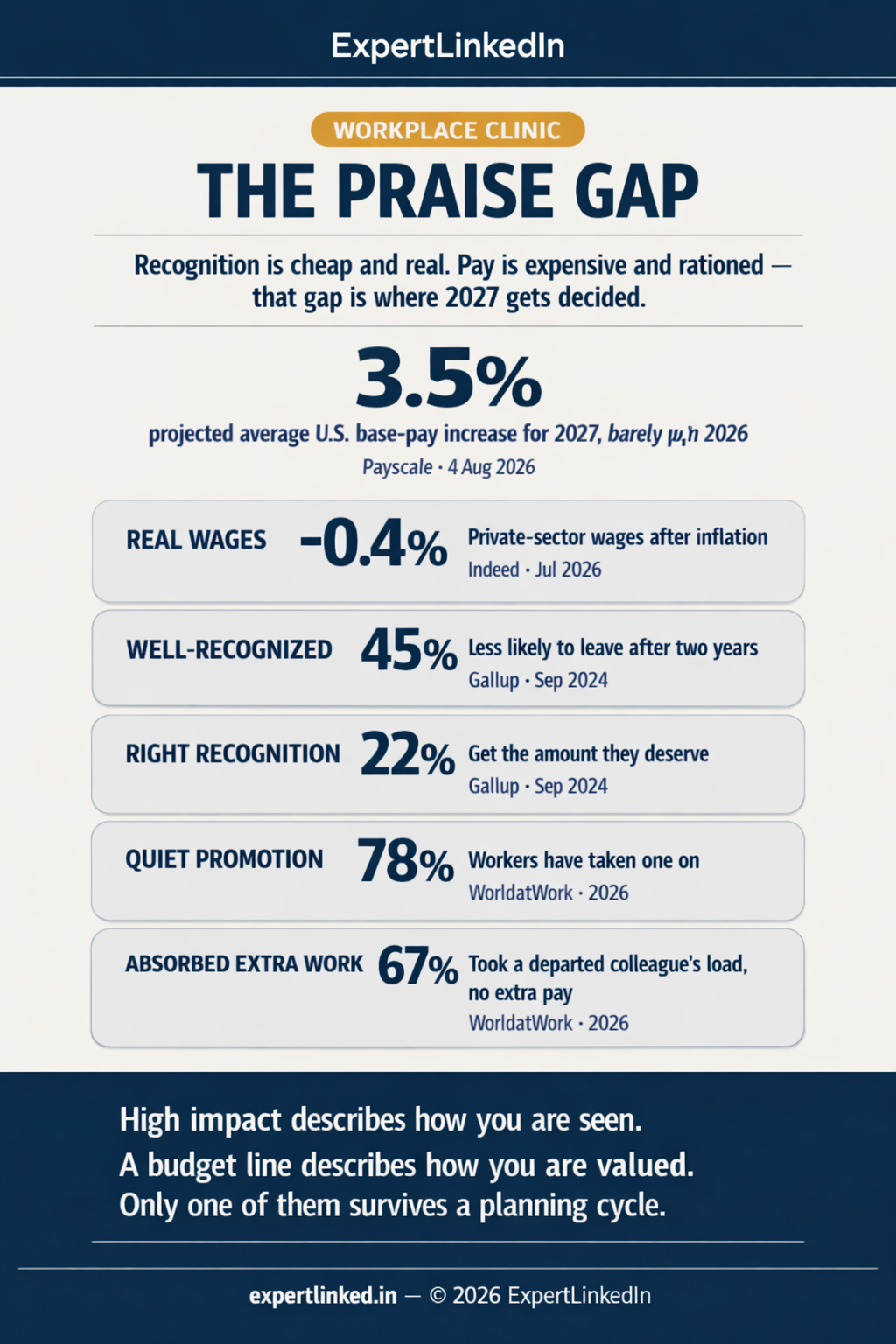
The last full Employment Cost Index reading, for the second quarter of 2026, showed civilian compensation costs up 3.4% over the year — wages and salaries up 3.2%, benefits up 3.8%. Sounds healthy until you adjust for prices. Indeed’s Hiring Lab flagged in its Q2 analysis, titled Losing Ground, that real, inflation-adjusted wages for private-sector workers fell 0.4% year over year — the first drop in buying power since 2022. Advertised pay on Indeed was already cooling to 2.4% in June, and posted wages tend to lead the government’s ECI by about seven months. More cooling is in the pipeline.
Now look at next year’s budget, because this is the part the “let’s revisit in Q1” conversation hopes you won’t check. Payscale’s 2026–2027 Salary Budget Survey puts average U.S. base-pay increases at 3.5% for 2027, up only marginally from 3.4% in 2026, and calls the mood “pay paralysis.” Mercer’s planning survey projects 3.2% merit and 3.5% total increases. WorldatWork lands in the same band. Three independent surveys, one verdict: next year’s matrix looks almost exactly like this year’s.
So when a company says “be patient until 2027 planning,” it is not describing a rebound. It is describing the same 3% it just gave you.
Here is the sharper twist. Payscale found that the share of organizations spreading one flat raise across everyone — “peanut butter pay” — is falling, from 44% heading into 2026 to 32% planning a standard increase for 2027. Pay is being differentiated. In theory that rewards your high-impact rating. In practice, in a year when 25% of organizations say unfair-pay perceptions are a leading reason they lose talent, it often means the money is going to someone the room remembers — and a rating nobody read is not a bid.
Why praise and pay run on different clocks #
Recognition is not fake. That is what makes this confusing.
Gallup and Workhuman have tracked thousands of employees and found that well-recognized workers are 45% less likely to have left two years later — and 65% less likely to be job-hunting when the praise is high quality. Recognition works. It also costs almost nothing. The same research shows only 22% of employees say they get the right amount of recognition, and more than half get none that meets the standard — while replacing a manager costs about 200% of their salary, and replacing a technical specialist about 80%. Put those numbers together and you can see the incentive clearly: if praise buys loyalty at a fraction of the price of pay, a rational employer under budget pressure will lean on praise hardest in exactly the year it can least afford raises.
That is not cynicism. It is arithmetic. The problem is that the same arithmetic makes it nearly impossible, from the inside, to tell gratitude from a retention tactic. They look identical in October. They separate in January.
There is a second mechanism, and it has a name. WorldatWork’s reporting on “quiet promotions” found that 78% of workers have experienced one, and 67% have taken on a departed colleague’s workload without more pay. Korn Ferry’s Tom McMullen calls it a breach of the psychological contract: “If you’re asking a worker to increase their effort, I would expect the employer to increase their rewards and recognition.” Instead, the extra scope becomes the new normal, and the high-impact rating is the receipt for it.
The recognition-vs-movement test #
Before you volunteer another quarter of patience, run a diagnosis. Recognition can be gratitude or it can be rationing — and the difference is measurable. Six tests:
The register test. Is the praise relational (“so glad you’re here”) or systemic (written into calibration, tied to a level or range, attached to a budget request)? Only the second one scales. A compliment lives in a manager’s memory. A sponsor’s sentence lives in the room where money is decided.
The pricing test. Did anything with a number move? Base pay, target bonus, equity refresh, a title attached to higher range? If “high impact” changed nothing numeric, the rating is decoration.
The know/did test. Did leadership know (awareness) or act (allocation)? Sponsorship shows up as money and protected scope — not as being told you’re important.
The replacement test. Gallup prices a technical replacement at about 80% of salary and a manager at 200%. If your raise is a rounding error against the cost of replacing you, your employer has already priced you — and priced you low.
The timing test. Is there a dated, named mechanism in writing, or only indefinite reassurance? “We’ll bring a market adjustment in the Q1 2027 cycle” is a plan. “Let’s revisit” is a hedge. No date and no line equals no plan.
The optionality test. Do you have one quiet, specific, time-boxed external option? Patience is only leverage if the organization believes you have an alternative. Without one, patience is just supply.
From one compliment to one dated ask #
Here is the hard part, and it is why I won’t tell you to simply “demand more.” APA’s 2026 Work in America survey found only 80% of workers feel valued at work, down from 84% a year earlier, while Gallup’s third-quarter data show U.S. engagement at 29%, the lowest since 2011. Fear is up, clarity is down. “Just say no” is not a strategy in a market like that.
So convert, don’t confront. Take the compliment you were given and spend it as the opening of a written ask:
- Quote them back. “You wrote that my work was high impact. I want to make sure my compensation reflects that band, not the band below it.” You are not arguing merit; you are asking them to honor their own words.
- Name the scope drift. “Since June I’ve absorbed [X] and [Y] without a change in title or pay. Can we correct the range before the 2027 budget locks?” This is what HBR calls the core of a retention conversation when new hires are paid more than incumbents — and top performers resign first.
- Ask for a date, in writing. “If the number can’t move now, when exactly will it be reviewed, at what rubric?” Put it in email. A date is testable; a promise is not.
- Price the patience. “I’m being asked to wait for the 2027 cycle. What in this year’s ask changes then that hasn’t changed now?” If there’s no answer, you have your answer.
One caution from the compensation literature: HBR’s guidance on negotiating in the age of pay-transparency laws notes companies have become less willing to stray from set ranges — which is exactly why you anchor to replacement cost and documented scope drift, not to fairness, effort, or how much you want it.
If you manage the person you just praised #
If you wrote “high impact,” the question is whether the system paid for it. Three moves before 2027 planning:
- Audit the raise against the rating. If someone is rated top-band but paid in the middle of the matrix, you have created a pay-compression problem that will cost more to fix later — and HBR’s retention research is blunt that the fix is systems, not sentiment.
- Stop paying in gratitude. If the budget truly can’t move, buy the thing you can fund: a title that matches the scope, a protected project, a written commitment with a date.
- Never let scope drift be free. When work lands on a survivor, name the trade in the same conversation. Unpriced reliability is how you lose your best person while telling them how valued they are.
The line to protect before 2027 planning #
Do not let a scorecard and a compliment be the same sentence. “High impact” describes how you are seen. A budget line, a title, a protected scope, or a dated market adjustment describes how you are valued. Only one of them survives a planning cycle.
So this week, before the 2027 numbers harden, do one thing: take the single best sentence anyone wrote about you this year, and turn it into one concrete, dated ask — in writing. Quote their words, name your scope drift, and ask when the number moves. Then price your patience accordingly.
You are not ungrateful for noticing. You are paying attention to the only part of the review that had a number attached.
Have you been told you’re “high impact” while your pay stayed flat? Send me the letter — especially the exact words your manager used, and whether anything with a number attached ever followed. The most useful Workplace Clinic letters start where the praise stops.
Email me at olivia.bennett@tlnw.uk
References #
- American Psychological Association (September 2026). “2026 Work in America Survey.” https://www.apa.org/pubs/reports/work-in-america/2026 (Accessed October 30, 2026)
- BLS (July 31, 2026). “Employment Cost Index Summary — 2026 Q02 Results.” https://www.bls.gov/news.release/eci.nr0.htm (Accessed October 30, 2026)
- CNBC / Eric Rosenbaum (October 29, 2026). “U.S. worker engagement sinks to a 15-year low, new Gallup poll shows.” https://www.cnbc.com/2026/10/29/us-employee-engagement-gallup-poll.html (Accessed October 30, 2026)
- Gallup (September 18, 2024). “Employee Retention Depends on Getting Recognition Right.” https://www.gallup.com/workplace/650174/employee-retention-depends-getting-recognition-right.aspx (Accessed October 30, 2026)
- Gallup (n.d.). “Employee Recognition: Low Cost, High Impact.” https://news.gallup.com/businessjournal/193238/employee-recognition-low-cost-high-impact.aspx (Accessed October 30, 2026)
- Harvard Business Review (January 20, 2026). “Policies Aren’t Enough to Retain Top Talent. You Need Systems.” https://hbr.org/2026/01/policies-arent-enough-to-retain-top-talent-you-need-systems (Accessed October 30, 2026)
- Harvard Business Review (March 5, 2024). “When New Hires Get Paid More, Top Performers Resign First.” https://hbr.org/2024/03/when-new-hires-get-paid-more-top-performers-resign-first (Accessed October 30, 2026)
- Harvard Business Review (September 6, 2023). “How to Negotiate Your Salary in the Age of Pay Transparency Laws.” https://hbr.org/2023/09/how-to-negotiate-your-salary-in-the-age-of-pay-transparency-laws (Accessed October 30, 2026)
- Indeed Hiring Lab (July 31, 2026). “Q2 2026 Employment Cost Index: Losing Ground.” https://hiringlab.indeed.com/2026/07/31/q2-2026-employment-cost-index-losing-ground/ (Accessed October 30, 2026)
- Mercer (August 31, 2026). “US employers stick with moderate pay increases for 2027.” https://www.mercer.com/en-us/about/newsroom/us-employers-stick-with-moderate-pay-increases-for-2027/ (Accessed October 30, 2026)
- Payscale (August 4, 2026). “Peanut Butter Pay is Losing Its Spread — 2026-2027 Salary Budget Survey.” https://www.payscale.com/press-releases/2026-salary-budget-survey (Accessed October 30, 2026)
- SHRM (August 18, 2026). “2027 Pay Raises Expected to Hold Largely Flat Amid Cost Pressures.” https://www.shrm.org/topics-tools/news/benefits-compensation/2027-pay-salary-raises-employers-decline-slightly (Accessed October 30, 2026)
- WorldatWork / Workspan Daily (n.d.). “Shhhh: Here Are the Pros and Cons of ‘Quiet Promotions’.” https://worldatwork.org/publications/workspan-daily/shhhh-here-s-the-pros-and-cons-of-quiet-promotions (Accessed October 30, 2026)
- ExpertLinked (September 18, 2026). “My Manager Agrees With Me Privately but Won’t Sponsor Me Publicly - and What to Do Before Q4 Reviews.” https://expertlinked.in/posts/2026-09-18-my-manager-agrees-with-me-privately-but-wont-sponsor-me-publicly-and-what-to-do-before-q4-reviews/ (Accessed October 30, 2026)
- ExpertLinked (October 9, 2026). “My Self-Evaluation Feels Like Propaganda - and What to Write Before Q4 2026 Calibration.” https://expertlinked.in/posts/2026-10-09-my-self-evaluation-feels-like-propaganda-and-what-to-write-before-q4-2026-calibration/ (Accessed October 30, 2026)
- ExpertLinked (October 23, 2026). “I’m the Reliable One, So Everything Late Lands on Me - and What to Do Before Year-End 2026.” https://expertlinked.in/posts/2026-10-23-im-the-reliable-one-so-everything-late-lands-on-me-and-what-to-do-before-year-end-2026/ (Accessed October 30, 2026)
AI Content Notice
This article was created using artificial intelligence technology. Whenever possible, we include references and sources to support the information presented. Readers are encouraged to consult these sources for further information. While we strive for accuracy and provide valuable insights, readers should independently verify information and use their own judgment when making business decisions. The content may not reflect real-time market conditions or personal circumstances.
Related Articles
Infographic: My Review Says I'm High Impact, But My Pay Isn't Moving - and What to Do Before 2027 Planning Starts
Your review said “high impact” and your raise said “wait until next year.” …
I'm the Reliable One, So Everything Late Lands on Me - and What to Do Before Year-End 2026
Being the reliable one feels like a compliment — until you realise it is an allocation decision. …
The Deadline Got Faster, Not Safer - and What to Do When AI Speed Becomes Your New Baseline in Q4 2026
AI did not give your team extra time. It reset the clock. When a two-day turnaround becomes the new …