The Deadline Got Faster, Not Safer - and What to Do When AI Speed Becomes Your New Baseline in Q4 2026

The most dangerous sentence in an AI-enabled workplace is not “Use the tool.” It is “Well, we know two days is doable now.”
That sentence is never a policy. It is a memory. Someone remembers that the last draft went out in two days instead of five, and from that moment the two-day clock stops being an achievement and becomes the floor. Nothing else changes — not the review layer, not the approval path, not the number of people. Only the deadline moves. And when the deadline moves but the system does not, the risk does not vanish. It flows downhill, onto whoever is closest to the work.

“I run a small content and reporting team at a mid-size software company. Since we rolled out AI in the spring, our turnaround has gone from about a week to two days. The problem is that nothing around it changed. Same three reviewers, same approvals, same Monday standup. Last Friday my director said, ‘Great — so we know two days is the new normal.’ Nobody announced a policy. It just became the number. I’ve started working Sunday afternoons to stay ahead of it, and I can feel my judgment getting worse, not better. Q4 calibration is three weeks away, and I am afraid I will be scored against a deadline I never agreed to. How do I reset this before it becomes official?” – Content operations lead, mid-size B2B software company
This is the third movement in a pattern I have been tracing since summer. On Sept. 11 I wrote about a workaround that quietly became the KPI — Our Summer Workaround Became the New KPI. On Sept. 25 I wrote about the errors that end up belonging to one person after the whole team “went faster” — AI Helped Us Move Faster - Now the Errors Belong to Me. This week is the piece those two were building toward: what happens to time itself. The deadline got faster. That is not the same thing as the work getting safer. And October — the first true Q4 operating month — is when the faster clock stops being a feeling and starts being a scorecard line.
The Clinical Read #
Start with the number that should reframe the whole conversation. Deloitte’s 2026 Global Human Capital Trends, a survey of more than 9,000 business and HR leaders across 89 countries, found that 7 in 10 leaders now say their primary competitive strategy over the next three years is to be “fast and nimble.” Speed is no longer a side effect of AI adoption. It is the strategy. And when speed becomes the strategy, speed becomes the metric — which means every temporary acceleration gets absorbed into the baseline.
The organizations also know this is not working as intended. Deloitte found that 59% of companies still take a tech-focused approach to AI, and those firms are 1.6 times more likely to miss their expected returns than organizations that redesign the work around people. The gap is not the model. It is the work design.
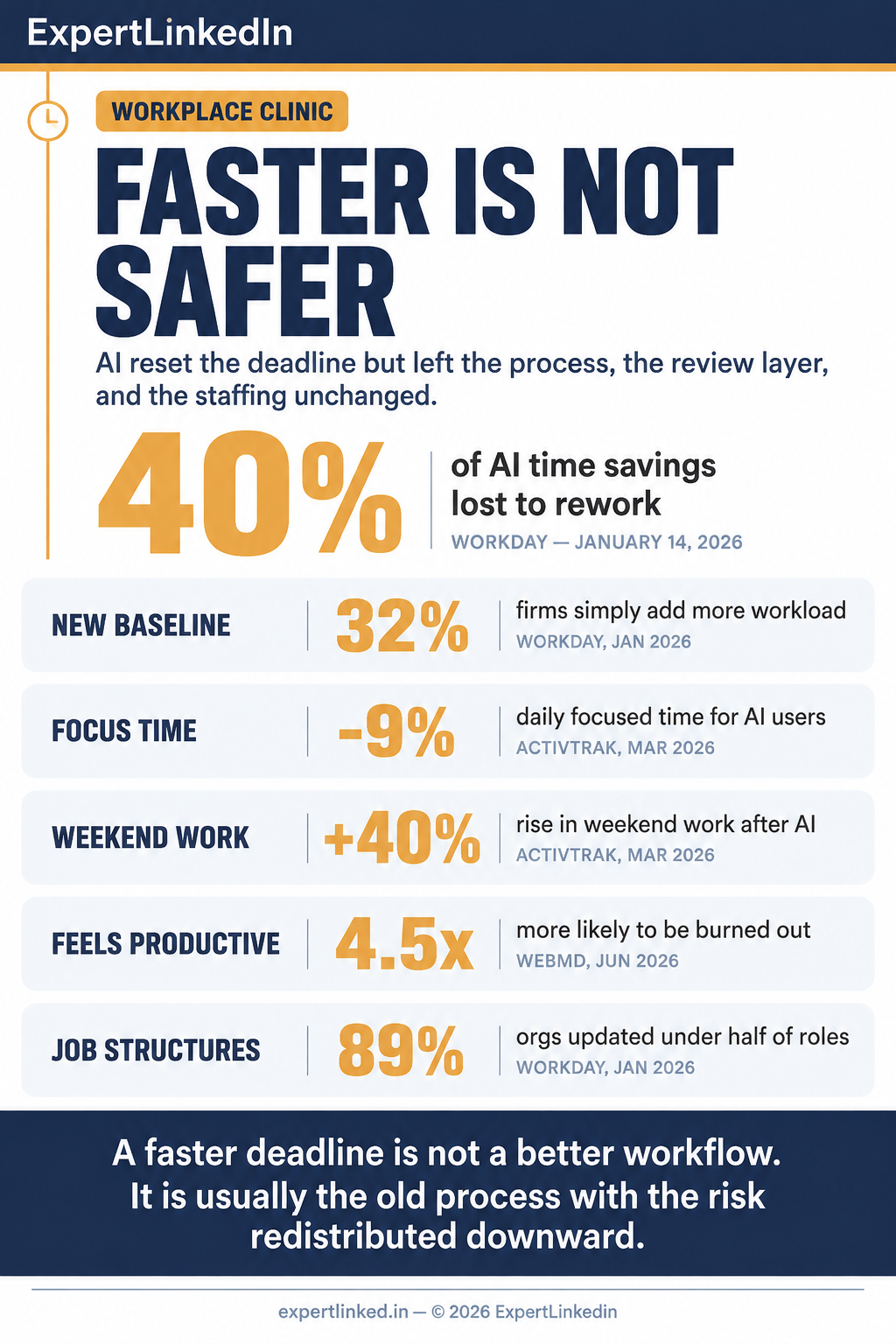
Workday’s global study of 3,200 AI-using employees captures the arithmetic most teams never do: nearly 40% of the time AI saves is lost again to rework — correcting errors, rewriting, re-checking — and only 14% of employees consistently get a clean net gain. Then comes the line that names our problem exactly. In 89% of organizations, fewer than half of roles have been updated to reflect AI. As Workday puts it, employees are using 2025 tools inside 2015 job structures.
A faster deadline is not a redesign. It is a 2015 job structure run at 2025 clock speed.
The focus data turns the same story physical. ActivTrak’s 2026 analysis of 443 million hours of work activity found that after AI adoption, time spent across work applications rose between 27% and 346% — email up 104%, chat and messaging up 145%. Daily focused time for AI users fell by 23 minutes, average focused sessions shrank, and weekend work rose more than 40%. Focus touched a three-year low. The tool sped the work up. The work got denser, not lighter.
Here is the counterintuitive part, and it is the one most leaders miss: the faster people feel, the worse they may actually be doing. MIT’s Neil Thompson and David Autor point to a software study in which programmers felt about 20% more productive while careful measurement put them roughly 20% less productive overall, because so much of the “saved” time went to managing the tool itself. WebMD Health Services’ 2026 survey of 3,872 employees found that workers who most strongly agreed AI makes them more productive were 4.5 times more likely to be burned out — and middle managers were burning out at three times the rate of individual contributors. The feeling of speed is real — and frequently a leading indicator of strain, not safety.
The strain has a name now, too. Harvard Business Review’s March 2026 research describes “AI brain fry” — the mental fog, headaches, and slowed decisions that come from supervising several AI tools at once. Workers who reported it logged 33% more decision fatigue and more minor and major errors. That is the loop nobody designed: a faster deadline pushes more parallel tools and more task-switching, which degrades judgment, which produces more rework, which lands again on the person at the end of the line.
And all of this lands on a workforce that already feels it cannot push back. APA’s 2025 Work in America survey found that 54% of workers said job insecurity was significantly affecting their stress. In that climate, “the deadline got faster” is not a productivity upgrade. It is a test — and you do not pass a test by pointing out the clock is wrong. Gallup shows why the ratchet holds: only 46% of employees clearly know what is expected of them at work. When the baseline was never defined, “faster than before” has nothing to anchor to.
How the baseline ratchet actually works #
It is rarely a decision. It is three quiet mechanics.
1. Throughput gets counted; the capacity that produced it does not #
The dashboard notices that the draft arrived in two days. It does not notice the Sunday you spent proofing it, the three reviews you compressed, or the judgment call to skip a check. Harvard Business Review’s reporting on the invisible work draining your best employees has a name for the missing piece — the coordination and quality labor that keeps things from breaking but never shows up on a chart.
2. The best case becomes the standard #
A rollout week, a light meeting week, one unusually clean draft — an exception produced an unusually fast turnaround. The organization remembers the result and forgets the conditions. That is how “we proved it was possible” becomes “this is the number” without anyone ever voting on it.
3. Speed gets measured; safety never does #
Workday found that instead of reinvesting saved time, many firms simply raise the workload — 32% do exactly that. Microsoft’s WorkLab states the mechanism in one line: “If speed is prioritized, speed scales. If volume is measured, volume scales.” Nobody is running a second dashboard for “was this safe to ship.” So the faster number compounds and the safer number stays invisible.
The 3-move response before Q4 calibration #
Move 1: Rebuild the old clock, next to the new one #
For two weeks, keep a turnaround log with four columns: what the deadline used to be; what actually moved faster; what you still had to check, rewrite, or verify by hand; and what leaked into evenings or weekends. You are not building a complaint. You are restoring the comparison the organization quietly deleted — the same move I recommended for the summer workaround, now applied to time.
Move 2: Separate speed from capacity in one conversation #
Ask four questions:
- What actually got faster — the draft, or the whole cycle including review?
- If two days is the new standard, what review or approval path changes to keep it safe?
- Who is the named approver on the compressed path?
- What comes off the plate to fund the extra checking?
One sentence does a lot of the work: “I can hold a two-day clock if we name what changes to make it safe.” HBR’s research on what companies get wrong about decision rights is blunt that where no one is named, work stalls and power struggles fill the vacuum. Your job is to name the approver before the deadline names you.
Move 3: Convert the invisible speed-up into one visible protection #
Ask for one structural thing that makes the new pace legible: a written turnaround standard instead of a “best case”; a named reviewer for client- or executive-facing output on the fast path; a 30-day pilot that measures rework time, weekend hours, and error rate alongside speed; or an explicit line in your review language that counts quality control. This is the same logic Jackson Rodriguez used in his risk-reduction promotion case: if the value is real, it can survive being written down.
For managers: a faster deadline is not a QA system #
If you lead people, the honest question is not whether AI made the team faster. It is what you did with the time it freed. Praising speed is easy; repricing capacity is the work.
Three tests:
- Run the counterfactual. If we executed last quarter’s process at this quarter’s clock, what would break first? Name the person, the step, and the failure.
- Design the exception path on purpose. Deloitte’s own framing question — who decides when humans intervene, and who is accountable when both humans and AI shape the output — is the layer most teams never built. Pick one recurring workflow, map where it stalls, and fix that one.
- Make it safe to say “this is not safe yet.” CCL’s research is clear that psychological safety — the belief that raising a concern won’t be punished — is what lets risk surface before it becomes an incident. If your team is quietly working Sundays to hit a clock nobody designed, that silence is not alignment. It is the accrued interest on a loan you have not admitted you took out.
The line to protect before calibration #
Do not let Q4 score you against a speed nobody designed. The faster deadline was never a decision you made; it was a decision made about you. October is the last month you can renegotiate it before it hardens into a rating. Name the baseline. Reprice the capacity. Write the trade-off down while it is still a conversation and not yet a number in your file.
Faster is not the same as better. And it is definitely not the same as safe.
Seeing a faster deadline of your own? Send me the version you are living through — especially the sentence someone said that made the speed permanent. The most useful Workplace Clinic letters begin the moment a “best case” quietly becomes the baseline.
Email me at olivia.bennett@tlnw.uk
References #
- Atlassian Teamwork Lab (April 27, 2026). “The State of Teams 2026.” https://www.atlassian.com/blog/state-of-teams-2026 (Accessed October 16, 2026)
- ActivTrak Productivity Lab (March 2026). “ActivTrak Productivity Lab Analyzes 443M Hours of Work Activity, Revealing AI Is Accelerating Work – Not Replacing It.” https://www.prnewswire.com/news-releases/activtrak-productivity-lab-analyzes-443m-hours-of-work-activity-revealing-ai-is-accelerating-work--not-replacing-it-302710985.html (Accessed October 16, 2026)
- American Psychological Association (May 21, 2025). “2025 Work in America Survey.” https://www.apa.org/pubs/reports/work-in-america/2025 (Accessed October 16, 2026)
- Center for Creative Leadership (April 10, 2026). “How Leaders Can Build Psychological Safety at Work.” https://www.ccl.org/articles/leading-effectively-articles/what-is-psychological-safety-at-work/ (Accessed October 16, 2026)
- Deloitte (March 4, 2026). “2026 Global Human Capital Trends.” https://www.deloitte.com/us/en/insights/topics/talent/human-capital-trends.html (Accessed October 16, 2026)
- Gallup (January 13, 2025). “U.S. Employee Engagement Sinks to 10-Year Low.” https://www.gallup.com/workplace/654911/employee-engagement-sinks-year-low.aspx (Accessed October 16, 2026)
- Gallup (September 5, 2023). “The Manager Squeeze: How the New Workplace Is Testing Team Leaders.” https://www.gallup.com/workplace/510326/manager-squeeze-new-workplace-testing-team-leaders.aspx (Accessed October 16, 2026)
- Harvard Business Review (February 2026). “AI Doesn’t Reduce Work - It Intensifies It.” https://hbr.org/2026/02/ai-doesnt-reduce-work-it-intensifies-it (Accessed October 16, 2026)
- Harvard Business Review (March 2026). “When Using AI Leads to ‘Brain Fry’.” https://hbr.org/2026/03/when-using-ai-leads-to-brain-fry (Accessed October 16, 2026)
- Harvard Business Review (July 2026). “What Companies Get Wrong About Decision Rights.” https://hbr.org/2026/07/what-companies-get-wrong-about-decision-rights (Accessed October 16, 2026)
- Harvard Business Review (July 6, 2026). “Performance Management Needs New Metrics in the AI Era.” https://hbr.org/2026/07/performance-management-needs-new-metrics-in-the-ai-era (Accessed October 16, 2026)
- Harvard Business Review (July 24, 2026). “The Invisible Work Draining Your Best Employees.” https://hbr.org/2026/07/the-invisible-work-draining-your-best-employees (Accessed October 16, 2026)
- MIT Initiative on the Digital Economy (2026). “AI and Productivity: Setting Expectations for ROI.” https://ide.mit.edu/insights/ai-productivity-and-roi/ (Accessed October 16, 2026)
- Microsoft WorkLab (2026). “AI@Work: Stop blaming AI and start deciding.” https://www.microsoft.com/en-us/worklab/ai-at-work-stop-blaming-ai-and-start-deciding (Accessed October 16, 2026)
- Microsoft WorkLab (2026). “AI@Work: Redesign first. Then AI just works.” https://www.microsoft.com/en-us/worklab/ai-at-work-redesign-first-then-ai-just-works (Accessed October 16, 2026)
- WebMD Health Services (June 18, 2026). “Employee Well-Being Slips as Financial Stress Surges, Survey Finds.” https://www.prnewswire.com/news-releases/employee-well-being-slips-as-financial-stress-surges-survey-finds-302803650.html (Accessed October 16, 2026)
- Workday (January 14, 2026). “Beyond Productivity: Measuring the Real Value of AI.” https://newsroom.workday.com/2026-01-14-New-Workday-Research-Companies-Are-Leaving-AI-Gains-on-the-Table (Accessed October 16, 2026)
- ExpertLinked (September 11, 2026). “Our Summer Workaround Became the New KPI - and What to Do Before Q4 2026 Review Season.” https://expertlinked.in/posts/2026-09-11-our-summer-workaround-became-the-new-kpi-and-what-to-do-before-q4-2026-review-season/ (Accessed October 16, 2026)
- ExpertLinked (September 25, 2026). “AI Helped Us Move Faster - Now the Errors Belong to Me. What to Do Before Q4 2026 Reviews.” https://expertlinked.in/posts/2026-09-25-ai-helped-us-move-faster-now-the-errors-belong-to-me-and-what-to-do-before-q4-2026-reviews/ (Accessed October 16, 2026)
- ExpertLinked (October 12, 2026). “How to Turn Risk Reduction Into a Q4 2026 Promotion Case Before Budget Freeze.” https://expertlinked.in/posts/2026-10-12-how-to-turn-risk-reduction-into-a-q4-2026-promotion-case-before-budget-freeze/ (Accessed October 16, 2026)
AI Content Notice
This article was created using artificial intelligence technology. Whenever possible, we include references and sources to support the information presented. Readers are encouraged to consult these sources for further information. While we strive for accuracy and provide valuable insights, readers should independently verify information and use their own judgment when making business decisions. The content may not reflect real-time market conditions or personal circumstances.
Related Articles
Infographic: The Deadline Got Faster, Not Safer - and What to Do When AI Speed Becomes Your New Baseline in Q4 2026
AI did not give your team extra time. It reset the clock. When a two-day turnaround becomes the new …
My Self-Evaluation Feels Like Propaganda - and What to Write Before Q4 2026 Calibration
If your self-evaluation sounds like a press release, your instinct is right. Here is how to stop …
Always-On Flexibility at Work in August 2026 - Here's the Clinical Read and the 3-Move Response
If your employer can interrupt you anytime but you cannot go unavailable without reputation cost, …