I'm the Reliable One, So Everything Late Lands on Me - and What to Do Before Year-End 2026

The most expensive compliment in the workplace is “you’re so reliable.” It is also the only compliment that arrives with a delivery schedule attached.
Nobody announces that you have been made the team’s shock absorber. It happens one rescue at a time — the report a colleague missed, the deadline that slipped, the client escalation that needed a steady hand at 6 p.m. on a Friday. Each rescue earns a thank-you. Each thank-you teaches the organization the same quiet lesson: late work can be absorbed without changing anything.
That lesson is the trap. In late October, as Q4 deadlines bunch, budgets freeze, and calibration starts turning private impressions into official numbers, the reliable person is not simply tired. They are about to be measured against a baseline their own competence created — one nobody ever agreed to.

“I run operations for a mid-size logistics company, and I have become the person everything late lands on. When a client escalates, it comes to me. When someone is out, I cover. When a report is wrong, I fix it before anyone notices. My manager calls me ’the one who keeps the wheels on,’ and honestly, it feels good to be trusted. But I have not had a normal week since August. Last month a colleague went on a two-week holiday and I absorbed his work without anyone even discussing it. When I raised it, I got praised, not helped. I am exhausted, and I am afraid that if I stop absorbing, I will suddenly look like the problem. Year-end is two months away. How do I change this before it becomes permanent?” — Operations manager, mid-size logistics company
This is the fourth movement in a pattern I have been tracing since summer. On Sept. 11 I wrote about a workaround that quietly became the KPI — Our Summer Workaround Became the New KPI. On Sept. 25 I wrote about the errors that end up belonging to one person after the whole team “went faster” — AI Helped Us Move Faster - Now the Errors Belong to Me. On Oct. 9 I wrote about the self-evaluation that starts to feel like propaganda — My Self-Evaluation Feels Like Propaganda. Each of those pieces assumed something I have not yet named directly: that one person in the building absorbs the spillover. This week is about that role — being the reliable one — and why it is the most under-priced job in the organization.
The Clinical Read #
Here is the uncomfortable reframe, and it comes from the business press rather than a therapist’s couch. On Oct. 21, Fast Company ran a piece titled The hidden cost of being the ‘reliable one’ at work. Its first line lands like a diagnosis: “Being needed feels like winning. It isn’t.” When a company depends on you so completely that your absence becomes a liability, that is not job security. Risk managers have a name for it — key person risk — and it means the business has stopped seeing your expertise as an asset and started seeing you as its biggest exposure.
Sit with that. The same reliability that earns you the compliment is the thing that makes you fragile. And the compliment is not a lie. You really are the one who keeps the wheels on. That is exactly why it is so hard to protest — and exactly why the cost stays hidden.
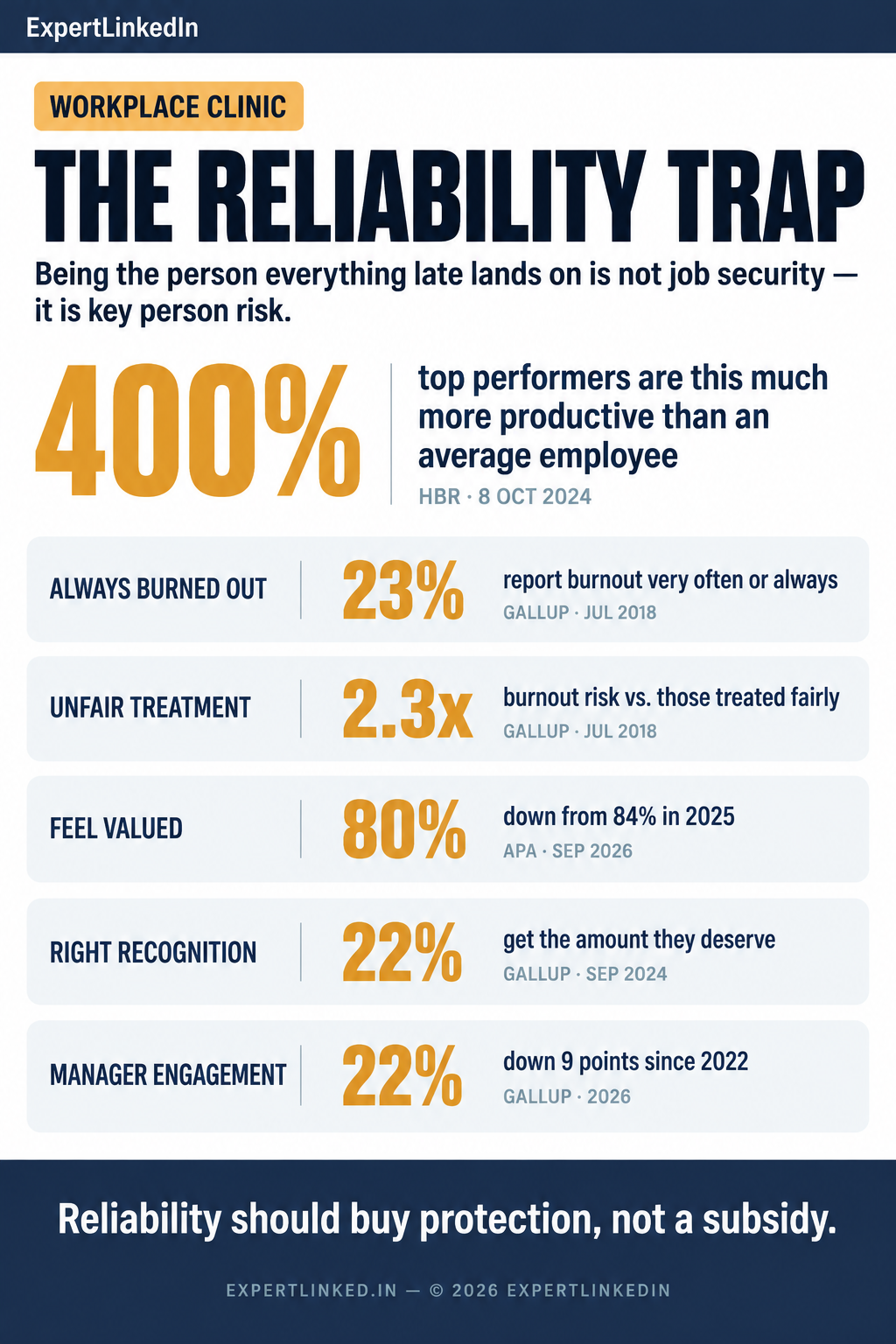
The numbers behind the feeling are not subtle. Gallup’s study of nearly 7,500 full-time employees found that 23% report feeling burned out “very often or always,” and another 44% sometimes — about two-thirds of the workforce. The reliable person rarely shows up in the first number, because they are still delivering. They show up in the second.
More telling is what Gallup found actually causes burnout. It is not effort. It is unfairness and unmanageable load. Employees who strongly agree they are often treated unfairly at work are 2.3 times more likely to burn out. And here is the mechanism that maps precisely onto our letter-writer: when a manager is overloaded, work does not get distributed by design. It gets routed to whoever is least likely to say no. The WorkLife reporting on this calls it a cognitive shortcut — “cognitively overloaded” managers “rely on biases that make it quick to go to certain types of people”. Gallup’s 2026 global data explains why those managers are so overloaded: manager engagement has fallen nine points since 2022, to 22% — the same level as the people they lead. The person who should be protecting your time is themselves running on empty.
Why late work always finds the same person #
It is rarely a decision. It is a set of quiet mechanics, and once you can see them, you cannot unsee them.
1. Your spare capacity is priced at zero #
A budget line can see a hire. It cannot see the hours you have left in you. So the organization treats your willingness as free capacity — and free things get used. This is the “quiet promotion” pattern: extra work, extra projects, more expectations than your peers, with no change in title or pay. The academic name for it is performance punishment, and the cost is documented — burnout, resentment, and the quiet masking of someone else’s underperformance.
2. The first rescue is praised; the tenth is expected #
Psychology Today describes the trap exactly: the person who saves the day is “recognized for saving the day once or twice until it becomes the norm, at which point they’re now effectively doing someone else’s work for no greater reward or recognition”. The praise is the bait. It is real at first, and then it becomes the baseline — the same baseline ratchet I wrote about in September.
3. The scorecard cannot see the load #
Harvard Business Review’s reporting on the invisible work draining your best employees is the missing piece. Leaders measure workload in hours, deadlines, and metrics — none of which capture the coordination, repair, and translation labor that keeps output from breaking. So your overload never shows up as a problem. It shows up as competence. And competence, HBR notes elsewhere, is systematically overlooked: high performers are roughly 400% more productive than an average employee, yet managers pour their attention into the under-performers who demand intervention. You are trusted to self-manage, which means no one is advocating for your load.
4. Late October normalizes it #
This is the cruelest timing. Deadlines bunch before the holidays, budgets freeze, and Q4 calibration starts converting private impressions into official judgments. Gallup’s “Great Detachment” research found that 73% of employees experienced disruptive change in the past year, and less than half say they clearly know what is expected of them. When the boundary is undefined, “everything late” has nowhere to stop. And when you are praised for absorbing it, the praise becomes the proof that you never needed help.
The three tests: are you being developed or rationed? #
Before you change anything, run a diagnosis. Reliability can be development or it can be rationing, and the difference is measurable.
The comparison test. Do your peers carry comparable late work, or are you the default? If you are the only name on the emergency list, this is not a compliment — it is a concentration risk.
The pricing test. Has your reliability produced protection — a back-up, a scope change, a promotion case, more pay — or only praise? Gallup’s recognition research draws the line: well-recognized employees are 45% less likely to leave, but only 22% of employees say they get the right amount of recognition, and more than half get none that meets the standard. Being thanked is not the same as being protected.
The concentration test. If you disappeared for two weeks, would the work stop? If yes, you have key person risk — which is the organization’s fragility, not your security. The Fast Company piece is right: “Staying the only one who knows isn’t job security. It’s how you get stuck.”
The reallocation script: a “no” that survives a weak market #
Here is the hard part. APA’s 2026 Work in America survey found that 32% of workers now fear losing their job in the next few weeks or months, up from 26% a year earlier — and only 80% feel valued at work, down from 84%. In a market like that, “just say no” is dangerous advice. So the move is not refusal. It is reallocation. You do not decline the work; you make the cost visible and route the ownership.
Try these, adapted from the NeuroLeadership researchers quoted by WorkLife:
- Trade, don’t refuse. “I can take this. To do it well, [X] moves to next week or [Y] comes off my plate — which do you prefer?” You have said yes and forced a choice at the same time.
- Turn the ask into development. “I’m glad you came to me. This is also a chance to develop [name]; I’ll own it this time and train them to own it next.” You protect your reputation and break the bias loop.
- Name the pattern before it hardens. “This is the third late-stage rescue this month. Can we note where it came from, so it doesn’t quietly become the new baseline?”
- When your manager is the bottleneck, fall back to writing: log the ask, the hours, and what slipped; ask for prioritization in writing; keep the record for calibration.
For managers: run a reliability audit #
If you lead people, the question is not whether your reliable person can handle more. It is whether you have mistaken their capacity for a system. Three moves:
- Look at your assignment log. Is the same name appearing on every late task? That is not a staffing plan; that is a cognitive shortcut, and Gallup’s manager research says you are probably running it while overloaded yourself.
- Price the spare capacity. If someone absorbs 20% more, either remove 20% elsewhere or compensate it. Unpriced reliability is how you lose your best person while telling them how valued they are.
- Manage the key person risk. Single-owner knowledge is organizational fragility. Insist on a named back-up before the vacation, not after the incident.
The line to protect before calibration #
Do not let Q4 score you against a load nobody designed. The reliability was yours. The rationing was not. October is the last month you can re-price it before it hardens into a rating.
Start a consequence ledger this week: three columns — what would have broken without me, what I absorbed that was not mine, and what protection I asked for and whether it arrived. That is not a complaint file. It is the evidence that turns “I’m so reliable” from a compliment into a case. Bring it to your next check-in, and to your self-evaluation before calibration.
The reliable one does not have to become unreliable to be treated fairly. They have to become expensive to misuse.
Reliability should buy protection, not a subsidy. The compliment is only real when someone acts on it.
Are you the one everything late lands on? Send me the letter — especially the sentence someone said that made the extra work permanent, and whether you got help or a thank-you. The most useful Workplace Clinic letters start where the praise stops.
Email me at olivia.bennett@tlnw.uk
References #
- American Psychological Association (September 2026). “Workers weather stress, uncertainty, and AI with psychological capital — 2026 Work in America Survey.” https://www.apa.org/pubs/reports/work-in-america/2026 (Accessed October 23, 2026)
- Fast Company (October 21, 2026). “The hidden cost of being the ‘reliable one’ at work.” https://www.fastcompany.com/91617787/the-hidden-cost-of-being-the-reliable-one-at-work-reliability-work-burnout-leadership (Accessed October 23, 2026)
- Gallup (July 12, 2018). “Employee Burnout, Part 1: The 5 Main Causes.” https://www.gallup.com/workplace/237059/employee-burnout-part-main-causes.aspx (Accessed October 23, 2026)
- Gallup (September 5, 2023). “The Manager Squeeze: How the New Workplace Is Testing Team Leaders.” https://www.gallup.com/workplace/510326/manager-squeeze-new-workplace-testing-team-leaders.aspx (Accessed October 23, 2026)
- Gallup (September 18, 2024). “Employee Retention Depends on Getting Recognition Right.” https://www.gallup.com/workplace/650174/employee-retention-depends-getting-recognition-right.aspx (Accessed October 23, 2026)
- Gallup (December 2, 2024). “The Great Detachment: Why Employees Feel Stuck.” https://www.gallup.com/workplace/653711/great-detachment-why-employees-feel-stuck.aspx (Accessed October 23, 2026)
- Gallup (2026). “State of the Global Workplace Report.” https://www.gallup.com/workplace/349484/state-of-the-global-workplace.aspx (Accessed October 23, 2026)
- Harvard Business Review (October 8, 2024). “Stop Ignoring Your High Performers.” https://hbr.org/2024/10/stop-ignoring-your-high-performers (Accessed October 23, 2026)
- Harvard Business Review (July 24, 2026). “The Invisible Work Draining Your Best Employees.” https://hbr.org/2026/07/the-invisible-work-draining-your-best-employees (Accessed October 23, 2026)
- Psychology Today (February 15, 2023). “Are You Guilty of Performance Punishment?” https://www.psychologytoday.com/us/blog/navigating-the-new-workplace/202302/guilty-of-performance-punishment-try-these-4-mindset (Accessed October 23, 2026)
- WorkLife (January 30, 2023). “How performance punishment builds resentment among high-achieving employees.” https://www.worklife.news/talent/performance-punishment/ (Accessed October 23, 2026)
- Wikipedia. “Performance punishment.” https://en.wikipedia.org/wiki/Performance_punishment (Accessed October 23, 2026)
- ExpertLinked (September 11, 2026). “Our Summer Workaround Became the New KPI - and What to Do Before Q4 2026 Review Season.” https://expertlinked.in/posts/2026-09-11-our-summer-workaround-became-the-new-kpi-and-what-to-do-before-q4-2026-review-season/ (Accessed October 23, 2026)
- ExpertLinked (September 25, 2026). “AI Helped Us Move Faster - Now the Errors Belong to Me. What to Do Before Q4 2026 Reviews.” https://expertlinked.in/posts/2026-09-25-ai-helped-us-move-faster-now-the-errors-belong-to-me-and-what-to-do-before-q4-2026-reviews/ (Accessed October 23, 2026)
- ExpertLinked (October 9, 2026). “My Self-Evaluation Feels Like Propaganda - and What to Write Before Q4 2026 Calibration.” https://expertlinked.in/posts/2026-10-09-my-self-evaluation-feels-like-propaganda-and-what-to-write-before-q4-2026-calibration/ (Accessed October 23, 2026)
AI Content Notice
This article was created using artificial intelligence technology. Whenever possible, we include references and sources to support the information presented. Readers are encouraged to consult these sources for further information. While we strive for accuracy and provide valuable insights, readers should independently verify information and use their own judgment when making business decisions. The content may not reflect real-time market conditions or personal circumstances.
Related Articles
Infographic: I'm the Reliable One, So Everything Late Lands on Me - and What to Do Before Year-End 2026
Being the reliable one feels like a compliment — until you realise it is an allocation decision. …
The Deadline Got Faster, Not Safer - and What to Do When AI Speed Becomes Your New Baseline in Q4 2026
AI did not give your team extra time. It reset the clock. When a two-day turnaround becomes the new …
Infographic: The Deadline Got Faster, Not Safer - and What to Do When AI Speed Becomes Your New Baseline in Q4 2026
AI did not give your team extra time. It reset the clock. When a two-day turnaround becomes the new …