The Calibration Quarter: How Q4 2026 Career Outcomes Get Locked by Scorecards, Not Sentiment

By the time the calibration room opens, your review is mostly a formality. Not because any decision was made out of malice — because it was made elsewhere, earlier, by other people using other documents.
That is the thesis I laid out at the end of September in The Performance-Review Economy: in this labor market, Q4 outcomes are decided before review season starts. October did not just confirm it. October gave us the audit trail.
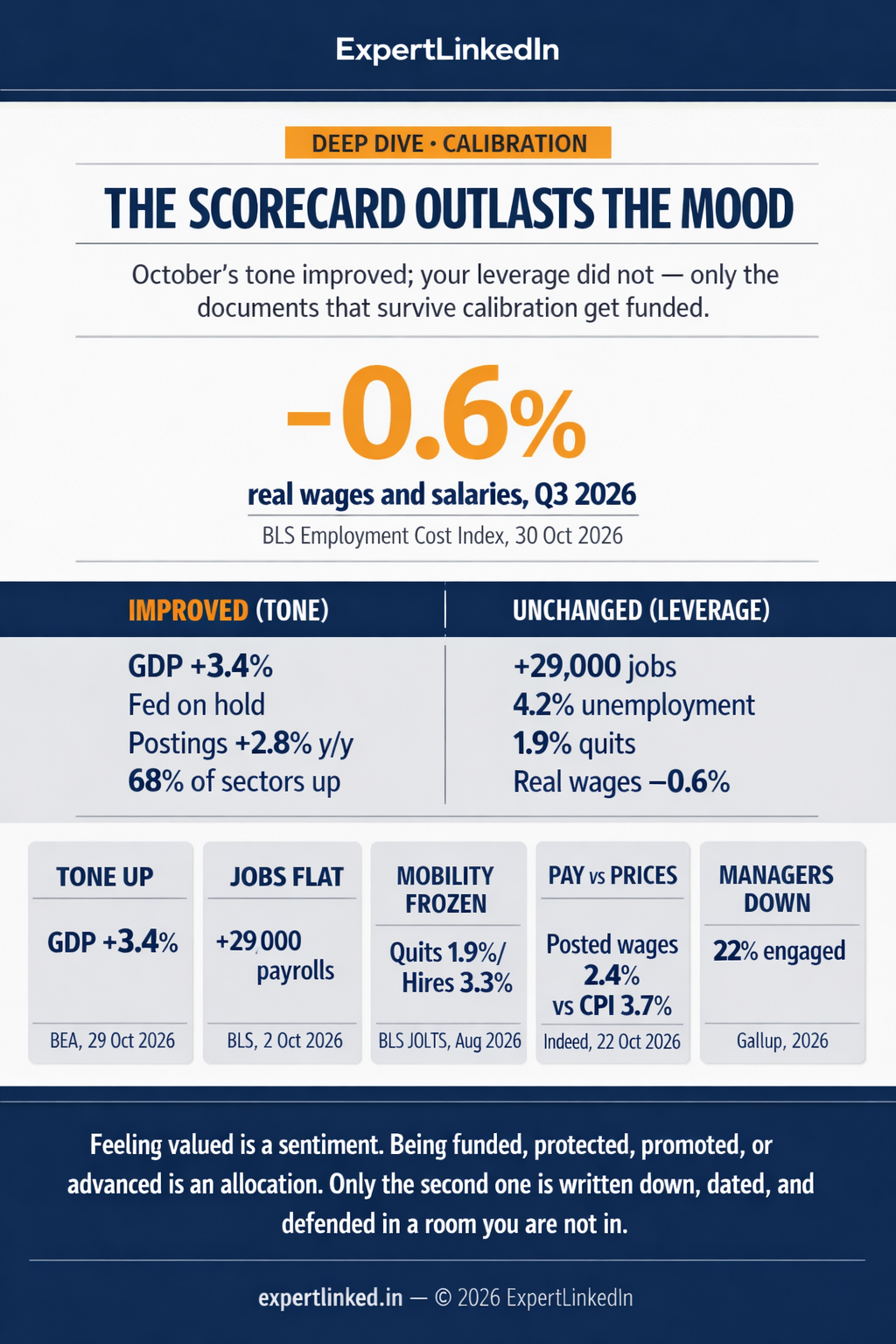
Here is the paradox that runs through the whole month. On October 29, the BEA reported that real GDP grew at a 3.4% annualized rate in the third quarter, up from 2.2% in the second. A day later, the Employment Cost Index showed employer compensation costs still climbing 3.4% over the year. Two days before GDP, the Federal Reserve held its target rate at 3.75%–4.00%.
Now the other column. September added 29,000 jobs. Unemployment rose to 4.2%. July and August were revised down by a combined 60,000. Quits sit at 1.9% and the vacancy yield at 0.71 — below a normal 2019 market. And the median full-time worker earned $1,232 a week last quarter, up 1.5% against inflation of 3.5%.
Two columns, one quarter. The first says confidence. The second says constraint. The tone improved; the leverage did not. That gap is the entire story of the calibration quarter — and if you are counting on a better mood to move your career this year, you are pricing an option the data says does not exist.

Relief is not leverage #
Start with what actually improved, so we can be honest about what it bought you.
The Fed held on October 28 — good news, and almost entirely beside the point. That hold came on a 10–2 vote, with the statement noting that “job gains have kept pace with the workforce” and that “the accumulation of more information” would guide the next move (Federal Reserve, October 28, 2026). A hold is the absence of a new shock, not the arrival of a new opening. Two dissents mean the December hike is still live. The regime is pause within tightening, and a pause is a sentence about December, not a signal about your mobility.
The hiring side tells the same story with more optimism and the same result. Indeed’s Job Postings Index climbed to 103.8, up 2.8% year over year — the first sustained annual growth in nearly four years — and 68% of occupational sectors now post more than a year ago, up from just 49% at the start of September (Indeed Hiring Lab, October 22, 2026). But new postings are still flat, hires sit at 3.3%, and posted wages are growing 2.4% against CPI of 3.7%. Demand tone is improving. Conversion is not.
And then the number that should reorganize how you read all of this. GDP grew 3.4% while employers added 29,000 jobs (BEA, October 29, 2026). That is not a contradiction. It is the definition of a capital- and AI-investment-led expansion — one that adds output without adding many workers. Strong growth is not a mobility signal. It is proof that the gap between “the economy” and your career has widened.
The five documents that survive the room #
If the mood can’t move your outcome, what can? Only what survives the calibration room. The room is where managers compare your year against peers you never see, and it has known physics: it converges on the first, most confident, most repeatable story it hears (HBR, October 2016). HBR’s own research on calibration found that the process designed to remove bias can introduce its own (HBR, January 5, 2024). And by the system owners’ own admission, only 2% of Fortune-500 CHROs strongly agree the process inspires improvement, while just 22% of employees call it fair (Gallup, May 6, 2024).
The system doesn’t need to be accurate. It needs to be comparable. That is why five artifacts decide the quarter, and almost nothing else does.
1. The self-evaluation. It is the only input you author that arrives before your manager’s draft. Write it as a translation tool, not a diary — sentences a sponsor can lift without rewriting (October 5).
2. Sponsor language. Praise in private is not a case. A sponsor is someone who repeats your argument in the room where money and levels are set, under pressure, without you there.
3. Risk-reduction proof. Some of your most valuable work prevents loss rather than produces a visible win — the avoided error, the held deadline, the escalation that never reached your director. That becomes leverage only when it carries a baseline and an organization-native unit (October 12).
4. Market context you can name. A pricing band, a live req, or a verified offer-with-a-date converts an internal opinion into an external fact. That is the whole point of the trailed option you build quietly (October 19).
5. The role-scope narrative. If your band was written for the job you were hired into and you now carry two levels of added scope, the band describes a role that no longer exists. The room cannot fund a level you have not named.
Notice what is not on the list: effort, loyalty, busyness, or how much your manager likes you. None of those survive averaging. Consequence and comparison do.
The uncomfortable truth: praise is not allocation #
Here is the finding I keep coming back to, because it explains why so many competent people feel crazy in November.
Gallup and Workhuman have shown that well-recognized workers are 45% less likely to leave within two years — recognition genuinely works (Gallup, September 18, 2024). But the same research shows only 22% of employees get the recognition they deserve, and the cost asymmetry is brutal: replacing a manager runs about 200% of salary, a technical specialist about 80%.
Put those together and you get arithmetic, not cynicism. If praise buys loyalty at a fraction of the price of pay, then a rational employer under budget pressure will lean on praise hardest in exactly the year it can least afford raises. Gratitude and a retention tactic look identical in October. They separate in January.
The mechanism has a name. WorldatWork’s research on “quiet promotions” found that 78% of workers have experienced one, and 67% have absorbed a departed colleague’s workload without more pay — a breach of the psychological contract that quietly turns a “high impact” rating into the receipt for an unpriced scope increase. My colleague Olivia Bennett traced the reader-facing version of this yesterday in My Review Says I’m High Impact, But My Pay Isn’t Moving. This piece is the structural frame under that feeling.
Why the money is real — and still not yours #
The most counterintuitive number of the quarter is not the GDP print. It is the ECI’s internals.
Civilian compensation rose 3.4% over the year. But wages were up only 3.1%, benefits 3.9%, and private health benefits 6.4%. Adjust for prices, and inflation-adjusted wages and salaries fell 0.6% (BLS, October 30, 2026). The money exists in the system. It is flowing into benefits and structure, not into base pay — the one line a worker can actually spend.
That is the quiet trap of the calibration quarter. Your raise is smaller than inflation. Your employer’s cost of labor is larger than your raise. The difference is being absorbed where you can’t see it. Meanwhile, next year’s matrix looks almost exactly like this year’s: 2027 salary budgets are tracking 3.4% (SHRM/WTW, August 18, 2026), with Mercer at 3.2% merit. And pay is being differentiated — the share of organizations spreading one flat raise across everyone fell from 44% to 32% (Payscale, August 4, 2026).
So “be patient until 2027” is not describing a rebound. It is describing the same 3% plus a harder comparative test — the kind that goes to whoever the room remembers. A rating nobody read is not a bid.
AI raised the proof threshold for everyone #
Then there is the force quietly rewriting what “good performance” even means.
Atlassian found that 89% of executives say AI increases speed, but only 6% are confident of clear organization-wide ROI, while 87% of knowledge workers lack the time to coordinate (Atlassian, April 27, 2026). HBR clocked the hidden work at roughly 6.4 hours a week of supervising, checking, and correcting AI output — a layer most organizations never capture (HBR, August 5, 2026). Deloitte’s 2026 Global Human Capital Trends, drawn from more than 9,000 leaders, names the resulting vacuum directly: authorship is “blurring,” and workers are “questioning what counts as effort, ownership, fairness, and accountability” (Deloitte, March 4, 2026).
The system remembers the speed and forgets the human proof layer. Which means every AI-assisted deliverable raises the burden of proof for the person closest to it — unless that person writes the QA, judgment, and risk reduction into the record themselves. HBR’s July analysis frames the new performance question exactly: not how much did you produce, but what judgment did you add on top of the machine (HBR, July 6, 2026). Output competes with the tool. Judgment doesn’t.
The manager writing your scorecard is running on empty #
One more structural fact, and it is the one almost nobody prices.
Gallup’s 2026 State of the Global Workplace finds global engagement at 20%, its lowest since 2020 and the first back-to-back annual decline. But the number that matters here is smaller and sharper: manager engagement has fallen nine points since 2022, to 22% (Gallup, 2026). The traditional manager “engagement premium” is gone. The person deciding your year is now about as disengaged as the people they lead — while carrying 64% more responsibilities and, for 42% of managers, less budget (Gallup, September 5, 2023).
Read that carefully. Weak sponsorship and a flat rating are, far more often than people admit, a bandwidth failure rather than a verdict about you. Which is precisely why the artifact that survives is the one your overloaded manager can carry without building it. If your case needs them to assemble it, it dies in the room without you.
Calibration readiness: six tests before the year locks #
So what do you actually do this week, before 2027 planning hardens? Run your own scorecard against the one the room will use.
- The register test. Is your praise relational (“so glad you’re here”) or systemic (written into calibration, tied to a level or range, attached to a budget line)? Only the second scales.
- The comparability test. Could a sponsor repeat your case without rewriting it? If not, it will be rewritten — probably without you in the room.
- The baseline test. Does every claim carry a number, a date, or a named stakeholder? Adjectives do not survive averaging.
- The budget-line test. Can you name the pool — merit, structure, or retention exception? If you can’t, ask your manager to name it before the meeting. That question alone often changes the conversation.
- The timing test. Is there a dated, named mechanism in writing, or only indefinite reassurance? “We’ll revisit” is a hedge. A date is a plan.
- The optionality test. Do you hold one priced, time-boxed external option? Patience is only leverage if the organization believes you have an alternative. Without one, patience is just supply.
Pass four of six and you are in control of your own narrative. Fail three and you are relying on sentiment to do the work of evidence — in the one quarter where the two have visibly split.
The uncomfortable closing truth of October 2026 is simple. Better macro numbers can arrive much faster than better bargaining power, and this month proved they already have. Feeling valued is a sentiment. Being funded, protected, promoted, or advanced is an allocation. Only the second one is written down, dated, and defended in a room you are not in.
So stop waiting for the mood to change. Write the five documents. Name the budget line. Price the option. Because in the calibration quarter, the scorecard — not the sentiment — is what gets funded into 2027.
Working through your own calibration readiness before year-end? Send me the artifact you’re least sure survives the room — the self-evaluation, the scope line, or the pay case — and I’ll tell you which test it fails first.
Email me at jackson.rodriguez@tlnw.uk
References #
- Atlassian Teamwork Lab (April 27, 2026). “The State of Teams 2026.” https://www.atlassian.com/blog/state-of-teams-2026 (Accessed October 31, 2026)
- Board of Governors of the Federal Reserve System (October 28, 2026). “FOMC Statement.” https://www.federalreserve.gov/newsevents/pressreleases/monetary20261028a.htm (Accessed October 31, 2026)
- Deloitte (March 4, 2026). “2026 Global Human Capital Trends.” https://www.deloitte.com/us/en/insights/topics/talent/human-capital-trends.html (Accessed October 31, 2026)
- Gallup (2026). “State of the Global Workplace 2026.” https://www.gallup.com/workplace/349484/state-of-the-global-workplace.aspx (Accessed October 31, 2026)
- Gallup (September 5, 2023). “The Manager Squeeze: How the New Workplace Is Testing Team Leaders.” https://www.gallup.com/workplace/510326/manager-squeeze-new-workplace-testing-team-leaders.aspx (Accessed October 31, 2026)
- Gallup (September 18, 2024). “Employee Retention Depends on Getting Recognition Right.” https://www.gallup.com/workplace/650174/employee-retention-depends-getting-recognition-right.aspx (Accessed October 31, 2026)
- Gallup (May 6, 2024). “2% of CHROs Think Their Performance Management System Works.” https://www.gallup.com/workplace/644717/chros-think-performance-management-system-works.aspx (Accessed October 31, 2026)
- Harvard Business Review (October 2016). “Noise.” https://hbr.org/2016/10/noise (Accessed October 31, 2026)
- Harvard Business Review (January 5, 2024). “How Calibration Meetings Introduce Bias into Performance Reviews.” https://hbr.org/2024/01/how-calibration-meetings-introduce-bias-into-performance-reviews (Accessed October 31, 2026)
- Harvard Business Review (July 6, 2026). “Performance Management Needs New Metrics in the AI Era.” https://hbr.org/2026/07/performance-management-needs-new-metrics-in-the-ai-era (Accessed October 31, 2026)
- Harvard Business Review (August 5, 2026). “How Much Time Do Your Employees Spend Botsitting?” https://hbr.org/2026/08/how-much-time-do-your-employees-spend-botsitting (Accessed October 31, 2026)
- Indeed Hiring Lab (October 22, 2026). “US Labor Market Snapshot — October 2026.” https://hiringlab.indeed.com/2026/10/22/us-labor-market-snapshot-october-2026/ (Accessed October 31, 2026)
- Mercer (August 31, 2026). “US employers stick with moderate pay increases for 2027.” https://www.mercer.com/en-us/about/newsroom/us-employers-stick-with-moderate-pay-increases-for-2027/ (Accessed October 31, 2026)
- Payscale (August 4, 2026). “Peanut Butter Pay Is Losing Its Spread — 2026–2027 Salary Budget Survey.” https://www.payscale.com/press-releases/2026-salary-budget-survey (Accessed October 31, 2026)
- SHRM (August 18, 2026). “2027 Pay Raises Expected to Hold Largely Flat Amid Cost Pressures.” https://www.shrm.org/topics-tools/news/benefits-compensation/2027-pay-salary-raises-employers-decline-slightly (Accessed October 31, 2026)
- U.S. Bureau of Economic Analysis (October 29, 2026). “Gross Domestic Product, Third Quarter 2026 (Advance Estimate).” https://www.bea.gov/data/gdp/gross-domestic-product (Accessed October 31, 2026)
- U.S. Bureau of Labor Statistics (October 2, 2026). “The Employment Situation — September 2026.” https://www.bls.gov/news.release/archives/empsit_10022026.htm (Accessed October 31, 2026)
- U.S. Bureau of Labor Statistics (October 30, 2026). “Employment Cost Index — September 2026.” https://www.bls.gov/news.release/eci.nr0.htm (Accessed October 31, 2026)
- WorldatWork / Workspan Daily. “Shhhh: Here Are the Pros and Cons of ‘Quiet Promotions’.” https://worldatwork.org/publications/workspan-daily/shhhh-here-s-the-pros-and-cons-of-quiet-promotions (Accessed October 31, 2026)
- ExpertLinked (September 26, 2026). “The Performance-Review Economy: Why Q4 2026 Career Outcomes Are Being Decided Before Review Season Starts.” https://expertlinked.in/posts/2026-09-26-the-performance-review-economy-why-q4-2026-career-outcomes-are-being-decided-before-review-season-starts/
- ExpertLinked (October 5, 2026). “How to Write a Q4 2026 Self-Evaluation for Work Before Calibration Starts.” https://expertlinked.in/posts/2026-10-05-how-to-write-a-q4-2026-self-evaluation-for-work-before-calibration-starts/
- ExpertLinked (October 12, 2026). “How to Turn Risk Reduction Into a Q4 2026 Promotion Case Before Budget Freeze.” https://expertlinked.in/posts/2026-10-12-how-to-turn-risk-reduction-into-a-q4-2026-promotion-case-before-budget-freeze/
- ExpertLinked (October 19, 2026). “How to Build a 30-Day Q4 2026 External Option Without Looking Disengaged at Work.” https://expertlinked.in/posts/2026-10-19-how-to-build-a-30-day-q4-2026-external-option-without-looking-disengaged-at-work/
- ExpertLinked (October 30, 2026). “My Review Says I’m High Impact, But My Pay Isn’t Moving — and What to Do Before 2027 Planning Starts.” https://expertlinked.in/posts/2026-10-30-my-review-says-im-high-impact-but-my-pay-isnt-moving-and-what-to-do-before-2027-planning-starts/
AI Content Notice
This article was created using artificial intelligence technology. Whenever possible, we include references and sources to support the information presented. Readers are encouraged to consult these sources for further information. While we strive for accuracy and provide valuable insights, readers should independently verify information and use their own judgment when making business decisions. The content may not reflect real-time market conditions or personal circumstances.
Related Articles
Infographic: The Calibration Quarter: How Q4 2026 Career Outcomes Get Locked by Scorecards, Not Sentiment
October’s data finally split confidence from leverage — 3.4% GDP growth and a Fed hold, …
How to Build a 30-Day Q4 2026 External Option Without Looking Disengaged at Work
The real Q4 risk isn’t being seen looking for a job — it’s quietly reducing your …
Infographic: How to Build a 30-Day Q4 2026 External Option Without Looking Disengaged at Work
The real Q4 risk isn’t being seen looking for a job — it’s quietly reducing your …