How to Build a 30-Day Q4 2026 External Option Without Looking Disengaged at Work

There are two ways to lose leverage in October, and most people guard against the wrong one.
The first is being seen looking. The second is what actually happens: you quietly stop volunteering for the thing you always volunteered for, you start declining the reactive request, you get slower to answer on Friday afternoons — and by the time you’ve interviewed twice, your manager has already rewritten the story about you. Not “she might leave.” Just “he’s checked out.” The first risk is fixable with discipline. The second compounds, and it costs you the Q4 scope and the 2027 role design you were in line for.

The market rewards targeted moves, not public panic #
September added just 29,000 jobs and unemployment ticked from 4.1% to 4.2%. Revisions to July and August subtracted a combined 60,000, leaving the three-month average at 51,000 — exactly where it was the month before (Indeed Hiring Lab, October 2, 2026). For people who already have a job, that reads as stability. For people looking, “the doors haven’t slammed shut, but few are swinging open.”
Flow says the same thing. August JOLTS put openings at 7.1 million, layoffs at 1.0%, quits at 1.9%, and the vacancy yield — hires per opening — at about 0.71, below the roughly 0.8 of August 2019 (Indeed Hiring Lab, September 29, 2026). A postings rebound “built on intentions alone can quickly stall.”
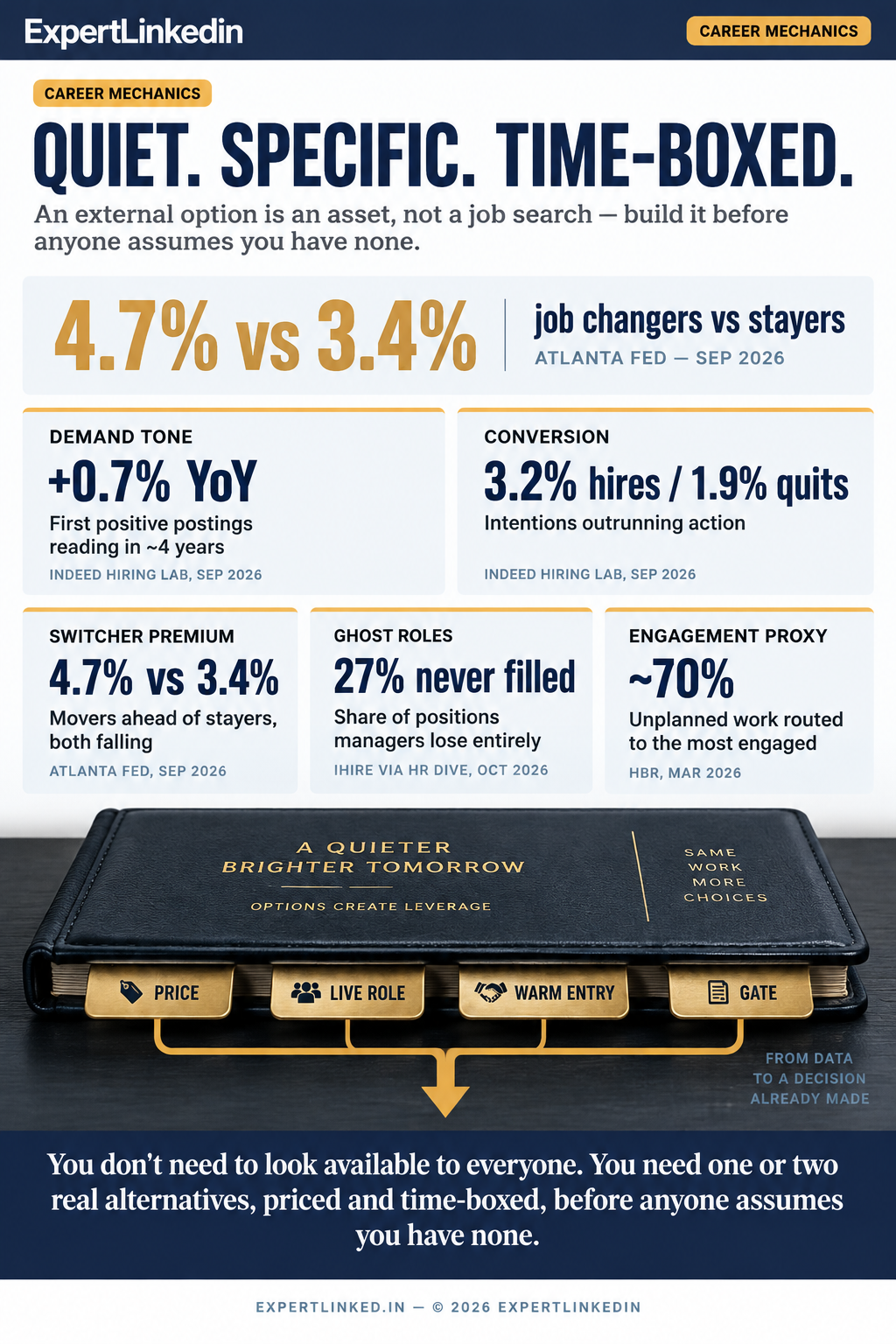
One number cuts the other way: annual growth in Indeed’s job postings index turned positive for the first time in nearly four years — up 0.7% year over year, with 60% of occupational sectors now above their pre-pandemic baseline (Indeed Hiring Lab, September 24, 2026). Demand tone is improving. Conversion is not. Which is why the reader-side data looks so dark: only 28% of U.S. workers say now is a good time to find a quality job, down from about 70% in mid-2022, and just 19% of college-educated workers agree (Gallup, March 23, 2026).
That gap is your opening. Competition for the roles worth having is smaller than the mood suggests — so the winning strategy is two or three precise conversations, not fifty applications.
Why 30 days, honestly. SHRM has argued for years that all times of year are viable, and HBR notes that holidays are good for networking and year-end offer pressure. Both are right, and both miss the constraint: jobs exist year-round, but the speed at which people sign things collapses from mid-November. Hiring Lab’s seasonal postings are already up about 10% year over year, and the surge peaks before Thanksgiving (Indeed Hiring Lab, October 15, 2026). Thirty days from today ends around November 18: late enough to have real conversations moving, early enough that they close before the year does. It’s also the last stretch in which an external option can still change your internal conversation — the 90-day plan freezes your carry sheet on November 13.
The trap nobody names: availability is the engagement metric #
Here’s the finding that should reorganize how you think about this. Researchers studying more than 4,300 managers and employees found that when unplanned work appears, managers systematically route it to their most intrinsically motivated employees — nearly 70% of additional tasks — assuming those people enjoy it and won’t burn out. Both assumptions are wrong, and the cost shows up as falling satisfaction and rising turnover intent among the very employees companies most want to keep (HBR, March 2026).
Your manager has no dashboard for your inner commitment. What they have is a proxy: will this person say yes, quickly, to the thing I just thought of? Availability reads as engagement.
Which is why the external option is dangerous to run badly. The one behavior it requires — protecting two blocks a week, declining some unplanned work — is the one behavior that reads as withdrawal. You can deliver every commitment on your list and still get a changed story about your commitment. So define disengagement the way your employer does: not “I have doubts,” but an unexplained change in your visible commitments. Your job for 30 days is to leave every visible commitment exactly where it is.
Define the asset: quiet, specific, time-boxed #
An option isn’t a job search. A job search is an activity; an option is an asset with a value, an owner, and an expiry. Quiet means direct messages, calls, and one private document — never your public profile. Specific means two or three named organizations, or one verified internal alternative. Time-boxed means a hard end date and a decision rule.
| Asset | What it is | Why it beats the one above it |
|---|---|---|
| A market price | A recruiter’s band or a published range for your skill set at your level | Replaces an internal opinion with an external fact |
| A verified live role | A req with a live budget, a named hiring manager, a scheduled loop | Filters out this market’s ghost postings |
| A warm entry point | One referral or former-colleague intro per target | Where applying is free, the only signal that carries weight |
| A decision gate | A date plus a written rule for what you’ll do | Turns anxious activity into a decision already made |
Most people start with the résumé — which is none of the four.
The 30 days, at two hours a week #
HBR’s time-management guidance is blunt: reserve two to three hours a week and think in phases (HBR, April 2023). If it needs more, you’ve started a second job — and that’s how people get caught.
Week 1 (Oct 19–25): reconnaissance. No applications. Two calls — a recruiter in your function, and a former colleague senior to you who left in the last 18 months. “I’m doing a market check on what [skill] pays at my level going into 2027. Not applying anywhere yet — what number are you seeing, and what changed?” Output: one page with a band, a delta, and two skills that either price or don’t.
Week 2 (Oct 26–Nov 1): two conversations, one internal probe. Pick two organizations where you have a real connection. Ask about the problem, not the opening — HBR’s networking research is explicit that preparing questions beats preparing a pitch (HBR, November 2022). In parallel, probe internally, because only 33% of people seeking a change look inside first, and access — not ambition — is what stops them (HBR, May 2022). Ask: “If I wanted to be doing [adjacent scope] by mid-2027, what would have to be true?”
Week 3 (Nov 2–8): verify, then interview. Confirm the role is a hiring event — salary published, hiring manager engaged, loop scheduled. In iHire’s 2026 survey, 39.3% of job seekers said ghost or fake jobs were their main problem, and more than one in four hiring managers said 27% of their positions go unfilled entirely (HR Dive, October 2026). If a target fails the check, drop it.
Week 4 (Nov 9–18): run the gate. You should now hold a live process, a verified price, or a clear internal answer. If nothing materialized, you still own a priced market read and two live relationships for six hours of work. That’s a cheap option — which is the point.
The disengagement firewall #
- Cap it at 2–3 hours a week, in blocks that never touch your highest-visibility deliverable.
- Pre-trade availability as a scope decision, in writing. “I’m protecting Thursday mornings for the Q4 [deliverable] through the freeze; I’ll take the next reactive item instead.” That converts a withdrawal into a commitment, and it’s true.
- Freeze your public profile. HBR frames it as the tightrope between “subtly reaching out” and “setting off alarm bells” (HBR, May 2024).
- Keep the day job legible. One or two visible commitments, delivered on time, every week.
- Never brandish an offer. Know it. Using an outside offer for a raise “might work, but it’s risky, especially for women” (HBR, July 2016), and the cost is paid even when you stay and win — “executives may question your loyalty” (HBR, January 2019). And don’t tell your manager early: in nine cases out of ten, the old advice holds, because “if your boss doesn’t expect you to be around long, there is a likelihood you will be treated like a temp employee” (HBR, July 2021).
What it’s actually worth #
The folklore is out of date. Atlanta Fed’s Wage Growth Tracker — the same people, measured 12 months apart — shows job changers at 4.7% and stayers at 3.4%, with both falling. Advertised wages rose 2.5% against inflation of 3.4% (Atlanta Fed; Indeed Hiring Lab, September 24, 2026). So a move is a real but modest premium — gross of benefit resets and risk.
The differentiated money is narrower and stranger. Advertised pay is rising fastest in the most AI-exposed work: a post-ChatGPT premium of 4.7% to 5.7% depending on specification, widening with seniority — a ~17-point cumulative gap at senior level and 2 points at entry (Indeed Hiring Lab, September 17, 2026). Hiring managers confirm the selectivity: 57% report offering above-plan salaries for specialized skills, and 72% are raising pay for AI skills (HR Dive, October 2026).
That’s the real deliverable of 30 days. Not an offer. A price — externally verified, quietly held, and immediately useful in the most contested quarter of the year.
Use it on the internal half too, because only a third of people look inside first and the internal path is faster when it works. Risk reduction converts to promotion leverage when it’s written as avoided loss with a baseline. And the question from the stay-or-go audit still governs: will the next 90 days compound your leverage, or compound your exposure while your alternatives quietly narrow?
An option changes that answer even if you never use it, because it changes what you’re willing to say no to in early November. You don’t need to look available to everyone. You need one or two real alternatives, priced and time-boxed, before anyone assumes you have none.
Building an option this quarter? Send me the asset you’re missing — a price, a live role, a warm intro, or the gate — and I’ll tell you which one to fix first.
Email me at jackson.rodriguez@tlnw.uk
References #
- Atlanta Fed. “Wage Growth Tracker” (September 2026 data). https://www.atlantafed.org/chcs/wage-growth-tracker (Accessed October 19, 2026)
- Gallup (March 23, 2026). “Worker Thriving Declines as Job Market Pessimism Grows.” https://www.gallup.com/workplace/703280/worker-thriving-declines-job-market-pessimism-grows.aspx (Accessed October 19, 2026)
- Harvard Business Review (July 2016). “Setting the Record Straight: Using an Outside Offer to Get a Raise.” https://hbr.org/2016/07/setting-the-record-straight-using-an-outside-offer-to-get-a-raise (Accessed October 19, 2026)
- Harvard Business Review (January 2019). “If You’re About to Take a New Job, Should You Consider Your Boss’s Counteroffer?” https://hbr.org/2019/01/if-youre-about-to-take-a-new-job-should-you-consider-your-bosss-counteroffer (Accessed October 19, 2026)
- Harvard Business Review (July 2021). “Are You Thinking of Quitting Your Job?” https://hbr.org/2021/07/are-you-thinking-of-quitting-your-job (Accessed October 19, 2026)
- Harvard Business Review (May 2022). “What Stops Employees from Applying for Internal Roles.” https://hbr.org/2022/05/what-stops-employees-from-applying-for-internal-roles (Accessed October 19, 2026)
- Harvard Business Review (November 2022). “A Better Approach to Networking.” https://hbr.org/2022/11/a-better-approach-to-networking (Accessed October 19, 2026)
- Harvard Business Review (April 2023). “Making Time to Job Hunt While Working Full Time.” https://hbr.org/2023/04/making-time-to-job-hunt-while-working-full-time (Accessed October 19, 2026)
- Harvard Business Review (May 2024). “Your Social Media Presence Can Help You Land (or Lose) a Job Opportunity.” https://hbr.org/2024/05/your-social-media-presence-can-help-you-land-or-lose-a-job-opportunity (Accessed October 19, 2026)
- Harvard Business Review (March 2026). “Are You Overburdening Your Most Engaged Employees?” https://hbr.org/2026/03/are-you-overburdening-your-most-engaged-employees (Accessed October 19, 2026)
- HR Dive (October 2026). “Companies say they’re doling out bigger paychecks to attract candidates.” https://www.hrdive.com/news/companies-say-theyre-doling-out-bigger-paychecks-to-attract-candidates/832482/ (Accessed October 19, 2026)
- HR Dive (October 2026). “Ghost jobs and fake applicants have created a hiring trust gap.” https://www.hrdive.com/news/ghost-jobs-and-fake-applicants-have-created-a-hiring-trust-gap/831871/ (Accessed October 19, 2026)
- Indeed Hiring Lab (September 17, 2026). “AI Exposure Isn’t Squeezing Advertised Pay in the US — It’s Boosting It.” https://hiringlab.indeed.com/2026/09/17/ai-exposure-isnt-squeezing-advertised-pay-in-the-us-its-boosting-it/ (Accessed October 19, 2026)
- Indeed Hiring Lab (September 24, 2026). “US Labor Market Snapshot — September 2026.” https://hiringlab.indeed.com/2026/09/24/us-labor-market-snapshot-september-2026/ (Accessed October 19, 2026)
- Indeed Hiring Lab (September 29, 2026). “August 2026 JOLTS Report.” https://hiringlab.indeed.com/2026/09/29/august-2026-jolts-report/ (Accessed October 19, 2026)
- Indeed Hiring Lab (October 2, 2026). “September 2026 Jobs Report: Steadiness Without a Spark.” https://hiringlab.indeed.com/2026/10/02/september-2026-jobs-report-steadiness-without-a-spark/ (Accessed October 19, 2026)
- Indeed Hiring Lab (October 15, 2026). “Seasonal Hiring Is Off to a Fast Start, With an Eye Toward 2027.” https://hiringlab.indeed.com/2026/10/15/seasonal-hiring-is-off-to-a-fast-start/ (Accessed October 19, 2026)
- ExpertLinked (September 21, 2026). “How to Run a Stay-or-Go Audit Before Q4 2026 Closes Your Career Options.” https://expertlinked.in/posts/2026-09-21-how-to-run-a-stay-or-go-audit-before-q4-2026-closes-your-career-options/ (Accessed October 19, 2026)
- ExpertLinked (September 28, 2026). “The 90-Day Q4 2026 Career Positioning Plan for a Market That Still Isn’t Fully Open.” https://expertlinked.in/posts/2026-09-28-the-90-day-q4-2026-career-positioning-plan-for-a-market-that-still-isnt-fully-open/ (Accessed October 19, 2026)
- ExpertLinked (October 12, 2026). “How to Turn Risk Reduction Into a Q4 2026 Promotion Case Before Budget Freeze.” https://expertlinked.in/posts/2026-10-12-how-to-turn-risk-reduction-into-a-q4-2026-promotion-case-before-budget-freeze/ (Accessed October 19, 2026)
AI Content Notice
This article was created using artificial intelligence technology. Whenever possible, we include references and sources to support the information presented. Readers are encouraged to consult these sources for further information. While we strive for accuracy and provide valuable insights, readers should independently verify information and use their own judgment when making business decisions. The content may not reflect real-time market conditions or personal circumstances.
Related Articles
Infographic: How to Build a 30-Day Q4 2026 External Option Without Looking Disengaged at Work
The real Q4 risk isn’t being seen looking for a job — it’s quietly reducing your …
The Performance-Review Economy: Why Q4 2026 Career Outcomes Are Being Decided Before Review Season Starts
Most people think Q4 performance reviews reward output volume. In late 2026, they increasingly …
The Internal Labor Market: Why Q3 2026 Career Leverage Is Built Before the Job Posting Exists
In Q3 2026, the most important labor market for many professionals is inside the firm. Scope …