The Performance-Review Economy: Why Q4 2026 Career Outcomes Are Being Decided Before Review Season Starts

By the time the performance review starts, a surprising share of the outcome is already over.
In late 2026, the formal review meeting increasingly functions less like a jury and more like paperwork. The real argument often gets settled earlier, when a manager decides whose workaround is now “just part of the job,” when a skip-level leader decides whose work is promotable, and when a tight labor market quietly reduces everyone’s room to call the bluff.
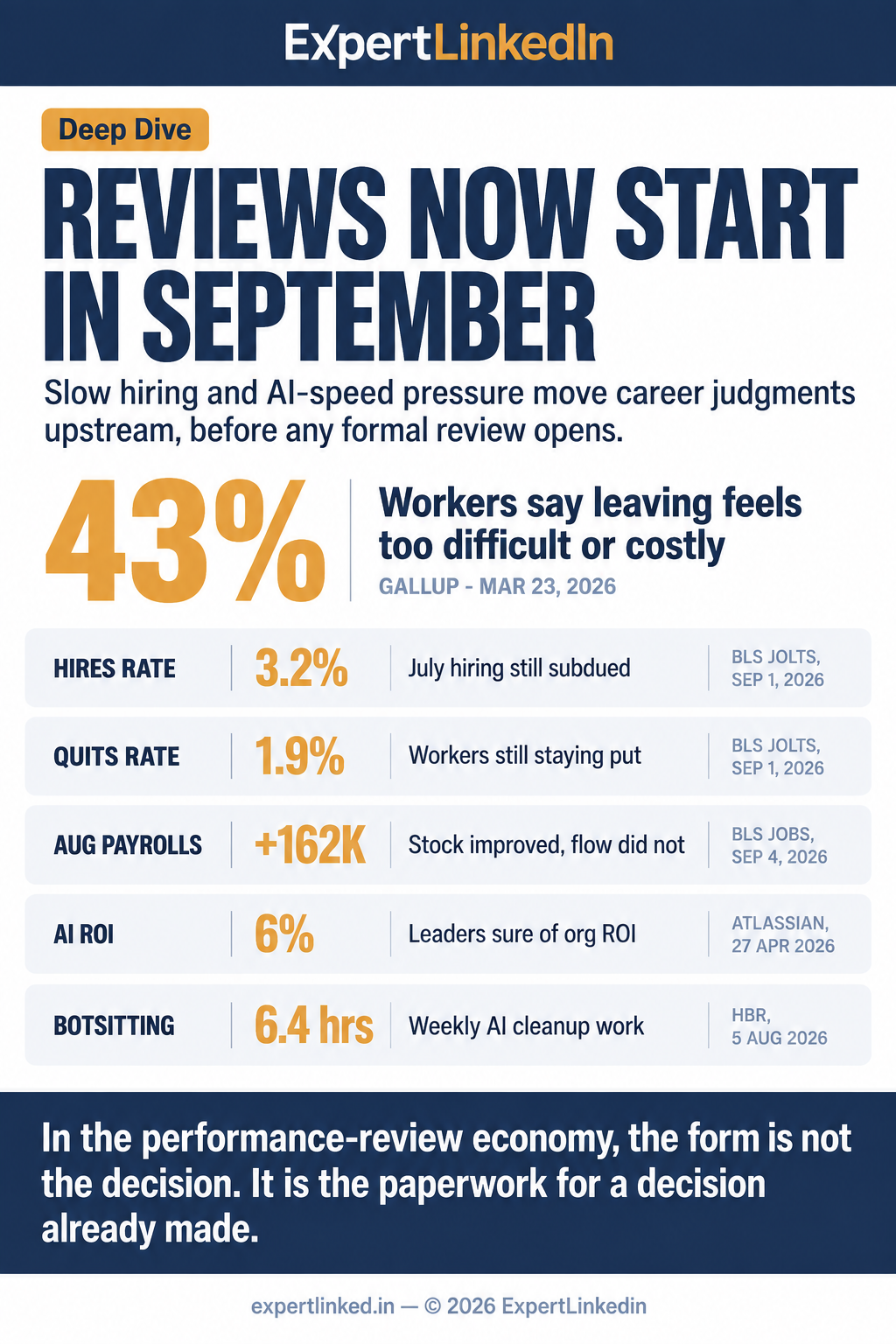
That shift is not just workplace paranoia. July JOLTS still showed 7.3 million job openings, but only a 3.2% hires rate and a 1.9% quits rate, while Gallup found that just 28% of U.S. workers say now is a good time to find a quality job and 43% say leaving feels too difficult or costly (U.S. Bureau of Labor Statistics, September 1, 2026; Gallup, March 23, 2026). August payrolls added 162,000 jobs and unemployment held at 4.1%, and the Sep. 15-16 FOMC meeting raised the federal funds rate to 3.75%-4.00% while still describing economic activity as expanding at a solid pace (U.S. Bureau of Labor Statistics, September 4, 2026; Federal Reserve, September 16, 2026). That is the exact mix that turns review season into a market. Employers feel stable enough to keep standards high. Workers do not feel free enough to ignore how those standards are being interpreted.
This piece is the structural sequel to Jackson’s September run on sponsor maps, evidence packets, stay-or-go decisions, and August’s internal-labor-market frame. The larger claim underneath all of them is simple: in the performance-review economy, Q4 outcomes are increasingly allocated before the official review process opens.
Why the review starts before the review #
The first thing to understand is that formal review season and actual evaluation season are no longer the same thing.
When hiring is loose, a weak internal read can sometimes be corrected by exit. That is not the market most professionals are in now. July JOLTS still showed a 3.2% hires rate and 1.9% quits rate, and Indeed’s August economist survey still saw a cooled market with postings expected to be down 0.5% from June by late September and 1.4% by June 2027 (Indeed Hiring Lab, August 5, 2026; Indeed Hiring Lab, September 1, 2026). In a market like that, formal review becomes one of the few remaining ways organizations allocate protection, pay, and scope.
The Fed’s September projections sharpen the point. Policymakers nudged 2026 median GDP to 2.3%, lowered unemployment to 4.1%, kept PCE inflation at 3.7%, and lifted the year-end funds-rate projection to 4.1% (Federal Reserve, September 16, 2026). That is selective-confidence territory: solid enough for leaders to stay disciplined, not loose enough for workers to ignore internal judgments. August real average hourly earnings still slipped 0.1% month over month and 0.3% year over year (U.S. Bureau of Labor Statistics, September 11, 2026). People still feel pressure. Employers still feel justified in being selective.
How summer workaround labor becomes autumn criteria #
Summer is where the trap gets laid.
Someone covers vacation. Someone cleans up a broken handoff. Someone becomes the unofficial final reader on AI-assisted drafts because the first version keeps arriving fast and half-right. Someone else starts translating across teams because the manager no longer has the bandwidth. By September, that emergency help can already feel like ordinary role behavior.
Harvard Business Review’s July analysis of invisible work argues that leaders still misread workload because they track hours, deadlines, and visible output while missing the mental load of planning, coordinating, and quality control (Harvard Business Review, July 24, 2026). Gallup’s manager data explains why the miss persists: with 64% reporting added responsibilities, 51% restructuring, and 42% budget cuts, quiet competence is easily mistaken for spare capacity (Gallup, September 5, 2023).
AI is making the pattern harsher. Atlassian found that 89% of executives say AI increases speed, but only 6% are sure they have clear organization-wide ROI, while 87% of knowledge workers say they lack time to coordinate (Atlassian Teamwork Lab, April 27, 2026). Harvard Business Review’s botsitting research found that 75% of digital workers said AI made them more productive, but just 13% said their organization had seen significantly improved performance, and workers still spent 6.4 hours a week managing, checking, and correcting AI output (Harvard Business Review, August 5, 2026). Review systems remember the speed. They often forget the human cleanup that made the speed usable.
That is the hidden pre-review story. Once cleanup work gets repeated often enough, the organization stops treating it as temporary stretch and starts treating it as what your role naturally includes.
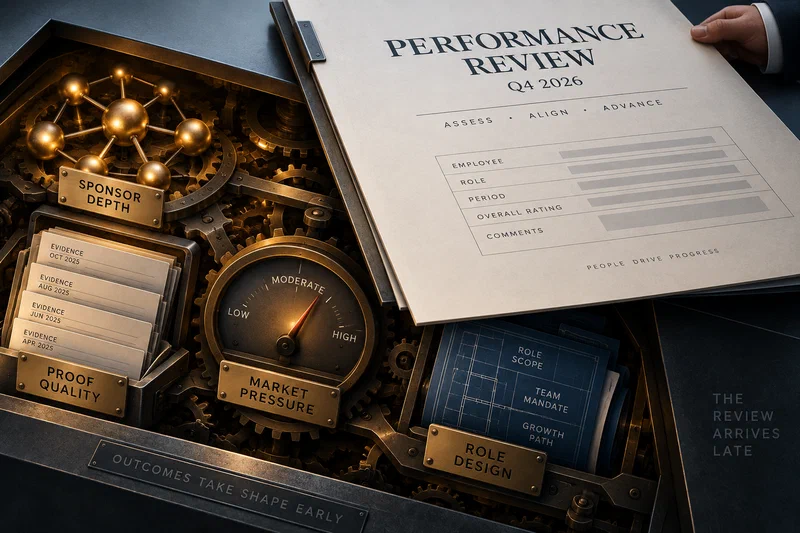
The four leverage drivers #
If that sounds unfair, it is. It is also legible. Q4 review outcomes now hinge disproportionately on four leverage drivers that have less to do with generic effort than most people want to admit.
1. Sponsor depth #
The first driver is whether your work has enough defenders in the right rooms.
This is why the September sponsor-map logic matters. One supportive manager is not a strategy if calibration, budget, or cross-functional movement sits elsewhere. Rosalind Chow’s Harvard Business Review argument makes the key distinction: sponsorship becomes real when someone defends your case under pressure, not when they praise it in private (Harvard Business Review, February 14, 2023). Center for Creative Leadership points to the same problem from the process side: outcomes depend on involving the right people and clarifying who owns the decision (Center for Creative Leadership, March 2, 2026).
2. Evidence quality #
The second driver is not whether you worked hard. It is whether your evidence travels.
This is the pressure behind The 4-Page Q4 2026 Evidence Packet for Performance Reviews, Promotions, and Pay Talks. In overloaded systems, the winning packet is not the thickest one. It is the one a sponsor can repeat without rewriting. Harvard Business School Working Knowledge summarized research showing that asking for “advice” instead of “feedback” produces more concrete developmental input because it pushes reviewers toward future action (Harvard Business School Working Knowledge, January 16, 2026). Under time pressure, review systems reward clarity and consequence more than exhaustive narrative.
3. Market context #
The third driver is the market outside the review room.
The same manager reads the same contribution differently in a hot market than in a selective one. Gallup’s 43% “stay because leaving feels too costly” number is therefore not just a labor-market statistic. It is a power condition inside the firm (Gallup, March 23, 2026). Better macro tone after the Fed helps leaders justify discipline. It does not widen the door for workers whose next move depends on review outcomes.
4. Role design #
The fourth driver is whether your extra work has become a role or is still being treated as a favor.
This is where August’s internal-labor-market thesis carries forward. If the organization still sees your extra work as personal helpfulness, the review can praise you without repricing the role. If the work has an owner, a boundary, and a visible business consequence, it becomes harder to treat as optional. That is why so many Q4 disappointments feel confusing: the employee thinks the stretch proved readiness; the organization thinks it proved willingness.
Who gets under-credited in this economy #
The people who lose in this system are often the ones doing the work that keeps everything else believable.
Coordinators fix flow rather than produce the artifact people remember. Translators turn executive or AI ambition into something a team can live with. QA owners and botsitters do work whose best outcome is that nothing embarrassing happens. And because the manager layer is overloaded, weak sponsorship often comes from bandwidth failure before it comes from bad intent.
That is why AI-era performance pressure feels so strange to many readers. The fastest worker is not always the safest one, and the person closest to the tool is often closest to the blame.
A Q4 framework: document, renegotiate, escalate, or exit #
So what should a reader do with this before year-end?
First, document the outputs, coordination work, exception handling, and risk reduction that changed because you intervened. Invisible work that stays uncaptured is future under-credit waiting to happen.
Second, renegotiate if the workaround is now recurring role reality. Bring evidence and ask what advice would make formalization easier this quarter.
Third, escalate through the sponsor map: validator, translator, funder. Ask which decision is actually being made and what proof carries it.
Fourth, exit if the work is essential, permanently informal, and still treated as free. At that point, the stay-or-go audit is not abstract. It is overdue.
The biggest mistake readers can make now is waiting for the form to open before deciding what season they are actually in.
The uncomfortable truth is that many review systems no longer mainly reward the person who did the most work. They reward the person whose work was easiest to translate, safest to defend, and already designed into the organization’s story before the form arrived.
In the performance-review economy, the form is not the decision. It is the paperwork for a decision already made.
Seeing these dynamics already play out on your team or in your own review cycle? I’d like to hear what signals you are seeing before Q4 locks them in.
Email me at jackson.rodriguez@tlnw.uk
References #
- Atlassian Teamwork Lab. (April 27, 2026). “The State of Teams 2026.” https://www.atlassian.com/blog/state-of-teams-2026 (Accessed September 26, 2026)
- Center for Creative Leadership. (March 2, 2026). “Decision-Making for Leaders: A Practical Framework for Better Outcomes.” https://www.ccl.org/articles/leading-effectively-articles/leadership-and-decision-making/ (Accessed September 26, 2026)
- ExpertLinked. (August 29, 2026). “The Internal Labor Market: Why Q3 2026 Career Leverage Is Built Before the Job Posting Exists.” https://expertlinked.in/posts/2026-08-29-the-internal-labor-market-why-q3-2026-career-leverage-is-built-before-the-job-posting-exists/ (Accessed September 26, 2026)
- ExpertLinked. (September 7, 2026). “How to Build a Q4 2026 Sponsor Map Before Performance Review Season Starts.” https://expertlinked.in/posts/2026-09-07-how-to-build-a-q4-2026-sponsor-map-before-performance-review-season-starts/ (Accessed September 26, 2026)
- ExpertLinked. (September 14, 2026). “The 4-Page Q4 2026 Evidence Packet for Performance Reviews, Promotions, and Pay Talks.” https://expertlinked.in/posts/2026-09-14-the-4-page-q4-2026-evidence-packet-for-performance-reviews-promotions-and-pay-talks/ (Accessed September 26, 2026)
- ExpertLinked. (September 21, 2026). “How to Run a Stay-or-Go Audit Before Q4 2026 Closes Your Career Options.” https://expertlinked.in/posts/2026-09-21-how-to-run-a-stay-or-go-audit-before-q4-2026-closes-your-career-options/ (Accessed September 26, 2026)
- Federal Reserve. (September 16, 2026). “Federal Reserve issues FOMC statement.” https://www.federalreserve.gov/newsevents/pressreleases/monetary20260916a.htm (Accessed September 26, 2026)
- Federal Reserve. (September 16, 2026). “Summary of Economic Projections.” https://www.federalreserve.gov/monetarypolicy/fomcprojtabl20260916.htm (Accessed September 26, 2026)
- Gallup. (March 23, 2026). “U.S. Worker Thriving Declines as Job Market Pessimism Grows.” https://www.gallup.com/workplace/703280/worker-thriving-declines-job-market-pessimism-grows.aspx (Accessed September 26, 2026)
- Gallup. (September 5, 2023). “The Manager Squeeze: How the New Workplace Is Testing Team Leaders.” https://www.gallup.com/workplace/510326/manager-squeeze-new-workplace-testing-team-leaders.aspx (Accessed September 26, 2026)
- Harvard Business Review. (February 14, 2023). “Don’t Just Sponsor Women and People of Color - Defend Them.” https://hbr.org/2023/02/dont-just-sponsor-women-and-people-of-color-defend-them (Accessed September 26, 2026)
- Harvard Business Review. (July 24, 2026). “The Invisible Work Draining Your Best Employees.” https://hbr.org/2026/07/the-invisible-work-draining-your-best-employees (Accessed September 26, 2026)
- Harvard Business Review. (August 5, 2026). “How Much Time Do Your Employees Spend Botsitting?” https://hbr.org/2026/08/how-much-time-do-your-employees-spend-botsitting (Accessed September 26, 2026)
- Harvard Business Review. (May 25, 2026). “Managers Are Struggling to Keep Up with the AI Productivity Boom.” https://hbr.org/2026/05/managers-are-struggling-to-keep-up-with-the-ai-productivity-boom (Accessed September 26, 2026)
- Harvard Business School Working Knowledge. (January 16, 2026). “Want Better Performance Reviews? Change This One Word.” https://www.library.hbs.edu/working-knowledge/want-better-performance-reviews-change-this-one-word (Accessed September 26, 2026)
- Indeed Hiring Lab. (August 5, 2026). “Economists Expect a Cooled Labor Market and an AI Reshuffling of White-Collar Work.” https://hiringlab.indeed.com/2026/08/05/q2-labor-market-outlook-survey/ (Accessed September 26, 2026)
- Indeed Hiring Lab. (September 1, 2026). “July 2026 JOLTS Report: Little Changed. Again.” https://hiringlab.indeed.com/2026/09/01/july-2026-jolts-report-little-changed-again/ (Accessed September 26, 2026)
- U.S. Bureau of Labor Statistics. (September 1, 2026). “Job Openings and Labor Turnover - July 2026.” https://www.bls.gov/news.release/jolts.nr0.htm (Accessed September 26, 2026)
- U.S. Bureau of Labor Statistics. (September 4, 2026). “The Employment Situation - August 2026.” https://www.bls.gov/news.release/empsit.nr0.htm (Accessed September 26, 2026)
- U.S. Bureau of Labor Statistics. (September 11, 2026). “Consumer Price Index Summary - August 2026.” https://www.bls.gov/news.release/cpi.nr0.htm (Accessed September 26, 2026)
- U.S. Bureau of Labor Statistics. (September 11, 2026). “Real Earnings - August 2026.” https://www.bls.gov/news.release/realer.nr0.htm (Accessed September 26, 2026)
AI Content Notice
This article was created using artificial intelligence technology. Whenever possible, we include references and sources to support the information presented. Readers are encouraged to consult these sources for further information. While we strive for accuracy and provide valuable insights, readers should independently verify information and use their own judgment when making business decisions. The content may not reflect real-time market conditions or personal circumstances.
Related Articles
Infographic: The Performance-Review Economy: Why Q4 2026 Career Outcomes Are Being Decided Before Review Season Starts
Most people think Q4 performance reviews reward output volume. In late 2026, they increasingly …
Briefing Room - September 2026: The Best Reporting on Fall Hiring, Sponsorship, and AI Performance Pressure
September’s strongest labor, Fed, management, and AI-governance reporting all pointed to one …
The Internal Labor Market: Why Q3 2026 Career Leverage Is Built Before the Job Posting Exists
In Q3 2026, the most important labor market for many professionals is inside the firm. Scope …