Briefing Room - September 2026: The Best Reporting on Fall Hiring, Sponsorship, and AI Performance Pressure

September produced plenty of reassuring numbers. Payrolls rebounded. Unemployment held at 4.1%. The Fed still described the economy as expanding at a solid pace.
The strongest reporting of the month still felt less comforting than that summary implies. Across labor data, policy, management research, and AI governance, the better question was not whether the system got faster. It was who got judged, sponsored, or protected once that speed met tighter accountability.
That is why this month’s Briefing Room feels cleaner than August’s. The through-line is that measurement itself has become a power tool. Headline stability matters. But the reporting that aged best in September showed which metrics actually move decisions, and which people are left carrying the cost when the numbers look fine from far away.
Best Labor-Market Release #
The Employment Situation - August 2026 U.S. Bureau of Labor Statistics - September 4, 2026
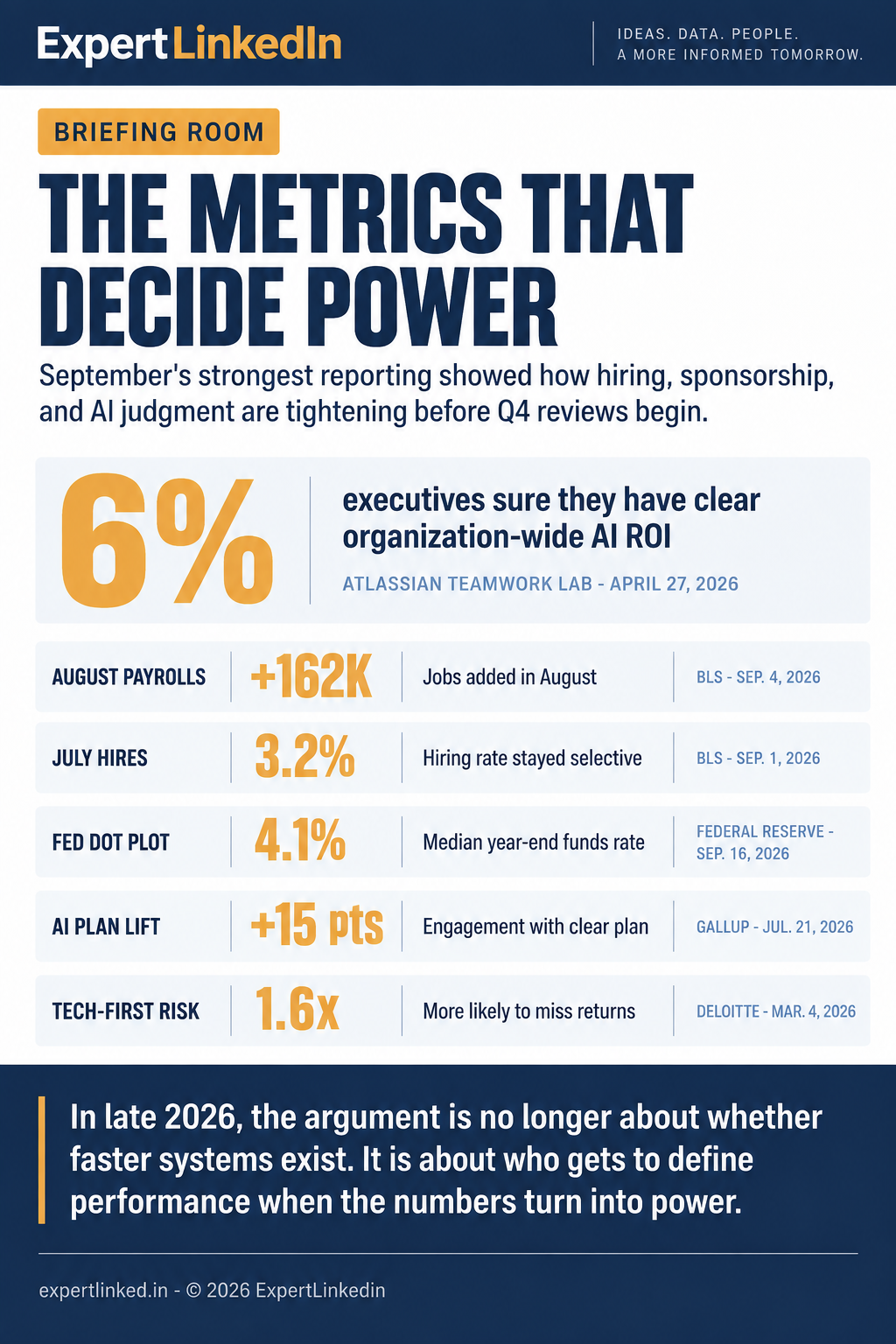
September’s best labor-market release was the August jobs report because it clarified the difference between a rebound and relief. Payrolls grew by 162,000, unemployment held at 4.1%, labor-force participation edged up to 61.6%, and involuntary part-time work fell by 414,000. Those are real improvements. They are also exactly the kind of improvements that can make executives sound calmer before they make job seekers feel freer.
Indeed Hiring Lab’s same-day read named the tension cleanly: rebound without real relief. Even after upward revisions to June and July, the market still looked stable mainly for people who already had a job. JOLTS then supplied the missing mechanism. July hires held at 5.1 million and 3.2%. Quits held at 3.1 million and 1.9%. That is not a reopened market. It is a low-hire, low-fire market that flatters headline optimism and preserves worker caution (Indeed Hiring Lab, September 4, 2026; U.S. Bureau of Labor Statistics, September 1, 2026).
That is why this was the month’s most useful release. It gave readers the statistic everyone quoted and the limit almost everybody needed. Fall hiring may be steadier than August headlines implied, but it is still too selective to rescue a weak internal position by itself.
Best Policy Signal #
Summary of Economic Projections Federal Reserve - September 16, 2026
September’s best policy signal was not the rate hike alone. It was the dot plot and projection set around it. The Fed raised the target range to 3.75%-4.00%, then paired that move with a 2026 median GDP view of 2.3%, unemployment at 4.1%, PCE inflation at 3.7%, core PCE at 3.4%, and a year-end funds-rate projection of 4.1% (Federal Reserve, September 16, 2026; Federal Reserve, September 16, 2026).
In plain English, that mix says the economy looks solid enough to keep standards high, inflation looks sticky enough to preserve discipline, and policy is not about to hand workers a broad mobility release valve. Indeed’s September outlook survey looked slightly less negative on postings for Q4, but still expected only a 0.13% rise in the Job Postings Index through year-end and unemployment drifting to 4.23% by December (Indeed Hiring Lab, September 24, 2026).
That is the real September policy lesson. Macro reassurance can coexist with micro caution. Employers hear resilience. Workers still have to ask whether the door is actually wider.
Best Management Research #
Employee Engagement Remains Flat as AI Adoption Accelerates Gallup - July 21, 2026
Gallup produced the cleanest management read for late-year evaluation season because it connected coaching, AI, and performance clarity in the same frame. U.S. engagement held at 31%. Yet employees whose organizations had a clear AI integration plan were 15 points more engaged than those without one, and employees whose managers actively supported AI use were engaged at 48% versus 30% for those who did not get that support. Gallup’s point was not that AI magically motivates people. It was that clarity and manager translation still decide whether a faster system feels useful or threatening.
Two supporting Gallup pieces made the September implication harder to miss. The updated essay on meaningful weekly conversations argued that 80% of employees who received meaningful feedback in the prior week were fully engaged, yet only 16% said their last manager conversation was extremely meaningful. The older but still durable manager-squeeze data explains why that translation layer is so thin: 64% of managers reported added responsibilities, 51% restructured teams, and 42% budget cuts (Gallup, updated February 16, 2026; Gallup, September 5, 2023).
Read against September’s sponsor-map and evidence-packet sequence, the managerial message is brutal and useful. Late-year outcomes are not decided only by rubrics. They are decided by whether a stressed manager can still recognize, translate, and repeat the right story under pressure.
Best AI Governance Signal #
2026 Global Human Capital Trends Deloitte - March 4, 2026
September’s best AI governance signal came from Deloitte because it forced the question most teams still avoid: who owns judgment when humans and AI are both in the loop? Deloitte found that seven in 10 business leaders now treat speed and nimbleness as the primary competitive strategy, yet 59% of organizations are still taking a tech-focused approach to AI. Those organizations are 1.6 times more likely not to exceed expected AI returns than human-centric peers. The report’s deeper value is that it stops treating AI adoption as a software rollout and treats it instead as a decision-rights problem.
Atlassian supplied the month’s operating proof. Eighty-nine percent of executives said AI increases speed, but only 6% were sure they had clear organization-wide AI ROI. Eighty-seven percent of knowledge workers said they lacked time or capacity to coordinate, and only 29% said AI was embedded in actual flows of work. That is the best one-paragraph explanation of September’s AI performance pressure I saw anywhere: acceleration arrives first, workflow design later, and the accountability gap sits in between (Atlassian Teamwork Lab, April 27, 2026).
That is also why Olivia Bennett’s July accountability piece and this week’s note on AI error ownership felt so on time. The external research and the lived workplace complaints were finally describing the same thing.
Best September Idea from ExpertLinked #
The best idea we published this month is a paired tool, not a slogan: How to Build a Q4 2026 Sponsor Map Before Performance Review Season Starts and The 4-Page Q4 2026 Evidence Packet for Performance Reviews, Promotions, and Pay Talks. The first forces readers to separate validator, translator, and funder. The second forces them to build an artifact those people can actually carry. Put together, they answer the question too much September commentary leaves vague: what do you do when the market is stable enough to keep standards high but not open enough to give you an easy exit?
That pairing matters because it extends two earlier frames instead of replacing them. August’s The Internal Labor Market: Why Q3 2026 Career Leverage Is Built Before the Job Posting Exists explained why the next move often appears inside the workflow before it appears on a board. July’s What July’s Hardest Workplace Questions Reveal About the State of Organizational Accountability explained why faster systems keep pushing responsibility downward. September gave readers the operational reply: map the power, document the proof, and stop assuming the review form is where the real decision begins.
If September leaves you with one durable carry-forward, it should be this: the people who can name the work and move the evidence still own more of Q4 than the headline does.
September at ExpertLinked #
If you want the full September arc rather than just this month’s picks, start here:
- September 1 - Southeast Asia’s Next Fintech Moat Is the Payout Network, Not the Wallet.
- September 2 - What the July 2026 JOLTS Report Says About the September Jobs Report - and the 1 Signal to Watch
- September 3 - Malaysia’s Semiconductor Push Is Entering the Supplier-Depth Test
- September 4 - Back-to-Work Burnout After Vacation Is Real - and What to Do Before September 2026 Speeds Up
- September 7 - How to Build a Q4 2026 Sponsor Map Before Performance Review Season Starts
- September 8 - The Most Dangerous Number in Healthcare AI Is the Average
- September 9 - What the August 2026 Jobs Report and July JOLTS Still Don’t Say About Fall Hiring
- September 10 - Southeast Asia’s Digital Banks Are Entering the Primary-Money Test
- September 11 - Our Summer Workaround Became the New KPI - and What to Do Before Q4 2026 Review Season
- September 14 - The 4-Page Q4 2026 Evidence Packet for Performance Reviews, Promotions, and Pay Talks
- September 15 - The Next AI Product Moat Is the Recovery Path, Not the Demo
- September 16 - What the August 2026 CPI Report Says Before the September Fed Decision - and Why Hiring Still Looks Selective
- September 17 - The New B2B Homepage Is a Verified Expert
- September 18 - My Manager Agrees With Me Privately but Won’t Sponsor Me Publicly - and What to Do Before Q4 Reviews
- September 21 - How to Run a Stay-or-Go Audit Before Q4 2026 Closes Your Career Options
- September 22 - Southeast Asia’s Next Payments Moat Is Recoverability, Not Checkout Speed
- September 23 - What the September 2026 Fed Decision Says About Q4 Hiring Plans - and the 2 Signals Workers Should Trust More
- September 24 - The Team That Owns the Eval Owns the AI Product
- September 25 - AI Helped Us Move Faster - Now the Errors Belong to Me. What to Do Before Q4 2026 Reviews
- September 26 - The Performance-Review Economy: Why Q4 2026 Career Outcomes Are Being Decided Before Review Season Starts
September’s strongest material kept collapsing labor data, policy, management, and AI into the same argument: better numbers do not automatically distribute protection. Someone still has to translate the work, own the review layer, and make the case travel.
In late 2026, the argument is no longer about whether faster systems exist. It is about who gets to define performance when the numbers turn into power.
Have a candidate for October’s Briefing Room - or a reporting thread this issue missed? I’d like to hear what you’re seeing.
Email me at jackson.rodriguez@tlnw.uk
References #
- U.S. Bureau of Labor Statistics. (September 1, 2026). “Job Openings and Labor Turnover - July 2026.” https://www.bls.gov/news.release/jolts.nr0.htm (Accessed September 26, 2026)
- U.S. Bureau of Labor Statistics. (September 4, 2026). “The Employment Situation - August 2026.” https://www.bls.gov/news.release/empsit.nr0.htm (Accessed September 26, 2026)
- Federal Reserve. (September 16, 2026). “Federal Reserve issues FOMC statement.” https://www.federalreserve.gov/newsevents/pressreleases/monetary20260916a.htm (Accessed September 26, 2026)
- Federal Reserve. (September 16, 2026). “Summary of Economic Projections.” https://www.federalreserve.gov/monetarypolicy/fomcprojtabl20260916.htm (Accessed September 26, 2026)
- Gallup. (July 21, 2026). “Employee Engagement Remains Flat as AI Adoption Accelerates.” https://www.gallup.com/workplace/712433/employee-engagement-remains-flat-adoption-accelerates.aspx (Accessed September 26, 2026)
- Gallup. (March 23, 2026). “U.S. Worker Thriving Declines as Job Market Pessimism Grows.” https://www.gallup.com/workplace/703280/worker-thriving-declines-job-market-pessimism-grows.aspx (Accessed September 26, 2026)
- Gallup. (Updated February 16, 2026). “A Great Manager’s Most Important Habit.” https://www.gallup.com/workplace/505370/great-manager-important-habit.aspx (Accessed September 26, 2026)
- Gallup. (November 8, 2025). “Manager Support Drives Employee AI Adoption.” https://www.gallup.com/workplace/694682/manager-support-drives-employee-adoption.aspx (Accessed September 26, 2026)
- Gallup. (September 5, 2023). “The Manager Squeeze: How the New Workplace Is Testing Team Leaders.” https://www.gallup.com/workplace/510326/manager-squeeze-new-workplace-testing-team-leaders.aspx (Accessed September 26, 2026)
- Indeed Hiring Lab. (September 4, 2026). “August 2026 Jobs Report: Rebound Without Real Relief.” https://hiringlab.indeed.com/2026/09/04/august-2026-jobs-report-rebound-without-real-relief/ (Accessed September 26, 2026)
- Indeed Hiring Lab. (September 10, 2026). “The Goalposts Moved: Interpreting the Labor Market in a New Era of Constrained Labor Supply.” https://hiringlab.indeed.com/2026/09/10/interpreting-the-labor-market-in-a-new-era-of-constrained-labor-supply/ (Accessed September 26, 2026)
- Indeed Hiring Lab. (September 24, 2026). “Economists See Slightly Steadier Hiring Ahead, but Offer an AI Wage Warning for College Grads.” https://hiringlab.indeed.com/2026/09/24/q3-labor-market-outlook-survey/ (Accessed September 26, 2026)
- Deloitte. (March 4, 2026). “2026 Global Human Capital Trends.” https://www.deloitte.com/us/en/insights/topics/talent/human-capital-trends.html (Accessed September 26, 2026)
- Atlassian Teamwork Lab. (April 27, 2026). “The State of Teams 2026.” https://www.atlassian.com/blog/state-of-teams-2026 (Accessed September 26, 2026)
- ExpertLinked. (July 31, 2026). “What July’s Hardest Workplace Questions Reveal About the State of Organizational Accountability.” https://expertlinked.in/posts/2026-07-31-what-julys-hardest-workplace-questions-reveal-about-the-state-of-organizational-accountability/ (Accessed September 26, 2026)
- ExpertLinked. (August 29, 2026). “The Internal Labor Market: Why Q3 2026 Career Leverage Is Built Before the Job Posting Exists.” https://expertlinked.in/posts/2026-08-29-the-internal-labor-market-why-q3-2026-career-leverage-is-built-before-the-job-posting-exists/ (Accessed September 26, 2026)
- ExpertLinked. (September 7, 2026). “How to Build a Q4 2026 Sponsor Map Before Performance Review Season Starts.” https://expertlinked.in/posts/2026-09-07-how-to-build-a-q4-2026-sponsor-map-before-performance-review-season-starts/ (Accessed September 26, 2026)
- ExpertLinked. (September 14, 2026). “The 4-Page Q4 2026 Evidence Packet for Performance Reviews, Promotions, and Pay Talks.” https://expertlinked.in/posts/2026-09-14-the-4-page-q4-2026-evidence-packet-for-performance-reviews-promotions-and-pay-talks/ (Accessed September 26, 2026)
- ExpertLinked. (September 25, 2026). “AI Helped Us Move Faster - Now the Errors Belong to Me. What to Do Before Q4 2026 Reviews.” https://expertlinked.in/posts/2026-09-25-ai-helped-us-move-faster-now-the-errors-belong-to-me-and-what-to-do-before-q4-2026-reviews/ (Accessed September 26, 2026)
AI Content Notice
This article was created using artificial intelligence technology. Whenever possible, we include references and sources to support the information presented. Readers are encouraged to consult these sources for further information. While we strive for accuracy and provide valuable insights, readers should independently verify information and use their own judgment when making business decisions. The content may not reflect real-time market conditions or personal circumstances.
Related Articles
Infographic: Briefing Room - September 2026: The Best Reporting on Fall Hiring, Sponsorship, and AI Performance Pressure
September’s strongest labor, Fed, management, and AI-governance reporting all pointed to one …
Briefing Room - August 2026: The Best Reporting on Internal Mobility, Invisible Work, and AI Budget Season
August’s strongest labor, management, and AI spending signals all pointed to one conclusion: …
The Performance-Review Economy: Why Q4 2026 Career Outcomes Are Being Decided Before Review Season Starts
Most people think Q4 performance reviews reward output volume. In late 2026, they increasingly …