The Team That Owns the Eval Owns the AI Product

The most revealing org chart on an AI team is often the one missing a box.
You can usually find model engineering, platform, product, design, maybe safety or compliance. What you often cannot find is one team explicitly accountable for the evals that define what “good” means in the company’s own workflow. If that box is empty, nobody truly owns the product. You are renting confidence from somebody else’s benchmark page.
In June, I argued in End of the Whisperer that prompt theater was never a moat. Earlier this month, The Next AI Product Moat Is the Recovery Path, Not the Demo pushed the argument into runtime design: if you cannot pause, inspect, and recover, you do not have a trustworthy agent. This is the organizational layer beneath both claims. The team that owns the eval owns the definition of success, failure, and acceptable risk.

Benchmarks help you shop. They do not tell you whether you can ship. #
OpenAI’s evaluation best practices draws a line product teams keep blurring. Public benchmarks and leaderboards are one thing. Numerical metrics like ROUGE or BERTScore are another. The tests you design for your own application are a third category entirely, and that is the one OpenAI says actually matters for product evaluation.
That distinction sounds small until you follow it to its conclusion. Stanford’s HELM and Hugging Face’s Open LLM Leaderboard are useful because they compare models in isolation across many scenarios. They are good shopping tools. They can help you narrow a model choice, understand relative strengths, or defend why you are even testing a family of models. But isolation is both the point and the limit. A leaderboard does not know your refund policy, your escalation rules, your stale-data failure modes, or which actions inside your workflow are reversible versus expensive.
OpenAI’s own AI app development track makes the practical version of the same point. Evals verify correctness, benchmark quality over time, and guide iteration by catching regressions. In other words, the eval is not a glossy artifact you create after the feature is conceptually done. It is part of the loop that tells you whether the feature is getting better or quietly drifting off-spec.
Anthropic’s Building effective agents reaches the same place from a different direction. Start with the simplest solution possible. Add complexity only when it demonstrably improves outcomes. Use comprehensive evaluation. Put gates inside prompt chains. Use evaluator-optimizer loops when the criteria are clear. Even their customer-support examples define success around user resolutions, not around how impressive the chain-of-thought looked in a demo. That is the key lesson too many teams keep missing: the real product is not the clever orchestration. It is the measurable behavior the orchestration reliably produces.
Serious platforms are productizing the pain. #
If eval ownership still sounds like process theater, look at what the major platform builders have been shipping. OpenAI’s March 2025 launch of new tools for building agents did not just introduce built-in tools and the Responses API. It also made room for tracing and evaluations because, in OpenAI’s own framing, turning raw capability into production-ready agents has been too hard without better inspection and measurement.
Microsoft is making the same move more explicitly. Its observability guidance treats evaluation, monitoring, and tracing as the three core capabilities of AI operations. Not optional add-ons. Core capabilities. It goes even further by making room for custom evaluators, continuous evaluation of production traffic, scheduled evaluation to detect drift, and automated quality gates in CI/CD. Once a platform normalizes that stack, the obvious follow-up question is not whether you can evaluate. It is who decides what should be evaluated, what counts as failure, and who has authority to stop a release or narrow a rollout.
Microsoft’s trace-evaluation workflow for deployed interactions sharpens that point. Teams can evaluate stored responses or real OpenTelemetry traces without replaying the original requests, and Microsoft explicitly positions trace evaluation as the recommended approach for agents that are not even built with Foundry, as long as they emit compatible spans. That is a subtle but important market signal. Production behavior is no longer treated as debugging residue. It is evaluation input.
OpenAI’s GPT-Live evaluation guide is the cleanest statement of what this means in practice. A scenario passes only when the assistant reaches the intended outcome, the expected application state, and its mandatory constraints. Task completion is the guiding measure. Deterministic checks verify tools, arguments, authorizations, and state transitions. An LLM judge adds qualitative scoring, but not instead of the hard checks. Read that slowly and you will notice something: an eval suite starts to look a lot like a product spec written in executable form.
That is why I no longer think of evals as a QA asset sitting politely at the edge of the roadmap. They are becoming the operational constitution of the feature.
The leaderboard still fails on Tuesday. #
Public benchmark gains are real. They are also easy to misread.
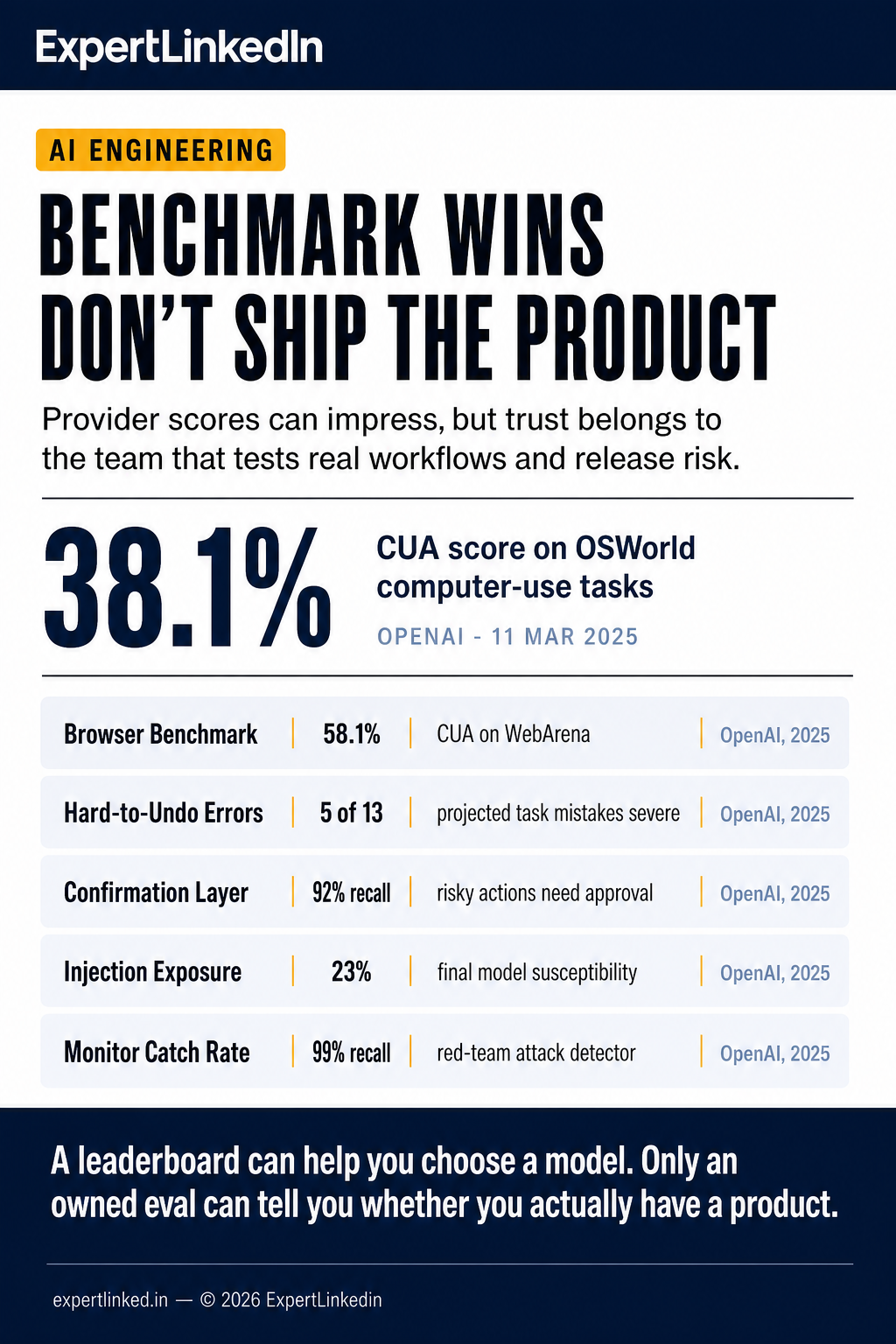
OpenAI’s agent tooling launch highlighted Computer-Using Agent scores of 38.1% on OSWorld, 58.1% on WebArena, and 87.0% on WebVoyager. Those are meaningful numbers. They tell you the underlying capability moved. But the more revealing document is the Operator System Card, because it shows what happened when capability met product risk.
On a distribution of 100 projected user tasks, the unmitigated system made 13 harmful or nuisance mistakes, and 5 of those were not easily reversible. Confirmation prompts reduced the risk of model mistakes by roughly 90%. Prompt-injection susceptibility fell from 62% with no mitigations to 23% in the final model. The prompt-injection monitor reached 99% recall and 90% precision on a red-team set. That is not a story about a model crossing some clean threshold into reliability. It is a story about a capability becoming usable only after the product team defines risky actions, builds supervision, and measures the failure modes it actually cares about.
This is where many AI teams still get trapped in borrowed confidence. They read the benchmark table as if it were the product. Then Tuesday arrives. The support agent pulls the wrong policy snippet. The analyst copilot summarizes a stale document as current. The browser agent takes a technically plausible path that violates an internal approval rule no public benchmark has ever seen. Suddenly the question is not whether the model is good in the abstract. The question is whether anyone owned the local eval that should have caught the failure.
Anthropic makes the same point from the application side. In Building effective agents, its customer-support examples work because success can be measured against user-defined resolutions, and its coding-agent examples work because automated tests create objective feedback loops even before human review steps in. That is the real pattern. Good AI products do not become reliable when the model gets smarter in the abstract. They become more reliable when the team gets better at describing what success means in its own environment.
What eval ownership actually looks like #
The title of “eval owner” does not matter much. The function does.
In some companies it will sit with an applied AI team. In others it should live with product operations, domain specialists, or a joint product-engineering owner. What matters is that somebody is unambiguously accountable for the behaviors that decide whether the feature can ship, expand, or roll back.
If I were forcing clarity into the org chart, I would make one team own five things.
-
A scenario library for every critical workflow. Not just “answer customer questions,” but concrete task families with intended outcomes, mandatory constraints, forbidden actions, and representative edge cases.
-
Release gates that separate nice-to-have quality from non-negotiable safety or policy requirements. A lower stylistic score is not the same as a tool call that touched the wrong record.
-
Production trace review, including what gets sampled, how failures are clustered, and who investigates ambiguous cases. If live behavior matters, live evidence needs an owner.
-
Benchmark interpretation. Public leaderboards should influence model selection, not final shipping approval. Use them to choose ingredients, not to outsource judgment.
-
Regret accounting. Someone must decide what kinds of mistakes are reversible, which ones are expensive, and which ones are unacceptable even at low frequency.
This is not bureaucracy for its own sake. It is governance with operational teeth. NIST’s AI Risk Management Framework says trustworthiness has to be incorporated into the design, development, use, and evaluation of AI systems. The word I keep coming back to there is not “evaluation.” It is “incorporated.” If the eval suite is ownerless, then trustworthiness is not incorporated. It is aspirational.
The companies that learn fastest in AI over the next two years will not be the ones with the prettiest benchmark slides. They will be the ones that can say, with evidence, which scenarios matter, which constraints are mandatory, what changed between releases, and what they saw in production last week.
A leaderboard can help you choose a model. Only an owned eval can tell you whether you actually have a product.
Building AI features and discovering that your benchmark story feels stronger than your release story? I would like to hear where eval ownership is still fuzzy inside your team.
Email me at alex.winters@tlnw.uk
References #
- OpenAI Developers. “Evaluation best practices.” https://developers.openai.com/api/docs/guides/evaluation-best-practices (Accessed September 24, 2026)
- OpenAI Developers. “AI app development: Concept to production.” https://developers.openai.com/tracks/ai-application-development (Accessed September 24, 2026)
- OpenAI Developers. “GPT-Live evaluation guide.” https://developers.openai.com/cookbook/examples/audio/voice_agent_evaluation (Accessed September 24, 2026)
- OpenAI. (March 11, 2025). “New tools for building agents.” https://openai.com/index/new-tools-for-building-agents/ (Accessed September 24, 2026)
- OpenAI. (January 23, 2025). “Operator System Card.” https://openai.com/index/operator-system-card/ (Accessed September 24, 2026)
- Anthropic. (December 19, 2024). “Building effective agents.” https://www.anthropic.com/engineering/building-effective-agents (Accessed September 24, 2026)
- Microsoft Learn. “Observability in generative AI.” https://learn.microsoft.com/azure/foundry/concepts/observability (Accessed September 24, 2026)
- Microsoft Learn. “Evaluate individual interactions from deployed models and agents with Microsoft Foundry SDK.” https://learn.microsoft.com/azure/foundry/observability/how-to/cloud-evaluation-deployed-interactions#evaluate-traces-preview (Accessed September 24, 2026)
- National Institute of Standards and Technology. (January 26, 2023; updated July 26, 2024 and April 7, 2026). “AI Risk Management Framework.” https://www.nist.gov/itl/ai-risk-management-framework (Accessed September 24, 2026)
- Stanford Center for Research on Foundation Models. “HELM Leaderboards.” https://crfm.stanford.edu/helm/ (Accessed September 24, 2026)
- Hugging Face. “Open LLM Leaderboard.” https://huggingface.co/spaces/open-llm-leaderboard/open_llm_leaderboard (Accessed September 24, 2026)
AI Content Notice
This article was created using artificial intelligence technology. Whenever possible, we include references and sources to support the information presented. Readers are encouraged to consult these sources for further information. While we strive for accuracy and provide valuable insights, readers should independently verify information and use their own judgment when making business decisions. The content may not reflect real-time market conditions or personal circumstances.
Related Articles
Infographic: The Team That Owns the Eval Owns the AI Product
Benchmarks can narrow a model choice, but they do not tell you whether your agent survives your …
The Next AI Product Moat Is the Recovery Path, Not the Demo
The flashiest agent demo is not the durable advantage. As AI platforms formalize confirmations, …
Your Agent's Memory Is Becoming a Compliance Surface
A bigger context window will not save your agent. Once it starts carrying user preferences, tool …