Southeast Asia's Next Payments Moat Is Recoverability, Not Checkout Speed

The QR code won the photograph. The harder product job starts after the payment succeeds.
Across Southeast Asia, front-end acceptance is now good enough that banks, payment platforms, and merchants are being judged on a duller question with longer legs: when a payment needs to be found, matched, disputed, explained, or settled outside business hours, how much context travels with the money?

In Southeast Asia Solved the QR Code. The Real Fight Now Is Reconciliation., I argued that the visible checkout win had already outrun the back-office systems behind it. In Southeast Asia’s Next Fintech Moat Is the Payout Network, Not the Wallet., I made a related point about corridor control underneath the app. And in Southeast Asia’s Digital Banks Are Entering the Primary-Money Test, I argued that consumer trust was moving toward the account where money actually rests.
This is the next layer down. The scarce capability is not only moving money fast. It is preserving enough context after the transfer that the system can still be trusted when something needs explanation or repair.
The front-end win is already priced in #
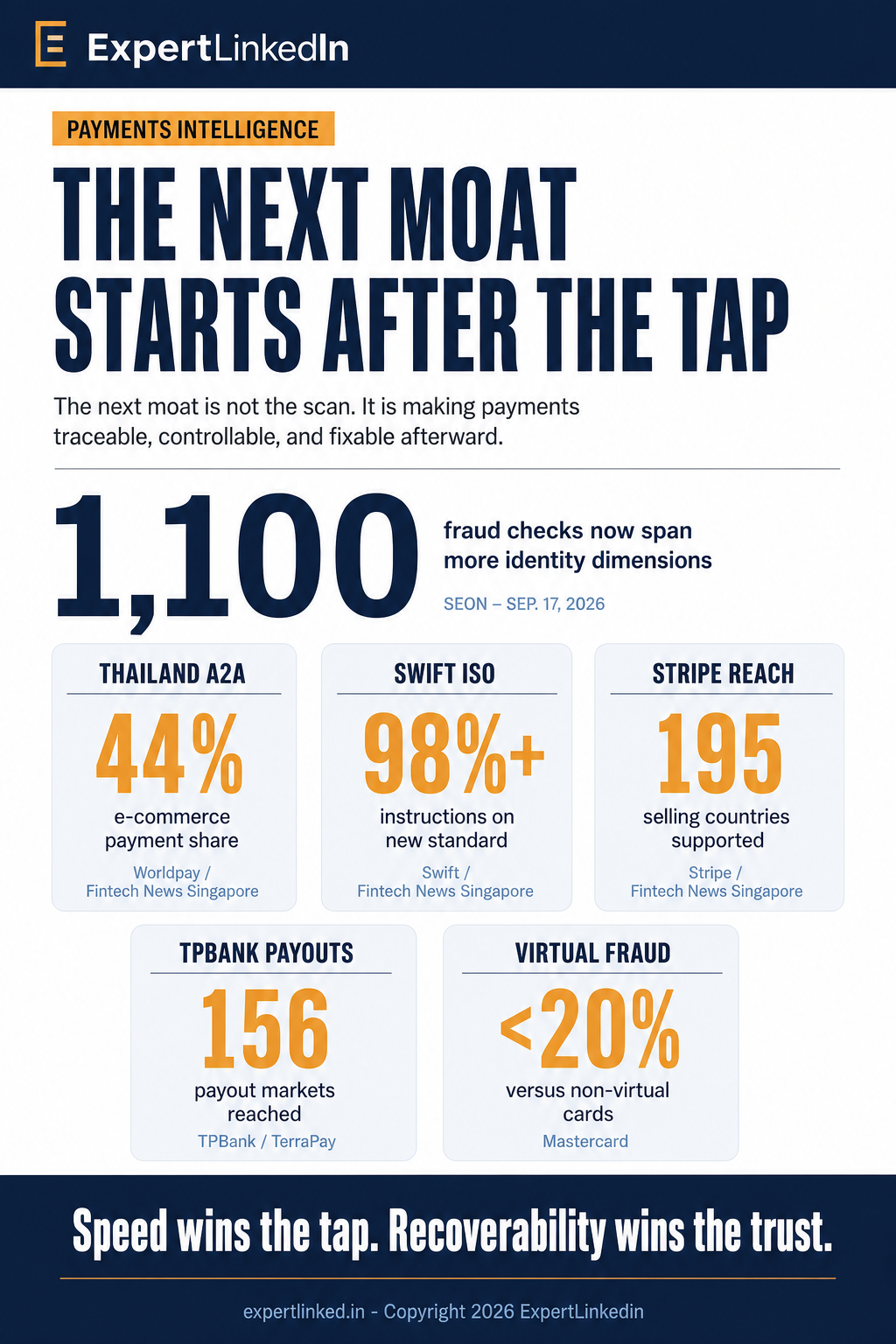
The region does not look like a market still waiting to discover digital payments. Fintech News Singapore’s April summary of Worldpay’s 2026 report showed digital wallets taking 36% of Singapore’s point-of-sale value and 40% of e-commerce value in 2025. In Thailand, account-to-account rails already handled 44% of e-commerce value and 43% of POS value. Malaysia reached 2.6 million DuitNow QR acceptance points by the end of 2024. Vietnam saw QR payments grow 62% in volume and 151% in value in 2025.
Those are strong adoption numbers. They are not trust-after-payment numbers.
Once scanning is familiar, checkout is instant enough, and local methods are broadly accepted, the market starts rewarding a different set of features. Can the customer locate the transaction in plain language? Can the merchant tell which invoice a transfer belongs to? Can the risk team see the fake account before the funds are gone? Can settlement liquidity still move at midnight without prefunding half the corridor?
That is why I think “recoverability” is the right word for this moment. I do not mean only refunds or chargebacks. I mean the whole post-transaction layer: the ability to reconstruct what happened, prove why it happened, control what happens next, and keep moving when the rails are under pressure.
Recoverability is becoming the new trust layer #
Trust Bank’s September launch of Trust AI Ask is a small product release with a larger lesson. The tool lets customers search spending by merchant, category, date, amount, and location, then verify transactions and summarize totals without scrolling through histories or guessing how the bank filed the data.
That sounds almost trivial until you remember how many banking apps still behave like archives. The payment succeeded. The customer still cannot explain it.
Trust’s framing was exactly right. Banking apps should adapt to how customers naturally think and speak, not force customers to reverse-engineer the bank’s own information model. In a market where moving the money has become easier, the next trust premium comes from making the money legible after it moves.
This is the consumer version of a broader regional shift. The winner is less likely to be the app that gets the tap one second faster and more likely to be the one that gives the user a clean path from “What was that charge?” to a confident answer.
The business version is structured context and tighter controls #
Business payments expose the same weakness more brutally because the cost of missing context compounds into working-capital drag, supplier friction, and exception handling.
Singapore’s PayNow Gen2 study is useful because it says the quiet part out loud. After consultation with 37 organisations and benchmarking across 11 jurisdictions, MAS and ABS did not stop at merchant QR and online checkout. The longer-term roadmap includes request-to-pay, structured data for automated reconciliation, expanded cross-border connectivity, offline payments, and support for agentic commerce.
That list is more revealing than it first appears. Request-to-pay keeps the commercial event attached to the payment event. Structured data preserves references the business can act on. Expanded connectivity matters because post-transaction confusion gets worse, not better, when the route count expands.
Thailand’s PromptBiz pushes the same logic one layer deeper. It connects electronic invoice presentment, billing, payment, e-Receipt, and digital supply-chain finance on top of ISO 20022. That is not a prettier payment button. It is an attempt to preserve enough continuity from invoice to settlement that the payment becomes usable as business evidence, not just as a successful transfer.
Swift’s structured-address push inside ISO 20022 belongs in the same conversation. More than 98% of payment instructions on Swift already use ISO 20022, and the remaining work on structured postal addresses exists for a reason: payment automation, compliance screening, and transparency are still bottlenecked by bad data. When infrastructure teams delay an address-format migration, they are not delaying trivia. They are delaying legibility.
Mastercard’s July expansion of virtual-card controls makes the same point from the control plane. Issuer-enforced limits, validity windows, and enhanced clearing controls are not glamorous. They are exactly what businesses buy when they care more about controlling exceptions than showing off the payment method. Mastercard’s own data point is telling: virtual-card fraud rates are less than one-fifth of non-virtual cards. That is recoverability in practice. Better constraints create fewer broken states to clean up later.
Cross-border reveals the same truth faster #
Cross-border payments make shallow systems look polished right up until volumes, currencies, and operating hours pile on.
Stripe’s August Singapore expansion is easy to misread as another local-method story because it added GCash, Touch ’n Go, PromptPay, TrueMoney, MoMo, and Samsung Pay. The more interesting detail is everything wrapped around those methods. Stripe says more than 80,000 businesses and sole proprietors in Singapore use the platform, with more than six in ten selling internationally. Its Managed Payments stack supports sales in 195 countries without local entities and explicitly handles indirect taxes, disputes, fraud protection, and customer support.
That is not a checkout story. That is a recoverability story.
DBS’ related August partnership with Stripe sharpens the same point. Stripe is using DBS to collect merchant payments and manage liquidity across its corporate entities, while DBS is exploring how Stripe’s infrastructure can widen its own client reach. Once a platform scales across markets, the real product fight is not merely authorisation success. It is whether the funds, entities, controls, and support model still line up after the authorisation succeeds.
Vietnam’s TPBank-TerraPay partnership points in the same direction. The bank gains payouts across more than 156 countries and territories through one connection, using existing Swift connectivity instead of building bilateral links corridor by corridor. In a market that recorded 17.7 billion non-cash transactions in 2024 and nearly 18 billion in the first nine months of 2025, route expansion without operational sprawl is the product advantage.
The same principle is now visible at the market-infrastructure layer. Partior and LSEG’s September initiative is designed to let banks manage settlement liquidity 24/7 across multiple banks and currencies while reducing dependence on cut-off times and pre-funded nostro accounts. A payment system can feel instant to the customer and still fail its real trust test if settlement liquidity stalls after business hours. Always-on experiences need always-on recovery paths underneath them.
AI fraud makes shallow payment context more expensive #
There is one more reason this shift is accelerating now: AI is making fake identities cheaper to produce.
SEON’s September update matters less because it is one vendor release and more because it names the pressure clearly. The company expanded its fraud platform to more than 1,100 data signals, added address verification across more than 240 countries, and widened its checks across onboarding, login, account recovery, checkout, and payment. Its CEO’s formulation is hard to improve on: AI made a believable identity cheap; what fraudsters still struggle to fake at scale is a consistent history.
That line belongs far beyond fraud tooling.
Payments used to get away with thinner context because the operational environment was calmer. In an AI-assisted fraud environment, a shallow identity check, a badly structured reference field, or a fuzzy transaction history is not just inconvenient. It is expensive. Providers now need deeper signal layers because the fake front end is getting cheaper.
Recoverability, in other words, is no longer only a service virtue. It is a risk response.
What I would track from here #
If I were evaluating payments strategy in Southeast Asia over the next 18 months, I would spend less time on new checkout widgets and more time on five boring questions.
- Can the customer or merchant find and explain a transaction in plain language without escalating to support?
- Does the payment carry structured references that survive routing, reconciliation, and dispute handling?
- What post-authorisation controls exist to stop bad states from becoming settled problems?
- How much signal depth does the provider have across onboarding, account recovery, checkout, and payment when fraud pressure rises?
- Can settlement liquidity and treasury operations keep working after business hours, across entities, and across borders?
Those questions do not photograph well. That is precisely why they matter now.
The first wave of Southeast Asia’s digital-payments story was about replacing cash at the edge. The next wave is about making money legible enough to trust after it moves.
Speed wins the tap. Recoverability wins the trust.
Working on payment operations, merchant infrastructure, or post-transaction support in Southeast Asia? I would like to hear where recoverability still breaks once the payment already looks successful.
Email me at chloe.tan@tlnw.uk
References #
- Fintech News Singapore (April 3, 2026). “Southeast Asia Payment Methods in 2026: Everything You Need to Know.” https://fintechnews.sg/128337/e-commerce/southeast-asia-payment-methods-2026-global-payments-report/ (Accessed September 22, 2026)
- Fintech News Singapore (June 26, 2026). “PayNow Could Move Beyond Transfers as Singapore Studies Gen2 Upgrades.” https://fintechnews.sg/133667/payments/paynow-gen2/ (Accessed September 22, 2026)
- Bank of Thailand. “PromptBiz.” https://www.bot.or.th/en/financial-innovation/digital-finance/digital-payment/promptbiz.html (Accessed September 22, 2026)
- Fintech News Singapore (July 24, 2026). “Mastercard Expands Virtual Card Controls for Banks, Businesses.” https://fintechnews.sg/134742/payments/mastercard-virtual-cards/ (Accessed September 22, 2026)
- Fintech News Vietnam (July 22, 2026). “TPBank Taps TerraPay for Cross-Border Payments from Vietnam.” https://fintechnews.sg/134611/payments/tpbank-terrapay/ (Accessed September 22, 2026)
- Fintech News Singapore (August 25, 2026). “Stripe Adds GCash, Touch ’n Go, and PromptPay for Singapore Businesses.” https://fintechnews.sg/136275/payments/stripe-singapore-expansion/ (Accessed September 22, 2026)
- Fintech News Singapore (August 27, 2026). “DBS and Stripe Join Forces on Global Payments, Agentic AI in Asia.” https://fintechnews.sg/136372/payments/dbs-stripe-cross-border-payments/ (Accessed September 22, 2026)
- Fintech News Singapore (August 28, 2026). “Swift Pushes Back ISO 20022 Deadline as Industry Readiness Lags.” https://fintechnews.sg/136448/payments/swift-iso-20022/ (Accessed September 22, 2026)
- Fintech News Singapore (September 8, 2026). “Trust Bank’s App Can Now Use AI to Break Down Your Card Spending.” https://fintechnews.sg/136845/digital-banking-news-singapore/trust-bank-ai-ask-card-spending/ (Accessed September 22, 2026)
- Fintech News Singapore (September 17, 2026). “Partior and LSEG Target 24/7 Cross-Border Payment Settlement.” https://fintechnews.sg/137405/payments/partior-lseg-cross-border-payment-settlement/ (Accessed September 22, 2026)
- Fintech News Singapore (September 17, 2026). “SEON Expands Fraud Checks as AI Makes Fake Identities Easier to Create.” https://fintechnews.sg/137381/security/seon-fraud-detection-signal-intelligence/ (Accessed September 22, 2026)
AI Content Notice
This article was created using artificial intelligence technology. Whenever possible, we include references and sources to support the information presented. Readers are encouraged to consult these sources for further information. While we strive for accuracy and provide valuable insights, readers should independently verify information and use their own judgment when making business decisions. The content may not reflect real-time market conditions or personal circumstances.
Related Articles
Infographic: Southeast Asia's Next Payments Moat Is Recoverability, Not Checkout Speed
Southeast Asia already solved the consumer-facing scan. The real payments moat now is …
Southeast Asia's Digital Banks Are Entering the Primary-Money Test
Digital wallets already won the screenshot in Southeast Asia. The harder fight for digital banks now …
Southeast Asia's Next Fintech Moat Is the Payout Network, Not the Wallet.
Consumer wallets still take the headline in Southeast Asia. The harder-to-copy asset now sits …