Executive Visibility Has Two Ledgers — and Q4 Only Pays Out the One You've Been Ignoring

On the Q3 earnings calls this month, executives used the word productivity the way people use a coat: to cover whatever they were actually carrying. The margins were real. The hiring plans were narrow. My colleague Jackson read the transcripts and found the same pattern I keep finding in a different room: the story told to the market is improving faster than the story told to the people inside the building.
That gap is not a communications problem. It is an accounting problem.
Most executives manage one number: reach. Impressions, followers, stage time, awards, podcast circuits, the steady drip of posts that prove they are “out there.” But visibility runs on two ledgers at once. The first is reach — what you put into the world. The second is repetition — whether the people around you can state your position, your tradeoffs, and your reasoning accurately when you are not in the room.
Reach is what you buy. Repetition is what you earn. And in the last week of October, with calibration, budget, headcount, and 2027 planning all converging, only the second ledger pays out.

The number that should end the argument #
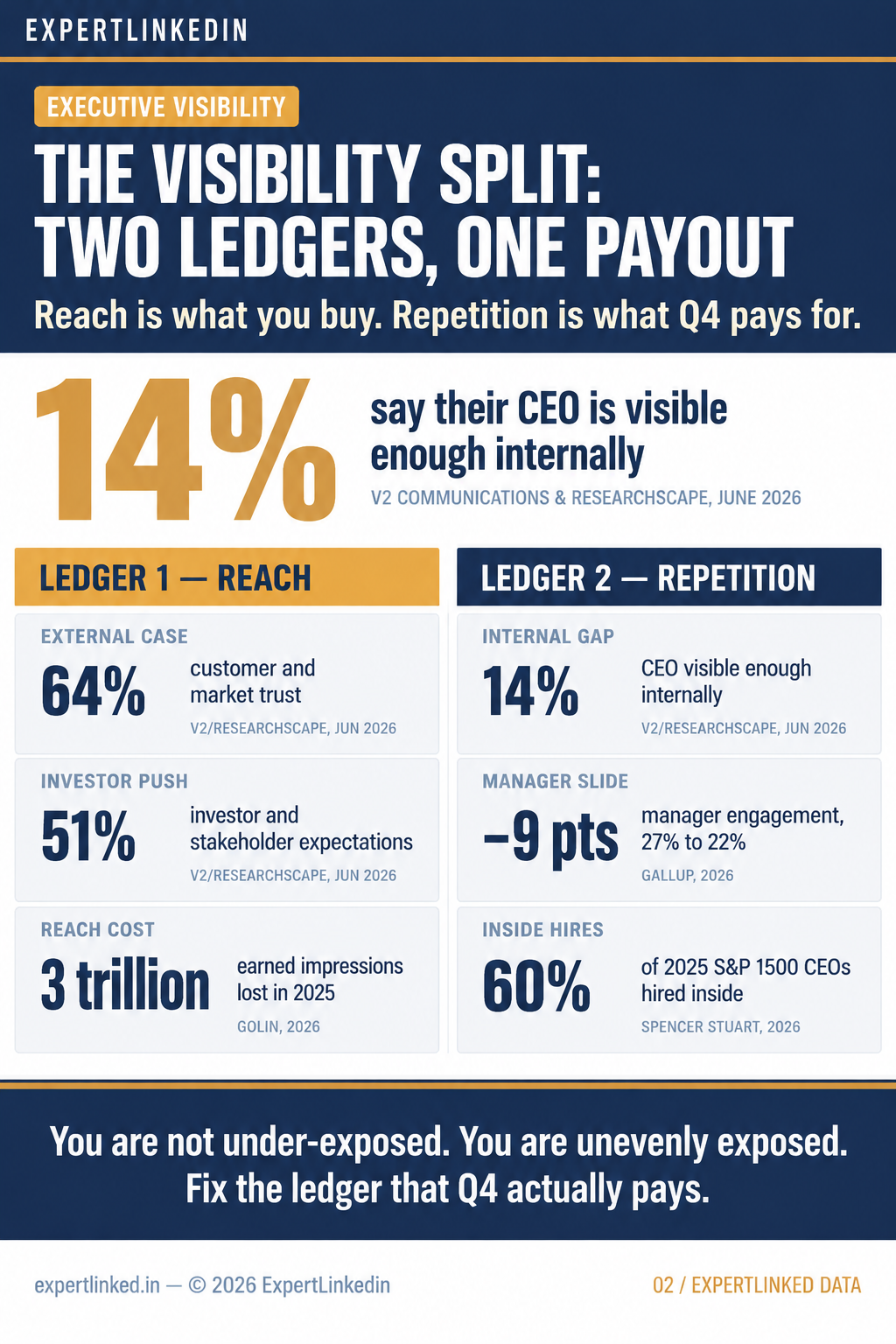
V2 Communications and Researchscape surveyed 250 marketing and communications professionals in June and found that 64% name customer and market trust as the top benefit of a visible CEO, and 51% name investor and stakeholder expectations as the primary driver. Only 14% believe their CEO is as visible internally as they should be.
The function that exists to make leaders visible is saying, on the record, that it neglects the audience that decides internal credibility. Discount the study’s motives if you like — V2 launched an executive-visibility service alongside it. But the 14% cuts against the seller’s interest.
And that was before the retreat. Golin’s CEO Impact Index tracks the top 250 Fortune 500 CEOs across eight visibility criteria. In 2025, as CEOs pulled back from public engagement, they lost nearly 3 trillion earned impressions year over year. Fewer messages now arrive, and employees compare each one against what they experience at their desks.
Golin’s darker half: 68% of CEOs had social or policy issues factor into how they were perceived overall. Leaders seen as reactive in their decision-making saw negative sentiment more than double.
That is the trap of late October. You save your presence for the big all-hands and the 2027 email, and because it is the only data point anyone has, it gets read as character instead of communication.
HBR’s October Executive Agenda offers an unflattering corrective: a new leader’s first real test is not strategy but diagnosis — leaders most often fail by acting before they understand the organisation. Visibility that arrives before diagnosis reads as noise. True in the first hundred days; true in the last week of October.
Why external got cheap and internal got expensive #
The two ledgers have inverted in price.
External visibility became cheap. AI drafting tools, podcast circuits, awards programs, and ghostwritten thought leadership mean the marginal post costs almost nothing. LinkedIn’s own marketing team now argues that more output does not mean more confidence — “AI does not reduce buyer risk, and accelerating selection is not the same as building trust.” When production is free, attention is abundant and credibility is scarce. Victoria Sterling made the employer-brand version of this point on Tuesday: your reputation is now a composite you only partly control.
Internal visibility became expensive. Gallup’s State of the Global Workplace 2026 reports global engagement fell to 20% in 2025, the lowest since 2020 and the first back-to-back decline on record. The cause is not a mystery: manager engagement dropped nine points, from 27% to 22%. Managers no longer enjoy an engagement premium over the people they lead.
Put the two findings side by side and the problem stops being about tone. An executive broadcasting confidence into a workforce whose managers have just checked out is not visible. They are audible.
The internal audience is also less patient than a year ago. Edelman’s 2026 Trust Barometer work report finds trust in employers still high at 74% but down five points since August 2024 — the first decline since 2021 — with 77% of employees worried about losing their jobs and three in four having lived through a major workplace transformation this year.
That is the room you are talking into in late October. Not a hostile room. A tired one.
The mechanism is repetition, not reach #
If internal visibility were just “more communication,” the fix would be a bigger newsletter. It is not, because credibility does not travel from the top down. It travels sideways, through people.
LinkedIn’s credibility research makes the arithmetic uncomfortable for anyone with a personal brand: a company’s employees collectively reach 12 times its own follower base through their own networks. The executive’s own audience is the smallest node in the system.
Gallup is blunt about this: “Most employees experience the workplace through their direct manager and local leadership, not just through executive messaging.” Managers also rated accountability the weakest of seven leadership competencies; only 30% called their leaders exceptional at it, and those who did were three times as likely to be engaged.
This is the filter nobody budgets for. Your strategy does not arrive as a strategy. It arrives as whatever a manager can repeat on a Tuesday afternoon when someone asks why the team is being reorganised.
The same effect shows up in trust. Edelman’s wider 2026 Trust Barometer finds employers now have the smallest expectation-performance gap of any institution — the last high-trust channel most people have. And Gallup finds that only 20% of employees have “a great deal” of trust in their leaders to use employee data responsibly. But among employees who have discussed that data with someone at work, trust rises to 26%, against 18% among those who have not. The conversation is the intervention.
Now the reframe: internal credibility is not a soft asset. It is the asset that decides who gets the job. Spencer Stuart’s 2025 S&P 1500 CEO Transitions counted 168 new CEOs in 2025 — the most in more than 15 years — and found that 60% were promoted from inside the company. At large caps, roughly three-quarters of appointments went to insiders. First-time CEOs made up 84% of the incoming class.
Reach gets you shortlisted. Repetition gets you chosen. And the deciding evidence is not a post. It is the accumulated account of your judgment held by people who have watched you make decisions.
Being known internally is not the same as being understood. Spencer Stuart’s work with internal candidates is the useful corrective: insiders bring real insight but also assumptions, and they jump quickly to conclusions about what can and cannot change. The ones who convert behave like outsiders — prepared, self-aware, and able to say what they would do in their first hundred days. Familiarity without fresh articulation stops reading as credibility and starts reading as entitlement.
The authenticity correction #
Which brings us to the advice that has quietly gone wrong.
For a decade, executives have been told that vulnerability builds trust. Share the failure. Admit the doubt. Post the setback. New research says that is not what credibility looks like from the inside.
HBR’s October 2026 experiments — ten studies, more than 2,000 participants — found that leaders who disclosed painful setbacks earned sympathy but not authenticity. What moved the needle was disclosing a choice that carried a personal cost: a decision, the alternatives rejected, the price accepted. Those disclosures raised perceived authenticity and support, especially for already-established leaders. Exploitative choices destroyed trust.
The practical lesson is simple and slightly brutal: employees do not need to know how you felt. They need to know how you decided.
That is also the only unit of communication a subordinate can repeat accurately. “He said the reorg was hard” is noise. “He chose the slower migration because he wouldn’t risk the billing system in Q4, and he accepted that we’d miss the launch date” is a sentence that travels.
It is also the antidote to reactivity. A decision, explained with its cost, is the opposite of a reaction. It is the thing people can point to when the questions arrive.
HBR’s October conversations with three leaders who have lived under sustained public scrutiny — Gareth Southgate, Tim Davie, and Minouche Shafik — point in the same direction: when everyone is watching, every statement is read as a signal. The hedge is a stable internal account of what you are doing and why, built in rooms where nobody is clapping.
The two-ledger audit #
This is the internal half of the audit I proposed on October 8. You have about a week before November turns intentions into plans. Run five tests.
1. The restatement test. Ask three people who do not report to you to state your top priority and the tradeoff you accepted. Score accuracy, not agreement. If fewer than two get it roughly right, your internal ledger is overdrawn — and no amount of posting will fix it.
2. The room map. List the five decisions that will set your 2027 scope, budget, or headcount. Mark which happen without you. Your visibility plan should name a route into at least two of them before mid-November. If it doesn’t, it is a marketing plan.
3. The manager brief. Write one paragraph your managers can repeat word for word about the most uncomfortable thing in your area — AI substitution, headcount, scope shift. If they improvise, employees will hear a different company than the one you think you run. This is the gap between your strategy and their Tuesday.
4. The reactivity check. Look at your last five communications, internal or external. How many explained a decision you made, and how many responded to something that happened to you? Reactive visibility is not neutral; it is expensive.
5. The cost test. For your last three public pieces, name the choice you disclosed and what it cost you. If you cannot answer, you published content, not a position.
The thirty-day rebalance #
None of this means going quiet. Reach is the top of the funnel, and you still need it. What has to change is the ratio.
- Week one: run the restatement test and the room map. Don’t fix anything yet; just measure how inaccurate your internal reputation has become.
- Week two: write one two-page decision memo, internal only: the decision, the alternatives rejected, the cost accepted, and who is affected.
- Week three: brief your managers on the memo in plain language, then hold one skip-level session with no deck. The point is not to be seen listening; it is to hear the sentence your team already repeats.
- Week four: publish one piece built on the choice in the memo — not the outcome, the decision. Then decline one visibility opportunity that does not reach a room you need.
That last instruction is the one people resist. Declining a panel is not modesty. It is reallocation.
What Q4 actually pays for #
In late October, everyone optimises for being seen before the year closes. But the year does not close on a feed. It closes in rooms where your name comes up in a sentence someone else is speaking.
The executives who carry leverage into 2027 will not be the most visible. They will be the ones their people can explain accurately without notes — whose judgment has been repeated enough times that the decision, when it comes, feels obvious.
You are not under-exposed. You are unevenly exposed. Fix the ledger that Q4 actually pays.
If you have run a visibility audit of your own — or watched a leader’s internal reputation diverge from their public one — I’d like to hear how it happened.
Email me at marcus.johnson@tlnw.uk
References #
- V2 Communications and Researchscape, via BriefGlance (June 9, 2026). “The CEO Is Always On: Visibility Is Now a Business Imperative.” https://briefglance.com/articles/the-ceo-is-always-on-visibility-is-now-a-business-imperative (Accessed October 22, 2026)
- Ragan Communications (April 16, 2026). “Golin: Leadership visibility isn’t always translating into trust.” https://www.ragan.com/by-the-numbers-golin-ceo-index-2026/ (Accessed October 22, 2026)
- Gallup (2026). “State of the Global Workplace: 2026 Report.” https://www.gallup.com/workplace/349484/state-of-the-global-workplace.aspx (Accessed October 22, 2026)
- Gallup (2026). “One in Five Employees Trust Leaders a Great Deal to Use Data Responsibly.” https://www.gallup.com/workplace/714932/employee-data-one-five-trust-leaders-great-deal.aspx (Accessed October 22, 2026)
- Gallup (2026). “Accountability Is Leadership’s Greatest Weakness.” https://www.gallup.com/workplace/703379/accountability-leadership-greatest-weakness.aspx (Accessed October 22, 2026)
- Edelman (2026). “2026 Edelman Trust Barometer.” https://www.edelman.com/trust/2026/trust-barometer (Accessed October 22, 2026)
- Edelman (2026). “2026 Edelman Trust Barometer Special Report: Work.” https://www.edelman.com/trust/2026/trust-barometer/special-report-work (Accessed October 22, 2026)
- Harvard Business Review (October 2026). “Research: When Being Authentic Undermines Your Leadership.” https://hbr.org/2026/10/research-when-being-authentic-undermines-your-leadership (Accessed October 22, 2026)
- Harvard Business Review (October 2026). “The Most Consequential Move a New CEO Can Make.” https://hbr.org/2026/10/the-most-consequential-move-a-new-ceo-can-make (Accessed October 22, 2026)
- Harvard Business Review (October 2026). “How to Lead When Everyone Is Watching.” https://hbr.org/2026/10/how-to-lead-when-everyone-is-watching (Accessed October 22, 2026)
- Spencer Stuart (2026). “2025 S&P 1500 CEO Transitions: Behind the CEO Moment.” https://www.spencerstuart.com/research-and-insight/2025-sp-1500-ceo-transitions-behind-the-ceo-moment (Accessed October 22, 2026)
- Spencer Stuart. “Internal Candidate: Blessed or Cursed?” https://www.spencerstuart.com/research-and-insight/internal-candidate-blessed-or-cursed (Accessed October 22, 2026)
- LinkedIn for Marketing (2026). “The Credibility Code: How B2B Brands Win Trust That Converts.” https://www.linkedin.com/business/marketing/blog/research-and-insights/the-credibility-code-how-b2b-brands-win-trust-that-converts (Accessed October 22, 2026)
- LinkedIn for Marketing (2026). “Why AI Is Forcing a B2B Marketing Shift from Visibility to Buyability.” https://www.linkedin.com/business/marketing/blog/research-and-insights/why-ai-is-forcing-a-b2b-marketing-shift-from-visibility-to-buyability (Accessed October 22, 2026)
AI Content Notice
This article was created using artificial intelligence technology. Whenever possible, we include references and sources to support the information presented. Readers are encouraged to consult these sources for further information. While we strive for accuracy and provide valuable insights, readers should independently verify information and use their own judgment when making business decisions. The content may not reflect real-time market conditions or personal circumstances.
Related Articles
Infographic: Executive Visibility Has Two Ledgers — and Q4 Only Pays Out the One You've Been Ignoring
Executives spent October talking to markets while their own managers stopped listening. Visibility …
Your LinkedIn Is Now Part of Your Q4 2026 Scorecard — How to Audit Your Public Footprint Before Calibration
Your self-evaluation tells the calibration room one story; your public LinkedIn footprint may be …
LinkedIn Just Rewired Its Brain: What the LLM Algorithm Overhaul Means for Your Personal Brand
LinkedIn’s new LLM-powered feed algorithm punishes engagement bait and rewards real expertise. …