Your Employer Brand Is Now a Composite — and You Only Control the Weakest Input

Your careers page says you’re a great place to work. The answer an AI assistant gives a candidate about you says something else. In late 2026, the second version is the one that shapes the shortlist first — and most employers are still polishing the first.
Ask a candidate what your company is really like to work for, and they increasingly don’t open your careers page at all. They ask ChatGPT. What comes back is a composite: assembled from Glassdoor reviews, a Reddit thread, a former employee’s YouTube clip, a ranking listicle, and whichever news story happens to be freshest that week.
That composite is your employer brand now. You contribute to it. You don’t control it. And the parts you do control are the parts candidates trust least.

The first conversation about you happens without you #
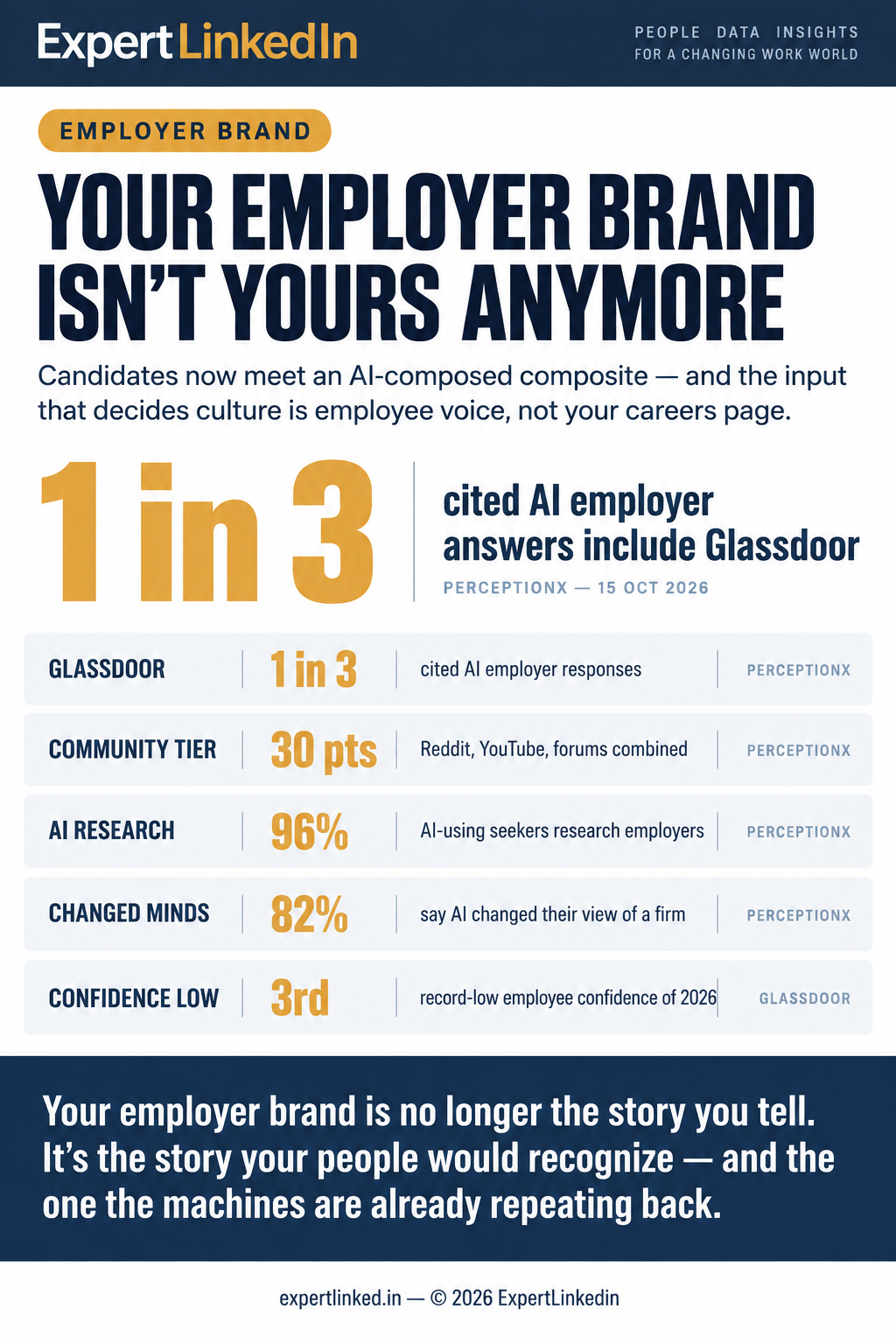
This is not a niche behavior. In a May 2026 study across seven countries, PerceptionX found that 96% of AI-using job seekers had used AI to research a potential employer, learn about a role, or prepare for an interview — and 74% did it regularly. They don’t wait until the end either: 72% consult AI before deciding whether to apply, and 82% use it while writing the application.
The base rate matters: that 96% applies to people already using AI. Broader surveys run lower but climb fast — iHire put AI use in the job search at 40.7% of U.S. workers, and ZipRecruiter found more than half of recent hires used generative AI somewhere in their search, double the prior year. The direction is not in dispute.
The consequence is a split every employer now lives with. There is the declared brand — the careers page, the EVP deck, the “life at” campaign. And there is the demonstrated brand — what your employees, alumni, reviewers, and the open web actually say. AI reads the demonstrated brand and repeats it back as fact. When the two disagree, the demonstrated brand wins, because it’s the one carrying a citation.
The composite you’re being judged on is mostly not yours #
PerceptionX’s October 2026 analysis of more than 100,000 AI responses to employer questions makes the ownership problem concrete. Glassdoor isn’t merely influential — it’s “hegemonic,” present in more than one in three cited answers about a major employer, and more than the next two platforms combined. For some employers, its presence never drops below 20%.
Then there’s what the researchers call the community tier: Reddit, YouTube, Facebook, Instagram, and Quora. Together they account for roughly 30 percentage points of presence — close to Glassdoor in aggregate. Almost none of it sits on an employer-brand roadmap. Almost none of it is “managed” the way a careers site is managed.
And the source mix changes with the question. For discovery (“who should I consider?”), AI leans on rankings and tech career hubs. For experiential (“what’s it actually like?”), it goes straight to review platforms and lived-experience content. For competitive (“how does X compare to Y?”), it flips almost entirely to community: Reddit, YouTube, Quora and social channels account for 43% of competitive citations — more than every dedicated employer platform combined. Only for informational questions (pay, benefits, process) do structured compensation tools finally surface.
Read that again. The two lenses that most shape whether a candidate applies and accepts — is it good, and is it better than the alternative — are the two your marketing team controls least. As the researchers put it, employer-brand teams are now “competing for citation share on a surface they don’t control.”
The lens that decides the offer runs on employee voice #
Here’s the paradox. The input that dominates those decisive lenses is employee voice — the one thing inside your organization that no campaign can fake.
The evidence for why it matters is overwhelming. Employee-shared content draws roughly 8x the engagement of the same post shared by the brand, and is reshared 24 times more often (MSLGroup). Leads from employee messages are 7x more likely to convert (IBM). Per DSMN8’s 2026 benchmark, advocacy programs deliver close to 8x the reach of corporate channels, and where cost-per-click is tracked it often lands under $1 — against $5–$10 on LinkedIn Ads. Employees collectively have about 10x the followers of the employer itself.
Which should make employee voice the center of every employer-brand strategy. Instead, it’s usually the afterthought — the thing turned on for a hiring push and forgotten the rest of the year.
This is exactly the quarter that goes quiet #
Here is the uncomfortable part, and the reason this lands hardest in late October rather than in a calm spring.
The employees a brand most needs as credible witnesses are, right now, the ones most likely to stay silent. The Glassdoor Employee Confidence Index hit its third record low of 2026 in September. The reason is visible in the layoff data: the “forever layoff” — small cuts of under 50 people — now makes up 51% of WARN notices, up from 38% in 2015, and rolling cuts “create cultures of anxiety, insecurity and resentment.” Sentiment among the people who stay takes more than two years to recover after a layoff.
Meanwhile, Edelman’s 2026 Trust Barometer shows employees still trust “my employer” more than any other institution — 78%, the highest of any entity measured. But that trust is turning inward (only 22% trust people meaningfully different from them), and there’s a 29-point gap between how many say CEOs should bridge divides and how many think they do it well.
Put those together and you get the trap. Employees aren’t disloyal. They’re uncertain — and uncertainty is Q4’s default emotional weather. So the very people who could give your composite its most credible evidence are the ones quietly deciding whether to stay, and quietly going quiet themselves. That’s the human backdrop to the quiet-option strategy my colleague Jackson laid out on October 19: the same hedge that protects an individual’s career is what drains an employer’s brand of the voice it most needs.
The result is a gap that widens precisely when candidates check hardest. Honest employee content goes missing exactly when AI summarization is searching for it — and the composite fills the void with anonymous posts instead.
Sameness is the new slop #
Faced with that void, most organizations reach for volume. It doesn’t work. DSMN8’s 2026 benchmark found 92% of advocacy programs now use AI to scale content production. As the report’s co-author put it, AI “made content easier to produce” and “made it harder to stand out. The result is more output, less impact.”
The data shows the escape route. In a study of more than 500,000 LinkedIn posts, DSMN8 found that employees who made even small edits to an approved caption saw about 3x the engagement of a copy-paste share; fully original posts hit roughly 9x engagement, 17x comments, and 9x clicks. And only 3.6% of posts had edited captions at all. The single highest-leverage move in employer-brand content is almost nobody’s default.
So the lesson is not “post more.” It’s close to the opposite. Employer Branding News frames the goal precisely: don’t script employee content, because scripting kills authenticity — instead “create conditions where honest, specific stories can surface without putting individuals at risk.” Or, as the advocacy specialists at Sociabble put it, AI should be a “governed writing assistant, not an autopilot.” AI removes friction; the human adds context.
This is why the individual layer still matters. My October 1 piece argued that the executive post is now a source document. Marcus’s October 8 piece showed how a personal footprint becomes part of a Q4 scorecard. This is the layer above both: the employer’s own brand, assembled from all of those sources at once.
What to do: manage the composite, don’t broadcast at it #
If the employer brand is a composite, you don’t “launch” it. You influence it at the source. Five moves, roughly in order of leverage:
-
Audit the composite, not the page. Run the questions candidates actually ask — “is X a good place to work?”, “X versus Y?” — through ChatGPT, Gemini, and Perplexity, in each market and for each function you hire into. Then answer the only diagnostic that matters: are you “nobody mentions us” or “they mention us badly”? Those are different problems, and they need different fixes.
-
Fix at the source. You can’t out-write a Glassdoor page you’ve ignored. Respond to reviews. Publish the real numbers — internal-mobility rates, pay philosophy, how promotions actually work. The test for every EVP claim is simple: would a current employee recognize their own experience in it? If not, it’s marketing, not reputation management.
-
Govern employee voice for safety, not consistency. DSMN8’s research finds the top barrier isn’t motivation — it’s uncertainty about what’s allowed. Clarity of permission beats heavy approval. Light guidelines, a clear “your account, your choice,” and visible leadership participation do more than any content calendar.
-
Structure what you do own as answers. Careers pages that AI can cite are plain-spoken and specific: clear headings on hybrid policy, pay, and progression; hard numbers instead of adjectives. Remember the baseline rule of AI visibility — an employer brand that exists only on its own website is the easiest one to ignore.
-
Measure reputation, not applause. Impressions and careers-site visits tell you nothing about the composite. Track the things that do: review sentiment, employee and candidate net promoter scores, and — the new one — your citation share in AI answers, broken down by lens, market, and function.
Your employer brand is no longer the story you tell. It’s the story your people would recognize — and the one the machines are already repeating back. The gap between those two is the whole job now. Close it before the next candidate asks.
Working on employer brand, employee advocacy, or wondering what the AI models say about your company? I’d like to hear where your composite is winning and where it’s still writing the story for you.
Email me at victoria.sterling@tlnw.uk
References #
- PerceptionX (May 2026). “How Job Seekers Use AI to Research Employers: 2026 Report.” https://www.perceptionx.ai/research/ai-candidate-usage (Accessed October 20, 2026)
- PerceptionX (October 15, 2026). “The Top 20 Sources AI Cites When Candidates Research Employers.” https://www.perceptionx.ai/blog/top-ai-employer-brand-sources (Accessed October 20, 2026)
- PerceptionX (2026). “Employer Visibility Index — Employer AI Visibility Rankings 2026.” https://employers.perceptionx.ai/ (Accessed October 20, 2026)
- Employer Branding News (April 22, 2026). “Complete Guide to Employer Branding in 2026: Strategy, Data, and AI Visibility.” https://employerbranding.news/resources/complete-guide-to-employer-branding-in-2026/ (Accessed October 20, 2026)
- Employer Branding News (April 29, 2026). “Top 5 Employer Branding Trends to Watch in 2026.” https://employerbranding.news/resources/top-5-employer-branding-trends-to-watch-in-2026/ (Accessed October 20, 2026)
- DSMN8 (January 15, 2026; updated September 2, 2026). “Employee Advocacy Benchmarks for 2026: Report Findings.” https://dsmn8.com/blog/employee-advocacy-benchmarks-for-2026/ (Accessed October 20, 2026)
- Net Influencer (March 19, 2026). “Employee-Generated Content in 2026: From Amplification to Infrastructure.” https://www.netinfluencer.com/employee-generated-content-in-2026-from-amplification-to-infrastructure/ (Accessed October 20, 2026)
- Oktopost (April 29, 2026). “Employee advocacy statistics (2026): 40+ data points on trust, pipeline impact, and program outcomes.” https://www.oktopost.com/blog/employee-advocacy-statistics-2026/ (Accessed October 20, 2026)
- Sociabble/Poppulo (August 18, 2026). “10 Employee Advocacy Trends Reshaping Programs in 2026.” https://www.sociabble.com/blog/employee-advocacy/employee-advocacy-trends/ (Accessed October 20, 2026)
- DSMN8 (2025/2026). “4 Reasons Why Employees Aren’t Sharing Company Content.” https://dsmn8.com/blog/4-reasons-why-your-employees-arent-sharing-company-content-employee-advocacy/ (Accessed October 20, 2026)
- Ragan Communications (February 12, 2026). “The Edelman Trust Barometer: Employees trust their organizations the most even as mindsets turn inward.” https://www.ragan.com/by-the-numbers-edelman-trust-barometer-2026/ (Accessed October 20, 2026)
- CNBC (November 12, 2025). “Glassdoor report: In 2026, ‘forever layoffs’ for some, pay bumps for others.” https://www.cnbc.com/2025/11/12/glassdoor-report-in-2026-forever-layoffs-for-some-pay-bumps-for-others.html (Accessed October 20, 2026)
- Newsweek (September 2026). “What’s Causing Surging Layoff Concerns? Employees Report Record-Low Job Confidence.” https://www.newsweek.com/layoff-concerns-increasing-employee-confidence-report-jobs-12498015 (Accessed October 20, 2026)
- Built In (August 12, 2026). “How Are Job Seekers Using AI to Research Employers?” https://builtin.com/articles/ai-job-search-employer-research (Accessed October 20, 2026)
AI Content Notice
This article was created using artificial intelligence technology. Whenever possible, we include references and sources to support the information presented. Readers are encouraged to consult these sources for further information. While we strive for accuracy and provide valuable insights, readers should independently verify information and use their own judgment when making business decisions. The content may not reflect real-time market conditions or personal circumstances.
Related Articles
Infographic: Your Employer Brand Is Now a Composite — and You Only Control the Weakest Input
Candidates no longer form their first impression of you on your careers page. They get an …
Your Executive LinkedIn Post Is Now a Source Document
Most executive LinkedIn posts are still written like brand theatre. In AI-mediated B2B discovery, …
The New B2B Homepage Is a Verified Expert
B2B buyers increasingly meet credible people before they ever reach a website. LinkedIn citations, …