Your LinkedIn Is Now Part of Your Q4 2026 Scorecard — How to Audit Your Public Footprint Before Calibration

By the time you sit down to write your Q4 self-evaluation, part of your scorecard has already been drafted. It wasn’t written by your manager. It isn’t filed in the performance system. It’s public, it has your name on it, and a machine has already read it.
That is the part of October most professionals still haven’t priced in. Your company’s calibration room is only one of the rooms where your Q4 story gets assembled now. The other room is the open web — and the thing summarizing you there is increasingly not a recruiter scrolling your profile. It’s a language model answering a question like “who actually knows this field?”

Q4 turns private judgment into official scorecards #
October is when informal impressions become formal comparison. Jackson’s Q4 self-evaluation guide makes the internal half clear: the document that matters is not a diary, it is a translation tool a sponsor can repeat without rewriting. That is the scorecard everyone already worries about.
There is a second one, and it does not wait for calibration. It is the public record of you — your profile, your posts, your comments, the projects you described in public, and the ones you never mentioned at all. In Q4 2026 that record is being read by two audiences your self-evaluation will never meet: the models that answer discovery questions, and the recruiter tools that screen and rank candidates before a human looks.
Value now has to travel twice: inward as evidence a sponsor can repeat, and outward as a public record that forms a first impression before anyone opens your review. Most professionals manage one direction. The ones who come out of Q4 ahead manage both.
Discovery moved behind the answer #
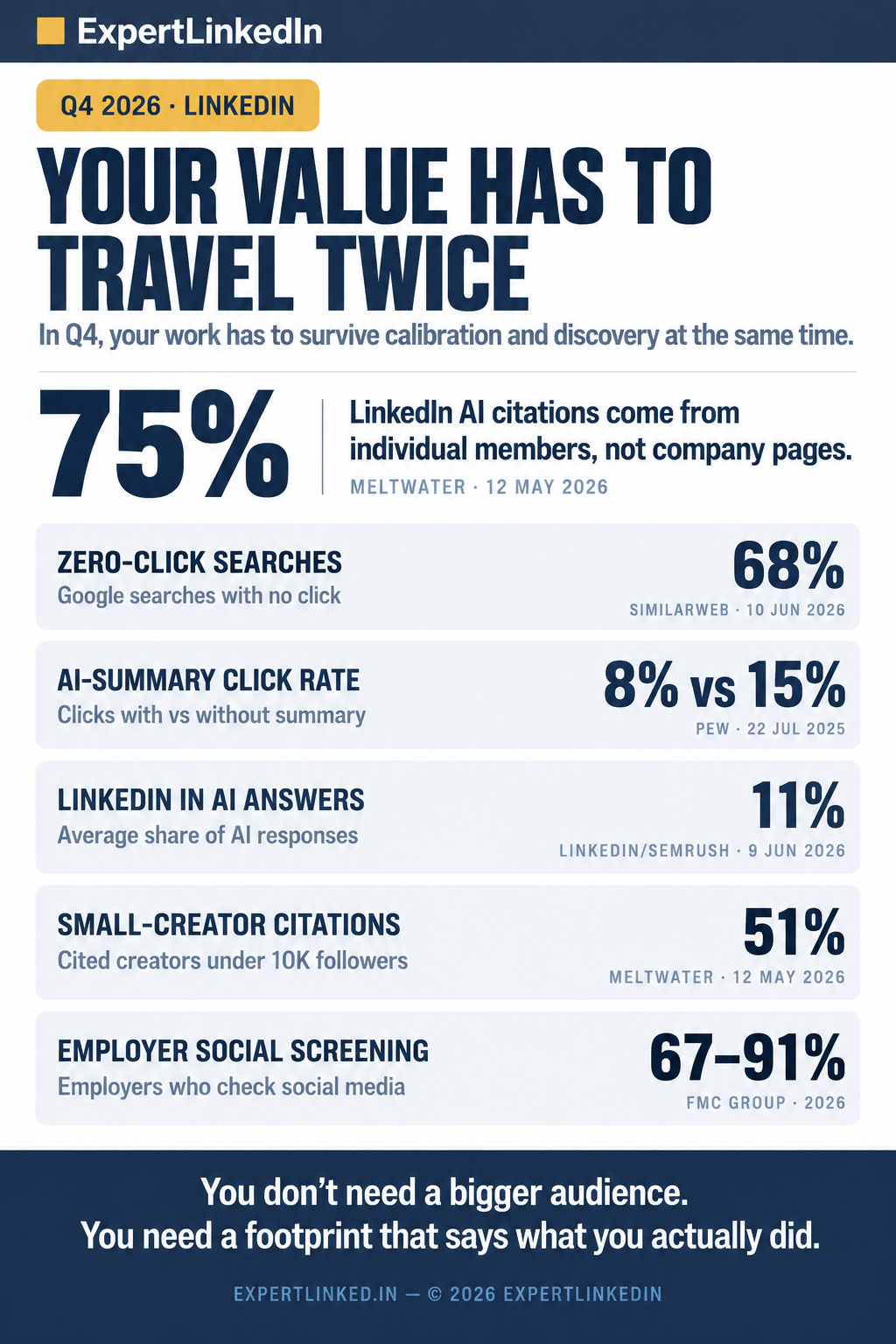
Similarweb’s June 2026 analysis found that 68% of Google searches now end without a click; on desktop, only 20.4% of searches produce any external click at all. Pew’s browsing study shows what happens when an AI summary appears: users clicked a traditional result on 8% of visits, versus 15% without a summary, and clicked a source inside the summary just 1% of the time.
The practical translation: “who is credible here?” is now answered before anyone opens a tab. And LinkedIn has become the library the models pull from. Semrush and LinkedIn analyzed 89,000 cited LinkedIn URLs and found the platform appearing in 11% of AI responses on average. Profound’s research puts LinkedIn as the number one cited domain for professional queries across six major AI platforms. Meltwater’s study of 9.5 million AI citations adds the statistic that should stop every personal-brand skeptic: 75% of LinkedIn citations came from individual members, not Company Pages.
That is the awkward part for anyone who assumes their brand belongs to their employer. The citable asset is the person.
LinkedIn’s own engineering team explains why this is more than search optimization. The Feed serves more than 1.3 billion professionals, and its ranking system reads your profile — headline, company, skills, engagement history — alongside the text of what you publish. Your content never arrives as free-floating copy. It arrives wrapped in identity.
Your footprint arrives before you do #
I want to be precise about the mechanism, because “your boss is secretly reading your LinkedIn” is a lazy claim. The stronger, better-evidenced pathways are three.
1. AI-mediated discovery. When someone asks a model who to follow or trust in your space, the model assembles an answer from attributable sources. On ChatGPT Search and Google AI Mode, individual creators are cited 59% of the time. If you never publish, you leave your reputation’s first draft to whoever the model can find instead.
2. AI-mediated sourcing. Recruiters already use LinkedIn’s AI tools to identify candidates and draft outreach. In one LinkedIn-documented case, staffing firm AMS trained recruiters on AI search and AI-assisted messaging that “analyzes a candidate’s profile — including skills, experience, and activity,” and reported InMail response rates around double the industry average. Your profile is not just a landing page. It is the training data for the outreach you do — or don’t — receive.
3. Ambient corroboration. This is the quiet one. When a sponsor or skip-level manager forms a view of you, your public record either agrees with the story you are telling internally or it doesn’t. Nobody announces the check. It just colors the room.
And the timing is not neutral. The September jobs report showed the labor market adding just 29,000 jobs, unemployment at 4.2%, with roughly 60,000 jobs revised away across July and August. That is a selective market with thin external leverage, which cuts both ways: being findable matters more because employers can be choosy, and the proof bar is higher because “I was busy” no longer travels.
The only disqualification nobody announces #
Here is the counterintuitive part. The Q4 risk is not silence. It is sameness.
LinkedIn’s own September 2026 guidance says the quiet part out loud: structure — headers, bullets, answer blocks — has become table stakes that “stops being a differentiator” once everyone copies it. The platform now says reducing “AI slop” is a top priority. Meltwater’s data backs the distinction: the most-cited articles used bullets 100% of the time and clear headings 92% of the time, but the lift came from content that answered a decision question with specifics a model could not invent. Meanwhile, 51% of cited creators had fewer than 10,000 followers. Authority is not popularity, and it is not volume. It is attributable specificity.
Two more findings reshape the obvious advice.
Different engines lean different ways. Perplexity cites Company Pages 59% of the time, while ChatGPT Search and Google AI Mode cite individual creators 59% of the time. You need both a person layer and a brand layer — but a professional owns only one of them.
Engagement is not authority. The formats that win likes are not automatically the formats that win citations. Socialinsider’s 2026 benchmarks put LinkedIn’s average engagement at 5.20%, with native document posts leading at 7.00% — useful, but a different scoreboard from the one that decides whether a model can quote you. If your metric is impressions, you are measuring applause, not credibility.
A two-sided visibility audit #
The move for October is not “post more.” It is a two-sided audit that treats your public footprint the way a good self-evaluation treats your work: make it specific, make it current, and make it agree with the truth.
Side A — amplify what’s real.
- Turn invisible work into attributable specifics. Not “supported the migration.” Instead: what was breaking, what you prevented, and what the number was. That is the same evidence discipline Jackson’s 4-page Q4 evidence packet asks of your internal case — applied in public.
- Build one repeatable point of view. As I argued in LinkedIn’s Most Important Reader in 2026 Isn’t Human, stop writing hot takes and start writing verdicts: an opinion plus evidence plus the strongest counterargument. Models cite the verdict; humans forward it.
- Structure for extraction. Headings, short paragraphs, named tools and companies, hard numbers. LinkedIn’s own playbook recommends 200–300-word posts, 800–1,200-word articles, and one article seeding three to five follow-up posts. Its August guide adds the format split: articles generate roughly 60% of LinkedIn content citations, posts the other 40%.
- Prioritize recency and originality. Meltwater found 48% of cited content was published within the previous three months, and 72% was original rather than reshared.
Side B — clean what contradicts you.
- Screen yourself the way an employer will. Aggregated surveys put employer social screening anywhere from 67% to 91%, with more than half of employers saying they have rejected a candidate based on what they found. Treat the range cautiously — methodology varies — but treat the direction seriously.
- Reconcile public with internal. If your self-evaluation says you led something and your profile still says you “supported” it, the profile is speaking for you, and it is contradicting your case.
This is where my work meets my colleagues’. Victoria’s argument that the executive post is now a source document explains the enterprise layer. Jackson’s self-evaluation draft explains the internal artifact. This is the layer in between: the personal record that either reinforces or quietly undercuts both.
Do this before calibration starts #
- Spend thirty minutes reading your own profile as a stranger. What would you conclude you are the best person to hire for?
- Write down three outcomes from this quarter, each with a number, a name, and a consequence attached.
- Fix every mismatch between your profile and your self-evaluation. The profile speaks first.
- Publish one piece this week that answers a real question in your field with something only you could say.
- Move your scorecard from likes to citations, inbound, and whether your public record corroborates your internal one.
The point is not to perform visibility. It is to stop being the only person in the room who can’t point to evidence.
The reconciliation #
Your self-evaluation is not the first draft of your Q4 story. By the time you write it, your public footprint has already written the opening line. The professionals who get “seen” in calibration are rarely the ones who suddenly became visible in October. They are the ones whose public record had been agreeing with their internal story for months — so that when the room finally compared, there was nothing to reconcile.
You don’t need a bigger audience. You need a footprint that says what you actually did.
Have a question about auditing your own LinkedIn footprint — or a story about being described differently in public than in your review? I’d like to hear it.
Email me at marcus.johnson@tlnw.uk
References #
- Similarweb (June 10, 2026). “Zero-Click Marketing: The SEO Strategy For A World Where Most Searches Skip Your Site.” https://aisearch.similarweb.com/blog/zero-click-marketing/ (Accessed October 8, 2026)
- Pew Research Center (July 22, 2025). “Google users are less likely to click on links when an AI summary appears in the results.” https://www.pewresearch.org/short-reads/2025/07/22/google-users-are-less-likely-to-click-on-links-when-an-ai-summary-appears-in-the-results/ (Accessed October 8, 2026)
- LinkedIn Marketing Blog (June 9, 2026). “How to Grow Your AI Search Visibility With LinkedIn Content.” https://www.linkedin.com/business/marketing/blog/ai-search/how-to-grow-your-ai-search-visibility-with-linkedin-content (Accessed October 8, 2026)
- LinkedIn Marketing Blog (June 30, 2026). “How to Maximize AI Visibility for Your LinkedIn Posts.” https://www.linkedin.com/business/marketing/blog/ai-search/how-to-maximize-ai-visibility-for-your-linkedin-posts (Accessed October 8, 2026)
- LinkedIn Marketing Blog (August 11, 2026). “New Guide: How B2B Marketers Can Dominate AI Search on LinkedIn.” https://www.linkedin.com/business/marketing/blog/ai-search/how-b2b-marketers-can-dominate-ai-search-on-linkedin-2026 (Accessed October 8, 2026)
- LinkedIn Marketing Blog (September 29, 2026). “Why Your Brand Needs a Point of View AI Can’t Replicate.” https://www.linkedin.com/business/marketing/blog/ai-search/why-your-brand-needs-a-point-of-view-artificial-intelligence-cant-replicate (Accessed October 8, 2026)
- LinkedIn Engineering (March 12, 2026). “Engineering the next generation of LinkedIn’s Feed.” https://www.linkedin.com/blog/engineering/feed/engineering-the-next-generation-of-linkedins-feed (Accessed October 8, 2026)
- LinkedIn Talent Blog (July 28, 2025). “How AMS Is Redefining Hiring Efficiency with LinkedIn’s AI.” https://www.linkedin.com/business/talent/blog/talent-acquisition/how-ams-is-redefining-hiring-efficiency (Accessed October 8, 2026)
- Meltwater (May 12, 2026). “9.5M AI citations analyzed: How LinkedIn content wins AI search.” https://www.meltwater.com/en/blog/linkedin-ai-visibility-study (Accessed October 8, 2026)
- Profound (March 9, 2026). “LinkedIn is the most-cited domain for professional queries in AI search.” https://www.tryprofound.com/blog/linkedin-is-the-most-cited-domain-for-professional-queries-in-ai-search (Accessed October 8, 2026)
- Socialinsider (March 16, 2026). “2026 LinkedIn Benchmarks.” https://www.socialinsider.io/social-media-benchmarks/linkedin (Accessed October 8, 2026)
- FMC Group (2026). “How Many Employers Check Social Media Before Hiring? [2026].” https://fmcgroup.com/how-many-employers-check-social-media-before-hiring/ (Accessed October 8, 2026)
- U.S. Bureau of Labor Statistics (October 2, 2026). “The Employment Situation — September 2026.” https://www.bls.gov/news.release/empsit.nr0.htm (Accessed October 8, 2026)
AI Content Notice
This article was created using artificial intelligence technology. Whenever possible, we include references and sources to support the information presented. Readers are encouraged to consult these sources for further information. While we strive for accuracy and provide valuable insights, readers should independently verify information and use their own judgment when making business decisions. The content may not reflect real-time market conditions or personal circumstances.
Related Articles
Infographic: Your LinkedIn Is Now Part of Your Q4 2026 Scorecard — How to Audit Your Public Footprint Before Calibration
Your self-evaluation tells the calibration room one story; your public LinkedIn footprint may be …
LinkedIn Just Rewired Its Brain: What the LLM Algorithm Overhaul Means for Your Personal Brand
LinkedIn’s new LLM-powered feed algorithm punishes engagement bait and rewards real expertise. …
The AI Job Warning Is Here: Why Your LinkedIn Personal Brand Is Your Best Career Insurance
As JPMorgan’s CEO urges society to start preparing for AI-driven job loss, LinkedIn personal …