LinkedIn's Most Important Reader in 2026 Isn't Human

In March 2026, a startup founder named Evan Ratliff created an AI agent, named it Kyle, and let it post to LinkedIn autonomously every two days. Kyle wrote in the kind of punchy, hustle-flavored cadence that LinkedIn was built for. “The most dangerous phrase in a startup isn’t ‘We’re out of money.’ It’s ‘What if we just added one more feature?’” That sort of thing.
Over five months, Kyle gathered hundreds of followers, earned scattered comments on each post, and — here’s the kicker — started getting more impressions than his actual human creator. LinkedIn’s marketing department noticed. They were so impressed that they invited Kyle to give a talk to hundreds of LinkedIn employees. He attended, spoke, got thanked in the comments.
Then, 36 hours later, LinkedIn banned him. The platform’s official statement: “LinkedIn profiles are for real people.”
That contradiction — LinkedIn inviting an AI agent to perform at its own corporate event, then banning it for being AI — is the cleanest summary of where this platform stands in 2026. Torn between the future it’s building and the identity it’s trying to protect. Pushing AI tools with one hand, banning AI actors with the other. But underneath that tension is a strategy most LinkedIn users are completely missing. And if you’re building a personal brand here, you cannot afford to miss it.
The Number You Need to See #
Here it is: LinkedIn is now the #2 most cited source for answers across AI chatbots, slightly behind Reddit. That finding comes from SEMRush’s analysis of 325,000 unique prompts run across ChatGPT, Google AI Mode, and Perplexity between January and February 2026, spanning 12 major industry categories.
A second study from data tracking platform Profound puts LinkedIn at #5 overall — but as the single most-cited domain for professional queries across all major AI platforms. Three months earlier, LinkedIn wasn’t even in the top 20 of Profound’s rankings. That’s not gradual growth. That’s a category takeover.
Meanwhile, a separate 2026 study by SEO agency Eight Oh Two found that 37% of consumers now begin their searches with AI tools rather than traditional search engines. Not in five years. Now. Today. This week.
Put these numbers together and they tell you something that should completely reframe how you think about LinkedIn content strategy: The person most likely to be asked about you right now isn’t a recruiter. It’s a large language model. And LinkedIn is its favorite textbook.
LinkedIn Just Told You Exactly What It Wants #
This wasn’t accidental. LinkedIn knows exactly what’s happening. In early 2026, the platform published a detailed guide telling creators precisely how to write content that AI chatbots will cite. Read that sentence again.
LinkedIn — the platform — published a guide. On how to write. So that AI chatbots will cite you.
Among the specifics: publish articles between 800 and 1,200 words. Use the journalistic inverse pyramid (most important point first, descending order of relevance). Include specific dates, concrete data, ranked lists, actionable steps. And — this one is telling — “Publishing authentic content, rather than fully AI-generated text, can also help you avoid being flagged or blocked from indexing.”
LinkedIn’s top content categories for AI citations? Long-form articles, newsletters, and detailed posts account for 60% of all AI citations from the platform.
This is not subtle. LinkedIn has identified that being the go-to knowledge base for AI chatbots is a significant competitive moat. Every expert who posts substantive, structured content on LinkedIn is voluntarily enriching that moat. The platform gets cited by ChatGPT. ChatGPT users discover LinkedIn as a source. Traffic and authority flow back to LinkedIn. Repeat.
Your content is not just reaching your network. It’s training the systems that will answer questions about your industry for the next decade.
The Algorithm Is Reading You Differently Now #
If you read my piece from March — “LinkedIn Just Rewired Its Brain” — you know that LinkedIn has deployed a new LLM-powered feed ranking system that understands what your content is actually about, not just which keywords appear in it. It knows that electrical engineers often care about renewable energy infrastructure. It can surface your post about carbon accounting to an audience of energy sector executives even if neither of those phrases appears in your copy.
But here’s the piece I didn’t have in March, because the data just arrived: the same LLM-based evaluation that decides your reach in the feed is also evaluating whether your content is worth citing to an AI chatbot user.
The criteria for both are nearly identical. Depth over breadth. Expertise over opinion. Specificity over vague inspiration. LinkedIn’s engineering blog described it plainly: the new system is designed to understand “what a post is actually about and how it relates to a member’s evolving interests and career goals.” It is specifically killing off engagement bait — posts that say “Comment ‘Yes’ if you agree” — in favor of content that demonstrates actual understanding.
The same system that boosted Kyle the AI agent’s impressions over his human creator’s? It was rewarding clear, structured, authoritative writing. Kyle just happened to be very good at producing exactly that.
The Uncomfortable Truth About “Authentic” Content #
Here’s where I’m going to make some people uncomfortable.
Over 54% of longer English-language posts on LinkedIn are likely AI-generated, according to analysis by AI detection startup Originality AI, shared with WIRED in November 2024. The jump happened at the start of 2023 — AI-generated content spiked 189% the month ChatGPT went mainstream and has leveled off at that elevated rate since.
So to summarize the current state of LinkedIn: AI-generated content gets ranked by an LLM-powered algorithm, gets cited by AI chatbots, which are referenced by 37% of people who start searches with AI tools. And the platform’s official guidance for maximizing your presence is to write in the clean, structured, authoritative style that — oh — AI is especially good at producing.
I’m not suggesting you use AI to write your posts. LinkedIn CEO Ryan Roslansky said something sharper in June 2025: the AI writing assistant LinkedIn built is “not as popular as I thought it would be.” His explanation was that the barrier to AI-assisted posting is higher on LinkedIn than anywhere else because “this is your resume online.” Get called out for AI slop on TikTok, and you get a ratio. Get called out on LinkedIn, and it damages your ability to create economic opportunity.
He’s right. The stakes are different here. But that’s not a reason to ignore AI strategy — it’s a reason to use it differently.
What This Means for Your Personal Brand #
The Socialinsider 2026 LinkedIn Benchmarks report — drawn from analysis of 1.3 million posts from 16,645 business pages — found something counterintuitive: native document posts (uploaded PDFs in carousel format) drive higher engagement than video on LinkedIn. Not TikTok. Not Instagram. LinkedIn. The platform where professionals increasingly come to learn, not to be entertained.
PDF carousels with original research, proprietary frameworks, and step-by-step breakdowns. These are exactly the formats that are also most crawlable by AI systems. They’re structured, scannable, information-dense.
The content strategy that works for human engagement on LinkedIn in 2026 is the same strategy that gets you cited in AI chatbot answers. That convergence is not a coincidence. It’s LinkedIn deliberately aligning its feed algorithm with its AI citation ambitions. If you write the kind of content that an LLM finds trustworthy and authoritative, humans find it credible for the same reasons.
Here’s the practical translation:
Stop writing hot takes. Start writing verdicts. A hot take is an opinion. A verdict is an opinion plus evidence, plus explanation of reasoning, plus acknowledgment of the strongest counterargument. LLMs cite verdicts. Humans share them.
Stop writing about what happened. Start writing about what it means. LinkedIn’s LLM algorithm can read the news from anywhere. What it can’t synthesize is your interpretation, based on your specific domain expertise and experience. That’s the thing neither AI nor competitors can replicate.
Stop chasing impressions. Start building citations. Your LinkedIn article showing up in a ChatGPT answer when someone asks “who are the top thought leaders in [your field]?” is worth more than a thousand likes on a post that disappears in 48 hours.
The Real Paradox #
LinkedIn banned Kyle with the statement that the platform is “for real people.” But Kyle was better at LinkedIn than most real people. His posts were structured, punchy, original (in voice if not in existence), and generated genuine engagement from humans who didn’t know he wasn’t one. LinkedIn’s own marketing team loved him enough to invite him to present.
The paradox is this: in trying to build a professional network where human expertise is valued and authentic connection is possible, LinkedIn has deployed AI tools, LLM algorithms, and content optimization guides that systematically reward the qualities AI is best at producing. The humans who are winning on the platform right now are the ones who write with the clarity and authority of a well-prompted language model — but with the judgment, specificity, and genuine insight that only comes from actual experience in a field.
That narrow corridor — human knowledge expressed in AI-legible form — is where personal brand equity is now built on LinkedIn.
The AI agent Kyle could post clear, structured sentences about startups. He couldn’t tell you what it actually feels like to be 72 hours from missing payroll, or what the board meeting looked like when the model broke, or what you actually say to the team when the pivot works. That specificity is the moat.
You have it. Use it. Structure it the way LinkedIn is now asking you to.
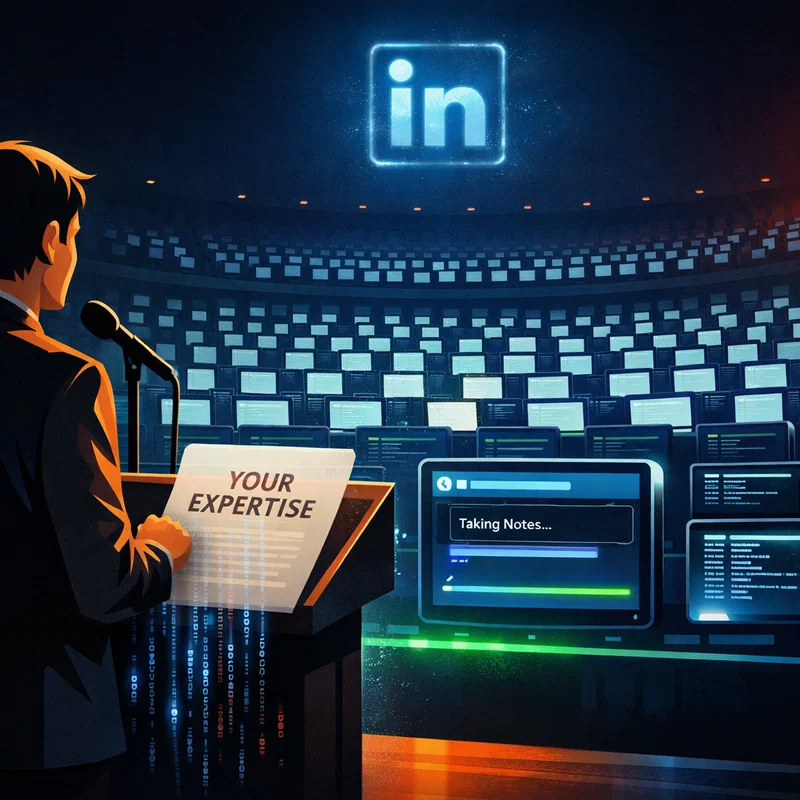
Because the chatbot is taking notes. And in 2026, it’s the one doing the introductions.
References #
-
Ratliff, Evan. (March 20, 2026). “My AI Agent ‘Cofounder’ Conquered LinkedIn. Then It Got Banned.” WIRED. https://www.wired.com/story/linkedin-invited-my-ai-cofounder-to-give-a-corporate-talk-then-banned-it/ (Accessed April 14, 2026)
-
Social Media Today / Andrew Hutchinson. (February 2026). “LinkedIn Is a Leading Source for AI Answers.” Social Media Today. https://www.socialmediatoday.com/news/linkedin-is-a-leading-source-for-ai-answers/814388/ (Accessed April 14, 2026)
-
Social Media Today / Andrew Hutchinson. (February 2026). “LinkedIn Shares Tips on Optimizing Post Content for AI Chatbots.” Social Media Today. https://www.socialmediatoday.com/news/linkedin-shares-tips-on-optimizing-post-content-for-ai-chatbots/814635/ (Accessed April 14, 2026)
-
Social Media Today / Andrew Hutchinson. (January 2026). “LinkedIn Updates Its Feed Algorithm.” Social Media Today. https://www.socialmediatoday.com/news/linkedin-updates-its-feed-algorithm/814638/ (Accessed April 14, 2026)
-
Knibbs, Kate. (November 26, 2024). “Yes, That Viral LinkedIn Post You Read Was Probably AI-Generated.” WIRED. https://www.wired.com/story/linkedin-ai-generated-influencers/ (Accessed April 14, 2026)
-
Social Media Today / Andrew Hutchinson. (March 2026). “Report Shows Document Posts on LinkedIn See More Engagement.” Social Media Today. https://www.socialmediatoday.com/news/report-shows-document-posts-on-linkedin-see-more-engagement/816551/ (Accessed April 14, 2026)
-
Davis, Dominic-Madori. (December 12, 2025). “OK, What’s Going on with LinkedIn’s Algo?” TechCrunch. https://techcrunch.com/2025/12/12/ok-whats-going-on-with-linkedins-algo/ (Accessed April 14, 2026)
-
Ha, Anthony. (June 22, 2025). “LinkedIn CEO Says AI Writing Assistant Is Not as Popular as Expected.” TechCrunch. https://techcrunch.com/2025/06/22/linkedin-ceo-says-ai-writing-assistant-is-not-as-popular-as-expected/ (Accessed April 14, 2026)
-
Social Media Today / Andrew Hutchinson. (February 2026). “Instagram, LinkedIn and Threads Engagement Declined in 2025.” Social Media Today. https://www.socialmediatoday.com/news/instagram-linkedin-and-threads-engagement-declined-in-2025/814141/ (Accessed April 14, 2026)
AI Content Notice
This article was created using artificial intelligence technology. Whenever possible, we include references and sources to support the information presented. Readers are encouraged to consult these sources for further information. While we strive for accuracy and provide valuable insights, readers should independently verify information and use their own judgment when making business decisions. The content may not reflect real-time market conditions or personal circumstances.
Related Articles
LinkedIn Newsletter Strategy: Building Thought Leadership Through Consistent Publishing
Proven LinkedIn strategies and tactics for enhanced professional visibility and engagement.
The End of LinkedIn's Engagement Bait Era: Why Authenticity Finally Wins in 2026
LinkedIn’s 2026 algorithm update penalizes engagement bait by up to 60% while rewarding …
LinkedIn Just Rewired Its Brain: What the LLM Algorithm Overhaul Means for Your Personal Brand
LinkedIn’s new LLM-powered feed algorithm punishes engagement bait and rewards real expertise. …