How to Build a Year-End Pay Ask Before the Q3 2026 Employment Cost Index Lands

You are reading this four days before the Q3 Employment Cost Index lands and ten days after the merit page closed. That timing is not incidental. It is the article.
If you are still assembling a merit increase request, you are not early. You are late. The comparison page froze on October 16 and the carry sheet went up on October 23 (the 90-day Q4 plan). The decision for your role is already shaped, and the number was set before you had this quarter’s evidence.
What is still open is the exception.
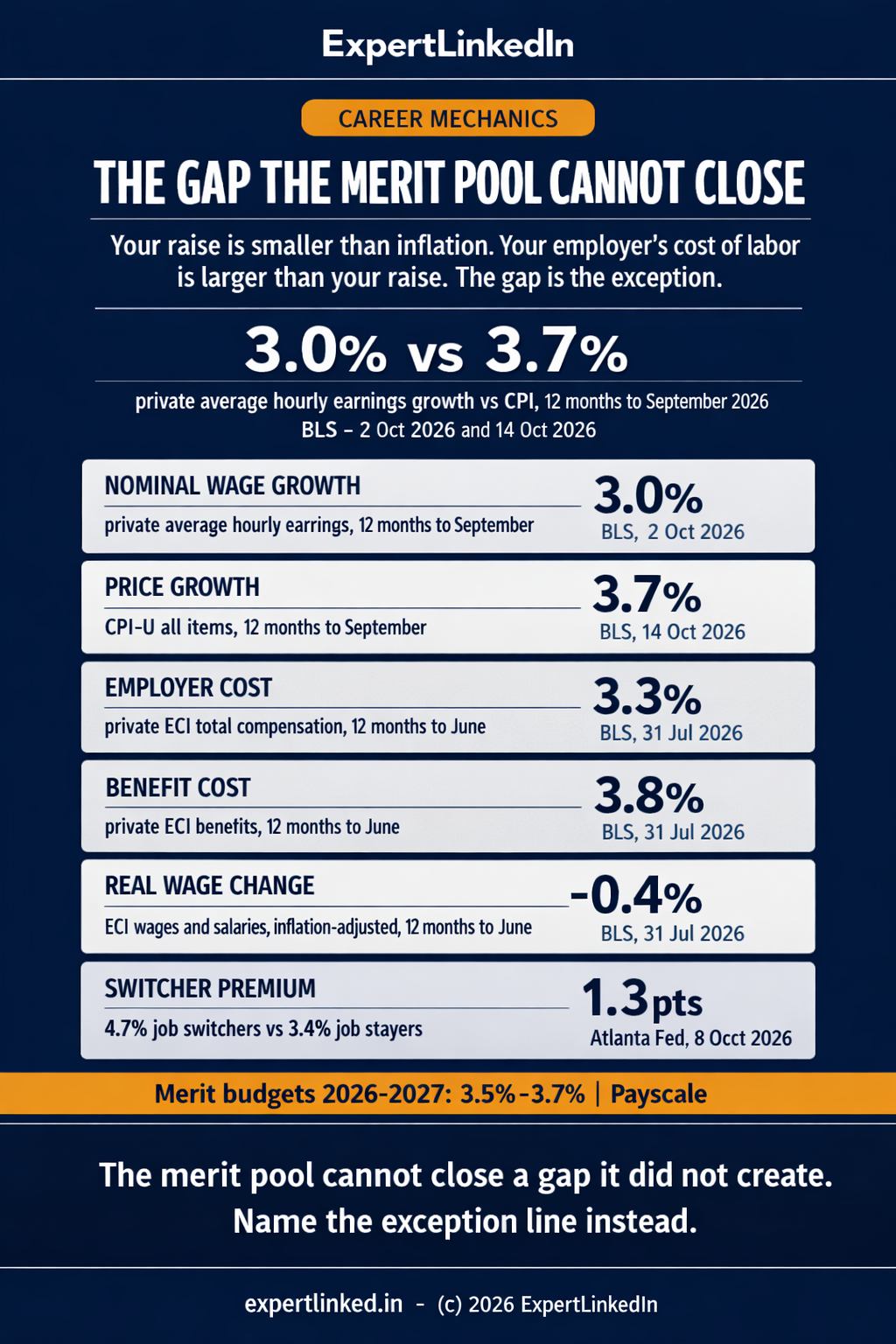
Three numbers explain why. Private average hourly earnings rose 3.0% over the year to September (BLS, October 2, 2026). CPI rose 3.7% over the same twelve months (BLS, October 14, 2026). And the Employment Cost Index for private industry — what your employer’s peers actually paid for the same job mix — was running 3.3% for total compensation in the second quarter, with benefits up 3.8% (BLS, July 31, 2026).
Your raise is smaller than inflation. Your employer’s cost of labor is larger than your raise. The gap is being absorbed by benefits you cannot spend. On Friday, the fourth number lands and sets next year’s band.
That is the document to build this week — not a plea about how hard you worked, but a comparison leadership can price.

The merit page already closed. Here is what is still open. #
The compensation calendar runs on a different clock than your evidence does. Most calendar-year companies draft the merit matrix and the structure increase in September and October, using the previous quarter’s market data. That is why the Q3 ECI matters more than any single CPI print: it arrives in time to update the band that governs 2027, not the raise already assigned for 2026 (BLS ECI release schedule).
Payscale’s 2026–2027 survey puts merit budgets in the 3.5%–3.7% range, with a meaningful share of organizations planning flat headcount and increased use of separate “hot skills” and retention pools (Payscale, 2026–2027 Salary Budget Survey). Structure increases keep lagging merit budgets. The band is not keeping up with the market, so sitting at the top of your band is a structural cap, not a performance verdict.
There are at least three budget lines, not one: the merit pool, essentially closed; the structure adjustment, set by market data like the ECI; and the retention or market-exception pool, smaller, discretionary, approved under a different standard.
A 3.6% ask against a 3.6% merit pool is invisible. A 4.4% ask cannot be a merit increase at all — it has to be named as a market adjustment plus a retention exception. That request goes to a different approver, with a different document, on a different clock. Naming the budget correctly is half the ask. Most people never do it, which is why good cases die as “not in this cycle.”
Why effort is the wrong currency this year #
“I worked hard” is not weak because managers are cruel. It is weak because it cannot be converted into a funding decision. Effort is unverifiable, non-comparable across roles, and already priced into your current salary. The raise is a decision about the risk the company needs you to absorb next.
The system reinforces this. Only 2% of Fortune 500 CHROs strongly agree their performance management system inspires improvement, and just 22% of employees strongly agree their review process is fair and transparent (Gallup, May 6, 2024). The room is not evaluating your sincerity. It is comparing line items under scarcity. As the risk-reduction piece put it two weeks ago, “arguing effort” reads as a diary entry, not a ledger.
The comparison is narrower than you think: what does this role cost us, what does it cost to fill, and what happens to the number if it goes empty? All three are answerable with data you already have.
The four inputs leadership can actually compare #
1. Replacement cost. What would it take to hire someone into this scope now? Use three real postings for equivalent work, not a salary site’s median, and add time-to-fill, agency fee, and ramp. August JOLTS showed 7.1 million openings against 5.2 million hires — roles stay open, and every empty week is a cost the employer is already paying (BLS JOLTS, August 2026). Indeed’s September snapshot shows the function split: Software Development sits near 77 against its February 2020 baseline while Healthcare is 117 and Production 123 (Indeed Hiring Lab, September 24, 2026). Your replacement cost is a function of your function, not “the market” in aggregate.
2. Market timing. The Atlanta Fed’s Wage Growth Tracker for September put overall wage growth at 3.9%, stayers at 3.4%, switchers at 4.7% (Federal Reserve Bank of Atlanta, October 8, 2026). The switcher premium has compressed to roughly 1.3 points, well below its 2022 peak above three. That is the cost of loyalty in base pay — and the number that makes “match a fraction of the switcher premium and avoid the replacement event” cheaper than hiring your replacement at market.
3. Scope drift. If your band was written for the job you were hired into and you now carry two levels of added scope — vendor ownership, cross-team translation, final QA on AI output — the band describes a role that no longer exists. Because structure increases lag merit budgets, this is mechanical, not personal. The fix is re-banding, an argument about scope, not effort. That is why the 4-page evidence packet puts scope comparison on page two: the room cannot fund a level you have not named.
4. Consequence. The avoided error, the held deadline, the escalation that never reached your director — each needs a baseline and an organization-native unit. The risk-reduction ledger already built that; attach it rather than rebuilding it.
| What you want to say | What the room can actually fund |
|---|---|
| “I worked hard all year.” | “The scope I carry is now two levels above my band.” |
| “Inflation is 3.7%, so I need more.” | “My nominal raise was 3.0% against a 3.3% employer cost trend.” |
| “I deserve more.” | “Replacing this scope costs $X and takes Y weeks.” |
The ECI’s real job is jurisdictional, not informational #
Almost everyone treats Friday’s release as a mood ring. It is not. The ECI is a fixed-weight measure of what employers paid for the same mix of jobs, including benefits, published quarterly and seasonally adjusted. Its design holds the employment mix constant so the change reflects price, not composition (BLS ECI overview). That makes it the number that updates the band, not the individual.
Leadership uses ECI to set the merit matrix and the structure increase. You use CPI to argue about your grocery bill. The mismatch is the entire problem.
The Q2 print is instructive. Civilian total compensation rose 3.4% over the year; wages 3.2%; benefits 3.8%. Private industry total compensation rose 3.3%, wages 3.1%, benefits 3.8%. And the inflation-adjusted wage series fell 0.4% (BLS, July 31, 2026). The government’s own employer-cost index, adjusted for inflation, says wages lost ground. Your employer cannot claim the market forced a real cut without conceding that the same market supports a real correction.
Note what benefits at 3.8% does to the total-rewards speech. The cushion is thinning. Benefit costs are inflating faster than wage costs, so “your benefits are worth 30% on top” is a weaker argument this year than last — the money is going to health insurance, not your base. The base line is the smaller, more controllable line. Ask for that one.
If Friday’s ECI lands near 3.3%–3.5%, a request materially above band midpoint cannot be a merit increase. Build the exception before the print, so the ECI confirms your case instead of starting it. Wait for the release and the band is set; you are negotiating against a closed number.
The one-page exception document #
Do not send the four-page packet to the compensation committee. Send one page, four blocks, and a routing line. The packet is the backup; this is the instrument.
Block 1 — The role, re-banded. Current title and band on the left. The scope you actually carry on the right. Two or three lines unambiguously outside the band definition: the vendor contract you own, the cross-team translation you do, the final QA nobody else performs. No adjectives. No “trusted partner.”
Block 2 — The replacement math. Three real postings for equivalent scope, with dates. Time-to-fill for the role family. Agency fee if you have it, typically 20–25% of first-year base. Ramp time. One sentence: “Replacing this scope costs approximately $X and takes Y weeks.”
Block 3 — The retention gap. Current base against band midpoint against the ECI trend against the switcher premium. One sentence: “The gap is Z% and has persisted for N quarters.” Do not editorialize about loyalty; the switcher premium already prices it.
Block 4 — The consequence ledger. Two or three avoided losses with baselines and units. Attach the full ledger as page two. Let the numbers travel; do not summarize them in the room.
The routing line. “This is a retention exception or market adjustment against [budget line], not a merit increase.” If you cannot name the budget line, ask your manager to name it before the meeting. That question alone often changes the conversation, because it forces the room to admit which pool it is actually protecting.
What to say when… #
Opening. “I want to talk about my compensation before the Q3 ECI sets the 2027 band, not after. Can we put 20 minutes on the calendar this week?”
Making the ask. “I am not asking you to reopen the merit pool. I am asking you to route an exception. The scope I carry is outside my band, the replacement math is on page two, and the retention gap is on page three.”
If the budget is closed. “I understand the merit pool is closed. Then I need two things: a dated commitment for the next cycle, and a named trigger that would reopen the exception — a scope change, a resignation in the role family, or the Q3 ECI printing above a level we agree on now.”
If you are at the top of your band. “Then the band is the problem, not my performance. A cap on a stale band is a structure issue. Let’s talk about re-banding the role, or about what scope would justify the next level.”
Three ways this goes wrong #
Leading with inflation. September CPI at 3.7% looks like your best argument. It is your weakest. Gasoline rose 9.1% in the month and energy is up 20.4% over the year, while core inflation is 2.6% (BLS, October 14, 2026). A manager can answer “everyone’s costs went up” and mean it. Worse, real average hourly earnings fell 0.7% over the year — the employer is already winning on real terms. Inflation is context, not leverage. The September CPI piece made that case two weeks ago; this is the operational version.
Quoting “market rate” without a named comparable. Market rate is not a number; it is a claim about a specific role, in a specific function, at a specific scope. Indeed’s posted wage growth is 2.5% year over year against CPI’s 3.7%, and posted ranges are being set below incumbent trend in exactly the functions where AI re-scoping is happening. Quote a generic median and you anchor yourself to a number that is already soft.
Asking your manager to build the case. Gallup’s manager research is blunt: managers report more stress and burnout than the people they manage, with 64% reporting added responsibilities and 42% reporting budget cuts (Gallup, September 5, 2023). If your document needs your manager to assemble it, it dies in the room without you. The page must be liftable.
The uncomfortable part #
Low quits are read as satisfaction. They are more accurately read as immobility. At 1.9%, the employer’s base rate for “this person will actually leave over pay” is low — and they know it. You are not arguing against a tight market; you are arguing against a stuck one. Gallup finds 43% of workers stay primarily because leaving would be too difficult or costly (Gallup, March 23, 2026). Your manager has read the same data.
So do not build the ask as a threat. Build it as a priced exception. And be honest about the possible answer: they may call the bluff. The document’s job is not to guarantee a yes. It is to make the comparison legible enough that a no becomes information — about your band, your budget line, and your real market.
If the answer is no and there is no date and no trigger, you have learned something more valuable than a raise: the retention risk is not priced, which means the external option deserves a real test rather than a fantasy. The 30-day external option was built for exactly that moment. A weak market discovered in October is still useful in November — and it tells you what your replacement costs, which is the number you needed anyway.
Friday’s ECI will be reported as a macro story about wage pressure. For you it is a document deadline. Build the page this week. Bring it before the band is set. And if the answer is no, at least make it a no you can price.
Building this page and stuck on the replacement-cost number — or on which budget line your role actually sits in? Send me the scope line and the band, and I’ll tell you which argument the room will fund.
Email me at jackson.rodriguez@tlnw.uk
References #
- U.S. Bureau of Labor Statistics (July 31, 2026). “Employment Cost Index — June 2026.” https://www.bls.gov/news.release/eci.nr0.htm (Accessed October 26, 2026)
- U.S. Bureau of Labor Statistics (October 2, 2026). “The Employment Situation — September 2026.” https://www.bls.gov/news.release/empsit.nr0.htm (Accessed October 26, 2026)
- U.S. Bureau of Labor Statistics (October 14, 2026). “Consumer Price Index — September 2026.” https://www.bls.gov/news.release/cpi.nr0.htm (Accessed October 26, 2026)
- U.S. Bureau of Labor Statistics (October 14, 2026). “Real Earnings — September 2026.” https://www.bls.gov/news.release/realer.nr0.htm (Accessed October 26, 2026)
- U.S. Bureau of Labor Statistics (October 21, 2026). “Usual Weekly Earnings of Wage and Salary Workers — Third Quarter 2026.” https://www.bls.gov/news.release/wkyeng.nr0.htm (Accessed October 26, 2026)
- U.S. Bureau of Labor Statistics (August 2026). “Job Openings and Labor Turnover Survey — August 2026.” https://www.bls.gov/news.release/jolts.nr0.htm (Accessed October 26, 2026)
- U.S. Bureau of Labor Statistics. “Employment Cost Index: Overview.” https://www.bls.gov/opub/hom/eci/home.htm (Accessed October 26, 2026)
- Indeed Hiring Lab (September 24, 2026). “US Labor Market Snapshot — September 2026.” https://hiringlab.indeed.com/2026/09/24/us-labor-market-snapshot-september-2026/ (Accessed October 26, 2026)
- Federal Reserve Bank of Atlanta (October 8, 2026). “Wage Growth Tracker — September 2026.” https://www.atlantafed.org/chcs/wage-growth-tracker (Accessed October 26, 2026)
- Payscale (2026). “2026–2027 Salary Budget Survey.” https://www.payscale.com/research-and-insights/salary-budget-survey/ (Accessed October 26, 2026)
- Gallup (May 6, 2024). “2% of CHROs Think Their Performance Management System Works.” https://www.gallup.com/workplace/644717/chros-think-performance-management-system-works.aspx (Accessed October 26, 2026)
- Gallup (March 23, 2026). “U.S. Worker Thriving Declines as Job Market Pessimism Grows.” https://www.gallup.com/workplace/703280/worker-thriving-declines-job-market-pessimism-grows.aspx (Accessed October 26, 2026)
- Gallup (September 5, 2023). “The Manager Squeeze: How the New Workplace Is Testing Team Leaders.” https://www.gallup.com/workplace/510326/manager-squeeze-new-workplace-testing-team-leaders.aspx (Accessed October 26, 2026)
- Harvard Business Review (August 2023). “Making the Case for the Resources Your Team Needs.” https://hbr.org/2023/08/making-the-case-for-the-resources-your-team-needs (Accessed October 26, 2026)
- Harvard Business Review (January 2011). “The Persuasive Power of Opportunity Costs.” https://hbr.org/2011/01/column-the-persuasive-power-of-opportunity-costs (Accessed October 26, 2026)
- Knight, Rebecca (January 2018). “How to Ask for a Promotion.” Harvard Business Review. https://hbr.org/2018/01/how-to-ask-for-a-promotion (Accessed October 26, 2026)
- Malhotra, Deepak (April 2014). “15 Rules for Negotiating a Job Offer.” Harvard Business Review. https://hbr.org/2014/04/15-rules-for-negotiating-a-job-offer (Accessed October 26, 2026)
- ExpertLinked (September 14, 2026). “The 4-Page Q4 2026 Evidence Packet for Performance Reviews, Promotions, and Pay Talks.” https://expertlinked.in/posts/2026-09-14-the-4-page-q4-2026-evidence-packet-for-performance-reviews-promotions-and-pay-talks/ (Accessed October 26, 2026)
- ExpertLinked (October 12, 2026). “How to Turn Risk Reduction Into a Q4 2026 Promotion Case Before Budget Freeze.” https://expertlinked.in/posts/2026-10-12-how-to-turn-risk-reduction-into-a-q4-2026-promotion-case-before-budget-freeze/ (Accessed October 26, 2026)
- ExpertLinked (October 14, 2026). “What the September 2026 CPI Report Could Change About Q4 Pay Talks — and What It Probably Won’t.” https://expertlinked.in/posts/2026-10-14-what-the-september-2026-cpi-report-could-change-about-q4-pay-talks-and-what-it/ (Accessed October 26, 2026)
- ExpertLinked (October 19, 2026). “How to Build a 30-Day Q4 2026 External Option Without Looking Disengaged at Work.” https://expertlinked.in/posts/2026-10-19-how-to-build-a-30-day-q4-2026-external-option-without-looking-disengaged-at-work/ (Accessed October 26, 2026)
- ExpertLinked (September 28, 2026). “The 90-Day Q4 2026 Career Positioning Plan for a Market That Still Isn’t Fully Open.” https://expertlinked.in/posts/2026-09-28-the-90-day-q4-2026-career-positioning-plan-for-a-market-that-still-isnt-fully-open/ (Accessed October 26, 2026)
AI Content Notice
This article was created using artificial intelligence technology. Whenever possible, we include references and sources to support the information presented. Readers are encouraged to consult these sources for further information. While we strive for accuracy and provide valuable insights, readers should independently verify information and use their own judgment when making business decisions. The content may not reflect real-time market conditions or personal circumstances.
Related Articles
Infographic: How to Build a Year-End Pay Ask Before the Q3 2026 Employment Cost Index Lands
The merit page closed on October 16. If you are still preparing a merit ask, you are already late. …
How to Turn Risk Reduction Into a Q4 2026 Promotion Case Before Budget Freeze
The most valuable work you did this quarter is probably not in your self-evaluation — it’s the …
How to Build a 30-Day Q4 2026 External Option Without Looking Disengaged at Work
The real Q4 risk isn’t being seen looking for a job — it’s quietly reducing your …