Southeast Asia's Next Fintech Moat Is Settlement Finality, Not the Stablecoin
The stablecoin won the headline. The shared ledger is winning the argument.
This month, the Monetary Authority of Singapore described its tokenised-bill trials with a phrase that will never trend: “settlement certainty and finality.” MAS Managing Director Chia Der Jiun used it to explain why the central bank is putting tokenised government securities on the same infrastructure as digital central-bank money. The sentence is dull, and it is the most important thing said about Southeast Asian payments in October. It names the real product problem: not issuing another token, but proving that tokenised money is final, redeemable and safe the moment it moves.

In Southeast Asia’s Next Payments Moat Is Recoverability, Not Checkout Speed I argued that the trust premium had moved to what happens after a payment succeeds. Before that, the payout network sat underneath the wallet, and reconciliation sat underneath the QR code. This is the next layer down. The scarce capability in late 2026 is the interoperability and settlement layer that lets tokenised money move across banks, currencies and ledgers with the certainty of a central-bank transfer.
The front end is priced in — and so is the stablecoin story #
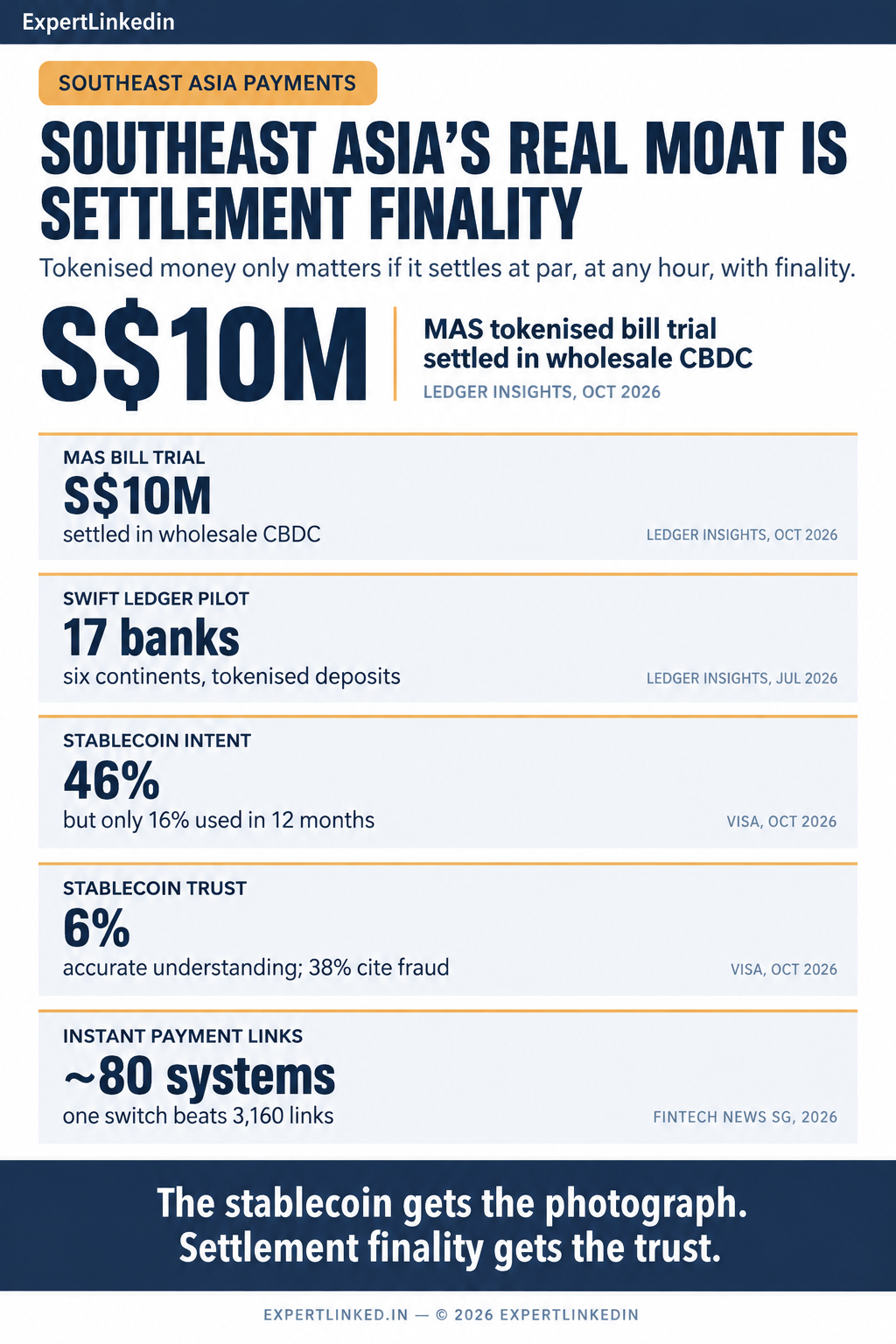
The consumer case for stablecoins keeps looking better on paper than in practice. Visa’s Consumer 360 study, published on 9 October, found that 46% of Asia-Pacific consumers say they are likely to use stablecoins within five years. But only 16% had used them in the past 12 months. Two-thirds were aware of them, yet only 6% could accurately explain how they work, 49% thought stablecoins were only for buying and selling crypto, and 38% of non-users cited fraud or scam fears.
That is a shallow market with a trust problem, and it is not the market that institutional treasurers are playing in. The Bank for International Settlements made the institutional position explicit in late August. BIS General Manager Pablo Hernández de Cos told the Jackson Hole symposium that tokenised deposits are a stronger foundation for future payments than stablecoins because they stay connected to central-bank money and remain redeemable at face value. Stablecoins, he said, “do not yet uphold the foundational properties of money” — their prices can drift from par under stress, they sit across fragmented blockchains, and they are often self-custodied, which makes anti-money-laundering checks harder.
So the interesting fight is not consumer stablecoins. It is tokenised bank money — and whether it can actually settle.
Singapore just ran the experiment in public #
Look at what happened in a single month. MAS has already issued two tokenised MAS bills, a S$1 million issue on 23 September and a S$10 million issue maturing on 23 October, both settled in wholesale CBDC on Singapore’s dollar test network. They are deliberately tiny next to the S$10 billion-plus of a normal MAS bill auction. They are capability tests, not funding operations. And the capability being tested is exactly the one Chia named: “settlement certainty and finality.”
Underneath that, the commercial banks have gone live. DBS and Citi completed a cross-border US dollar tokenised-deposit payment on a weekend in September that took minutes rather than the usual two business days. DBS, OCBC and UOB then completed Singapore’s first live SGD interbank transactions using tokenised deposits. UOB became the first Singapore-headquartered bank to transact live on Swift’s ledger with HSBC. And on 7 October, OCBC and Ant International launched a tokenised-deposit treasury solution that lets Ant move SGD and USD liquidity between Singapore and Malaysia 24/7, outside banking hours.
The architecture matters more than the headlines. Each bank issues tokenised deposits on its own ledger. Swift’s shared ledger is an orchestration layer — 17 banks across six continents were preparing to pilot on it as of July — that records and nets payment commitments, after which final interbank settlement still happens through conventional systems. MAS’s Project Guardian pushes the same idea into tokenised bank liabilities for transaction banking, with live use cases from Ant Group, DBS, Franklin Templeton, Hamilton Lane, OCBC and UBS. Meanwhile, MAS is consulting on stablecoin rules whose feedback window closes on 16 October.
Many issuers. One shared coordination layer. That is the shape of the market.
The bottleneck is coordination, not code #
Here is the part the stablecoin coverage keeps missing. The BIS is clear that the hard problem is not cryptography. In its own words, “no interoperable tokenised deposit network currently spans multiple banks and jurisdictions,” and wider adoption “would require common technical standards, clear governance, legal certainty and stronger cybersecurity.”
The practitioners agree. In July, Ledger Insights put the BIS’s question — why aren’t tokenised deposits moving faster? — to two multibank consortia, the UK’s Great British Tokenised Deposits project and Germany’s Commercial Bank Money Token. Both ranked coordination first, regulatory clarity second, and technology third. The German group’s own framing is blunt: achieving fungibility across participating banks is “one of the core conceptual challenges,” and without broad alignment the network effect is hard to reach. Germany’s regulator has ruled that a tokenised deposit counts as a deposit, but there is still no harmonised legal classification across Europe.
PYMNTS captured the same shift from a different angle: banks are not choosing between public and private blockchains at all. They are converging on shared infrastructure where identity, permissions, privacy and regulatory recourse stay tightly controlled — “share the ledger, permission the activity.” The competitive question is therefore no longer which chain wins, but who owns the rules, identity and interoperability layer connecting them.
For anyone building in Southeast Asia, that reframes the roadmap. The moat is not the token. It is the standards, governance, identity checks and audit trail that make a tokenised transfer provable and final. That is a product-management problem, not an engineering one — and it is the fintech version of this month’s editorial theme: proof that travels.
The same logic is already reshaping instant payments #
Tokenised money is not the only place this is playing out. Project Nexus applies the identical “one connection, common standards” logic to ordinary instant payments. Roughly 80 domestic instant payment systems are live or emerging worldwide; linking all of them bilaterally would require 3,160 separate connections, a build Nexus estimates would take about 180 years one corridor at a time. Nexus instead offers a single connection point, run by a not-for-profit formed by five central banks — India, Malaysia, the Philippines, Singapore and Thailand — with Indonesia joining as a full member and the European Central Bank running feasibility work. Its shared rulebook includes a minimum uplift such as real-time sanctions screening, so each corridor keeps its own rules while the network stays safe.
The two tracks are converging. NETS group chief executive Lawrence Chan expects tokenised deposits and CBDCs to move over existing fiat rails first, before purpose-built rails matter on their own, and Nexus describes itself as settlement-agnostic. Whichever instrument wins a given corridor, the value accrues to the layer that connects the rails — not to the rail.
The counter-argument worth taking seriously #
There is a serious objection, and it comes from the institutions that watch systemic risk rather than product roadmaps. The IMF’s latest Global Financial Stability Report notes that the delays and middlemen that make today’s markets slow and costly also act as shock absorbers. Remove them, and a crisis could travel faster. The Fund also warns that many benefits credited to tokenisation are really the fruits of digitalisation, achievable without a blockchain; what is genuinely new is putting assets, money and automated rules on one shared platform. The FSB goes further on stablecoins specifically, warning that regulatory frameworks remain “untested in severe stress and insolvency.”
That is not a reason to slow down. It is a design brief. The shared layer has to re-insert the buffers, supervisory visibility and circuit breakers that friction used to provide — and it has to prove they work. It is worth noting that Singapore passed a bill on 6 October giving MAS power to require systemically important banks to hold extra loss-absorbing capacity. The same state that is tokenising its settlement rails is simultaneously hardening the resilience of the banks that will run them. Speed and safety are being engineered together, in public, which is exactly how a new settlement layer earns trust.
What I would track from here #
If I were setting payments strategy in Southeast Asia over the next 18 months, I would stop counting stablecoin launches and start asking five dull questions.
- Which tokenised instrument can settle at par, at any hour, with legal finality — and who has proven it?
- Who owns the interoperability layer, and is it governed by a shared rulebook or a single vendor?
- Does a tokenised transfer carry a tamper-evident audit trail that a regulator, an auditor and a counterparty can all read the same way?
- Can the system re-insert the buffers, limits and supervisory visibility that friction used to provide?
- When a corridor scales from a S$10 million trial to everyday business flows, does the standard still travel?
Those questions do not photograph well. Neither did SWIFT, ISO 20022 or settlement finality — until they quietly became the reason money moves at all.
The stablecoin gets the photograph. Settlement finality gets the trust. In 2026, the winning product will be the one that makes tokenised money boring enough to prove.
Building payments infrastructure, treasury tooling or tokenised-money products in Southeast Asia? I would like to hear where interoperability still breaks before the money settles.
Email me at chloe.tan@tlnw.uk
References #
- Fintech News Singapore (October 12, 2026). “MAS Plans Next Phase of Wholesale CBDC Settlement With Tokenised Bills.” https://fintechnews.sg/138851/digitalassets/mas-wholesale-cbdc-tokenised-assets/ (Accessed October 13, 2026)
- OCBC (October 7, 2026). “OCBC launches tokenised deposit solution with Ant International for treasury management between Singapore and Malaysia.” https://www.ocbc.com/group/media/release/2026/ocbc-tokenised-deposit-ant-international-treasury (Accessed October 13, 2026)
- Fintech News Singapore (September 11, 2026). “Three Singapore Local Banks Make First Live Tokenised Deposit Payments Together.” https://fintechnews.sg/137069/blockchain/dbs-ocbc-uob-singapore-tokenised-deposits/ (Accessed October 13, 2026)
- Fintech News Singapore (September 2026). “DBS and Citi Complete Weekend USD Payment With Tokenised Deposits.” https://fintechnews.sg/136809/digitalassets/dbs-citi-tokenised-deposits/ (Accessed October 13, 2026)
- Fintech News Singapore (September 2026). “UOB Is First Singapore Bank to Complete Live Tokenised Deposits With HSBC on Swift.” https://fintechnews.sg/136424/digitalassets/uob-hsbc-tokenised-deposits/ (Accessed October 13, 2026)
- Fintech News Singapore (September 2026). “BIS Sees Tokenised Deposits Playing Bigger Role Than Stablecoins in Future Payments.” https://fintechnews.sg/136513/digitalassets/bis-tokenised-deposits/ (Accessed October 13, 2026)
- Fintech News Singapore (October 9, 2026). “46% of APAC Consumers Likely to Use Stablecoins by 2031: Visa Survey.” https://fintechnews.sg/138772/digitalassets/visa-stablecoin-survey-asia-pacific/ (Accessed October 13, 2026)
- Fintech News Singapore (2026). “What Will It Take to Build the Future of Cross-Border Payments?” https://fintechnews.sg/136678/payments/future-cross-border-payments-nexus-asean/ (Accessed October 13, 2026)
- Fintech News Singapore (2026). “Indonesia Joins Nexus Global Payments as José Beltrán Takes Board Chair Role.” https://fintechnews.sg/125444/payments/nexus-global-payments-indonesia/ (Accessed October 13, 2026)
- Fintech News Singapore (October 12, 2026). “What is Reshaping the Global Payment Landscape?” (BCG Global Payments Report 2026). https://fintechnews.sg/138815/payments/what-is-reshaping-the-global-payment-landscape/ (Accessed October 13, 2026)
- Fintech News Singapore (October 7, 2026). “Singapore Passes Bill Giving MAS Powers to Set Loss Absorption Rules for D-SIBs.” https://fintechnews.sg/138656/regtech/singapore-bank-loss-absorption/ (Accessed October 13, 2026)
- Ledger Insights (July 16, 2026). “Why aren’t tokenized deposits moving faster?” https://www.ledgerinsights.com/why-arent-tokenized-deposits-moving-faster/ (Accessed October 13, 2026)
- Ledger Insights (July 9, 2026). “Citi, HSBC, UBS among 17 banks to pilot tokenized deposits via Swift blockchain.” https://www.ledgerinsights.com/citi-hsbc-ubs-among-17-banks-to-pilot-tokenized-deposits-via-swift-blockchain/ (Accessed October 13, 2026)
- Ledger Insights (October 2026). “Singapore issues second tokenized bill, settled in wCBDC.” https://www.ledgerinsights.com/singapore-issues-second-tokenized-bill-settled-in-wcbdc/ (Accessed October 13, 2026)
- Ledger Insights (2026). “FSB warns stablecoin regulatory frameworks remain ‘untested’ in crisis.” https://www.ledgerinsights.com/fsb-warns-stablecoin-regulatory-frameworks-remain-untested-in-crisis/ (Accessed October 13, 2026)
- Ledger Insights (2026). “IMF says tokenization strips out buffers along with friction.” https://www.ledgerinsights.com/imf-says-tokenization-strips-out-buffers-along-with-friction/ (Accessed October 13, 2026)
- PYMNTS (October 2026). “The Public Blockchain Debate Is Already Obsolete for Banks.” https://www.pymnts.com/blockchain/2026/the-public-blockchain-debate-is-already-obsolete-for-banks/ (Accessed October 13, 2026)
- Monetary Authority of Singapore. “Project Guardian.” https://www.mas.gov.sg/schemes-and-initiatives/project-guardian (Accessed October 13, 2026)
- Bank for International Settlements. “Project Nexus.” https://www.bis.org/project/nexus (Accessed October 13, 2026)
AI Content Notice
This article was created using artificial intelligence technology. Whenever possible, we include references and sources to support the information presented. Readers are encouraged to consult these sources for further information. While we strive for accuracy and provide valuable insights, readers should independently verify information and use their own judgment when making business decisions. The content may not reflect real-time market conditions or personal circumstances.
Related Articles
Infographic: Southeast Asia's Next Fintech Moat Is Settlement Finality, Not the Stablecoin
Stablecoins get the headlines, but Southeast Asia’s real fintech moat in 2026 is settlement …
Southeast Asia's Next Payments Moat Is Recoverability, Not Checkout Speed
Southeast Asia already solved the consumer-facing scan. The real payments moat now is …
Infographic: Southeast Asia's Next Payments Moat Is Recoverability, Not Checkout Speed
Southeast Asia already solved the consumer-facing scan. The real payments moat now is …