The Verification Tax: Who Actually Pays for the AI Productivity Gain

Every AI productivity number you have heard this year is a gross number. The net one is being invoiced to someone who was never in the room when the tool was bought.
That is the shape of a story the industry finally started naming this month. On October 10, The New York Times DealBook put a phrase to it — the verification tax: the secondary workload that appears when AI drafts, and drafts, and drafts again, and a human then has to check, correct, and redo. The phrase is new. The labor is not. What is new is that we can finally put a number on who pays it — and the answer is not the people booking the savings.

The gain is booked upstairs. The bill is paid downstairs. #
Start with the arithmetic everyone skips.
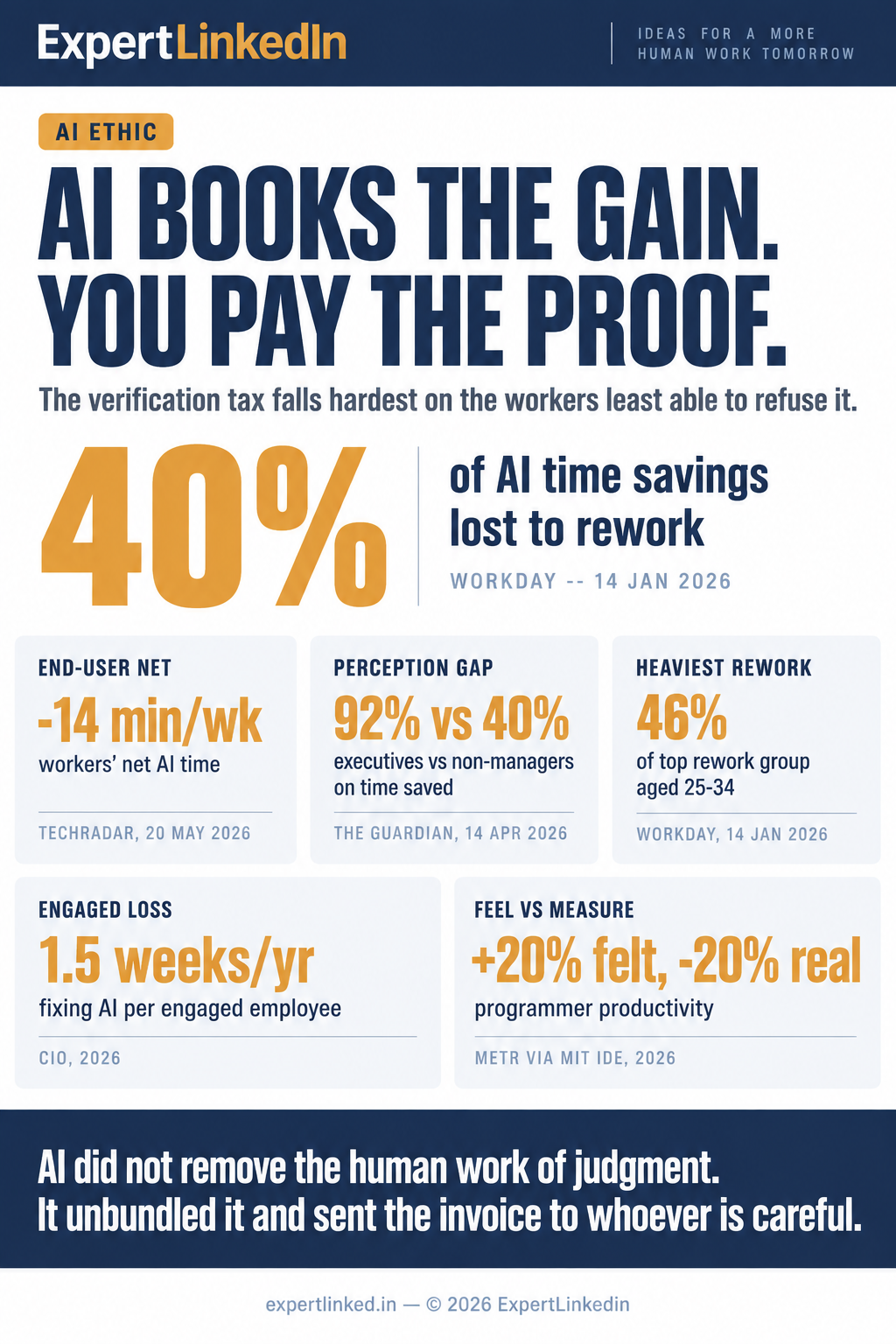
Workday’s global study of 3,200 employees and leaders found that roughly 40% of the time AI saves is lost again to rework — correcting errors, rewriting content, re-checking output. For every 10 hours saved, about four come back as cleanup, and only 14% of employees consistently get a clear net gain. And the gross numbers look wonderful: 85% of workers say AI saves them one to seven hours a week.
That gap is where the confusion lives. TechRadar Pro’s research on document-heavy work found that while 89% of executives believe AI is boosting productivity, the net gain collapses to about 16 minutes a week once verification is counted — and end users are, on average, 14 minutes a week worse off. MIT’s Neil Thompson is blunter still: in a software study he cites, programmers felt 20% more productive while careful measurement put them about 20% less productive overall.
Now hold that next to the perception data. A survey of 5,000 white-collar workers found that 92% of senior executives say AI makes them more productive, while 40% of non-managers say it saves them no time at all. Gallup’s February 2026 panel of 23,717 U.S. adults found the same skew — roughly seven in ten leaders report AI efficiency gains versus just over half of individual contributors — and, tellingly, about 40% of non-users who avoid the tools cite ethical or data-privacy concerns rather than mere reluctance. Both groups can be telling the truth. AI raises gross output. Net of verification, the gain can round to zero. The difference does not evaporate. It becomes somebody’s work.
That is the thread running through this column — and through October. Enterprises are booking the AI gain at the top of the building while the verification cost is redistributed to the bottom. This is not an ROI footnote. It is a transfer.
The tax is regressive — it lands on the people you can least afford to lose #
If the verification tax were spread evenly, it would still be a governance problem. It is not spread evenly.
Workday found that workers aged 25–34 make up 46% of the heaviest rework group. The cohort everyone calls “digital native” is spending the most time checking the machine. Other coverage of the same study adds the detail that matters: the extra labor works out to roughly 1.5 weeks per highly engaged employee each year, and a company’s strongest people tend to become its safety net. The people catching the errors are the ones you can least afford to bury in cleanup.
Middle managers pay it too. HBR’s research on AI adoption found managers absorbing review, coaching, and quality-control work with no corresponding relief — role accretion, not role elevation — while manager engagement slid from 30% to 22%. And in engineering the tax is explicitly a senior-engineer tax: under high AI adoption, pull-request review time rose 441%, 43% of AI-generated code still needed production debugging after passing QA, and 96% of developers said they did not fully trust the code while only 48% always verified it.
The pattern is consistent. The tax lands wherever error tolerance is low and accountability is high — on the careful, the junior, and the responsible. That is the opposite of a merit system.
The second tax is attribution, and it is the one that corrupts the scorecard #
Being unpaid for verification is bad. Being unable to claim it is worse.
The New York Times reported two cases that should be pinned above every AI dashboard. A healthcare analyst spent more than a year building a process; her manager asked her to present it as though the AI had “come up with the idea and executed it.” When she split the difference, the manager announced in the meeting that it had been done “in a minute with AI.” Her annual review came back tepid — and the manager later confirmed the episode was a factor. A Fortune 500 developer who credited his coding agents for transparency found management began assuming all his contributions came from AI; he believes it stalled his promotion. “The praise goes to AI,” he said, “but going through its content is our responsibility, and if an error goes through, that, too, is registered as our responsibility.”
Researchers have a name for this. Northeastern’s Christoph Riedl describes an “AI penalty”: when AI use is disclosed without detail about how it was used, a manager’s default assumption is that the human contributed less. Oliver Schilke at the University of Arizona found that even good-faith disclosure makes people trust you less — producing “the paradoxical dynamic that those who do the morally right thing must bear the penalty for transparency.” At Adidas, an engineering executive found that a mandatory AI-attribution rule quietly killed initiative, because engineers did not want their best work “footnoted” as machine-made.
Put the two taxes together and the trap closes. Verification is unpaid and unattributable. The scorecard has no field for “the human who prevented the error.” That is the layer beneath my earlier argument in The New AI Divide at Work Is Permission, Not Access: access was never the hard part. Neither is disclosure — if disclosure costs you the credit.
Why October turns all of this into a verdict #
For two months, this column and its neighbors have argued that Q4 is when private impressions harden into official scorecards. By mid-October the comparison page is being drafted, and AI has quietly rewritten what “productivity” means on it.
HBR’s July research names the trap precisely. Employees who lean on AI look highly productive; those who slow down to verify assumptions, challenge outputs, or correct errors look less efficient — precisely when they are adding the most value. The same work shows why that is dangerous: in a large field experiment, AI users were 19% less likely to produce a correct answer on a task just outside the model’s capability — the “jagged frontier,” where the tool fails abruptly on tasks that look similar to ones it aced. Meanwhile HBR’s research on “workslop” found that 41% of employees could recall receiving low-value AI work in the prior month, with almost all of the cost landing on the receiver.
So the scorecard does something perverse. It rewards the person who pushed work past the frontier and hopes it holds, and it penalizes the person who caught it. That is why turning risk reduction into a promotion case is now a survival skill: the only way the verifier survives calibration is to make avoided loss legible as value. It is also why AI speed becoming a new baseline is the human half of the same story — a compressed deadline is usually the old process with the risk moved downstream onto whoever is left.
The uncomfortable truth is that October rewards the AI-flattered number, not the human judgment that makes the number survivable.
What fair verification would actually require #
This is not an argument against the tools. It is an argument about who is allowed to invoice for making them safe. Five changes would alter the outcome.
- Name it. Verification is a job, not “cleanup.” If it has no owner, it has no budget and no credit.
- Fund it. Workday’s own conclusion points the right way: the organizations capturing real value reinvest saved time into people — skills, role redesign, outcomes — rather than just buying more technology.
- Measure it. HBR’s three-layer framework separates human contribution, AI-system performance, and combined output, with metrics like boundary judgment and escalation accuracy — did the person catch what the model missed?
- Attribute it. The fix for the credit problem is infrastructure, not exhortation. IBM’s AI Attribution Toolkit and CMU’s OpenHands both attach a chain of responsibility to machine-assisted work. Adidas’s lesson is simpler still: credit outcomes, not tools.
- Design for disagreement. MIT’s look at a Stanford chest-X-ray system found radiologists performed worse with the AI than without it, because the tool had no way for a human and a model to reason through a disagreement. Collaboration has to be built, not assumed.
None of this is complicated. It is just expensive — in the same way every hidden subsidy is expensive, until someone finally puts it on the books.
AI did not remove the human work of judgment. It unbundled it and sent the invoice to whoever is careful. The companies that win the next two years will not be the ones that booked the biggest AI gain. They will be the ones honest enough to show who paid for it.
Seeing a verification tax inside your own company — or working somewhere that has actually funded and credited the checking work? I want the details that never make it into the rollout deck.
Email me at emily.chen@tlnw.uk
References #
- The New York Times (October 10, 2026). “What’s Dragging Down A.I. Efficiency? The ‘Verification Tax.’” https://www.nytimes.com/2026/10/10/business/dealbook/ai-verification-tax-rework.html (Accessed October 15, 2026)
- Workday (January 14, 2026). “New Workday Research: Companies Are Leaving AI Gains on the Table.” https://newsroom.workday.com/2026-01-14-New-Workday-Research-Companies-Are-Leaving-AI-Gains-on-the-Table (Accessed October 15, 2026)
- Harvard Business Review (July 2026). “Performance Management Needs New Metrics in the AI Era.” https://hbr.org/2026/07/performance-management-needs-new-metrics-in-the-ai-era (Accessed October 15, 2026)
- Harvard Business Review (June 2026). “AI Adoption Is Overloading Your Middle Managers.” https://hbr.org/2026/06/ai-adoption-is-overloading-your-middle-managers (Accessed October 15, 2026)
- Harvard Business Review (January 2026). “Why People Create AI ‘Workslop’—and How to Stop It.” https://hbr.org/2026/01/why-people-create-ai-workslop-and-how-to-stop-it (Accessed October 15, 2026)
- The Guardian (April 14, 2026). “Bosses say AI boosts productivity – workers say they’re drowning in ‘workslop’.” https://www.theguardian.com/technology/2026/apr/14/ai-productivity-workplace-errors (Accessed October 15, 2026)
- MIT Initiative on the Digital Economy. “AI and Productivity: Setting Expectations for ROI.” https://ide.mit.edu/insights/ai-productivity-and-roi/ (Accessed October 15, 2026)
- TechRadar Pro (May 20, 2026). “The verification economy is redefining productivity.” https://www.techradar.com/pro/the-verification-economy-is-redefining-productivity (Accessed October 15, 2026)
- Northeastern Global News (August 14, 2026). “Who gets credit when AI joins the team? Rethinking what it means to own an idea.” https://news.northeastern.edu/2026/08/14/human-ai-collaboration-credit/ (Accessed October 15, 2026)
- The New York Times (July 13, 2026). “Employees are doing the work. AI is getting the credit.” (syndicated copy: https://dnyuz.com/2026/07/13/employees-are-doing-the-work-ai-is-getting-the-credit/) (Accessed October 15, 2026)
- CIO (2026). “40% of AI productivity gains lost to rework for errors.” https://www.cio.com/article/4157471/40-of-ai-productivity-gains-lost-to-rework-for-errors.html (Accessed October 15, 2026)
- Gallup, quarterly workforce panel (February 2026, N=23,717 U.S. adults), reported via Associated Press. Summary: https://wiss.com/ai-adoption-at-work-in-2026-new-gallup-data/ (Accessed October 15, 2026)
AI Content Notice
This article was created using artificial intelligence technology. Whenever possible, we include references and sources to support the information presented. Readers are encouraged to consult these sources for further information. While we strive for accuracy and provide valuable insights, readers should independently verify information and use their own judgment when making business decisions. The content may not reflect real-time market conditions or personal circumstances.
Related Articles
Infographic: The Verification Tax: Who Actually Pays for the AI Productivity Gain
AI booked the productivity gain. Somebody still has to check, correct, and defend the output — and …
The New Interview Is a Verification Tax
AI did not remove friction from hiring. It moved the cost of trust onto candidates through AI …
The New AI Divide at Work Is Permission, Not Access
Almost everyone can open a chatbot at work. Far fewer workers have the protected time, trusted …