The New AI Divide at Work Is Permission, Not Access

Almost everyone in a knowledge business can now open an AI tool. Far fewer are allowed to get good at it where the career stakes are real.
That is the workplace divide I keep seeing in 2026. Companies talk about AI access as if the hard part were procurement: buy licenses, publish a policy, run a lunch-and-learn. In practice, the real advantage is narrower. Who can use AI on live work, with the right data, during the workday, and with a manager willing to review the output and own the risk?
In The Manager’s AI Accountability Gap, I argued that organizations were quietly asking managers to translate machine speed into work they could still defend. In AI-Resilient Jobs Aren’t AI-Free. That’s the Point., I made a related claim about labor design: the scarce human value is moving toward judgment, context, and trust. The next layer down is this: AI access is becoming common. Permission is not.

Access is cheap. Safe practice is not. #
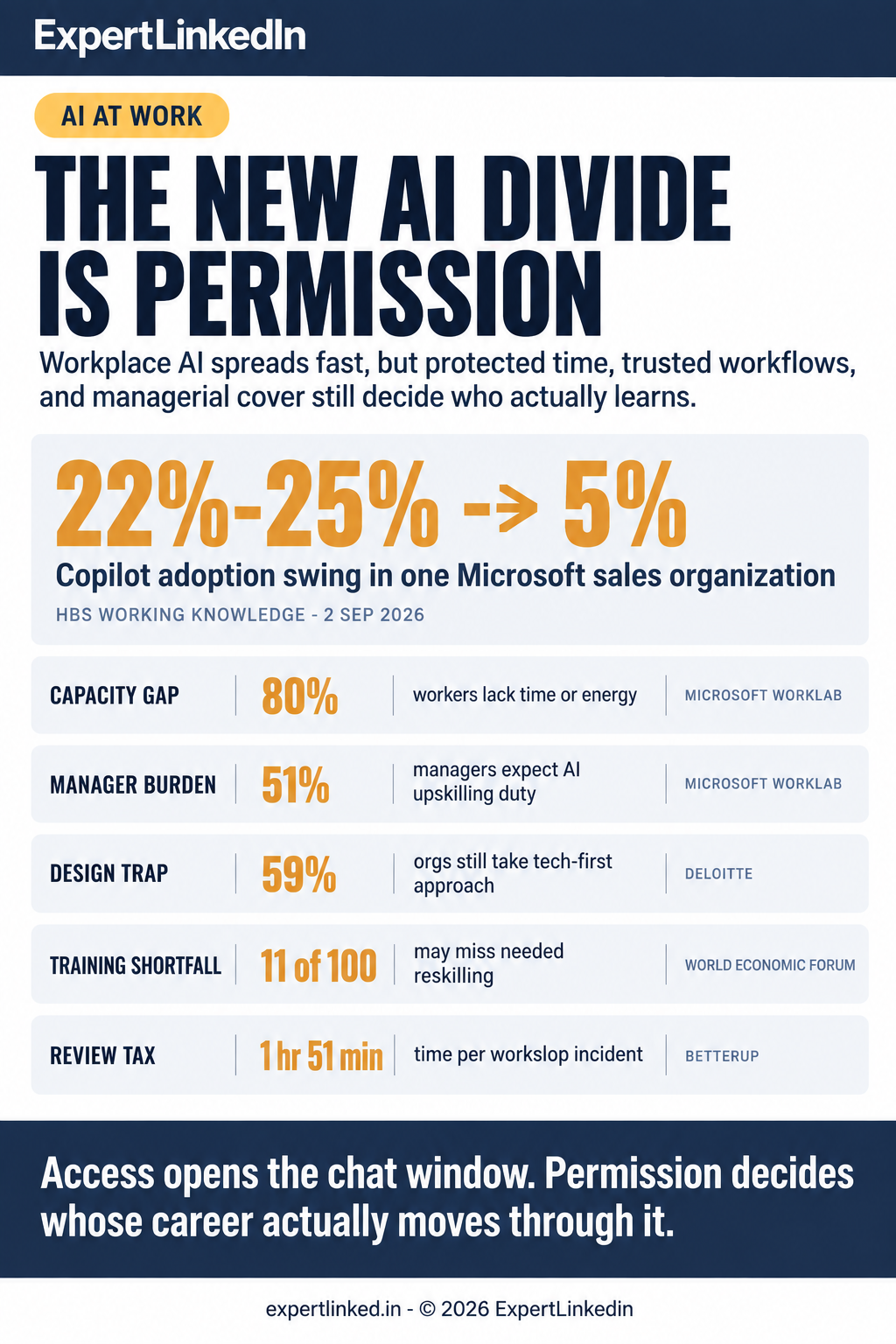
Microsoft’s 2025 Work Trend Index is revealing not because it says AI is everywhere, but because it shows how unevenly the benefits are already forming. Fifty-three percent of leaders said productivity must increase, while 80% of the global workforce said they lacked enough time or energy to do their jobs. Leaders were also well ahead of employees on agent familiarity, 67% versus 40%, and on the belief that AI would accelerate their careers, 79% versus 67%.
Those numbers are often read as an excitement gap. I think the sharper read is a permission gap. People do not become fluent with a new system because they were told it matters. They become fluent because they are given repeated, low-risk chances to use it on work that counts.
That was the most interesting point in Harvard Business School’s September 2 interview with Iavor Bojinov. He described a Microsoft Copilot case in which adoption inside a sales organization rose to roughly 22% to 25% and then fell to 5%. That is not a demand story. It is a trust story. P&G tried to build that trust by working closely with users, running hackathon days, and telling employees that if something broke, the company would own the fix.
That last part matters more than many AI roadmaps admit. A license is access. Air cover is permission.
The company that says “everyone can use AI” usually means “everyone can experiment after hours” #
The same Microsoft report that celebrates the rise of agentic work also says 47% of leaders rank upskilling the existing workforce as a top strategy for the next 12 to 18 months, and 51% of managers expect AI training or upskilling to become a key team responsibility within five years. But responsibility without slack is not enablement. It is another unfunded mandate.
Bojinov puts the operational version plainly: organizations have to create space for people to play with AI, and the experimentation needs to be both structured and unstructured. Microsoft and JPMorgan, he notes, used simple internal challenges like saving 10 minutes every week for AI use. That sounds minor until you remember how hard it is to protect even ten minutes that is not tied to this week’s visible deliverable.
This is where the permission gap becomes self-reinforcing. The employees with supportive managers, flexible roles, and lower penalty for failed experiments get better faster. The employees working in tightly measured environments, or on teams where a single mistake can stick to a reputation, stay shallow users.
BetterUp’s September 2025 research on “workslop” shows why shallow use does not stay harmless. Fifty-four percent of managers reported receiving low-value AI-generated work, and employees said each instance took an average of 1 hour and 51 minutes to deal with. Unsupported experimentation does not create democratized productivity. It creates a review queue, which is why so many firms quietly ration live use cases even while celebrating broad access.
Permission is a role-design problem, not a motivation problem #
The convenient executive story is that workers who are not using AI enough are timid, resistant, or undertrained. That story flatters leadership because it frames the gap as a people problem downstream.
Deloitte’s 2026 Global Human Capital Trends points in a tougher direction. Seven in 10 business leaders say their primary competitive strategy over the next three years is to be fast and nimble. Yet 59% of organizations are still taking a tech-focused approach to AI, and those firms are 1.6 times more likely not to realize AI returns that exceed expectations compared with organizations taking a human-centric approach. Deloitte’s conclusion is the line more companies need to hear: with AI access widening, intentional design, not technology alone, is becoming the real differentiator.
Brookings makes the same point from the policy side. In its June 2026 framework for AI’s impacts on work and workers, the think tank argues that AI literacy and skilling remain important but limited. Training alone does not produce good jobs, and silver-bullet thinking leaves institutions mistaking activity for adaptation. Inside companies, the parallel mistake is obvious: leaders announce a chatbot and a training module, then act surprised when the real bottlenecks turn out to be workflow design, data access, and review ownership.
That is why I am skeptical when firms say the answer is simply more training. Harvard Business School’s June 18 feature on Raffaella Sadun’s reskilling research shows how thin generic upskilling narratives can be. In a survey of real-world job seekers in Italy, 38% said they would reskill into the offered IT or construction roles, 36% preferred generic upskilling, and 26% declined training entirely. The issue was not only money. It was identity.
The same is true inside companies. Workers do not want homework disguised as future-readiness. They want a believable path toward a different kind of relevance. Permission matters because it answers the implied question training alone does not: who do I become here if I get good at this?
The people with real permission are already pulling away #
This is why the new divide feels quieter and more consequential than the old digital-access story.
McKinsey’s July 14 essay on building expertise in the age of AI argues that as AI absorbs routine work, companies have to rebuild apprenticeship deliberately or weaken the pipeline of judgment they still need. Recent U.S. college-graduate unemployment sat at roughly 5.7% in the first quarter of 2026, about four in 10 recent graduates were underemployed, and Bank of America is still bringing in nearly 4,000 interns and campus recruits while redesigning those roles around AI and simulation from day one.
That is what real permission looks like: not a generic exhortation to learn AI on your own, but a workflow, a simulation environment, a coaching model, and a clear signal that the learning should happen on paid time and inside real role development.
California’s AI-Ready California pilot offers the public-sector version of the same insight. The first cohort is only 500 participants, but the design is telling: AI literacy is paired with civics and responsibility on one side and career and workforce readiness on the other. The program treats judgment, privacy, and employability as part of the skill, not as an afterthought.
The broader labor market makes this divide harder to escape by switching employers. LinkedIn data, reported by TechCrunch in April, shows hiring down around 20% since 2022, even as the skills needed for the average job have already changed 25% and are expected to change 70% by 2030. The World Economic Forum’s Future of Jobs Report 2025 says that if the workforce were made up of 100 people, 59 would need training by 2030. Employers say they understand this: 85% plan to prioritize upskilling, 50% plan to transition staff from declining to growing roles, and 70% expect to hire people with new skills. But the same report says 11 out of that imagined 100 are unlikely to receive the reskilling they need at all.
That is the distribution problem in one frame. AI access expands faster than institutions expand protected paths to competence.
It is also why this theme connects back to The New Interview Is a Verification Tax. When internal pathways feel ambiguous, the market responds by demanding more external proof. Workers without real permission inside the firm end up trying to prove AI fluency outside it, through certificates, portfolio artifacts, unpaid experiments, and polished outputs that may still not count as trustworthy experience.
What fair AI access would actually require #
Fairer AI access in 2026 would require at least five things.
- Protected practice time inside the workday, tied to live workflows, not just voluntary learning after hours.
- Clear permission tiers for data, tools, and use cases, so employees know where experimentation is safe and where human review is mandatory.
- A named reviewer or manager who owns the judgment layer when AI-assisted work is being learned, tested, or deployed.
- A visible career path for people who become good at redesigning work with AI, so fluency is rewarded as operating leverage rather than treated as free extra effort.
- Deliberate apprenticeship models, whether through simulations, side-by-side comparison work, or McKinsey’s answer-key style loops, so new workers can build judgment instead of borrowing it.
None of this is anti-technology. It is what serious adoption looks like. Access says the tool exists. Permission says the organization is willing to redesign status, time, risk, and learning around it. A company that gives everyone AI licenses while only a narrow class gets real workflow access, paid experimentation time, manager support, and upside if it works is not democratizing intelligence. It is reproducing hierarchy in faster software.
The next AI divide at work will not be between people who have heard of the tools and people who have not. It will be between workers who are allowed to convert AI into judgment, leverage, and career mobility, and workers who are merely told to keep up. Access opens the chat window. Permission decides whose career actually moves through it.
Seeing this AI permission gap inside your own company, or working somewhere that has actually built a fairer path from access to trust? I would like to hear what the operating model really looks like.
Email me at emily.chen@tlnw.uk
References #
- Harvard Business School Working Knowledge. (September 2, 2026). “From P&G to Microsoft, How Companies Are Speeding AI Adoption.” https://www.library.hbs.edu/working-knowledge/from-pg-to-microsoft-how-companies-speed-ai-adoption (Accessed September 29, 2026)
- Microsoft WorkLab. (April 23, 2025). “2025 Work Trend Index: The Year the Frontier Firm Is Born.” https://www.microsoft.com/en-us/worklab/work-trend-index/2025-the-year-the-frontier-firm-is-born (Accessed September 29, 2026)
- Deloitte. (March 4, 2026). “2026 Global Human Capital Trends.” https://www.deloitte.com/us/en/insights/topics/talent/human-capital-trends.html (Accessed September 29, 2026)
- McKinsey & Company. (July 14, 2026). “Building expertise in the age of AI: Who trains the next generation?” https://www.mckinsey.com/capabilities/people-and-organizational-performance/our-insights/building-expertise-in-the-age-of-ai-who-trains-the-next-generation (Accessed September 29, 2026)
- Brookings. (June 29, 2026). “Getting to all-of-the-above: A framework of solutions for AI’s coming impacts on work and workers.” https://www.brookings.edu/articles/ai-workforce-policy-framework/ (Accessed September 29, 2026)
- BetterUp Labs. (September 29, 2025). “The hidden cost of AI ‘workslop’ - and how leaders can fix it.” https://www.betterup.com/blog/hidden-costs-workslop (Accessed September 29, 2026)
- Harvard Business School Working Knowledge. (June 18, 2026). “Want Workers to Reskill? Show Them Who They Can Become.” https://www.library.hbs.edu/working-knowledge/want-workers-to-reskill-show-them-who-they-can-become (Accessed September 29, 2026)
- California Labor & Workforce Development Agency. (July 14, 2026). “California launches first-in-nation AI literacy micro-credential program.” https://www.labor.ca.gov/2026/07/14/california-launches-first-in-nation-ai-literacy-micro-credential-program/ (Accessed September 29, 2026)
- TechCrunch. (April 15, 2026). “LinkedIn data shows AI isn’t to blame for hiring decline… yet.” https://techcrunch.com/2026/04/15/linkedin-data-shows-ai-isnt-to-blame-for-hiring-decline-yet/ (Accessed September 29, 2026)
- World Economic Forum. (January 7, 2025). “The Future of Jobs Report 2025.” https://www.weforum.org/publications/the-future-of-jobs-report-2025/digest/ (Accessed September 29, 2026)
AI Content Notice
This article was created using artificial intelligence technology. Whenever possible, we include references and sources to support the information presented. Readers are encouraged to consult these sources for further information. While we strive for accuracy and provide valuable insights, readers should independently verify information and use their own judgment when making business decisions. The content may not reflect real-time market conditions or personal circumstances.
Related Articles
Infographic: The New AI Divide at Work Is Permission, Not Access
Almost everyone can open a chatbot at work. Far fewer workers have the protected time, trusted …
The Accountability Gap: Why Treating AI Agents as 'Coworkers' Creates Dangerous Organizational Blind Spots
New research reveals that calling AI agents ’employees’ makes humans 18% worse at …
Infographic: The Accountability Gap: Why Treating AI Agents as 'Coworkers' Creates Dangerous Organizational Blind Spots
New research reveals that calling AI agents ’employees’ makes humans 18% worse at …