What Melanie Perkins' Path From Fusion Books to Canva Teaches About Fixing Workflow Friction in Q4 2026

The most valuable thing you will own this quarter is probably not a number that went up. It is a workflow someone else can run without you.
For most of October I have been writing about what goes wrong when speed outruns design — deadlines that compress, errors that quietly land on one person, praise that arrives in writing long before it arrives in money. This week I want to do the opposite. I want to look at someone who spent fifteen years doing the slow, unglamorous thing that actually compounds: staying close to a boring problem and making it simple enough that anyone could use it.
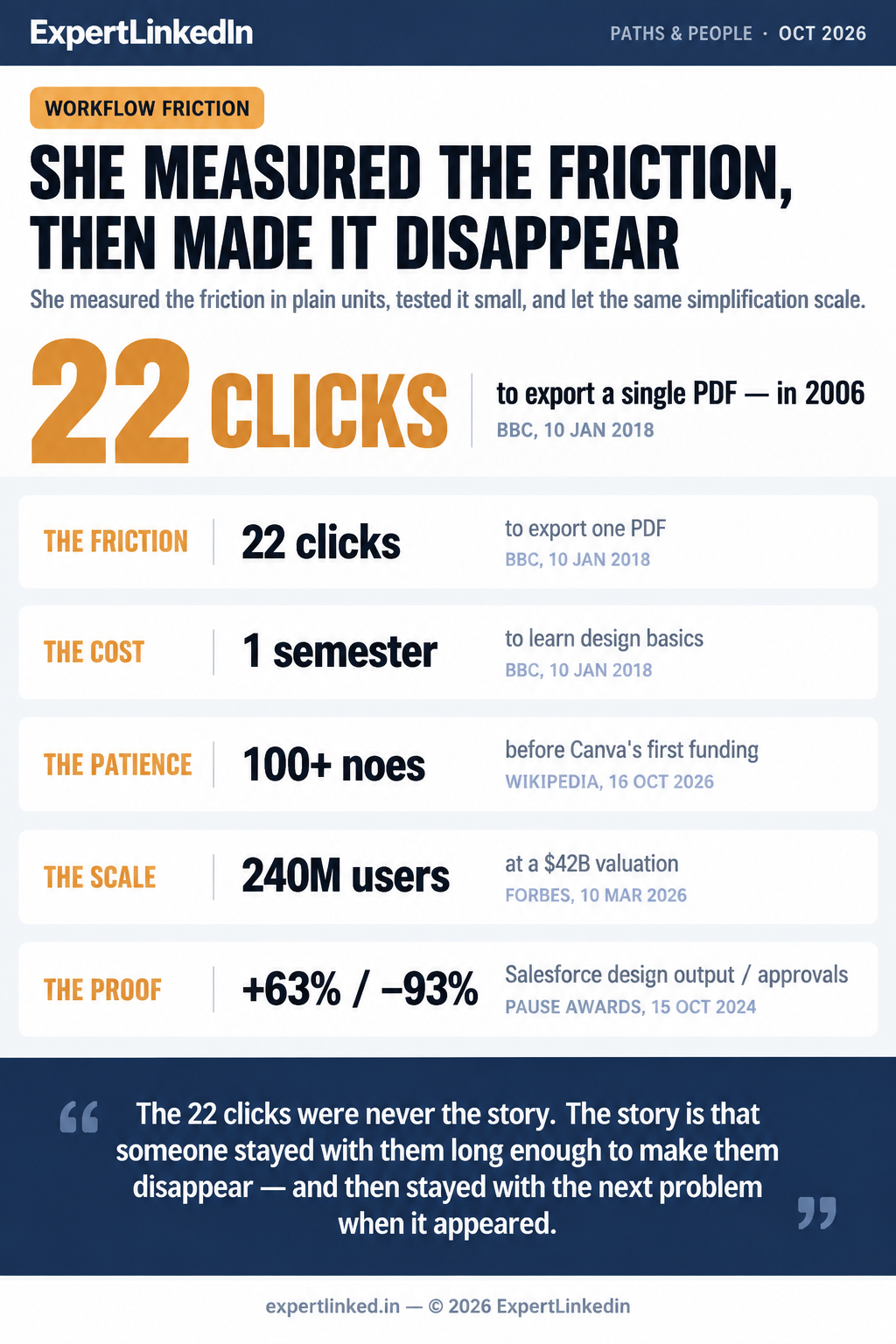
Her name is Melanie Perkins. Before she was the chief executive of a company valued at $42 billion (Forbes, updated March 10, 2026), she was a nineteen-year-old design tutor in Perth, watching her students struggle with tools that were supposed to help them. “It could take a whole semester to learn the very basics,” she later told the BBC. “Even the simplest tasks, like exporting a high-quality PDF file, could take 22 clicks” (BBC, January 10, 2018).
Most of us would have complained about the clicks and moved on. She measured them. That is the whole story, and it is the story I want you to hold on to as Q4 2026 calibration gets closer. The durable edge did not come from a brilliant leap. It came from staying close to a boring user problem long enough to turn confusion into a repeatable workflow anyone could use.

The problem was boring. That is why it worked. #
In 2006, Perkins was studying communications, psychology and commerce at the University of Western Australia and earning a little on the side by teaching design programs — Photoshop, InDesign — to beginners. Years later she gave the same explanation again and again: the software was difficult, expensive, and built for people who already knew how to use it. She also offered the sharpest version of it to CNBC: “People would have to spend an entire semester learning where the buttons were, and that seemed completely ridiculous” (CNBC Make It, January 9, 2020).
Notice what she did with that frustration. She did not try to imagine a glamorous new product. She named the friction in plain, countable units — a semester, 22 clicks — and then she stayed with it. Career Contessa, profiling her in 2016, put it simply: “As she watched them struggle to learn even the basics, she realized how difficult the programs were to grasp” (Career Contessa, May 5, 2016).
She didn’t pivot. She widened. #
Here is the detail that most retellings of the Canva story skip, and it is the one that matters for anyone building a career. Perkins’s first company was not a leap into the unknown. It was a deliberate, low-stakes test of the exact same idea.
In 2007, she and Cliff Obrecht founded Fusion Books, which let schools design their yearbooks online using a drag-and-drop editor and a template library. “Fusion Books took the idea of a simple design tool and applied it to the niche market of school yearbooks,” she told Career Contessa. “Over five years, my co-founder Cliff Obrecht and I grew Fusion Books into the largest yearbook company in Australia and expanded into France and New Zealand. But we knew all along that the technology we had built could be applied much more broadly — that’s how Canva was born.”
The BBC called Fusion Books “effectively a prototype version of what would become the Canva system” (BBC, 2018); CNBC reported it was created explicitly “to test out their idea” in a market small enough to survive mistakes (CNBC Make It, 2020). Same engine, smaller room. This is the part I want you to steal for Q4: she did not rebrand the problem to chase a trend. She proved the workflow where failure was cheap, then pointed it at a bigger market.
The part almost everyone misses: confidence, not just clicks #
If you only read the technical half of the Canva story, you would think simplification is about fewer buttons. The fuller account from the Pause Awards interview shows it is also about something more human. When Canva ran early user testing, the problem was not that the tool was still too hard. “People didn’t think they were creative,” Perkins said. The fix was not another menu — it was gamified tutorials designed to build belief, challenges as small as dragging a hat onto a monkey. “We wanted to make design fun” (Pause Awards, October 15, 2024).
Hold that thought against your own workplace. The workflow that actually spreads is not the fastest one. It is the one the least-confident person on the team can finish without asking permission. A process that only works when you run it is not a workflow. It is a bottleneck wearing your name.
What “without friction” actually bought #
By the time Canva turned ten, the company counted its milestones in access as much as in revenue: a launch waiting list of more than 50,000 people in 2013, its first non-English language in 2016, free tools for education, and a push to design “in every language” (Canva, August 25, 2023). Perkins described the through-line to EL PAÍS in one sentence: “Our whole thing at Canva is to enable people to take their idea, turn into a design and have no friction between those two points. That’s been our mission for the last decade” (EL PAÍS, June 9, 2023).
That thesis keeps paying, and it now pays inside large organisations. Salesforce integrated Canva into its workflow and reported “a 63% increase in design production,” with approval times dropping by 93% (Pause Awards, 2024). Read that number the way a manager reads it: the same team, the same people, a removed step. Nobody got promoted for adding a tool. Somebody got trusted for removing friction.
Your version of the 22 clicks #
Now bring it home to October 2026, because the clock is not neutral. This is the month private impressions turn into calibration language and next year’s budgets start to close. My colleague Jackson Rodriguez made the case earlier this month that the work most likely to be scored is the work nobody can see — the caught error, the held deadline, the fight that never reached the room (How to Turn Risk Reduction Into a Q4 2026 Promotion Case, October 12, 2026).
The reason that work stays invisible is almost always friction. It lives in one person’s head, in a workaround nobody wrote down, in the exception queue that “just happens” to get cleared. I wrote in September about the other side of this: when a team goes faster, the checking and correcting often falls to one person, and the risk becomes theirs alone (AI Helped Us Move Faster — Now the Errors Belong to Me, September 25, 2026).
Perkins’s move answers both problems at once. If the friction you carry each week can be turned into a repeatable workflow — one anyone can run, documented in plain steps, with its own small proof — it stops being invisible labour and becomes a visible system. That is precisely the kind of asset the 90-day Q4 positioning plan was built to protect: not a longer list of tasks, but a clearer, defensible scope.
Concretely, three moves, in her order:
- Name the friction in countable units. She said “22 clicks,” not “it’s frustrating.” Pick the one recurring step that costs your team time every week and describe it the way she did: how long it takes, how many hand-offs, how often it breaks. A number is the beginning of a workflow and the end of a complaint.
- Simplify it for the least-confident person. Build the version a new joiner could run without you, then test it in a small room the way Fusion Books tested in yearbooks. If it only works when you are watching, it is not finished.
- Document it so it travels. Write the steps down and attach one small proof — a before-and-after, a quality check that caught something, a turnaround that held. This is the same discipline Jackson described as converting prevention into a unit the room already reads, and the same one that turns “I was reliable” into “I own this system.”
The uncomfortable truth: the workflow is never finished #
Here is the part that keeps this from becoming a hero story, and it is the part I most want you to hear. Perkins did not solve friction once and retire. She is still solving it, and in 2026 it is not going smoothly.
This year Canva built agentic AI into its platform, then slowed the rollout and rebuilt the underlying architecture after the cost of serving AI features came in higher than expected — cutting its expected annual revenue growth rate from 30% to 20% in August 2026 (Wikipedia, “Canva,” accessed October 2026). The company that made “reduce friction” its entire brand had to admit that the new friction was real. What it did next is the actual lesson: Perkins said the cost per AI task had fallen nearly 90% since the April launch. They went back to the boring work — redesigning the workflow — instead of pretending the first version was done.
The same is true for you. No workflow you simplify in Q4 will stay simple forever, because the tools underneath keep changing. The edge is not the one-time fix. It is the habit of staying close enough to the problem to notice when it gets tangled again — and the patience to keep untangling it while everyone else is chasing something more exciting.
What to do before calibration locks #
Most Q4 career advice tells you to be more visible. I think that advice quietly fails, because visibility without a mechanism is just noise in a crowded room. Perkins was not visible for the first decade of her career in the way a personal-brand playbook would define it. She was useful in a way nobody had to translate.
So before the budget freeze and the calibration room do their work, do the least glamorous and most durable thing available to you: find the boring, repeated problem you already handle, and turn it into a workflow someone else could run.
And one honest note, because it matters. Her timeline was long — more than a hundred rejections before Canva’s first funding, and more than a decade from the first tutoring session to a platform used by a quarter of a billion people a month. She did not win this quarter; she won across many of them. You do not have that runway, which is exactly why you should start the boring work now rather than wait for a moment that feels worthy of it.
The 22 clicks were never the story. The story is that someone stayed with them long enough to make them disappear — and then stayed with the next problem when it appeared.
If you have turned a piece of daily friction into a workflow other people can run, I would like to hear how you did it — and what broke when the tool underneath changed. The most useful Paths & People stories begin with an unglamorous problem you refused to leave alone.
Email me at olivia.bennett@tlnw.uk
References #
- BBC (January 10, 2018). “The 30-year-old woman who designed a $1bn business.” https://www.bbc.com/news/business-42552367 (Accessed October 16, 2026)
- Canva (August 25, 2023). “The Canva timeline: 10 years of empowering the world to design.” https://www.canva.com/newsroom/news/canva-10-year-timeline/ (Accessed October 16, 2026)
- Career Contessa (May 5, 2016). “Melanie Perkins | Canva.” https://web.archive.org/web/20160509022701/http://www.careercontessa.com/contessas/canva-founder-melanie-perkins/ (via Wayback Machine; original now retired; accessed October 16, 2026)
- CNBC Make It (January 9, 2020). “How a 32-year-old turned a high school yearbook idea into a $3.2 billion business.” https://www.cnbc.com/make-it/2020/01/09/canva-how-melanie-perkins-built-a-3point2-billion-dollar-design-start-up.html (Accessed October 16, 2026)
- EL PAÍS (June 9, 2023). “Melanie Perkins, CEO of Canva: ‘With AI, we’re going into another era. We need to adapt’.” https://english.elpais.com/economy-and-business/2023-06-09/melanie-perkins-ceo-of-canva-with-ai-were-going-into-another-era-we-need-to-adapt.html (Accessed October 16, 2026)
- ExpertLinked (September 25, 2026). “AI Helped Us Move Faster — Now the Errors Belong to Me. What to Do Before Q4 2026 Reviews.” https://expertlinked.in/posts/2026-09-25-ai-helped-us-move-faster-now-the-errors-belong-to-me-and-what-to-do-before-q4-2026-reviews/ (Accessed October 16, 2026)
- ExpertLinked (September 28, 2026). “The 90-Day Q4 2026 Career Positioning Plan for a Market That Still Isn’t Fully Open.” https://expertlinked.in/posts/2026-09-28-the-90-day-q4-2026-career-positioning-plan-for-a-market-that-still-isnt-fully-open/ (Accessed October 16, 2026)
- ExpertLinked (October 12, 2026). “How to Turn Risk Reduction Into a Q4 2026 Promotion Case Before Budget Freeze.” https://expertlinked.in/posts/2026-10-12-how-to-turn-risk-reduction-into-a-q4-2026-promotion-case-before-budget-freeze/ (Accessed October 16, 2026)
- Forbes (updated March 10, 2026). “Melanie Perkins — Profile.” https://www.forbes.com/profile/melanie-perkins/ (Accessed October 16, 2026)
- Pause Awards (October 15, 2024). “How Canva transformed a simple idea to become global leader.” https://www.pauseawards.com/how-canva-transformed-a-simple-idea-to-become-global-leader/ (Accessed October 16, 2026)
- Wikipedia (accessed October 16, 2026). “Melanie Perkins.” https://en.wikipedia.org/wiki/Melanie_Perkins
- Wikipedia (accessed October 16, 2026). “Canva.” https://en.wikipedia.org/wiki/Canva
AI Content Notice
This article was created using artificial intelligence technology. Whenever possible, we include references and sources to support the information presented. Readers are encouraged to consult these sources for further information. While we strive for accuracy and provide valuable insights, readers should independently verify information and use their own judgment when making business decisions. The content may not reflect real-time market conditions or personal circumstances.
Related Articles
Infographic: What Melanie Perkins' Path From Fusion Books to Canva Teaches About Fixing Workflow Friction in Q4 2026
The most valuable thing you will own this quarter is a workflow someone else can run without you. …
The Performance-Review Economy: Why Q4 2026 Career Outcomes Are Being Decided Before Review Season Starts
Most people think Q4 performance reviews reward output volume. In late 2026, they increasingly …
The Internal Labor Market: Why Q3 2026 Career Leverage Is Built Before the Job Posting Exists
In Q3 2026, the most important labor market for many professionals is inside the firm. Scope …