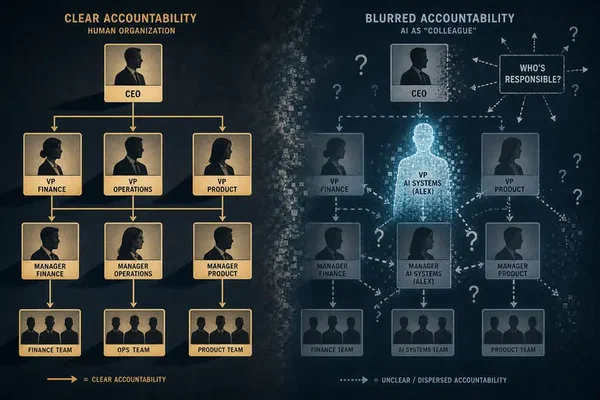
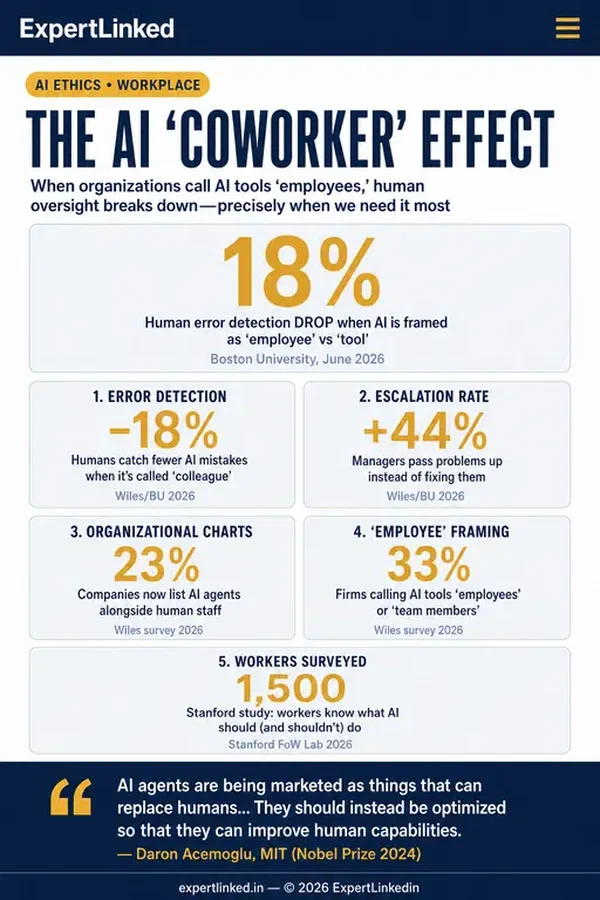
New research reveals that calling AI agents ’employees’ makes humans 18% worse at catching errors and creates dangerous accountability gaps. Why anthropomorphizing AI undermines human judgment precisely when we need it most.
New research reveals that calling AI agents ’employees’ makes humans 18% worse at catching errors and creates dangerous accountability gaps. Why anthropomorphizing AI undermines human judgment precisely when we need it most.
The world crossed a regulatory threshold yesterday: mandatory AI content labeling and three-hour takedowns are now law in India, signaling a global governance shift that every AI practitioner must understand.
AI workplace monitoring promises productivity gains but often delivers the opposite—undermining trust, creativity, and the very performance it aims to enhance.
Brain organoids are evolving from research tools to computational platforms, creating both unprecedented opportunities and urgent ethical dilemmas in healthcare AI.
As AI-generated content floods workplaces with low-quality “workslop,” organizations face a productivity paradox that threatens the very efficiency gains AI promised to deliver.
OpenAI and Microsoft’s rush to deploy AI browser agents exposes users to prompt injection attacks that could compromise emails, passwords, and personal data.
The rise of AI model betting and enduring lottery cultures reveal humanity’s complex relationship with uncertainty, prediction, and the illusion of control in an algorithmic society.
When AI algorithms decide who gets hired, promoted, or fired, employees deserve to know how these decisions are made—but most companies aren’t ready for that conversation.
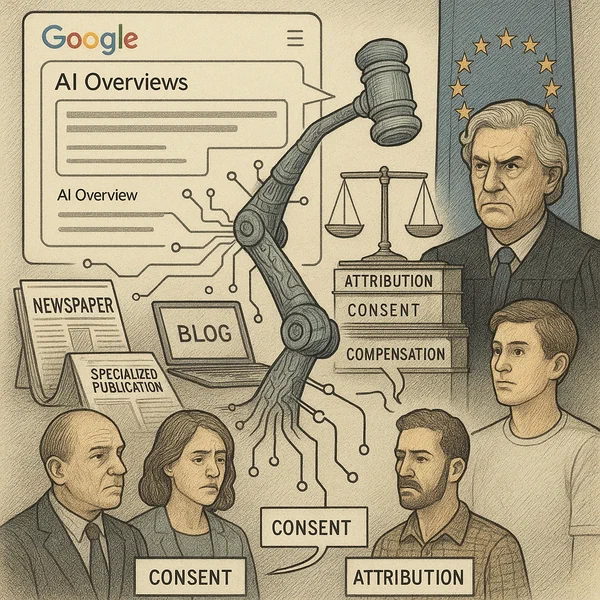
When AI systems extract and summarize content without meaningful publisher consent, we’re not just witnessing a business dispute—we’re seeing the collision between innovation and fundamental questions of digital rights and fair compensation.
Explore the fascinating race for empathetic AI and its implications for human connections. Examine whether machines can truly understand emotions or just simulate empathy, and discover what this means for workplace relationships and human-AI collaboration.
Explore why LinkedIn’s AI writing assistant failed to gain traction and what this reveals about professional authenticity. Learn how smart workers are choosing human connection over automation in their digital communications.
Discover the rise of the Centaur Artist—a powerful human-AI creative partnership that’s pushing the boundaries of imagination. Learn why AI isn’t replacing human creativity but augmenting it, creating new possibilities for artistic expression and innovation.
Navigate the critical crossroads of healthcare AI regulation as New York passes landmark safety legislation. Understand how new regulations, 23andMe’s nonprofit transformation, and emerging ethical frameworks are reshaping medical AI for safer, more responsible patient care.
Explore the critical ethical challenges as AI transforms the modern workplace. Learn how organizations can balance technological advancement with human dignity, build trust through transparent AI governance, and create ethical frameworks that protect worker rights while embracing innovation.
Navigate AI ethics in healthcare by addressing algorithmic bias, ensuring transparency in medical AI decisions, and developing AI-specific consent processes that prioritize patient welfare while enabling innovation.
Navigate AI-generated content ethics in professional branding by using AI as a collaborator rather than ghostwriter, maintaining transparency about AI assistance, and ensuring tools amplify your authentic voice instead of replacing it.
AI ethics in the workplace requires organizations to prioritize transparency, accountability, and employee involvement in AI system design to ensure technology augments human potential while building trust through responsible deployment and regular bias auditing.
AI recruitment tools offer efficiency gains but require careful ethical oversight to prevent algorithmic bias, ensure transparency in hiring decisions, and maintain fairness while processing historically biased hiring data responsibly.
AI ethics requires navigating the transparency paradox where complex algorithms offer transformative benefits alongside potential harm, demanding interpretable systems and meaningful human oversight to ensure responsible innovation in high-stakes applications.
Healthcare AI adoption has accelerated dramatically with 78% of organizations implementing AI technologies, but only 31% have comprehensive ethical frameworks governing patient data privacy, diagnostic transparency, and responsible innovation practices.
German AI ethics frameworks prioritize data privacy, algorithmic transparency, and systematic governance approaches that balance innovation potential with strict regulatory compliance and citizen protection principles.
AI ethics addresses critical issues of bias, fairness, transparency, and accountability in AI systems, requiring frameworks to ensure responsible development and prevent perpetuation of inequality in real-world applications.
Big tech companies face mounting pressure to address ethical concerns around AI development, data privacy, algorithmic bias, and social impact while balancing innovation speed with responsible technology deployment.
AI decision-making systems can perpetuate historical biases and make inexplicable judgments that affect real people’s lives, requiring careful oversight, transparency, and ethical frameworks to prevent algorithmic discrimination.
Ethical AI requires concrete implementation frameworks, algorithmic transparency, bias testing, stakeholder accountability, and measurable outcomes rather than superficial corporate commitments and marketing buzzwords.