Briefing Room — November 2026: Career Development, AI Work Design, and Hiring Evidence

November’s loudest numbers were about what the economy could do. Its quietest numbers were about what it decided to fund.
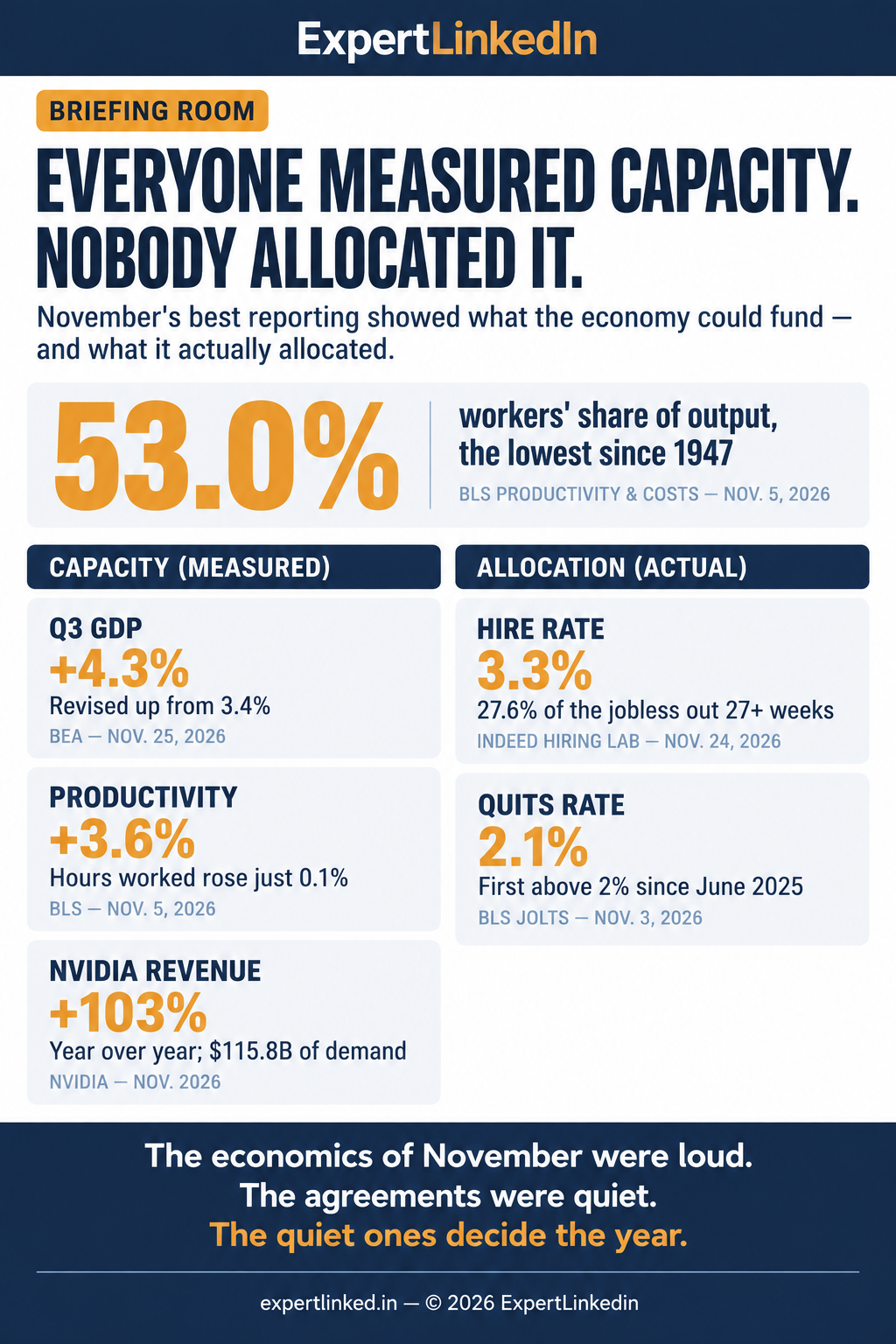
On paper, the month looked triumphant. The second estimate put third-quarter GDP growth at a 4.3% annual rate, revised up from 3.4% (BEA, November 25). Productivity rose 3.6% while hours worked grew just 0.1% (BLS, November 5). NVIDIA reported $115.8 billion of quarterly revenue, up 103% year over year (NVIDIA, November 2026). Job postings climbed 5.1% year over year.
Then the allocations. Payrolls added a solid-looking 165,000 jobs in October — but against a twelve-month average of just 48,000 (BLS, November 6). The hire rate sat near 3.3% and quits only barely cleared 2%. Workers’ share of national output fell to 53.0%, the lowest since the series began in 1947. And the Federal Reserve’s own Beige Book described firms “hiring primarily to replace for attrition” and “utilizing existing staff more efficiently.”
That split — between a stated intention and an allocation of work, time, or authority — is the thread that ties November’s best reporting together. Here is the month in one place.

Key arguments #
Labor — a vacancy is an intention; the hire is the fact. The September JOLTS report, released November 3, showed 7.5 million openings, 5.4 million hires, and a quits rate of 2.1% — the first time it has exceeded 2% since June 2025. Indeed’s November snapshot added the operational tell: postings up 5.1% year over year, but new postings stuck at 93.3, roles taking longer to fill, and 27.6% of unemployed workers out of work 27 weeks or more — the highest share outside a recession’s immediate aftermath since 1950. Posting a role is an intention. Filling it is the allocation.
Capacity — a profit is capacity; a requisition is a decision. The productivity numbers were genuinely strong, but they arrived without more hours, and the gains landed in margin rather than base pay. The third-quarter productivity report showed unit labor costs — the cost of labor per unit of output — falling 0.7% even as the labor share hit its record-low 53.0%. The Q3 second estimate lifted GDP to 4.3% yet showed profit growth slowing to $206 billion from $384 billion in the second quarter. October’s personal income and outlays report put the Fed’s preferred inflation gauge (PCE) at 3.8% headline and 3.3% core, with the saving rate at 4.1%. A profitable economy does not tell a particular team what it can fund.
Learning — access is not an allocation of time. Deloitte’s 2026 human-capital research is the month’s cleanest statement of the gap: 85% of respondents say adaptability is critical, 74% say they are making some progress, and only 7% say they are leading — while just 8% believe their organizations are highly effective at “always-on” learning. One-third of workers absorbed 15 major changes in a year; 60% reported increased workload. Deloitte’s own conclusion — that learning now has to be embedded “in the flow of work” — is the same point ExpertLinked made on November 9: a funded course with no protected calendar time is an intention, not a development plan.
AI work design — capability is not authority. Microsoft’s 2026 Work Trend Index found that organizational factors account for more than twice the reported AI impact of individual effort (67% versus 32%), with only 19% of AI users in the “Frontier” and 10% in “blocked agency” — skilled people whose organizations cannot absorb them. At Ignite 2026, Microsoft’s most instructive detail was a management one, not a model: its new Autopilot agent gets “its own identity” and “a named manager,” and IT “can scope its access and block it anytime” (Microsoft, November 17). The company is handing an agent the decision rights it still expects humans to negotiate. NVIDIA’s record quarter, meanwhile, is demand evidence — proof the world is buying compute, not that any reader’s job has been redesigned. For the full three-layer evidence test, see November 18.
Practical tools — two one-pagers that turn the distinction into a test. The month’s most useful ExpertLinked work does the same thing at the personal level. The November 16 decision-rights agreement asks who may propose, who approves, who can stop or override, and who owns follow-up — plus the question teams skip: who can actually grant the stop. The November 23 handover checklist asks for current state, next action, backup owner, and access, plus four escalation rules and one test that proves the handoff before you leave. Both exist to answer a single question: is this real, or merely stated?
Discussion #
The month’s columnists converged on the same diagnosis from different directions. My own November 4, 18, and 25 pieces built the capacity-versus-decision grammar across labor, AI, and profits. Olivia Bennett’s Clinics supplied the human cost: responsibilities that “changed without a conversation” (November 6), training approved but repeatedly cancelled (November 13), accountability for AI decisions without override authority (November 20), and a finished handover that still left a worker “expected online” (November 27).
Olivia Bennett’s take: the gap these readers describe is rarely a motivation problem. It is a coverage-and-authority problem — the work arrives, but the permission and the backup do not. That is why every practical fix this month took the form of an agreement (who covers, who approves, who stops) rather than advice to communicate better.
Emily Chen and Alex Winters pressed the liability side — who owns the decision when an algorithm rates, watches, or fires someone, and what happens when your change freeze does not cover your model provider. Read together, the month’s internal record is unusually consistent: workers are being asked to own outcomes for which the system has not yet allocated the authority to control.
Disagreement #
Three tensions are worth keeping open rather than resolving.
First, the Fed and the workforce read the same numbers differently. The October FOMC minutes, released November 18, note that “labor market dynamism remained unusually low” while also citing “strong corporate earnings” and strong productivity as sources of resilience. The central bank sees a stable economy; a worker sees a frozen door. Both descriptions are accurate.
Second, productivity optimism versus the labor share. Falling unit labor costs and record productivity can be celebrated as efficiency — or read as the clearest sign yet that the gains are landing in capital, not pay. The labor share at 53.0% settles which reading the data supports, even if the spin does not.
Third, the direction of 2027. Indeed and Glassdoor’s 2027 trends report argues the “holding pattern will end in 2027,” with pent-up frustration threatening a turnover wave the moment hiring thaws. The Beige Book and the FOMC minutes describe continued caution. Both can be true: a rebound and a squeeze can arrive in the same year. What would resolve it is employer-level evidence — funded requisitions, named fill dates, and rising entry-level demand.
One honest gap belongs here too. Because October 2025 CPI data were never collected, the Bureau of Labor Statistics could not publish year-over-year inflation or real-earnings changes for October 2026. The month’s real-pay picture is a month-over-month one. Good curation says so rather than borrowing a number that does not exist.
Decisions #
The month reaches a few firm conclusions. The economy has the capacity to pay, hire, and train; it has not allocated much of it. The bottleneck sits with the organization — not the worker’s effort — which is why every credible fix this month was a test of an actual agreement.
The carry-forward is deliberately mundane. Before you accept any 2027 claim about work, time, or authority, ask for the allocation: which process, whose calendar, which approver, and what happens by default when the condition fails. If you want the full synthesis of how workload, learning time, and decision rights fit on one page, that is the November 28 Deep Dive. If you want the two one-page tools, start with decision rights and the holiday handover checklist.
The economics of November were loud. The agreements were quiet. The quiet ones decide the year.
November at ExpertLinked #
If you want the full November arc rather than just this month’s picks, start here:
- November 2 — How to Renegotiate Job Responsibilities for 2027 With a 3-List Scope Audit
- November 4 — What the September 2026 JOLTS Report Says About 2027 Staffing Assumptions
- November 6 — My Job Responsibilities Changed Without a Conversation—What to Agree for 2027
- November 9 — How to Build a Career Development Plan for 2027 With Learning Time at Work
- November 11 — What October 2026 Jobs Data Says About Where to Invest Your Learning Time
- November 13 — My Manager Approved Training but Keeps Cancelling Learning Time—What to Agree
- November 16 — How to Set AI Decision Rights for 2027 With a 4-Question Team Agreement
- November 18 — What NVIDIA Earnings and Microsoft Ignite 2026 Can Reveal About AI Work Design
- November 20 — I’m Accountable for AI Decisions I Can’t Override—What to Change Before 2027
- November 21 — AI Can Rate, Watch and Fire You. Who Owns That Decision?
- November 23 — How to Build a Holiday Handover Checklist With 4 Clear Escalation Rules
- November 24 — Your Change Freeze Doesn’t Cover Your Model Provider
- November 25 — What Q3 2026 Profits and October PCE Mean for 2027 Staffing Claims
- November 27 — My Holiday Handover Is Done, but I’m Still Expected Online—3 Agreements to Make
- November 28 — How to Renegotiate Your Role for 2027: Workload, Learning Time, and Decision Rights
Have a candidate for December’s Briefing Room — or a reporting thread this issue missed? I’d like to hear what you’re seeing.
Email me at jackson.rodriguez@tlnw.uk
References #
- U.S. Bureau of Labor Statistics (November 3, 2026). “Job Openings and Labor Turnover — September 2026.” https://www.bls.gov/news.release/jolts.nr0.htm (Accessed November 27, 2026)
- U.S. Bureau of Labor Statistics (November 5, 2026). “Productivity and Costs — Third Quarter 2026 (Preliminary).” https://www.bls.gov/news.release/prod2.nr0.htm (Accessed November 27, 2026)
- U.S. Bureau of Labor Statistics (November 6, 2026). “The Employment Situation — October 2026.” https://www.bls.gov/news.release/empsit.nr0.htm (Accessed November 27, 2026)
- U.S. Bureau of Labor Statistics (November 10, 2026). “Real Earnings — October 2026.” https://www.bls.gov/news.release/realer.nr0.htm (Accessed November 27, 2026)
- U.S. Bureau of Economic Analysis (November 25, 2026). “GDP (Second Estimate) and Corporate Profits, Third Quarter 2026.” https://www.bea.gov/news/2026/gdp-second-estimate-and-corporate-profits-3rd-quarter-2026 (Accessed November 27, 2026)
- U.S. Bureau of Economic Analysis (November 25, 2026). “Personal Income and Outlays, October 2026.” https://www.bea.gov/news/2026/personal-income-and-outlays-october-2026 (Accessed November 27, 2026)
- Board of Governors of the Federal Reserve System (November 25, 2026). “Beige Book — November 2026.” https://www.federalreserve.gov/monetarypolicy/beigebook202611-summary.htm (Accessed November 27, 2026)
- Board of Governors of the Federal Reserve System (November 18, 2026). “Minutes of the Federal Open Market Committee, October 27–28, 2026.” https://www.federalreserve.gov/monetarypolicy/fomcminutes20261028.htm (Accessed November 27, 2026)
- Microsoft (May 5, 2026). “2026 Work Trend Index: Agents, human agency, and the opportunity for every organization.” https://www.microsoft.com/en-us/worklab/work-trend-index/agents-human-agency-and-the-opportunity-for-every-organization (Accessed November 27, 2026)
- Microsoft (November 17, 2026). “Copilot at Microsoft Ignite: Expanding what’s possible with intelligence built for work.” https://www.microsoft.com/en-us/copilot/blog/2026/11/17/copilot-at-microsoft-ignite-expanding-whats-possible-with-intelligence-built-for-work/ (Accessed November 27, 2026)
- Microsoft Ignite 2026 (November 17–20, 2026). https://ignite.microsoft.com/en-US/home (Accessed November 27, 2026)
- Deloitte (2026). “2026 Global Human Capital Trends.” https://www.deloitte.com/us/en/insights/topics/talent/human-capital-trends.html (Accessed November 27, 2026)
- Deloitte (2026). “Staying relevant in a world that won’t sit still” (adaptable workforce chapter). https://www.deloitte.com/us/en/insights/topics/talent/human-capital-trends/2026/creating-an-adaptable-workforce.html (Accessed November 27, 2026)
- NVIDIA (November 2026). “NVIDIA Announces Financial Results for Third Quarter Fiscal 2027.” https://nvidianews.nvidia.com/news/nvidia-announces-financial-results-for-third-quarter-fiscal-2027 (Accessed November 27, 2026)
- Indeed Hiring Lab (November 24, 2026). “US Labor Market Snapshot — November 2026.” https://hiringlab.indeed.com/2026/11/24/us-labor-market-snapshot-november-2026/ (Accessed November 27, 2026)
- Indeed Hiring Lab & Glassdoor Economic Research (November 18, 2026). “Indeed & Glassdoor’s 2027 US Hiring and Worklife Trends Report.” https://hiringlab.indeed.com/2026/11/18/indeed-glassdoor-2027-us-hiring-and-worklife-trends-report/ (Accessed November 27, 2026)
- Indeed Hiring Lab (November 18, 2026). “It’s Not Just the Paycheck: Total Compensation is Under Pressure.” https://hiringlab.indeed.com/2026/11/18/total-compensation-is-under-pressure/ (Accessed November 27, 2026)
AI Content Notice
This article was created using artificial intelligence technology. Whenever possible, we include references and sources to support the information presented. Readers are encouraged to consult these sources for further information. While we strive for accuracy and provide valuable insights, readers should independently verify information and use their own judgment when making business decisions. The content may not reflect real-time market conditions or personal circumstances.
Related Articles
Infographic: Briefing Room — November 2026: Career Development, AI Work Design, and Hiring Evidence
November’s loudest numbers were about capacity — GDP up to 4.3%, productivity +3.6%, NVIDIA at …
What NVIDIA Earnings and Microsoft Ignite 2026 Can Reveal About AI Work Design
Two of the week’s biggest AI events are being read as one signal about your job. They …
Briefing Room - October 2026: The Best Reporting on Calibration, Pay Pressure, and Selective Hiring
October’s best reporting connects measurement to money — GDP up 3.4% and a Fed hold beside …