What NVIDIA Earnings and Microsoft Ignite 2026 Can Reveal About AI Work Design

On Tuesday afternoon in California, one of the most consequential companies on earth reported earnings without the founder who built it. That evening, several hundred miles north, Microsoft opened a four-day conference about the future of work.
By the time you read this, the two events will have been fused into a single story: AI demand is enormous, the tools are ready, so your job is about to change. That story skips a step — and the step it skips is the only one that speaks to you.
Here is this week’s thread. Three kinds of evidence are on the table, and they are not interchangeable. Demand evidence shows that compute is being consumed and financed. Capability evidence shows that a product exists or is promised. Workflow evidence shows that a specific employer changed how a specific job gets done. Infrastructure demand, a demo, and a redesigned job are different claims. Before any of them becomes a career forecast, you have to name the missing link between them.
Let me take them in order.
What Nvidia’s numbers actually prove #
Nvidia’s fiscal third-quarter report lands on the back of a week nobody could have scripted. On November 12, Jensen Huang resigned as president and CEO after admitting an affair with a customer executive alleged to have Chinese-intelligence ties, and after reports of further affairs with employees. CFO Colette Kress is now interim CEO while the board runs a permanent search; independent directors retained former acting U.S. Attorney Joon H. Kim and Wachtell, Lipton to run an investigation. The stock has fallen for six straight weeks — its longest losing streak since 2012 — and the company’s market value is down $1.7 trillion.
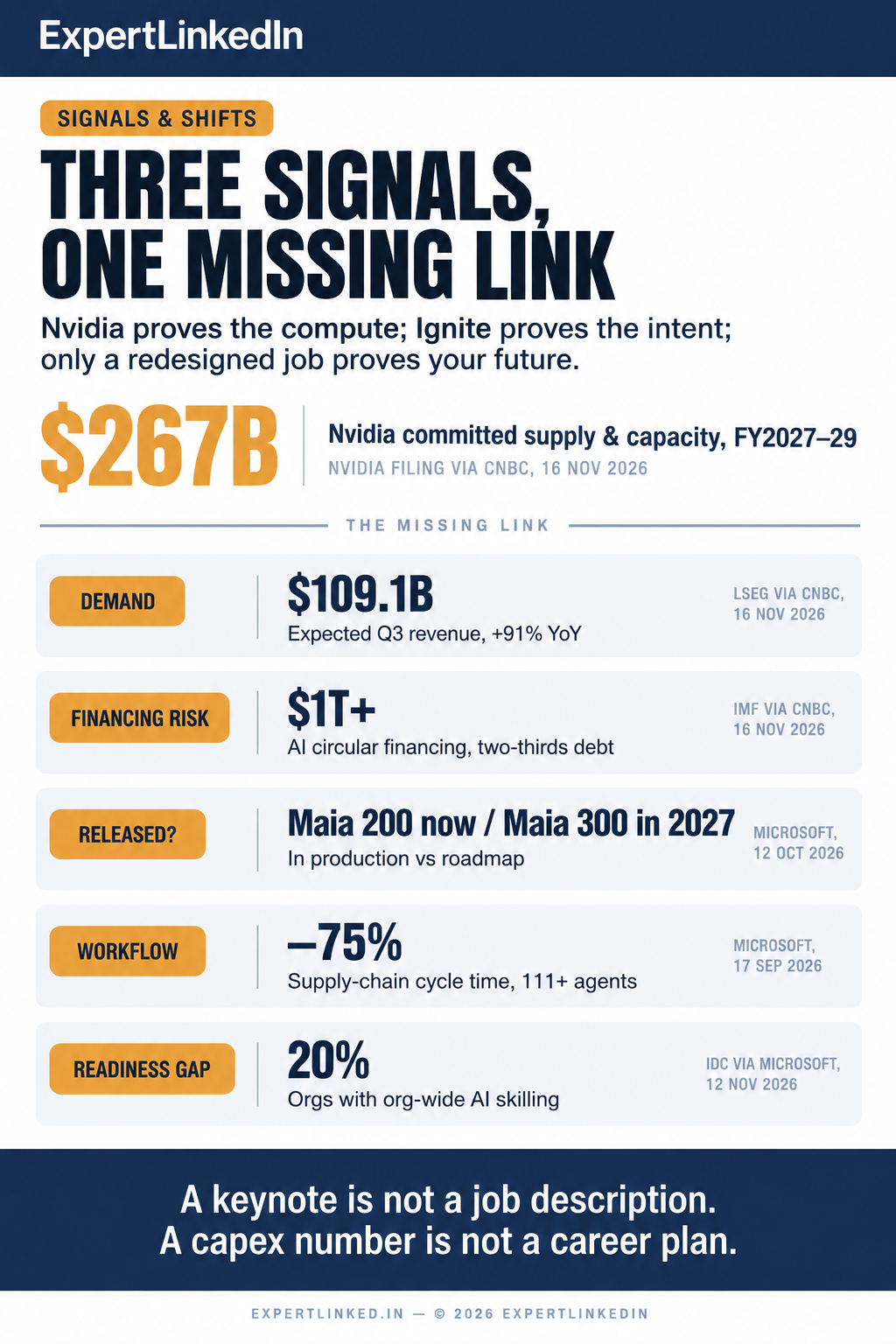
Underneath the drama, the demand signal is real and enormous. Analysts expected roughly 91% revenue growth to $109.1 billion (CNBC, November 16). In its most recent filing, Nvidia committed $92 billion in supply and capacity for the rest of this fiscal year, $87 billion for the year ending January 2028, and $88 billion for the year ending January 2029. It holds $99 billion in investments, another $25 billion in commitments, and $36 billion in cloud-service commitments, and stands behind up to $105 billion of credit guarantees for OpenAI’s Ohio data center (TechCrunch, November 12). The IMF estimates circular AI financing has passed $1 trillion, two-thirds of it debt.
That is a great deal of proof that the world is buying compute. It is zero proof about your job. A capex commitment is a bet that someone, somewhere, will use the capacity. It does not name a single task that stopped, a single role that changed, or a single team that reorganized. As I put it in October, a productivity sentence on an earnings call is “a forecast wearing the grammar of a result.” A supply commitment is a forecast wearing the grammar of a purchase order.

What Ignite can and cannot tell you #
Microsoft’s event is the second signal, and it is a different species. Even before the keynote, the shape is legible. Ignite runs November 17–20 in San Francisco, and Microsoft frames it around a “frontier ecosystem where AI tools support the work that people want to accomplish.” The company’s own live-news page says its Book of News — “all the products and features being unveiled” — appears only “at the conclusion of” Satya Nadella’s keynote.
Hold that sentence. A conference agenda is not a shipped product.
Microsoft is unusually candid about the gap, if you read the fine print. Its new Copilot with Home, Code, and Autopilot was announced in September with a precise release ladder: Home and Code “start rolling out in our Frontier program in the coming weeks,” Autopilot “expanding to private preview”, and the managed runtime “now in preview.” The same split appears in silicon: Maia 200 is running Microsoft production workloads today, while Maia 300 — and multi-gigawatt scale — is a 2027 story. “In production,” “in preview,” and “coming in 2027” are three different words, and they matter more than any demo.
The sharpest Ignite preview may not be a keynote at all, but a conversation. Nadella sat down with Gergely Orosz for a session titled “Software engineering after code becomes cheap”. That title is the real work-design question. A demo shows you what a tool can do; it does not tell you who owns the output, who verifies it, or who can stop it. That is the agreement I wrote about last week.
The evidence almost nobody puts in the keynote #
The third category is the rarest, and it is where the answer lives: an employer describing an actual change to work. The clearest example this week is Microsoft’s own operating record, published in September by its chief strategy and transformation officer, Kathleen Hogan. A 150-person cross-functional team deployed more than 100 purpose-built agents across cloud supply-chain planning, sourcing, fulfillment, and logistics, and cut cycle time by up to 75% — from roughly ten business days to under two and a half. Note the boundary conditions: agents act “within defined permissions and approval thresholds,” and the team had to decide “where people must review, approve or intervene.” That is a redesigned job, described by the employer that did it.
But read the same company’s fuller record and the picture gets uncomfortable. In October, Microsoft’s chief people officer introduced a Voluntary Exit Offer for eligible employees “at level 70 and below” in Canada, India, the U.K., and the U.S. — framed as “another way to adapt their workforce to changing needs.” Capability and cost-cutting arrived in the same season from the same employer. Customer cases show the same ambivalence: Northern Trust cut onboarding data preparation by 83% and Barclays migrated a legacy database in 20 days instead of three months, while BNY has put 150 “digital employees” on the org chart (Microsoft’s 2026 Work Trend Index) — genuine workflow change, often delivered by vendors and frequently without a new job title attached.
The Work Trend Index supplies the frame, and its central question is the one to carry into any AI conversation: who has the authority to update the workflows that agents run? Its own survey of 20,000 workers found that organizational factors account for 67% of AI’s real impact versus 32% for individual mindset, that only about 19% of AI users sit in the “Frontier” where skill and system reinforce each other, and that most companies are not built to capture the value. Microsoft’s commissioned IDC research makes the gap starker: only 20% of organizations have an organization-wide AI skilling strategy, and 36% are still piloting agents. The intent is everywhere. The allocation is rare.
Naming the missing link #
So here is the argument, stated plainly. The link between an infrastructure boom and a career is a conversion mechanism, and it has three parts: an employer decides which tasks move to agents, documents the handoff and approval path, and then reallocates headcount or learning time accordingly. Nvidia’s earnings speak to the first input — the compute. Ignite speaks to the tools, and sometimes to the intent. Only a documented redesign speaks to the outcome.
That is why the interesting disagreement this week is not “is AI real?” It is how to read the demand. Stratechery’s Ben Thompson has argued, since the agentic wave began with Anthropic’s Opus 4.5 in late 2025, that we are not in a bubble — the models are so token-hungry that “we really do need all of the compute that is being built.” Days ago, the IMF’s Kristalina Georgieva warned that the world economy is “standing on one leg” on AI. Both can be true: the compute may be needed, and the financing that pays for it may still be fragile. Microsoft’s own numbers carry the same double edge — the same company that showcases a 75% cycle-time cut also reports that only 48% of organizations are scaling AI value.
None of that debate tells you what to do on Monday. Three questions do:
- What kind of evidence is this? Demand, capability, or workflow? A capex number is demand. A keynote is capability. A task that actually moved is workflow.
- Where is the employer? If no named organization has changed a named process, there is no work-design evidence yet — only potential.
- Who can approve the change? Even a real redesign stalls unless someone holds the authority to update the workflow, staff it, and stop it. That is the decision-rights question.
The practical move this week is small and dull: before you act on any AI headline, ask which of the three kinds of evidence it is. Then ask whether the change has arrived inside your own building — not in a press release, but in a process map, a handoff document, and a manager who can approve next year’s version of your job.
A keynote is not a job description. A capex number is not a career plan. The missing link between them is a specific employer deciding to redesign specific work — and until you can point to that, keep your forecast long.
Reading this week’s AI news differently? Tell me which signal you actually trust for 2027 planning, and I’ll tell you what to test next.
Email me at jackson.rodriguez@tlnw.uk
References #
- TechCrunch (November 12, 2026). “Nvidia’s Jensen Huang resigns, chipmaker names CFO Colette Kress as interim CEO.” https://techcrunch.com/2026/11/12/nvidias-jensen-huang-resigns-chipmaker-names-cfo-colette-kress-as-interim-ceo/ (Accessed November 17, 2026)
- NVIDIA (November 13, 2026). “NVIDIA Announces CEO Transition.” https://nvidianews.nvidia.com/news/nvidia-announces-ceo-transition (Accessed November 17, 2026)
- CNBC (November 16, 2026). “Nvidia’s Colette Kress confronts key questions in first earnings report since Jensen Huang’s exit.” https://www.cnbc.com/2026/11/16/nvidia-earnings-jensen-huang-resignation.html (Accessed November 17, 2026)
- CNBC (November 16, 2026). “IMF’s Georgieva warns world economy is ‘standing on one leg’ as AI circular financing tops $1 trillion.” https://www.cnbc.com/2026/11/16/imf-georgieva-warning-ai-circular-financing.html (Accessed November 17, 2026)
- CNBC (November 16, 2026). “Nvidia’s board of directors is not considering bringing back Jensen Huang as CEO.” https://www.cnbc.com/2026/11/16/nvidia-ceo-jensen-huang.html (Accessed November 17, 2026)
- Microsoft (September 17, 2026). “What we’ve learned from Microsoft’s own AI transformation.” Kathleen Hogan. https://blogs.microsoft.com/blog/2026/09/17/what-weve-learned-from-microsofts-own-ai-transformation/ (Accessed November 17, 2026)
- Microsoft (October 26, 2026). “Introducing a Voluntary Exit Offer.” Amy Coleman. https://blogs.microsoft.com/blog/2026/10/26/introducing-a-voluntary-exit-offer/ (Accessed November 17, 2026)
- Microsoft (September 25, 2026). “Introducing the new Copilot with Home, Code and Autopilot.” Jared Spataro. https://blogs.microsoft.com/blog/2026/09/25/introducing-the-new-copilot-with-home-code-and-autopilot/ (Accessed November 17, 2026)
- Microsoft (October 12, 2026). “Microsoft to expand Azure Maia system to multi-gigawatt deployments.” Scott Guthrie. https://blogs.microsoft.com/blog/2026/10/12/microsoft-to-expand-azure-maia-system-to-multi-gigawatt-deployments/ (Accessed November 17, 2026)
- Microsoft (November 12, 2026). “Scaling AI value without losing control: Lessons from Frontier Firms.” Alysa Taylor. https://blogs.microsoft.com/blog/2026/11/12/scaling-ai-value-without-losing-control-lessons-from-frontier-firms/ (Accessed November 17, 2026)
- Microsoft (May 5, 2026). “2026 Work Trend Index: Agents, human agency, and the opportunity for every organization.” https://www.microsoft.com/en-us/worklab/work-trend-index/agents-human-agency-and-the-opportunity-for-every-organization (Accessed November 17, 2026)
- The Pragmatic Engineer (2026). “Software engineering after code becomes cheap with Satya Nadella.” https://www.youtube.com/watch?v=0NE89Nzfk20 (Accessed November 17, 2026)
- Stratechery, Ben Thompson (March 2026). “Agents over Bubbles.” https://stratechery.com/2026/agents-over-bubbles/ (Accessed November 17, 2026)
- Microsoft Ignite 2026. “Live News” and “Book of News.” https://news.microsoft.com/events/ignite/2026/live-news/ and https://news.microsoft.com/events/ignite/2026/book-of-news/ (Accessed November 17, 2026)
- ExpertLinked (October 21, 2026). “What Early Q3 2026 Earnings Calls Say About AI Productivity - and Why Q4 Hiring Plans Still Look Narrow.” https://expertlinked.in/posts/2026-10-21-what-early-q3-2026-earnings-calls-say-about-ai-productivity-and-why-q4-hiring/
- ExpertLinked (November 16, 2026). “How to Set AI Decision Rights for 2027 With a 4-Question Team Agreement.” https://expertlinked.in/posts/2026-11-16-how-to-set-ai-decision-rights-for-2027-with-a-4-question-team-agreement/
AI Content Notice
This article was created using artificial intelligence technology. Whenever possible, we include references and sources to support the information presented. Readers are encouraged to consult these sources for further information. While we strive for accuracy and provide valuable insights, readers should independently verify information and use their own judgment when making business decisions. The content may not reflect real-time market conditions or personal circumstances.
Related Articles
Infographic: What NVIDIA Earnings and Microsoft Ignite 2026 Can Reveal About AI Work Design
Two of the week’s biggest AI events are being read as one signal about your job. They …
The Late-August 2026 Labor Market Verdict: 3 Signals That Will Shape September Hiring
The late-August verdict is now clear: weak hiring flow, thin real wage relief, and capacity-first …
What the July 2026 FOMC Minutes and Q2 Earnings Say About Q4 Hiring Risk
If you are waiting for the July FOMC minutes to rescue fall hiring, you are watching the wrong …