How to Set AI Decision Rights for 2027 With a 4-Question Team Agreement

Someone on your team is already accountable for an AI decision they cannot stop. You may be that person.
The moment AI enters a workflow, the real question stops being what the model recommends. It becomes: who gets to disagree with it — and how fast?
That is not my line. It is how one leader described the stakes to MIT Sloan Management Review, quoted in Deloitte’s 2026 Human Capital Trends: “The moment AI enters the workflow, the real question isn’t ‘What does the model say?’ It’s ‘Who gets to disagree with it, and how fast?’” The same research found that “a surprising number of organizations lack clarity about decision rights,” and that AI is making it worse — muddying the very authority that oversight depends on. Microsoft’s 2026 Work Trend Index landed on the same nerve from the opposite direction, naming the governance question every organization now has to answer: who has the authority to update the workflows that agents run?
So here is the gap worth naming before we get to any tool. A named accountable person can still lack the practical authority to stop a workflow. When that happens, you have not built oversight. You have built what the researcher Madeleine Clare Elish calls a “moral crumple zone” — a human placed inside a system to absorb the blame for a decision the system never let them control. Accountability without a stop is not a safeguard. It is a liability with a job title.

Why “accountable” is not a control #
Most teams already have a decision-rights tool. It is called RACI, or DACI, or something with a vowel removed. The problem is not the acronym. Deloitte is specific about the mechanism: legacy, person-centric models “presume static authority.” With AI, rights have to become dynamic — “incorporating override privileges, escalation paths, and consensus rules … so humans and agents coordinate who decides, when, and on what basis.”
Read that as a design brief. The tool tells you who is accountable. It does not confirm that the accountable person can act.
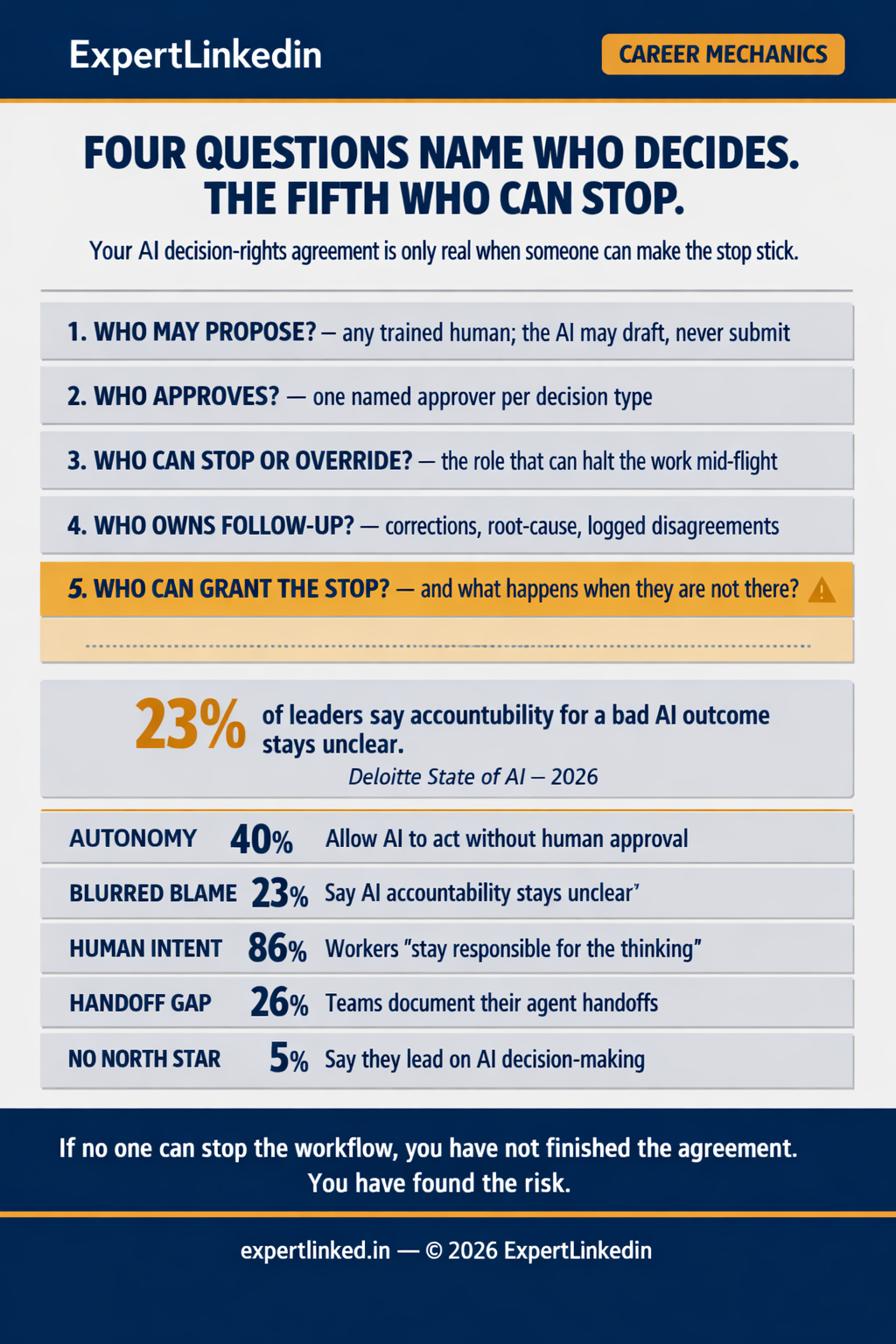
The evidence says acting is exactly the missing half. In Deloitte’s State of AI in the Enterprise survey of 3,500 senior leaders, 40% said they allow AI to execute decisions or actions without human approval to at least a moderate degree — and for 23%, accountability for a negative outcome “remains unclear.” Microsoft’s security guidance frames the fix architecturally: the controls that decide “whether it should continue operating must sit outside the model, where the model cannot bypass or tamper with them.” You cannot be the safeguard if the thing you are meant to override can route around you.
This is why so many “AI reviewer” roles fail quietly. Microsoft’s research also found we have not written the rules down: agent workflows, human handoffs, and quality standards are documented and repeatable at the team level for only about a quarter of teams. Accountability is being handed out faster than it is being instrumented.
The 4-question team agreement #
Here is the tool. One page, four questions. Run it on your own team, in your own words, over one process — not as a policy, and not as a spreadsheet nobody opens.
| # | The question | What you name | The test that exposes a fake answer |
|---|---|---|---|
| 1 | Who may propose this decision? | The roles allowed to draft and submit it. The AI may draft; only a human submits. | Can someone not on the list still get a draft into the queue? |
| 2 | Who approves it? | Exactly one named approver per decision type. | Is this a real decision-maker, or a rubber stamp? |
| 3 | Who can stop or override it? | The role that can halt, pause, or reverse the workflow mid-flight. | If they say stop, what happens in the next 30 minutes? |
| 4 | Who owns follow-up? | The person answerable for corrections, the root-cause fix, and logging any human–AI disagreement. | Does the row carry a name, or “the team”? |
Three habits make this more than a meeting. First, cocreate it. Harvard Business Review’s research on decision rights, drawing on work with more than 100 companies, found that dictated role lists get ignored — teams “looked at the file once and never again” — while roles people help define get played. Second, write one plain-English behaviour for each role, because teams genuinely disagree about what “accountable” means: when HBR polled 30 partners at a consultancy, half said the accountable person has the final say and half said it was the responsible person. Third, classify before you allocate: borrow the one-way/two-way door test and only delegate the low-stakes, reversible decisions to fast AI execution.
The question most agreements skip #
Now the part that decides whether any of it is real. The four questions above name who. They do not yet give that person a lever. So add a fifth field to every row:
Who can grant the stop authority — and what is the alternative escalation path?
That means three things written down: the role that can make a stop stick (whoever owns the agent’s permissions, the queue, or the release gate — often not your manager); the backup stopper when the primary is unavailable; and the route when the primary is the blocker. Give it a channel, a response window, and a fail-safe default: while a disputed decision is unresolved, the work holds. Atlassian’s team playbooks treat this escalation clause as the point where a working agreement earns its keep; it is the field real decisions die without. It matters more when the named approver is already stretched: Gallup finds half of CHROs are not confident their managers can guide AI use at all — precisely why a stop needs a named backup, not a hopeful assumption about the boss.
The uncomfortable truth is that approving and stopping are different rights, held by different people. The HBR team documented a venture firm that passed on what became a unicorn because the correct accountable person — the associate who had done the diligence — was overruled by a senior partner “acting as if he were accountable.” Labels lose to hierarchy unless you have named the person who can make the label stick. Deloitte’s own reading of EU human-oversight guidance makes the same point: do not assume a human in the loop is safe — “explicitly design authority, interfaces, and escalation” so the human can actually intervene.
Run it on one real process #
Take something small and live: an AI-assisted customer-credit workflow. A support agent’s AI reads the ticket and account history and drafts a refund recommendation and a reply. The agent reviews and submits. The team agreement fills in like this.
- Propose: any trained agent may draft and submit; the AI proposes but never submits.
- Approve: one named support lead on shift, for credits inside a set band. Above the band, this is not a team decision — it routes to finance.
- Stop or override: the support lead on shift can hold the queue and revoke the send. The agent who spots a bad recommendation can flag it, but flagging is not stopping; the lead holds the control.
- Follow-up: the agent owns the customer reply and correction; the lead owns the root-cause ticket and logs the disagreement at the weekly review.
- Grant + escalate: if the lead is unavailable — or is the person insisting on proceeding — the named alternative is the duty manager via a dedicated escalation channel with a 30-minute response clock. While unresolved, the default is hold, with a holding reply to the customer.
Why bother with the structure? Deloitte’s work-design research found organizations are twice as likely to exceed their AI return-on-investment expectations when they prioritize work design. A European telecom added an AI “expert” to customer service with no role or workflow change and got a 5% productivity lift; when it spent 90% of the rollout budget redesigning the human–AI interactions — new workflows, trust thresholds, escalation paths, training — it unlocked a 30% increase. The escalation path is not overhead. It is where the return lives.
What this is not #
Be explicit with your team: this is a discussion tool, not a legal or compliance policy. It cannot create rights, override a regulation, authorize a regulated action, or handle personal or sensitive data. Where a decision touches fraud, privacy, safety, finance, or a regulated area, the team does not govern it — the team routes it to the owner who does, by name and by clock.
Three layers exist, and yours is the smallest. The NIST AI Risk Management Framework is voluntary guidance for managing AI risk. The EU AI Act’s Article 14 is binding: for high-risk systems it requires a human who can “disregard, override or reverse” output and interrupt the system with a stop button — and, where the stakes are highest, at least two people with the “competence, training and authority.” And your employer’s own legal, risk, and HR policies sit above both. Your one-pager’s job is to spend the authority your team already holds, and to name the hand-off to everyone else.
The move #
Do not wait for the org chart to catch up. Microsoft found only 26% of AI users say their leadership is clearly aligned on AI; Deloitte found only 5% consider themselves leading on AI decision-making. The clarity is not coming down from the top on schedule. So build the smallest version locally: one process, five fields, one review date.
Then do the thing the four questions cannot do for you. Find the person who can make a stop real — not the person with “accountable” in their title, but the person who holds the lever. Write their name down. If no one can stop the workflow, you have not finished the agreement. You have found the risk.
Have a decision-rights row your team can’t fill in — or a workflow you’re accountable for but can’t stop? Send me the row you’re trying to write and the approver you’re trying to reach, and I’ll tell you where the agreement needs a decision.
Email me at jackson.rodriguez@tlnw.uk
References #
- Atlassian (accessed November 15, 2026). “Working Agreements Play.” Team Playbook. https://www.atlassian.com/team-playbook/plays/working-agreements
- Atlassian (accessed November 15, 2026). “DACI: A Decision-Making Framework.” Team Playbook. https://www.atlassian.com/team-playbook/plays/daci
- Deloitte (March 2026). “Decisions that echo / Decision-making with AI.” 2026 Global Human Capital Trends. https://www.deloitte.com/us/en/insights/topics/talent/human-capital-trends/2026/decision-making-with-ai.html (Accessed November 15, 2026)
- Deloitte (March 4, 2026). “Getting human and machine relationships right.” 2026 Global Human Capital Trends. https://www.deloitte.com/global/en/insights/topics/talent/human-capital-trends/2026/human-ai-interaction-design.html (Accessed November 15, 2026)
- Deloitte (2026). “The State of AI in the Enterprise.” https://www.deloitte.com/us/en/what-we-do/capabilities/applied-artificial-intelligence/content/state-of-ai-in-the-enterprise.html (Accessed November 15, 2026)
- Elish, M. C. (2019). “Moral Crumple Zones: Cautionary Tales in Human-Robot Interaction.” Engaging Science, Technology, and Society, 5. https://estsjournal.org/index.php/ests/article/view/260 (Accessed November 15, 2026)
- European Union (accessed November 15, 2026). “Article 14: Human Oversight.” EU Artificial Intelligence Act. https://artificialintelligenceact.eu/article/14/
- Gallup (2026). “AI’s Effect on Workplace Culture.” https://www.gallup.com/workplace/712976/ai-effect-on-workplace-culture.aspx (Accessed November 15, 2026)
- Greer, L., Jordan, J., & Sytch, M. (July–August 2026). “What Companies Get Wrong About Decision Rights.” Harvard Business Review. https://hbr.org/2026/07/what-companies-get-wrong-about-decision-rights (Accessed November 15, 2026)
- Microsoft (May 5, 2026). “2026 Work Trend Index: Agents, human agency, and the opportunity for every organization.” https://www.microsoft.com/en-us/worklab/work-trend-index/agents-human-agency-and-the-opportunity-for-every-organization (Accessed November 15, 2026)
- Microsoft Security (October 19, 2026). “Agents are your newest insiders. Security must move at their speed.” https://www.microsoft.com/en-us/security/blog/2026/10/19/agents-are-your-newest-insiders-security-must-move-at-their-speed/ (Accessed November 15, 2026)
- NIST (accessed November 15, 2026). “AI Risk Management Framework.” https://www.nist.gov/itl/ai-risk-management-framework
- ExpertLinked (October 15, 2026). “The Verification Tax: Who Actually Pays for the AI Productivity Gain.” https://expertlinked.in/posts/2026-10-15-the-verification-tax-who-actually-pays-for-the-ai-productivity-gain/ (Accessed November 15, 2026)
- ExpertLinked (November 2, 2026). “How to Renegotiate Job Responsibilities for 2027 With a 3-List Scope Audit.” https://expertlinked.in/posts/2026-11-02-how-to-renegotiate-job-responsibilities-for-2027-with-a-3-list-scope-audit/ (Accessed November 15, 2026)
AI Content Notice
This article was created using artificial intelligence technology. Whenever possible, we include references and sources to support the information presented. Readers are encouraged to consult these sources for further information. While we strive for accuracy and provide valuable insights, readers should independently verify information and use their own judgment when making business decisions. The content may not reflect real-time market conditions or personal circumstances.
Related Articles
Infographic: How to Set AI Decision Rights for 2027 With a 4-Question Team Agreement
A named ‘accountable’ person can still lack the authority to stop an AI workflow. Here …
How to Build a Career Development Plan for 2027 With Learning Time at Work
Most 2027 development plans fail at the same field: the calendar. A funded course can sit unused for …
How to Renegotiate Job Responsibilities for 2027 With a 3-List Scope Audit
Your 2027 job is being assembled without a subtraction column. Here is the 3-list scope audit — work …