How to Renegotiate Job Responsibilities for 2027 With a 3-List Scope Audit

The job you will do in 2027 is already being assembled. It is just not being assembled in any document you have seen. It is being assembled in a hundred small decisions about what you pick up and what quietly stays on your desk.
And the conversation driving it has a missing column: subtraction.
Ask almost any knowledge worker to list what they do, and they will give you the role they were hired for plus everything that has piled on since. Ask what they have formally stopped doing in the past year, and the list is usually empty. Not because nothing should have stopped — because no one was ever asked to approve a removal. That empty list is the most revealing document in the room, and it is where a 2027 conversation should start.

The work is being added faster than the role is being redefined #
This is not a feeling. It is now measurable. In an eight-month study of a 200-person US technology company, UC Berkeley’s Aruna Ranganathan and Xingqi Maggie Ye watched generative AI change how people worked. AI did not reduce work. It intensified it in three ways: employees multitasked more, took on a broader range of tasks, and stretched work into more hours — “often without being asked to do so” (HBR, February 9, 2026).
The mechanism matters more than the finding. Because AI made starting a task frictionless, product managers started writing code and researchers took on engineering work. Workers described this as “just trying things.” The researchers described it more precisely: “these experiments accumulated into a meaningful widening of job scope. In fact, workers increasingly absorbed work that might previously have justified additional help or head count.”
Read that sentence again, because it is the whole problem in one line. People absorbed work that would once have justified a hire. It felt like initiative. The job description never caught up.
It is not only AI. Microsoft’s 2026 Work Trend Index, drawn from 20,000 AI-using knowledge workers, found that 66% say AI has let them spend more time on higher-value work — yet only 19% sit in the “Frontier” zone where their organization can actually absorb and reward that capability. Another 10% are in what the report calls “blocked agency”: strong individual skill, no organizational system to apply it (Microsoft 2026 Work Trend Index, May 5, 2026).
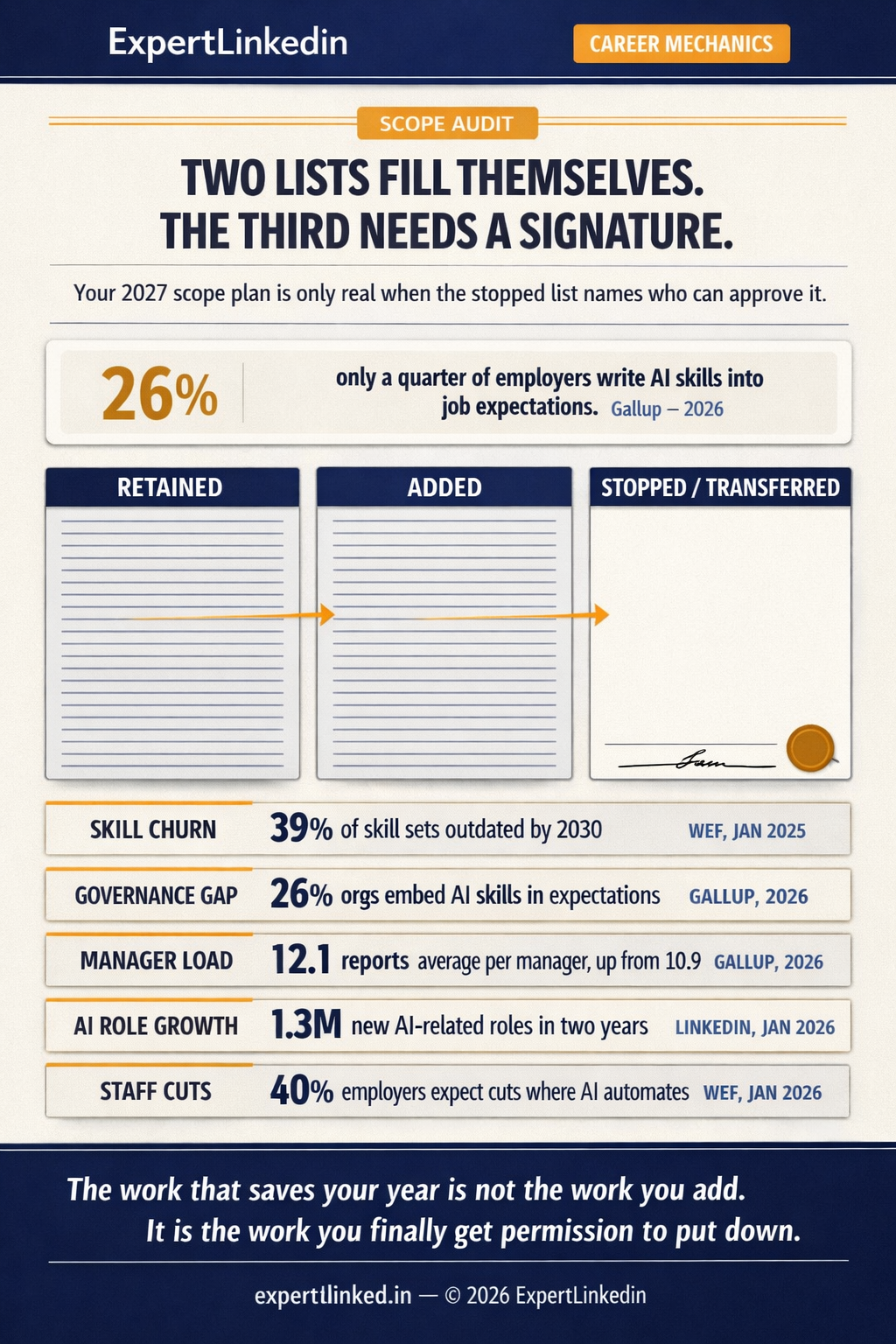
Gallup puts the governance gap in a single number. Just 26% of organizations say they are embedding AI skills into job expectations or performance goals (Gallup, “AI’s Effect on Workplace Culture,” 2026). The work is arriving faster than the definition of the job. So if your role feels bigger than your title, that is not a personal failure of focus. It is the default state of a system that measures additions and never asks for subtractions.
The theory that gets misread — including by people who quote it #
There is a well-known academic frame for taking control of this: job crafting. In their 2001 paper “Crafting a Job,” Amy Wrzesniewski and Jane Dutton defined it as “the physical and cognitive changes individuals make in the task or relational boundaries of their work” — changing the number and type of tasks you do, the relationships you maintain, or how you see the whole job (Wrzesniewski & Dutton, Academy of Management Review, 2001).
You have probably seen this research repackaged as “design your own job.” That is a misreading, and it is the misreading that gets people into trouble. Two details in the original paper get dropped:
Crafting is bounded by opportunity, not just motivation. The paper is explicit that the motivation to craft “is moderated by the perceived opportunity to do so.” If your work is highly interdependent with other people, or closely monitored, the room to reshape it by yourself shrinks.
Crafting often happens without permission. In their own summary of the examples, the authors note that employees crafted “often against management’s wishes.” That is a description of what people do, not a negotiation manual. Quietly dropping a task is crafting. It is also how you end up on the wrong side of a performance review.
So the useful move is not to craft in secret. It is to convert crafting into something explicit: a scope proposal that names each change and the person who can approve it. Wrzesniewski and Dutton also note that structural, economic, and status constraints give people “differential resources” to reshape work. Keep that sentence. We are coming back to it.
The 3-list scope audit #
One page. Three lists. Every row ends with a name, not a wish.
| What belongs here | The question that decides it | |
|---|---|---|
| 1. Work retained | The tasks you intend to keep owning in 2027 | Why does this stay — and who depends on it? |
| 2. Work added | Anything that arrived in the last 6–12 months | Was this ever approved, or did it just accumulate? |
| 3. Work stopped or transferred | Work to remove, automate, delegate, or hand off | Who can actually authorise this — and by when? |
Fill in the first two lists first. They are easy, and they are the reason the third one matters. When you write “work added” honestly, you usually discover it is longer than you thought: a weekly report you inherited when a colleague left, an AI-review step that became yours because you were the fastest to catch the errors, a coordination role nobody named. Microsoft’s own work-design research frames the organizational version of this as a question — “Who has the authority to update the workflows that agents run?” (Microsoft 2026 Work Trend Index). Deloitte reaches the same conclusion from the executive side: organizations that “intentionally redesign roles, workflows, and decision-making” to support human–AI collaboration are the ones that exceed expectations, and the question they must answer is “who has the authority to decide when algorithms act and when humans intervene?” (Deloitte 2026 Human Capital Trends, March 4, 2026).
Notice that every serious version of this question ends in authority. Not effort. Not intention. Authority.
The revealing list is the one nobody was asked to approve #
Here is the counterintuitive part. The third list is the most valuable one, and it is almost always the thinnest one — because it requires a decision from someone other than you. Adding work requires nobody’s permission. Removing it requires a specific person’s yes.
So do not write “improve prioritization” on the third list. That is not a scope change; it is a mood. Write the actual task, who should stop doing it (you, a colleague, a team, or an agent), and — this is the column that changes the conversation — the name of the person who can approve the removal.
The reason this works is that it turns a vague complaint into a decision someone can make. A manager cannot action “I’m stretched.” A manager can action “I propose we stop producing the manual weekly rollup; the dashboard already carries it; I’d transfer the last two review steps to Dana and free six hours a week. Can you approve this by November 20, or tell me who can?”
Who can actually say yes #
This is where most scope plans quietly fail, and it is worth saying plainly: the person who approves a removal is often not your direct manager. It might be a matrix owner who consumes the output, a budget holder who funds the process, or a downstream team that depends on the deliverable. Identify the approver before you write the proposal, or you are negotiating with the wrong person.
And be honest about the limits. The 2010 follow-up study by Justin Berg, Wrzesniewski, and Dutton found that job crafting is “shaped by employees’ structural location in the organization.” Higher-rank employees tend to see their crafting challenges as located in their own expectations, and can act within existing discretion. Lower-rank employees see them as located in their prescribed jobs and other people’s expectations — which means they must first change someone else’s mind before they can change their own work (Berg, Wrzesniewski & Dutton, Journal of Organizational Behavior, 2010).
The practical implication is uncomfortable but clear: a scope audit is a proposal tool, not a right. If you have demonstrated leverage and a manager who can act, it is the highest-return conversation available to you this quarter. If you do not, the same document becomes evidence — for a later review, or for an option you build elsewhere. It is not a promise that every worker can negotiate equally, because that is not true.
There is a third constraint worth naming: your manager may be the bottleneck. Gallup’s data show the average number of direct reports per manager rose from 10.9 in 2024 to 12.1 in 2025, part of a roughly 50% increase in average team size since 2013 as organizations flatten middle management (Gallup, “Span of Control,” 2025). The person who has to approve your removal is more overloaded than they were two years ago. That is exactly why you should hand them a decided recommendation, not an open question.
Run it as a decision, not a vent #
Three moves turn the audit into an outcome.
Bring one recommendation per row, not a status report. Managers triage decisions; they do not triage feelings. For each item on the stopped list, state the task, the proposed recipient, the cost of keeping it, and the specific approval you need.
Attach a consequence, so the trade is real. A scope change is not free — someone absorbs the work or the risk. Name it. “If we stop X, the risk is Y; I propose we accept it because Z.” Removing work without naming the consequence is how a good proposal gets deferred forever.
Set a decision date and a review. Ask for a yes, a no, or a named alternative by a specific date. Then log the agreement and a review point. Without a date, “we’ll revisit priorities” quietly means the retained list wins by default.
Deloitte’s 2026 research on change offers a reason to run it consultatively rather than as an ultimatum: workers are “twice as likely to feel negatively about an employer-imposed change as a self-imposed change” (Deloitte, “Staying relevant in a world that won’t sit still,” March 3, 2026). A scope agreement you co-author is more durable than one you announce or one that is announced to you.
The honest part #
This is a planning-window move, not a pay move. It comes before the money conversation, not instead of it. October was about proving the consequence of your work — the risk-reduction ledger that turned “I was reliable” into “here is the loss this role prevents.” And it was about pricing the role you hold now — the year-end retention exception built before the Q3 Employment Cost Index set next year’s band. Both of those answered the question what is my work worth.
This article answers the question that comes first: what work am I agreeing to own next year. Get the scope right, and the pay conversation has a subject. Leave the third list empty, and you will renegotiate the same overstuffed job again in twelve months.
So before 2027 planning closes your role by default, write the list nobody asked you to write. Name what stops. Name who has to say yes. The work that saves your year is not the work you add. It is the work you finally get permission to put down.
Have a scope conversation coming up — or a task nobody has agreed to stop? Send me the row you’re trying to write and the approver you’re trying to reach, and I’ll tell you where the proposal needs a decision.
Email me at jackson.rodriguez@tlnw.uk
References #
- Berg, J. M., Wrzesniewski, A., & Dutton, J. E. (2010). “Perceiving and responding to challenges in job crafting at different ranks: When proactivity requires adaptivity.” Journal of Organizational Behavior, 31, 158–186. https://positiveorgs.bus.umich.edu/article/perceiving-and-responding-to-challenges-in-job-crafting-at-different-ranks-when-proactivity-requires-adaptivity/ (Accessed November 2, 2026)
- Deloitte (March 3, 2026). “Staying relevant in a world that won’t sit still.” 2026 Human Capital Trends. https://www.deloitte.com/us/en/insights/topics/talent/human-capital-trends/2026/creating-an-adaptable-workforce.html (Accessed November 2, 2026)
- Deloitte (March 4, 2026). “From tensions to tipping points: Choosing the human advantage.” 2026 Human Capital Trends. https://www.deloitte.com/us/en/insights/topics/talent/human-capital-trends.html (Accessed November 2, 2026)
- Gallup (2026). “AI’s Effect on Workplace Culture.” https://www.gallup.com/workplace/712976/ai-effect-on-workplace-culture.aspx (Accessed November 2, 2026)
- Gallup (2025). “Span of Control: What’s the Optimal Team Size for Managers?” https://www.gallup.com/workplace/700718/span-control-optimal-team-size-managers.aspx (Accessed November 2, 2026)
- Harvard Business Review (February 9, 2026). Ranganathan, A., & Ye, X. M. “AI Doesn’t Reduce Work—It Intensifies It.” https://hbr.org/2026/02/ai-doesnt-reduce-work-it-intensifies-it (Accessed November 2, 2026)
- LinkedIn (January 2026). “Building a Future of Work That Works.” 2026 Labor Market Report. https://economicgraph.linkedin.com/content/dam/me/economicgraph/en-us/PDF/linkedIn-labor-market-report-building-a-future-of-work-that-works-jan-2026.pdf (Accessed November 2, 2026)
- Microsoft (May 5, 2026). “2026 Work Trend Index: Agents, human agency, and the opportunity for every organization.” https://www.microsoft.com/en-us/worklab/work-trend-index/agents-human-agency-and-the-opportunity-for-every-organization (Accessed November 2, 2026)
- World Economic Forum (January 2025). “Future of Jobs Report 2025.” https://www.weforum.org/publications/the-future-of-jobs-report-2025/ (Accessed November 2, 2026)
- Wrzesniewski, A., & Dutton, J. E. (2001). “Crafting a Job: Revisioning Employees as Active Crafters of Their Work.” Academy of Management Review, 26(2), 179–201. http://www.homepages.se.edu/cvonbergen/files/2019/02/Crafting-a-Job_Revisioning-Employees-as-Active-Crafters-of-Their-Work.pdf (Accessed November 2, 2026)
- ExpertLinked (October 12, 2026). “How to Turn Risk Reduction Into a Q4 2026 Promotion Case Before Budget Freeze.” https://expertlinked.in/posts/2026-10-12-how-to-turn-risk-reduction-into-a-q4-2026-promotion-case-before-budget-freeze/ (Accessed November 2, 2026)
- ExpertLinked (October 26, 2026). “How to Build a Year-End Pay Ask Before the Q3 2026 Employment Cost Index Lands.” https://expertlinked.in/posts/2026-10-26-how-to-build-a-year-end-pay-ask-before-the-q3-2026-employment-cost-index-lands/ (Accessed November 2, 2026)
AI Content Notice
This article was created using artificial intelligence technology. Whenever possible, we include references and sources to support the information presented. Readers are encouraged to consult these sources for further information. While we strive for accuracy and provide valuable insights, readers should independently verify information and use their own judgment when making business decisions. The content may not reflect real-time market conditions or personal circumstances.
Related Articles
Infographic: How to Renegotiate Job Responsibilities for 2027 With a 3-List Scope Audit
Your 2027 job is being assembled without a subtraction column. Here is the 3-list scope audit — work …
Briefing Room - October 2026: The Best Reporting on Calibration, Pay Pressure, and Selective Hiring
October’s best reporting connects measurement to money — GDP up 3.4% and a Fed hold beside …
The Calibration Quarter: How Q4 2026 Career Outcomes Get Locked by Scorecards, Not Sentiment
October’s data finally split confidence from leverage — 3.4% GDP growth and a Fed hold, …