How to Build a Career Development Plan for 2027 With Learning Time at Work

There is a particular kind of career stagnation that looks exactly like progress. You have chosen the course. You have the license. Your manager even approved it. What you do not have is a single protected hour in which to use any of it.
That is not a focus problem, and it is not a motivation problem. It is an allocation problem — and the research has a name for the exact moment it fails: transfer of training, the step where something learned in a course actually gets applied to the job.

The failure is rarely the learner’s. The 1988 model by Timothy Baldwin and John Ford — still the standard reference — locates the deciding factors in the work environment around the person: whether there is a real opportunity to perform the new skill, whether supervisors and peers support it, whether the climate provides cues and feedback that prompt you to use it, and whether regular check-ins keep it sharp. A course that never gets used is not learning. It is a receipt.
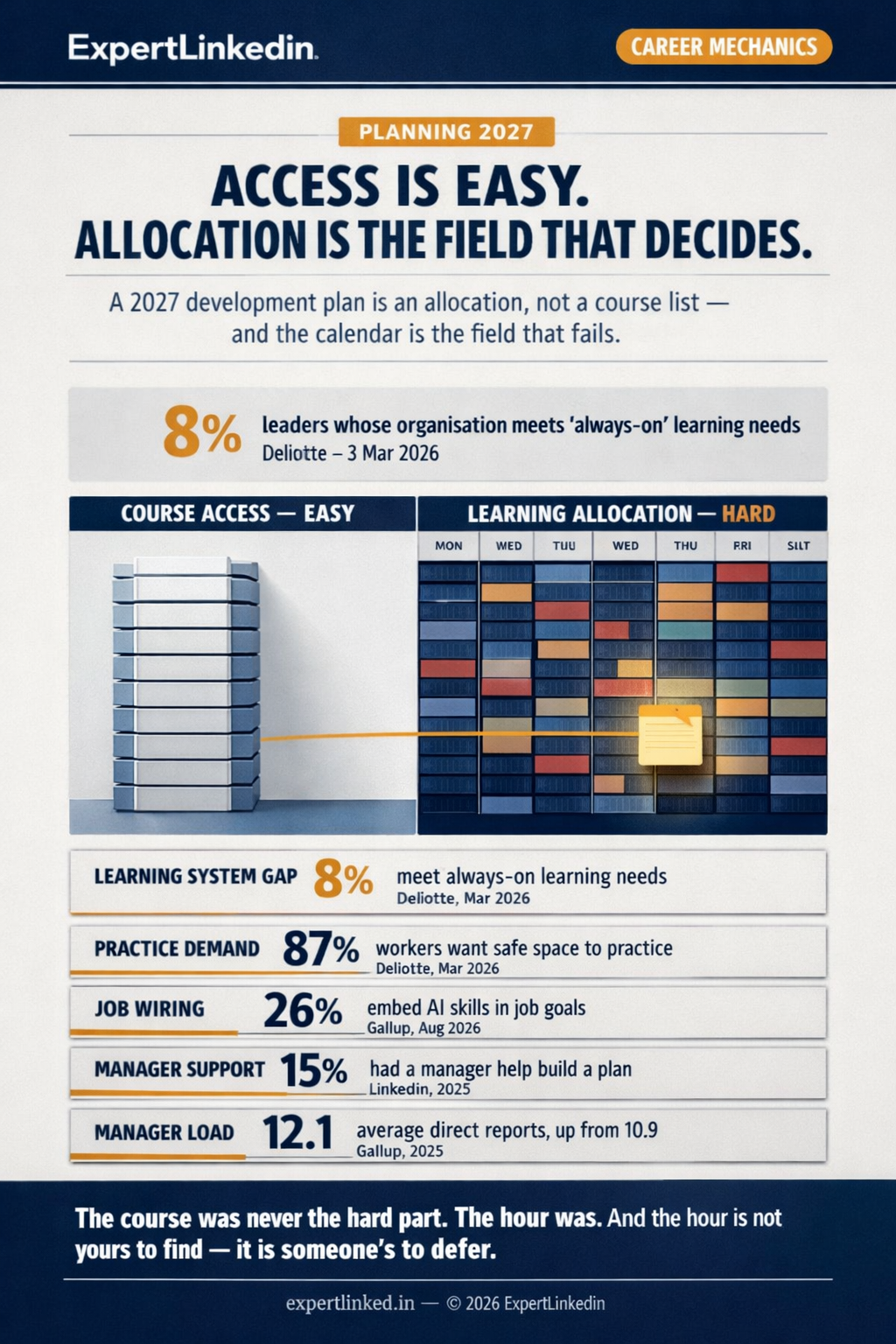
Here is the uncomfortable part. Almost everyone building a “2027 development plan” this month is optimizing the wrong field. They are choosing the course — the visible, satisfying, purchasable part — while ignoring the one input no course can supply: an hour of work you are allowed to spend differently. Deloitte’s 2026 Global Human Capital Trends puts the system failure in a single number. Only 8% of surveyed leaders believe their organizations are highly effective at meeting the continuous, “always-on” learning needs of their workforce (Deloitte, “Staying relevant in a world that won’t sit still,” March 3, 2026). The cause is not a shortage of content. As Deloitte puts it, growth still feels like “something outside of daily responsibilities — activities that require stepping away from ‘real work.’”
So stop planning a course. Plan an allocation.
The five fields of a plan that actually runs #
A 2027 development plan that survives contact with your calendar needs five named fields. Four of them are easy. One is the entire game.
| Field | What goes in it | The question that decides it |
|---|---|---|
| 1. The skill | A behavior specific enough to practice | Can I describe it as something I do, not something I know? |
| 2. The practice task | A real, repeatable rep at work | What will I produce, for whom, this week? |
| 3. The calendar allocation | The hours — taken from somewhere | What stops so this starts, and who approves that? |
| 4. The feedback source | A named person and a review cadence | Who sees the rep and tells me what to change? |
| 5. The opportunity to apply it | A live deliverable, not a sandbox | Where does the practiced skill actually ship? |
1. The skill: specific enough to practice #
“Learn AI” is not a skill. It is a mood. A goal you cannot observe cannot be practiced, and a goal you cannot practice cannot be planned.
So name a behavior. Microsoft’s 2026 Work Trend Index, from a survey of 20,000 AI-using knowledge workers, asked which human skills matter more as AI takes on more work. The top two answers were quality control of AI output (50%) and critical thinking — analyzing information objectively and making a reasoned judgment (46%). And 86% say they treat AI output as a starting point, not a final answer, and “stay responsible for the thinking” (Microsoft, “2026 Work Trend Index,” May 5, 2026).
That tells you what to write. Not “prompt engineering.” Something like: reviewing the AI-drafted forecast before it reaches the finance lead. The rising skills are human judgment skills — which means they can only be built on real material, with real stakes, inside real work.
2. The practice task: a real rep, not a study session #
Psychologist K. Anders Ericsson’s research on deliberate practice found that how expert you become depends less on how many times you perform a skill than on how you practice it. A session counts as “deliberate” only when it has a well-defined goal, immediate feedback so you can adjust, and the ability to repeat the task at increasing difficulty. And the feedback is not optional: practice without it tends to lock in existing habits rather than correct them.
Translation: watching a module is not practice. A practice task is a rep you complete this week — revise one AI-generated summary, then have someone mark exactly what you got wrong — and then run again on the next real thing that lands.
3. The calendar allocation: the field nobody writes down #
You do not “find” time. You reassign it. This is where the 3-list scope audit from last Monday pays off. Its third list — work stopped or transferred — is the supply side of your learning budget. The hour you practice in is an hour you took back from something else. If that list is empty, this field is empty too.
And because Deloitte finds workers are “twice as likely to feel negatively about an employer-imposed change as a self-imposed change,” the trade has to be co-authored, not announced. Do not ask for “learning time.” Offer a swap.
4. The feedback source: a person and a cadence #
Deliberate practice depends on immediate feedback; transfer depends on cues and check-ins. So this field names who, not what. It might be a senior colleague, a peer who also reviews AI output, or a manager willing to spend ten minutes on a marked-up draft. What matters is the cadence: a name and a recurring slot, not “whenever I have a question.”
This is the rarest field in practice. Gallup’s CHRO research found only 26% of organizations embed AI skills into job expectations or performance goals — even though 49% offer role-specific AI learning (Gallup, “AI’s Effect on Workplace Culture,” August 16, 2026). LinkedIn’s Workplace Learning Report found only 15% of employees say their manager helped them build a career plan in the past six months, down five points from 2024 (LinkedIn Learning, “2025 Workplace Learning Report”). Learning is offered far more often than it is wired into the job. The upside of a rare conversation is that the manager who is asked clearly remembers it.
5. The opportunity to apply it: a live deliverable #
The Center for Creative Leadership’s 70-20-10 rule, drawn from more than 30 years of its Lessons of Experience research, holds that roughly 70% of development comes from challenging experiences, 20% from developmental relationships, and 10% from coursework and training. The coursework has an “amplifier effect” — it clarifies and boosts the other 90% — but it cannot replace it (CCL, “The 70-20-10 Rule for Leadership Development,” April 24, 2025). A course with nowhere to apply is an amplifier with nothing to amplify.
So the fifth field is not a training environment. It is a named deliverable with a date — the Q1 forecast, the client deck, the March review — where the practiced skill has to perform.
The one question that makes it real #
All five fields collapse into a single sentence you say to your manager: what will you defer so the first practice session actually happens?
Not “can I have some learning time?” That request contains no trade, so the honest answer is always “we’ll see.” Ask for a decision instead:
“I want to get better at reviewing AI-drafted forecasts. I’ll practice on the Tuesday batch, Priya will give me feedback for four weeks, and I’ll apply it to the Q1 forecast. To make the first hour real, I propose we defer the weekly rollup by a day. Can you approve that by Friday — or tell me who can?”
That is the same move as the scope audit: a decided recommendation, not an open question. It matters more here, because the person you are asking is already stretched. Gallup’s data show the average number of direct reports per manager rose from 10.9 in 2024 to 12.1 in 2025 — nearly 50% larger teams than in 2013 — and managers who spend more than 40% of their time on individual work disengage faster (Gallup, “Span of Control,” 2025). A manager with no slack has no room for a vague request. Hand them a decision they can make in ten seconds.
The honest part #
A development plan is a planning tool. It is not a validated assessment, and it is not a promotion. The five fields above are an editorial framework, not a scored instrument, and none of the survey evidence behind them proves that a given skill will raise any individual’s pay.
The macro picture is genuinely unsettled. The World Economic Forum estimates that 39% of existing skill sets will be transformed or become outdated by 2030, that 40% of employers expect to reduce staff where AI can automate tasks, and that of every 100 workers, 11 are likely to miss out on the reskilling they need (World Economic Forum, “Future of Jobs Report 2025,” January 7, 2025). No plan changes those numbers. What a plan changes is whether the skill you pick this year is one you can actually use at work — or one more receipt.
And access is not the same as allocation. Several of the surveys here are self-reported and come from vendors with products to sell; treat them as directional, not causal. Nor does every reader have a manager who can defer anything — the Gallup span data are exactly why. This is a plan you propose and test, not a right you can assume.
Your one-page plan #
Write it on a single page, with a date:
- Skill: one observable behavior. I will get better at ___ .
- Practice task: the real rep, and how often. I will do it on ___ , starting ___ .
- Calendar allocation: the hours, and what stops. This replaces ___ ; approved by ___ .
- Feedback source: a person and a cadence. ___ will review it every ___ .
- Application: the live deliverable and its date. It ships in ___ on ___ .
- Review: the date you will re-read this page. ___ .
Then put the first practice session on the calendar before you do anything else. Not the course. The hour.
That is the whole difference between a 2027 plan and a 2027 wish. The course was never the hard part. The hour was. And the hour is not yours to find — it is someone’s to defer.
Building a 2027 development plan — or stuck with a course you never get to use? Send me the skill you chose and the hour you’re trying to protect, and I’ll tell you which field needs a decision.
Email me at jackson.rodriguez@tlnw.uk
References #
- Baldwin, T. T., & Ford, J. K. (1988). “Transfer of training: A review and directions for future research.” Personnel Psychology, 41(1), 63–105. DOI: 10.1111/j.1744-6570.1988.tb00632.x. Concept summary: https://en.wikipedia.org/wiki/Transfer_of_training (Accessed November 9, 2026)
- Center for Creative Leadership (April 24, 2025). “The 70-20-10 Rule for Leadership Development.” https://www.ccl.org/articles/leading-effectively-articles/70-20-10-rule/ (Accessed November 9, 2026)
- Deloitte (March 3, 2026). “Staying relevant in a world that won’t sit still.” 2026 Global Human Capital Trends. https://www.deloitte.com/us/en/insights/topics/talent/human-capital-trends/2026/creating-an-adaptable-workforce.html (Accessed November 9, 2026)
- Ericsson, K. A., Krampe, R. T., & Tesch-Römer, C. (1993). “The role of deliberate practice in the acquisition of expert performance.” Psychological Review, 100(3), 363–406. DOI: 10.1037/0033-295X.100.3.363. Concept summary: https://en.wikipedia.org/wiki/Deliberate_practice (Accessed November 9, 2026)
- Gallup (August 16, 2026). Meinen, M., & Mulherin, M. “AI’s Effect on Workplace Culture.” https://www.gallup.com/workplace/712976/ai-effect-on-workplace-culture.aspx (Accessed November 9, 2026)
- Gallup (2025). “Span of Control: What’s the Optimal Team Size for Managers?” https://www.gallup.com/workplace/700718/span-control-optimal-team-size-managers.aspx (Accessed November 9, 2026)
- LinkedIn Learning (2025). “2025 Workplace Learning Report.” https://learning.linkedin.com/resources/workplace-learning-report (Accessed November 9, 2026)
- Microsoft (May 5, 2026). “2026 Work Trend Index: Agents, human agency, and the opportunity for every organization.” https://www.microsoft.com/en-us/worklab/work-trend-index/agents-human-agency-and-the-opportunity-for-every-organization (Accessed November 9, 2026)
- World Economic Forum (January 7, 2025). “Future of Jobs Report 2025.” https://www.weforum.org/publications/the-future-of-jobs-report-2025/ (Accessed November 9, 2026)
- ExpertLinked (November 2, 2026). “How to Renegotiate Job Responsibilities for 2027 With a 3-List Scope Audit.” https://expertlinked.in/posts/2026-11-02-how-to-renegotiate-job-responsibilities-for-2027-with-a-3-list-scope-audit/ (Accessed November 9, 2026)
AI Content Notice
This article was created using artificial intelligence technology. Whenever possible, we include references and sources to support the information presented. Readers are encouraged to consult these sources for further information. While we strive for accuracy and provide valuable insights, readers should independently verify information and use their own judgment when making business decisions. The content may not reflect real-time market conditions or personal circumstances.
Related Articles
Infographic: How to Build a Career Development Plan for 2027 With Learning Time at Work
Most 2027 development plans fail at the same field: the calendar. A funded course can sit unused for …
How to Renegotiate Job Responsibilities for 2027 With a 3-List Scope Audit
Your 2027 job is being assembled without a subtraction column. Here is the 3-list scope audit — work …
Briefing Room - October 2026: The Best Reporting on Calibration, Pay Pressure, and Selective Hiring
October’s best reporting connects measurement to money — GDP up 3.4% and a Fed hold beside …