My Job Responsibilities Changed Without a Conversation—What to Agree for 2027

Your job changed this year. There was no meeting, no memo, and no moment you agreed to it.
A role almost never changes in one decision. It changes in a hundred small ones — the AI workflow you started supervising because you were fastest at catching its mistakes, the weekly report you inherited when a colleague left, the coordination between teams that nobody else was doing. Each addition felt small. Each felt like helping. Together they added up to a job you never applied for, sitting on top of the one you were hired to do.

“I work at a mid-size software company. Since we rolled out AI in the spring, I’ve become the de facto person who checks the model’s output and keeps the prompts and workflows from breaking. It started as ‘can you just keep an eye on it?’ Now it is most of my week — and I’m still doing my old job, the one I was hired for. Nobody has ever called this a new role. My title hasn’t changed, my pay hasn’t changed, and when I asked, my manager said it was just temporary help while the team gets up to speed. That was eight months ago. How do I get us to agree what my job actually is before 2027 planning locks?” — Operations lead, mid-size software company
This is the third time this autumn I have written about the same quiet mechanism, from a different angle. On Oct. 16 I wrote about time — how a faster deadline becomes a baseline nobody agreed to. On Oct. 30 I wrote about pay — how praise and money move on different clocks. This week is about the thing underneath both: the shape of the job itself. A deadline you never agreed to and a raise that never came are symptoms. The disease is a role that changed without a conversation.
The Clinical Read #
Start with the evidence, because it does two things at once: it tells you this is common, and it tells you it is costly.
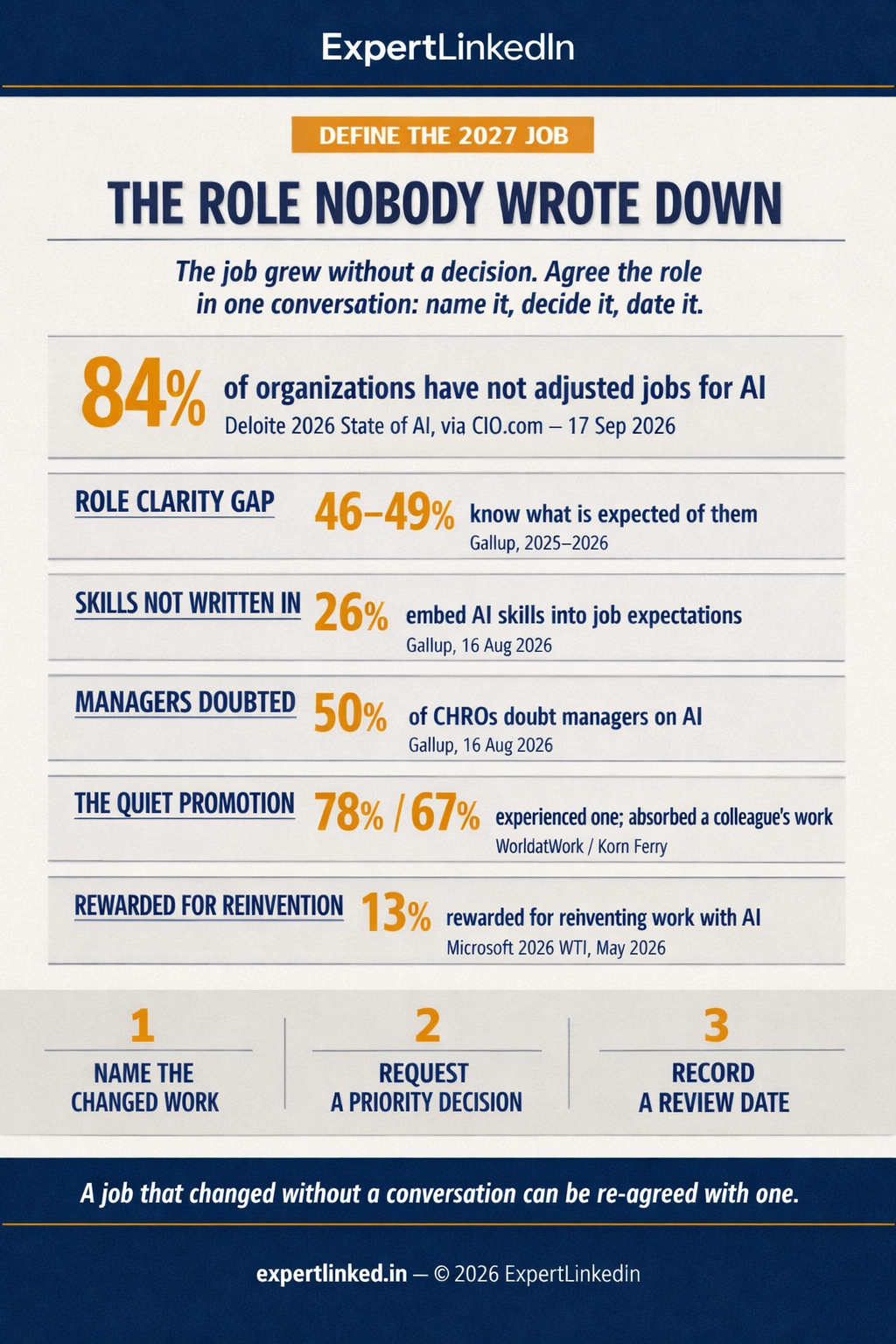
Role clarity is not a soft preference. A recent meta-analysis of role-stressor research found that role ambiguity “tends to be the most detrimental driver of employee and organizational outcomes” — worse than role conflict and worse than overload — and SHRM’s practitioners put the mechanism in one sentence: “ambiguity thrives when responsibilities are implied instead of stated” (SHRM, May 29, 2026). Fewer than half of employees strongly agree they know what is expected of them at work; Gallup measured 46% in 2024 and only 49% in the first half of 2026 (Gallup, Gallup, July 21, 2026). You are not the only person who cannot describe their own job.
Now the part that makes this a 2027 problem rather than a personal one. When AI enters a role, the role usually grows rather than shrinks. An eight-month study of a U.S. technology company found that AI did not reduce work — it intensified it, as people took on a broader scope of tasks and “increasingly absorbed work that might previously have justified additional help or head count” (HBR, Feb. 9, 2026). Yet the organization rarely updates the job to match. Deloitte’s 2026 State of AI in the Enterprise found that 84% of organizations have not adjusted jobs for AI, and only 21% have a mature governance framework (CIO.com, Sept. 17, 2026). Gallup puts it in a single number: just 26% of organizations embed AI skills into job expectations or performance goals (Gallup, Aug. 16, 2026). Microsoft’s research finds almost the same fraction on the process side: even among the most advanced AI users, only about a quarter say their team’s agent workflows, human handoffs and quality standards are documented and repeatable (Microsoft 2026 Work Trend Index). Two different 26%s, two different owners — one is the job description, the other the workflow — and together they say the changed role was never anyone’s formal assignment. And this is not only an AI story: WorldatWork and Korn Ferry find that 78% of workers have experienced a “quiet promotion,” and 67% have taken on a departed colleague’s workload without more pay (WorldatWork).
Read those together and the conclusion is uncomfortable and clarifying. The default state of a modern job is expansion without agreement. Your manager is not necessarily the villain of that story; the system simply measures additions and never asks anyone to approve a subtraction.
Two people, one job, two descriptions #
Here is the part that decides whether this goes well or badly. You and your manager may be describing two different jobs — and both of you can be sincere.
You are living a permanent role change. The work is now most of your week; you have reorganized around it; you are worried it has quietly become your identity and your risk.
Your manager may genuinely be holding a different account: that the new work is temporary help while the team gets up to speed. From that seat, nothing was ever decided because nothing was ever meant to be permanent. The help was supposed to end. It didn’t, because nobody revisited it.
This is exactly the gap the research keeps pointing at. Microsoft’s 2026 Work Trend Index found that organizational factors — culture, manager support, talent practices — account for more than twice the reported AI impact of individual factors (67% vs. 32%), and that only 13% of AI users say they are rewarded for reinventing their work even when results aren’t met (Microsoft 2026 Work Trend Index). Manager support is the lever inside that system, and it is measurable: employees whose manager actively supports their team’s AI use have an engagement rate of 48%, against 30% for those who don’t (Gallup, July 21, 2026). Silence is not neutral, either — workers who use AI frequently are more than twice as likely to fear their job will be eliminated, and Gallup finds that when AI’s role is ambiguous, it is more likely to “undermine workers’ identity or sense of job security” (Gallup, 2026). In other words, the change happened to you, but the decision about it lives somewhere you haven’t been invited.
So before you treat either account as the agreement, get both descriptions on the table. Not to prove who is right — to find out whether there is a plan at all. If you are mapping the work itself, Jackson Rodriguez’s 3-list scope audit is the companion worksheet for this conversation.
The 3-move response #
Move 1: Name the changed work #
Write it down before you discuss it, because implied responsibilities are the ones that never get decided. Two columns: the work you now do that you did not do a year ago, and the work you still do from the original role. Be literal. Not “better prioritization” — the actual task, the actual workflow, the actual meeting you now run.
Then add the column most people forget: what would have to stop. A scope conversation without a subtraction column is not a scope conversation; it is a wish list. When you can see the whole list, you can see why you are tired — and so can your manager.
Move 2: Request a priority decision #
Take the list to your manager and ask one question: if this is now part of my job, what should come off my plate — and who decides? You are asking for a decision, not a discussion. A discussion ends when you leave the room; a decision changes the list.
Microsoft’s own work-design test gives you the three questions to ask: Who reviews the AI’s performance? Who has the authority to change the workflow? How does a local win get captured and scaled? (Microsoft 2026 Work Trend Index). HBR’s research on decision rights is blunt that the sequence matters: clarify the goals before freezing the roles, or the roles are just a static document nobody follows (HBR, July 2026). And SHRM’s practitioners add the piece that matters most for a changed role — explain the decision-making boundaries, so you know what you can decide, what you can influence, and what you should escalate.
One sentence carries most of the work: “I can own this, but I need us to name what it replaces.”
Move 3: Record a review date #
Agree a specific date — in writing — to look at whether the new scope is still right. This is the move that keeps a “temporary” arrangement from hardening into a permanent job you never accepted. HBR’s decision-rights research says the tool should be “a framework for ongoing conversations,” revisited as decisions evolve. A review date is what makes that real. A date is testable; a promise is not. Put it in the calendar, and put the two-line summary of what you agreed in an email to yourself and your manager.
One caution about the evidence. Everything above is survey research — patterns across thousands of people. It can tell you that role ambiguity is common, that manager support matters, and that silence is expensive. It cannot tell you what your manager intended. Do not use a Gallup number to convict one person. Use it to know you are not imagining things — then go and ask.
For managers: the role changed under your watch #
If you lead the person whose job quietly grew, the honest question is not whether the help was useful. It is whether anyone ever decided it was permanent. Your behaviour is the strongest signal they have: Microsoft’s research found that when managers created psychological safety around experimentation, employees reported up to 20 points higher AI readiness and value (Microsoft 2026 Work Trend Index).
- Write the role down. You do not need a re-org; you need one page. List what the person now owns that they didn’t a year ago, and what you are prepared to remove. Ambiguity is not neutral — it is a cost you are running up on someone else’s account.
- Make one decision, not a speech. Name what stops, who approves a change, and what good performance now looks like as the work evolves. Gallup’s finding is precise: managers translate organizational priorities into day-to-day expectations, and employees left without that guidance “must interpret AI expectations on their own.”
- Set the date. Put the review in the calendar before you leave the conversation. A role agreement with no review date is just a snapshot of a moving object.
The line to protect before 2027 planning #
Do not let a temporary “yes” harden into a permanent role you never accepted. The survey evidence explains why this matters — role ambiguity is the most damaging role stressor, and manager support is the strongest lever — but it cannot diagnose your manager. Only the conversation can.
So this week, do one thing: write down what changed, ask one question about what it replaces, and ask for a date. A job that changed without a conversation can be re-agreed with one. That is not a demand. It is the smallest possible act of clarity — and clarity, unlike praise, survives a planning cycle.
Has your job changed without anyone saying so — an AI-coordination duty, an inherited function, a role that grew while your title stayed still? Send me the version you are living through, especially the sentence that made the addition feel permanent. The most useful Workplace Clinic letters begin the moment a role changes quietly.
Email me at olivia.bennett@tlnw.uk
References #
- CIO.com (September 17, 2026). “AI governance’s real gap is accountability, not technology” (reporting Deloitte’s 2026 State of AI in the Enterprise). https://www.cio.com/article/4223342/ai-governances-real-gap-is-accountability-not-technology.html (Accessed November 6, 2026)
- Gallup (August 16, 2026). “AI’s Effect on Workplace Culture.” https://www.gallup.com/workplace/712976/ai-effect-on-workplace-culture.aspx (Accessed November 6, 2026)
- Gallup (July 21, 2026). “Employee Engagement Remains Flat as AI Adoption Accelerates.” https://www.gallup.com/workplace/712433/employee-engagement-remains-flat-adoption-accelerates.aspx (Accessed November 6, 2026)
- Gallup (2026). “Using AI More Does Not Reassure Workers, Managers Do.” https://www.gallup.com/workplace/713231/ai-not-reassure-workers-managers-do.aspx (Accessed November 6, 2026)
- Gallup (January 13, 2025). “U.S. Employee Engagement Sinks to 10-Year Low.” https://www.gallup.com/workplace/654911/employee-engagement-sinks-year-low.aspx (Accessed November 6, 2026)
- Harvard Business Review (February 9, 2026). “AI Doesn’t Reduce Work—It Intensifies It,” by Aruna Ranganathan and Xingqi Maggie Ye. https://hbr.org/2026/02/ai-doesnt-reduce-work-it-intensifies-it (Accessed November 6, 2026)
- Harvard Business Review (July 2026). “What Companies Get Wrong About Decision Rights,” by Lindy Greer and Maxim Sytch. https://hbr.org/2026/07/what-companies-get-wrong-about-decision-rights (Accessed November 6, 2026)
- Microsoft (May 5, 2026). “2026 Work Trend Index: Agents, human agency, and the opportunity for every organization.” https://www.microsoft.com/en-us/worklab/work-trend-index/agents-human-agency-and-the-opportunity-for-every-organization (Accessed November 6, 2026)
- SHRM (May 29, 2026). “Why Role Clarity Belongs at the Heart of Performance Management,” by Martha Ekdahl. https://www.shrm.org/topics-tools/news/why-role-clarity-belongs-at-heart-of-performance-management (Accessed November 6, 2026)
- WorldatWork / Workspan Daily (n.d.). “Shhhh: Here Are the Pros and Cons of ‘Quiet Promotions’.” https://worldatwork.org/publications/workspan-daily/shhhh-here-s-the-pros-and-cons-of-quiet-promotions (Accessed November 6, 2026)
- ExpertLinked (October 16, 2026). “The Deadline Got Faster, Not Safer - and What to Do When AI Speed Becomes Your New Baseline in Q4 2026.” https://expertlinked.in/posts/2026-10-16-the-deadline-got-faster-not-safer-and-what-to-do-when-ai-speed-becomes-your-new/ (Accessed November 6, 2026)
- ExpertLinked (October 30, 2026). “My Review Says I’m High Impact, But My Pay Isn’t Moving - and What to Do Before 2027 Planning Starts.” https://expertlinked.in/posts/2026-10-30-my-review-says-im-high-impact-but-my-pay-isnt-moving-and-what-to-do-before-2027-planning-starts/ (Accessed November 6, 2026)
- ExpertLinked (November 2, 2026). “How to Renegotiate Job Responsibilities for 2027 With a 3-List Scope Audit.” https://expertlinked.in/posts/2026-11-02-how-to-renegotiate-job-responsibilities-for-2027-with-a-3-list-scope-audit/ (Accessed November 6, 2026)
AI Content Notice
This article was created using artificial intelligence technology. Whenever possible, we include references and sources to support the information presented. Readers are encouraged to consult these sources for further information. While we strive for accuracy and provide valuable insights, readers should independently verify information and use their own judgment when making business decisions. The content may not reflect real-time market conditions or personal circumstances.
Related Articles
Infographic: My Job Responsibilities Changed Without a Conversation—What to Agree for 2027
Your role grew an AI-coordination duty or another function while the old job stayed — and no one …
My Review Says I'm High Impact, But My Pay Isn't Moving - and What to Do Before 2027 Planning Starts
Your review said “high impact” and your raise said “wait until next year.” …
Back-to-Work Burnout After Vacation Is Real - and What to Do Before September 2026 Speeds Up
The first week back from vacation is usually a backlog-clearing sprint, not proof of sustainable …