How to Build a Holiday Handover Checklist With 4 Clear Escalation Rules

The handover you are most proud of is probably the one that fails first.
It is thorough. It is organised. It has tabs. And it transfers none of the permission required to act on any of it.
This is the week it starts. Thanksgiving falls on Thursday for US teams; the longer break is five weeks out. Somewhere in your organisation, a capable person is about to write nine pages and call it coverage. Their backup will read it, discover on day two that they cannot approve anything, and send a message that begins: “Sorry to bother you, but—”

Coverage is three things, not one document #
A handover has to move three things at once, and usually only one of them moves.
Information — what is happening, what happens next, what would change the plan. Operational access — the logins, the permission levels, the ability to send, approve or spend. Decision rights — the authority to choose, including the authority to stop something or escalate it.
Most handovers deliver the first and assume the other two follow from proximity. They don’t. The person who cannot take leave and the team that cannot function without them are the same problem from two directions — knowledge, access and authority in one body — which Olivia Bennett wrote about last month as key person risk rather than job security. A handover is that argument as an operating document.
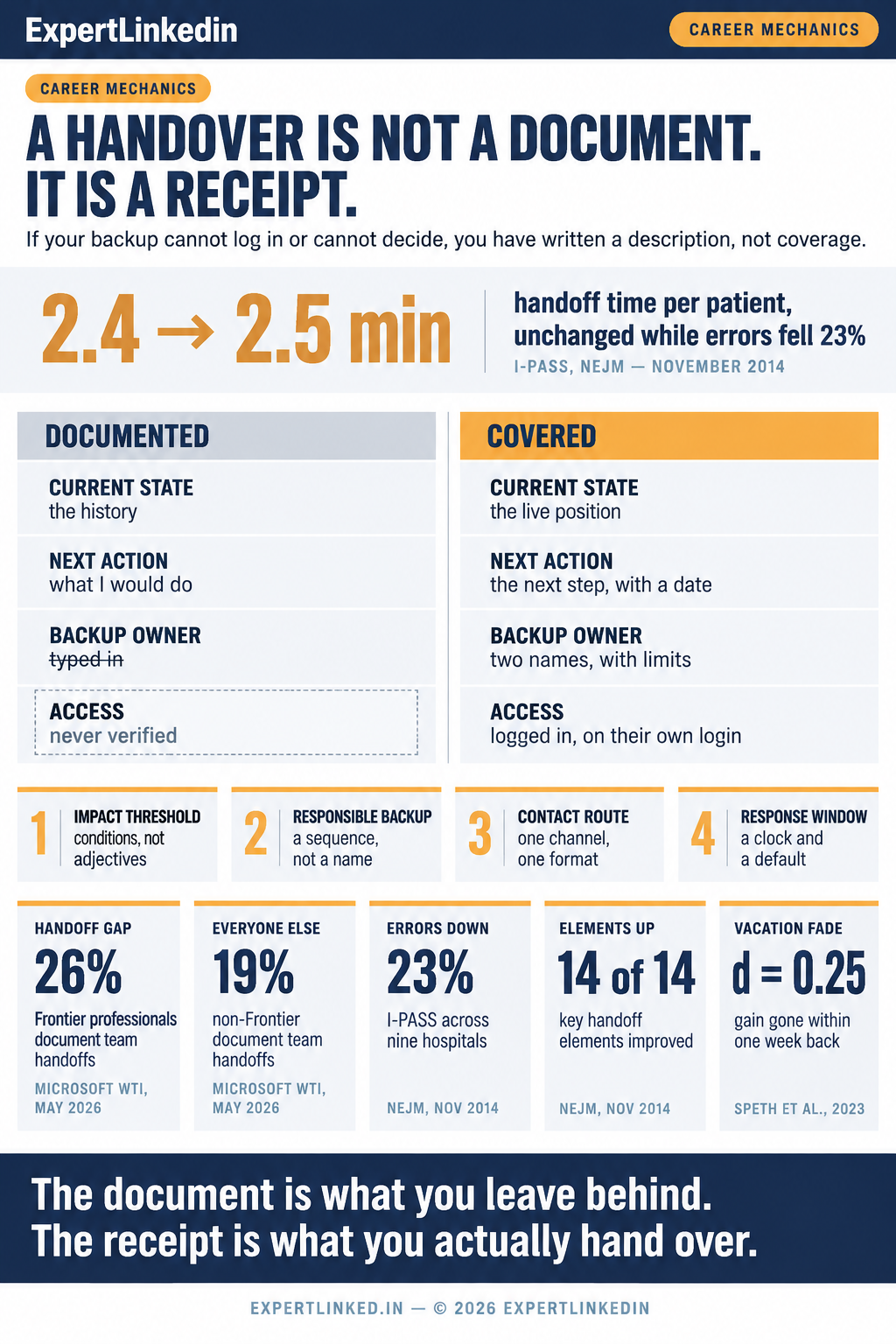
In the 2026 Work Trend Index, the most advanced AI users in a 20,000-person survey across ten markets — Microsoft calls them Frontier Professionals — say their team documents agent workflows, human handoffs and quality standards only 26% of the time. Everyone else says 19%. And of the three questions the report says every organisation must answer, one is not about documentation at all: who has the authority to update the workflows?
The people with the best tools still document handoffs about a quarter of the time, and even they treat authority as unsolved. Your nine-page document has not beaten that.
We write more because we cannot tell what the reader is missing #
I used to think the fix was better writing. The research is less flattering.
In the classic illusion-of-transparency studies, a person taps out a well-known song and predicts that about half the listeners will recognise it. Roughly three in a hundred do (Gilovich, Savitsky & Medvec, 1998). The tapper hears the melody. The listener hears rhythm. You are not writing down what you know; you are writing down whatever survives the translation, and you cannot feel the difference from the inside.
So you add more. Then consider the finding that should stop you. In the multicentre I-PASS study across nine hospitals and 10,740 admissions, a structured handoff programme cut medical errors by 23% and preventable adverse events by 30% — and verbal handoff time did not change. 2.4 minutes per patient before. 2.5 after. What changed was that fourteen required elements started appearing where they had been missing.
Better handovers are not longer. They are constrained. The constraint goes on the page.
The four-field checklist #
One row per live workstream. Not per project, not per person — per thing that could break or stall while you are away.
| Field | What belongs in it | The test that exposes a fake answer |
|---|---|---|
| Current state | What is true on the day you leave. The live position, including what is stuck and why. | Does this change what the backup does on Monday? If not, delete it. |
| Next action | The next physical step, with a date, and the condition that changes it. | Can the backup state it back to you without opening the document? |
| Backup owner | Two named people, and what each may decide without asking — a spend limit, a signing limit, a hold or publish call. | Has the person agreed, in writing, with the limit? Or did you just type a name? |
| Access | The system, the permission level, the expiry date, the ticket number. | Have they logged in, on their own credentials, while you watched? |
Here is that row, filled in for something that behaves like real year-end work: two software renewals expiring on 31 December.
- Current state: vendor A is agreed at $148,000 with one clause open on data residency; vendor B has not replied since 14 November and their account manager returns on 5 January.
- Next action: chase vendor B in writing by 19 December, hard answer date 6 January. If silent, renew on last year’s terms and renegotiate in Q1 — do not let it lapse.
- Backup owner: the operations lead, agreed 18 December, up to a $10,000 variance and standard renewals. The finance partner, up to $25,000. Above that, the CFO.
- Access: contract system as editor, expiring 12 January, ticket IT-4471. Vendor portal buyer role, approved 21 November.
Notice what that does that a narrative cannot: it assigns a ceiling. Ceilings are the part people skip, and ceilings decide whether a colleague acts or waits. It is the same gap as in the four-question decision-rights agreement I wrote on 16 November: a named person who cannot grant the exception is a label, not a control.
Four escalation rules, written as rules #
Most handovers leave escalation as a feeling. Four rules fix it.
1. Impact threshold: replace the adjective with a condition #
“Urgent” is an adjective, and adjectives are negotiable at 6 p.m. on a public holiday. Write three to five conditions, any one of which counts. Google’s reliability teams decide whether an incident exists on the same logic: a second team is needed, the problem is customer-visible, or it is still unsolved after an hour of concentrated analysis (SRE Book, Ch. 14). Their stated bias is to declare early.
Borrow the shape: money at risk above a stated amount; a commitment to an outside party due within 48 hours; a legal, safety, privacy or regulatory trigger; a decision only your title or budget can authorise. Then write the anti-triggers, which almost nobody does. A status update is not an escalation. A formatting preference is not one. “Just checking you saw this” is not one. Naming what does not qualify protects the two hours of holiday that would otherwise go to triage.
2. Responsible backup: a sequence, not a name #
One name is not a backup plan; it is a hope with a lowercase letter. Reliability teams run a primary and a secondary, and the secondary is the fall-through for whatever the primary misses (SRE Book, Ch. 11).
So: level one, level two, and the person who can authorise what level one cannot. That third person is usually not the manager. It is whoever owns the budget, the contract, the permission or the release gate.
There is a second reason to write the route rather than the rank. When researchers taught hospital residents a formal two-challenge rule for speaking up, challenges to senior physicians improved. Challenges to peers did not (Pian-Smith et al., 2009). People escalate up more readily than sideways, and holiday coverage is almost entirely sideways. A rule that says “escalate to my manager” will be under-used by the colleague who needs it most.
3. Contact route: the channel is part of the rule #
One channel for escalations, one for everything else, and one prohibition: escalations do not go into the absent person’s direct messages. Not because you would ignore them, but because a message with no acknowledgment clock is one you read at midnight out of guilt.
Then remove the composition problem. Give the format: what broke, what I tried, what I need decided, by when. A colleague in a hurry will copy four lines. A colleague facing a blank message will call you instead.
For a sanity check, Australia’s right-to-disconnect framework weighs the reason for the contact, how it was made and how disruptive it was, whether the person is compensated for being available, their role, and their personal circumstances (Fair Work Ombudsman). That is a useful test to run against your own rule. It is not a universal legal entitlement and I am not claiming it is.
4. Response window: a clock, a default, and who acts when it runs out #
Every escalation needs a number. Acknowledge within four hours, decide within one working day — or whatever your work can bear. PagerDuty calls this the escalation timeout: the time a responder has before the alert climbs to the next level, with acknowledgment stopping the climb but not resolving the incident (PagerDuty).
The part everyone omits is what happens when nobody answers. Write the default, and write that the backup proceeds on it rather than waiting. Hold the change. Send the holding reply. Do not spend above the limit. A default turns your absence from a pause into a decision.
It also changes what you ask of the person who stays. In a study of 2,876 professionals across four large employers, high after-hours availability expectations were associated with poor psychological detachment, and control over the boundary reduced the damage (Mellner, 2016). The expectation costs something even when the phone never rings.
The test: do not review the document, take a receipt #
Twenty minutes per workstream.
Prove the access. Not “do you have access?” Open it, on their login, with you watching. If a request is needed, file it before you leave and put the ticket and the approver in the access column. Time-bound, expiring access is routine machinery in most identity platforms; the obstacle is rarely capability, it is that nobody filed the request (Microsoft Entra PIM).
Ask one realistic, slightly under-specified question. Pull it from something that happened last quarter. “The supplier says the invoice is 12% over the purchase order and needs an answer before they release the shipment — what do you do, who do you tell, and what do you need from me?” Do not accept “I’d ping you.”
Make them say it back. The receiver states the current state, the next action and their first move, in their own words. Every serious handover tradition ends here. UK safety regulators call it “cross-checking of information by in-coming personnel” (HSE). Clinical handover calls it “Synthesis by Receiver.” Google’s incident commanders put it in one sentence: “You’re now the incident commander, okay?” — and do not leave the call until the acknowledgment is firm.
Rehearse the escalation once. Have someone play the person you would escalate to, and walk the backup through one. Almost no workplace has ever tested whether its escalation route connects.
What this is not #
This is an editorial tool, not a tested intervention.
The study that best explains why real time away matters is a one-week diary study of 166 public administration employees. It found that low psychological detachment in the evening predicted negative activation and fatigue the next morning (Sonnentag, Binnewies & Mojza, 2008). It says nothing about handovers, checklists or holidays. It gives you a reason to want the time to be genuinely yours; it does not show that this page produces it.
The vacation literature is more modest than the wellness industry implies. A 2023 meta-analysis of 13 studies found vacations improved well-being, with a small average effect, and the improvement was no longer significantly different from pre-vacation levels after the first week back (Speth, Wendsche & Wegge, 2023). Longer holidays did not help more. The argument is not that a break restores you. It is that the recovery is small and brief, which makes losing it to avoidable contact a bad trade.
And I-PASS is a resourced, trained, observed, multi-site clinical programme — not a one-pager written on a Friday afternoon. I am borrowing its mechanism, not its evidence.
A checklist does not guarantee coverage. It makes the gaps visible while you can still close them.
The move #
Do not build the whole thing. Build one row, for the workstream most likely to stall in your absence, and run the test on it this week.
Then do the arithmetic that matters. How many messages did you answer during your last break? Each one is a decision that had no name, no ceiling and no default. Attach them before you go.
The document is what you leave behind. The receipt is what you actually hand over.
Have a handover row your team cannot fill in — or a backup who has the title but not the access? Send me the row you are trying to write and the permission you are trying to get, and I will tell you where the coverage actually breaks.
Email me at jackson.rodriguez@tlnw.uk
References #
- Fair Work Ombudsman (accessed November 22, 2026). “Right to disconnect.” https://www.fairwork.gov.au/employment-conditions/hours-of-work-breaks-and-rosters/right-to-disconnect
- Gilovich, T., Savitsky, K., & Medvec, V. H. (1998). “The illusion of transparency: Biased assessments of others’ ability to read one’s emotional states.” Journal of Personality and Social Psychology, 75(2), 332–346. https://doi.org/10.1037/0022-3514.75.2.332 (Accessed November 22, 2026)
- Google SRE (2017). “Being On-Call.” Site Reliability Engineering, Chapter 11. https://sre.google/sre-book/being-on-call/ (Accessed November 22, 2026)
- Google SRE (2017). “Managing Incidents.” Site Reliability Engineering, Chapter 14. https://sre.google/sre-book/managing-incidents/ (Accessed November 22, 2026)
- Health and Safety Executive, UK (accessed November 22, 2026). “Shift handover.” https://www.hse.gov.uk/humanfactors/topics/shift-handover.htm
- Mellner, C. (2016). “After-hours availability expectations, work-related smartphone use during leisure, and psychological detachment.” International Journal of Workplace Health Management, 9(2), 146–164. https://doi.org/10.1108/IJWHM-07-2015-0050 (Accessed November 22, 2026)
- Microsoft (May 5, 2026). “2026 Work Trend Index: Agents, human agency, and the opportunity for every organization.” https://www.microsoft.com/en-us/worklab/work-trend-index/agents-human-agency-and-the-opportunity-for-every-organization (Accessed November 22, 2026)
- Microsoft Learn (accessed November 22, 2026). “Privileged Identity Management.” Microsoft Entra ID Governance. https://learn.microsoft.com/en-us/entra/id-governance/privileged-identity-management/pim-configure
- PagerDuty (accessed November 22, 2026). “Escalation Policy Basics.” https://support.pagerduty.com/main/docs/escalation-policies
- Pian-Smith, M. C. M., Simon, R., Minehart, R. D., Podraza, M., Rudolph, J., Walzer, T., & Raemer, D. (2009). “Teaching residents the two-challenge rule: A simulation-based approach to improve education and patient safety.” Simulation in Healthcare, 4(2), 84–91. https://doi.org/10.1097/SIH.0b013e31818cffd3 (Accessed November 22, 2026)
- Sonnentag, S., Binnewies, C., & Mojza, E. J. (2008). “‘Did you have a nice evening?’ A day-level study on recovery experiences, sleep, and affect.” Journal of Applied Psychology, 93(3), 674–684. https://doi.org/10.1037/0021-9010.93.3.674 (Accessed November 22, 2026)
- Speth, F., Wendsche, J., & Wegge, J. (2023). “We continue to recover through vacation! A meta-analysis on vacation effects and fade-out trajectories.” European Psychologist, 28(4), 274–287. https://doi.org/10.1027/1016-9040/a000518 (Accessed November 22, 2026)
- Starmer, A. J., et al. (2014). “Changes in medical errors after implementation of a handoff program.” New England Journal of Medicine, 371(19), 1803–1812. https://pubmed.ncbi.nlm.nih.gov/25372088/ (Accessed November 22, 2026)
- ExpertLinked (October 23, 2026). “I’m the Reliable One, So Everything Late Lands on Me — and What to Do Before Year-End 2026.” https://expertlinked.in/posts/2026-10-23-im-the-reliable-one-so-everything-late-lands-on-me-and-what-to-do-before-year-end-2026/ (Accessed November 22, 2026)
- ExpertLinked (November 16, 2026). “How to Set AI Decision Rights for 2027 With a 4-Question Team Agreement.” https://expertlinked.in/posts/2026-11-16-how-to-set-ai-decision-rights-for-2027-with-a-4-question-team-agreement/ (Accessed November 22, 2026)
AI Content Notice
This article was created using artificial intelligence technology. Whenever possible, we include references and sources to support the information presented. Readers are encouraged to consult these sources for further information. While we strive for accuracy and provide valuable insights, readers should independently verify information and use their own judgment when making business decisions. The content may not reflect real-time market conditions or personal circumstances.
Related Articles
Infographic: How to Build a Holiday Handover Checklist With 4 Clear Escalation Rules
A long handover gives you no coverage if your backup cannot log in or cannot decide. Here is the …
How to Set AI Decision Rights for 2027 With a 4-Question Team Agreement
A named “accountable” person can still lack the authority to stop an AI workflow. Here …
What NVIDIA Earnings and Microsoft Ignite 2026 Can Reveal About AI Work Design
Two of the week’s biggest AI events are being read as one signal about your job. They …