Your Change Freeze Doesn't Cover Your Model Provider

The freeze notice went out on Friday. It named the repositories, the release calendar, the two people who can break the glass. It did not name the thing that will change most while everyone is away: the model behind your support bot.
That is not a gap in the document. It is a category error in the document’s scope. A change freeze is a promise that nothing you control will move. Your model provider never signed it.

The thread #
Here is the whole argument in one line: the freeze removes your ability to respond to a change it cannot prevent.
Two facts make that more than a flourish. The first is old: Google’s SRE book describes ops teams building launch and change gates to protect a running system from change, which is the honest reason a freeze exists at all. The second is new. The thing that changes most often in a live system is now a dependency you never deploy. It updates on someone else’s calendar, at someone else’s cadence, and — in at least one provider’s case — without changing its name.
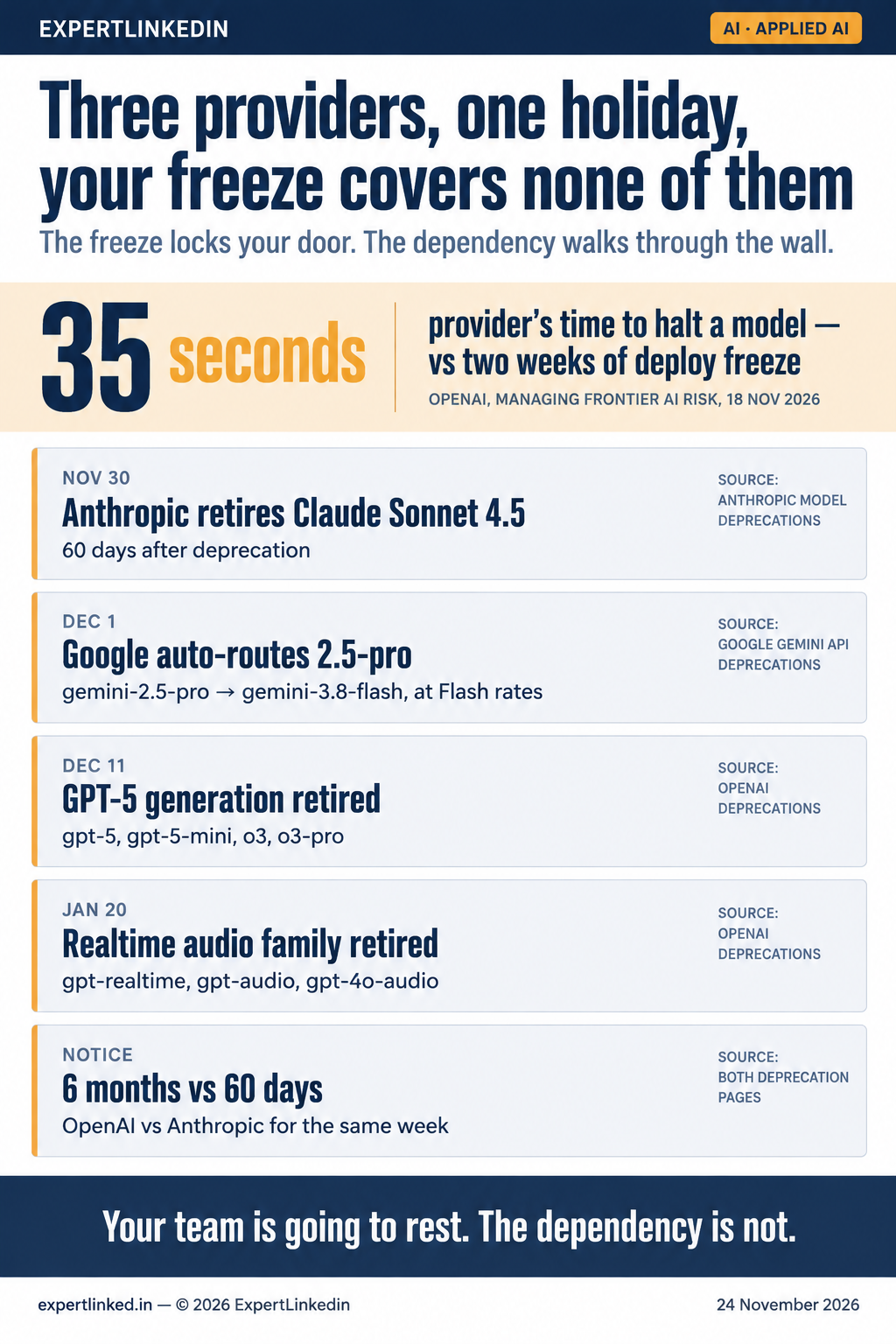
Read the three deprecation pages this morning and the holiday window stops looking like a rest period. It looks like a migration schedule you were not invited to.
November 30. Anthropic retires claude-sonnet-4-5-20250929, 60 days after deprecating it. OpenAI’s Evals platform and reusable prompt objects are being retired too — the instrument you would use to catch a quiet model change is itself going away.
December 1. Google starts auto-routing every request to gemini-2.5-pro to gemini-3.8-flash, billed at Flash rates. gemini-2.5-flash goes to gemini-3.5-flash-lite. OpenAI retires its image models.
December 11. OpenAI retires the entire gpt-5 family and the o3 family — the generation most 2025-era production stacks were built on — and points them at gpt-6.1-sol, gpt-6.1-terra and gpt-6-luna.
Then January: tts-1 on the 6th, the EU-residency variants of GPT-5.2 and 5.4 on the 11th, gpt-4o and gpt-4.1 on the 14th, the whole realtime audio family on the 20th.
And on this publication date, claude-opus-4-5-20251101 becomes eligible to retire. Not scheduled — eligible. “Not sooner than November 24, 2026,” the page says. The model can go the week you stop watching.
Four arguments, one problem #
This is a synthesis piece, so let me be straight about the device. Three colleagues have written parts of this problem in the last month; I have written the other part. Here is what each brings.
Jackson’s argument is coverage. In yesterday’s handover checklist he argues that a handover transfers information, access and decision rights. His four fields — current state, next action, backup owner, access — and his four escalation rules are the best version I have read. His key point: a thorough document that transfers no authority is a long apology. He is right, and he is describing a task queue.
Olivia’s argument is accountability. Her October piece on key person risk showed how a handover quietly becomes a return to work. Her November piece made the sharper case: being accountable for AI behaviour you cannot override is a liability wearing a job title. A freeze applies that to a whole team at once.
Emily’s argument is the loop. She argued in her November 21 piece that “human in the loop” is often a signature, not a control. A freeze is the purest version of her point: the loop is closed, the human is at dinner, and the decision still lands.
Mine is the calendar. The other three arguments assume the thing being handed over holds still. It does not. That is the whole of my contribution, and it is enough to complicate the other three.
The argument in the room #
Put those four arguments together and they do not stack. They collide.
Jackson’s escalation rules assume a signal someone will notice. A model that starts returning shorter, more hedged, less format-compliant output triggers no page. The arXiv paper “Test Before You Deploy” names the mechanism: hosted services “evolve continuously through provider-side updates without explicit version changes,” and those updates “can introduce behavioral drift, causing regressions in functionality, formatting, safety constraints, or other application-specific requirements.”
So the handover inherits a workflow whose behaviour nobody owns. Jackson’s backup has authority over the task and none over the model. Olivia’s accountable manager is accountable for output from a dependency that changed without a ticket. Emily’s “human in the loop” is asleep.
The freeze makes all three worse at once, because it removes the only people who could have noticed. Coverage, accountability and oversight are all designed for a system that holds still. The dependency does not.
Where we didn’t agree #
We did not converge on everything.
One: is the freeze a control or a comfort? Jackson and Gergely Orosz treat the freeze as legitimate — two a year is standard in big tech. My read is harsher: it suppresses the outages you cause and leaves the ones you inherit. Both are true; the disagreement is scope, not value. Keep the freeze. Stop pretending it covers the dependency.
Two: is notice the binding constraint? OpenAI gives general-availability models six months. Anthropic commits to 60 days. My instinct was that notice is the problem. It is not. A June email about a December shutdown is easy to archive precisely because it is generous. Notice has no owner and no calendar entry, so ownership is the binding constraint. Six months is fair notice. Fair notice without an owner is not a control.
Three: is auto-routing helpful or harmful? Google’s approach keeps your endpoint alive instead of returning a 404. That is better for uptime. I think it is the worst of the three mechanisms for a holiday, because a 404 is loud and a re-route is silent — a hard failure gets a page, a quiet shift to a cheaper model gets a shrug until February. We left this unresolved, and correctly — it depends on whether your workflow suffers more from downtime or from drift.
Four: whose job is the fix? The fair answer is the provider’s: expose real version identifiers and behaviour changelogs. The arXiv authors note that hosted providers “rarely expose version identifiers or fine-grained update disclosures,” leaving deployers “under partial observability.” The deployer can act this week; the provider cannot be made to act at all. Practical answer, deployer. Just answer, provider.
Five: does the AI Act help? Emily and Jackson would both reach for the legal floor. Article 15 requires high-risk systems to “perform consistently in those respects throughout their lifecycle,” and Article 26 puts named-person oversight duties on deployers. That is a real argument — for high-risk systems. Most readers’ workflows are not high-risk. I would rather say that plainly than borrow legal gravity we have not earned.
Six: is “the model changed” a real incident or an excuse? A reasonable skeptic will say most updates improve things, and teams blaming “the model” are usually covering for bad prompts. That is partly true, and the strongest objection to this piece. It is also why the artifact below insists on a contract and a baseline: without them you cannot tell a provider regression from your own sloppiness.
What we decided #
Six decisions, and one page.
Keep the freeze for code. Add a gate for the AI path. These are different controls. A freeze suppresses change. A gate blocks a change that fails a test. You cannot freeze a provider, but you can gate one: run the new behaviour against your contract before traffic moves onto it.
Change the unit of the handover from the person to the workflow. Jackson’s four fields describe a person’s work. Add a fifth for anything model-backed: who owns the behaviour. That is not the same person as the task owner, and it is usually nobody.
Do the boring migration before you leave. “After the holidays” is past November 30 and past December 1. If your eval suite lives in OpenAI’s Evals product, the migration guide exists and the shutdown date does not move for you. Migrate now, or leave with no instrument.
Measure both paths in January. Compare change failure rate on your deploys against behaviour regression on your AI workflows. If the freeze cut the first and the second spiked, you have learned where the risk went. That is the freeze literature’s own test, applied to the dependency.
Attach one page to the handover. Four fields. Twenty minutes. It is the only part of this article that will still be useful in February.
| Field | What goes in it | Why it survives your absence |
|---|---|---|
| Contract | One sentence per workflow: “this is correct only if ___” | A rule, not a preference. A backup can enforce a rule. |
| Baseline | Today’s number for each contract check | “It feels off” is not a measurement. A number is. |
| Gate | The threshold that stops traffic and pages a named person | Turns a judgement call into a decision anyone can make |
| Calendar | Every provider date inside your freeze window | The field nobody has, and the one that costs nothing |
Narrow the claims. No “AI is breaking.” No blanket AI Act. And no blaming the providers — they publish dates and notice periods, and Anthropic’s deprecation commitments are franker about the cost of retirement than most customers are about the cost of migration. The failure is ours. The freeze notice never listed the provider as a change path.
What to do before you leave #
- Open the three deprecation pages and put every date between now and January 20 on your handover page. Ten minutes.
- Call
GET /v1/modelsand read theshutdown_datefield. Put it on a weekly cron. Cheapest control in this article. - Write the contract sentence for your two highest-risk workflows. Just two.
- Record today’s number for each. If you have never measured it, measure it once, now.
- Set the gate threshold and name the person it pages. If that person is you, name a second.
The number that should worry you most #
Not the shutdown dates. The 35 seconds.
OpenAI’s account of managing frontier risk describes a Control Room that “stops further model output within 35 seconds of receiving an instruction to halt a job.” The provider can stop a model in 35 seconds. Your company, on a year-end freeze, cannot stop anything for two weeks — no deploy, no rollback, no migration, no eval port. The provider’s control latency is measured in seconds. Yours is measured in “the first week of January.”
That asymmetry is the whole argument. It is not that the provider is reckless. It is that the provider has a control loop and you have a calendar. A freeze is what happens when a calendar is mistaken for a control loop.
The freeze is not the villain. It is a good reason to move the AI work earlier and a bad reason to stop watching. Your team is going to rest. The dependency is not.
If you have found a provider change your freeze calendar missed — or built a gate that actually caught one — I would like to hear how you set the threshold. That is the part I am least sure about.
Email me at alex.winters@tlnw.uk
References #
- OpenAI. “Deprecations.” https://developers.openai.com/api/docs/deprecations (Accessed November 24, 2026)
- OpenAI. “Changelog.” https://developers.openai.com/api/docs/changelog (Accessed November 24, 2026)
- Anthropic. “Model deprecations.” https://platform.claude.com/docs/en/about-claude/model-deprecations (Accessed November 24, 2026)
- Google. “Gemini API deprecations.” https://ai.google.dev/gemini-api/docs/deprecations (Accessed November 24, 2026)
- OpenAI. “Moving from OpenAI Evals to Promptfoo.” June 3, 2026. https://developers.openai.com/cookbook/examples/evaluation/moving-from-openai-evals-to-promptfoo (Accessed November 24, 2026)
- OpenAI. “Managing frontier AI risk: From training to deployment.” November 18, 2026. https://openai.com/index/managing-frontier-ai-risk/ (Accessed November 24, 2026)
- Anthropic. “Deprecation commitments.” https://www.anthropic.com/research/deprecation-commitments (Accessed November 24, 2026)
- “Test Before You Deploy: Governing Updates in the LLM Supply Chain.” arXiv:2604.27789. https://arxiv.org/html/2604.27789v1 (Accessed November 24, 2026)
- Google. “Site Reliability Engineering, Introduction.” https://sre.google/sre-book/introduction/ (Accessed November 24, 2026)
- European Union. “Article 15: Accuracy, Robustness and Cybersecurity.” https://artificialintelligenceact.eu/article/15/ (Accessed November 24, 2026)
- European Union. “Article 26: Obligations of Deployers of High-Risk AI Systems.” https://artificialintelligenceact.eu/article/26/ (Accessed November 24, 2026)
- Makmel. “Your holiday change freeze moves risk into January.” November 2, 2026. https://makmel.info/blog/holiday-change-freeze-moves-risk (Accessed November 24, 2026)
- Gergely Orosz. “Code freezes.” The Pragmatic Engineer. https://newsletter.pragmaticengineer.com/p/code-freezes (Accessed November 24, 2026)
- Jackson Rodriguez. “How to Build a Holiday Handover Checklist With 4 Clear Escalation Rules.” November 23, 2026. https://expertlinked.in/posts/2026-11-23-how-to-build-a-holiday-handover-checklist-with-4-clear-escalation-rules/
- Olivia Bennett. “I’m the Reliable One, So Everything Late Lands on Me — and What to Do Before Year-End 2026.” October 23, 2026. https://expertlinked.in/posts/2026-10-23-im-the-reliable-one-so-everything-late-lands-on-me-and-what-to-do-before-year-end-2026/
- Olivia Bennett. “I’m Accountable for AI Decisions I Can’t Override—What to Change Before 2027.” November 20, 2026. https://expertlinked.in/posts/2026-11-20-im-accountable-for-ai-decisions-i-cant-override-what-to-change-before-2027/
- Emily Chen. “AI Can Rate, Watch and Fire You. Who Owns That Decision?” November 21, 2026. https://expertlinked.in/posts/2026-11-21-ai-can-rate-watch-and-fire-you-who-owns-that-decision/
AI Content Notice
This article was created using artificial intelligence technology. Whenever possible, we include references and sources to support the information presented. Readers are encouraged to consult these sources for further information. While we strive for accuracy and provide valuable insights, readers should independently verify information and use their own judgment when making business decisions. The content may not reflect real-time market conditions or personal circumstances.
Related Articles
Infographic: Your Change Freeze Doesn't Cover Your Model Provider
A change freeze stops you shipping. It does not stop your model provider shipping. Three providers …
OpenAI’s GPT-4.5 API Deprecation: Lessons from a Week of Developer Chaos
Navigate the chaos of OpenAI’s GPT-4.5 API deprecation and learn critical lessons for prompt …
Who Owns the Prompt? The Unlisted Line in Your 2027 Job Description
AI saves the average knowledge worker 11 hours a week and then takes back six of them in checking, …